Month: October 2016

The Fujifilm First Timer

dscf7762

guest-blogger-strip-blackBy Naomi Butters

Being married to a photographer has its ups and downs. On the plus side, you never have to worry about a bad photo being taken and your life is filled with (sometimes too many) images and memories! However, it does have its downsides too – mostly that it led to me becoming lazy when it comes to recording my own memories. While I take the odd snap with my phone (which rarely does justice to what I’m seeing), up until recently I’d not picked up a camera myself for around 11 years!

Determined to do something about this I decided that this year I was going to embrace the passion my husband enjoys so much and I would learn to take better photos. But first, I needed to find myself a new camera…


One of the things that frustrate me about DSLRs are their size. They’re big, even the entry-level models. You can’t take a photo discreetly when you’ve got a massive camera in front of your face! They’re also heavy and when you’re a girl who likes to carry a handbag, carrying a weighty camera as well… Well it doesn’t happen! And, don’t get me started on lenses! You basically leave the house with more equipment and luggage than a mother with a newborn.

So when Jordan suggested the Fujifilm X-Series I was intrigued. He loves his X100S and it’s usually his go-to camera for our city break adventures. It’s the perfect size to carry around when he’s having a break from his ‘work’ cameras.

I’ve used the X100S before, but I wanted something that I could zoom with, in order to shoot a variety of subjects – from days out with friends to landscapes and portraits. Jordan suggested either the X-E2S or the X-T10 and, after looking at them online, I opted for the X-E2S – there wasn’t much between the two and I simply preferred the viewfinder location and layout of the X-E2S.

When the camera arrived I spent an evening getting used to the camera – I must have taken around 100 photos of our dog, Archie! Fuji sent me two lenses to try: the XF35mmF2 R WR and the XF18-135mmF3.5-5.6 R LM OIS WR. I have to admit – I had no idea what the differences were between them did or how to best use them! I’m not sure Archie enjoyed sitting for photos for hours either, although he’s used to it!

X-E2S
FUJIFILM X-E2S – Silver

In July, we travelled to Italy for our summer holiday, making stops in Venice and Florence. These locations offered the perfect opportunity for me to get comfortable taking photos, improve my skills and, for once, prove that I don’t just go on holiday by myself by getting some shots of Jordan too!

I’ll admit, at first I was nervous. I know that sounds silly but when you’re married to a photographer, you’re aware that your images will come under scrutiny! But with a bit of guidance I quickly started to enjoy taking photos with the X-E2S.

If you’ve ever been to Venice you’ll know it’s full of beautiful scenery around every corner and crossing every bridge, there’s a stunning view or timely gondola approaching ready for you to take that perfect shot. Jordan suggested I use the 18-135mm lens as it has a good zoom and would be versatile when walking around the city. Although the lens was long, it didn’t add much weight to the camera and I could fit it in my small hand bag. Bonus!

dscf7946

Usually when Jordan and I go away, I take in a landmark, maybe take a photo on my phone and then move on to the next point of interest. However, Jordan can take at least ten minutes at a landmark, capturing shots from various angles. I once lost him in New York because he’d stopped to wait for that decisive moment and I’d walked several blocks before I noticed he wasn’t with me!

However, with a camera in front of my face and the view of the grand canal in front of me, we both spent several minutes trying out different angles and compositions. At first, Jordan had to tell me how to set the camera up – adjusting the aperture and ISO were things I’d never done with my phone! However I quickly got the hang of it and started to feel comfortable in using the camera on my own.

dscf0132

Although the larger lens was great for wide angles or zooming in on a distant subject, I did find the smaller 35mm f/2 a lot lighter and easier to use. I liked that the aperture was marked on the lens so I could quickly check what I’d selected without looking at the screen. I left the camera in aperture-priority mode and, with some go-to apertures explained (f/2 for portraits, f/8 to f/11 for landscapes, etc), I really enjoyed taking close up shots and wider views of the city.

The exposure adjustment dial made it straightforward to adjust the exposure without messing around with the settings directly too; simply + for brighter, or – for darker, easy! Before long I was showing Jordan what I’d captured on the back of the camera with confidence. The X-E2S captures bright colours and details beautifully.

I also made good use of the built-in Wi-Fi feature. After downloading the Fujifilm app to my phone it was simple to ping images across and upload them to Facebook or Instagram really quickly. #nofilter!

dscf0225

By the end of our holiday in Italy, I was mirroring Jordan’s photography poses, delving deeper into apertures and lighting and thoroughly enjoying my new camera.

I always enjoyed capturing moments with my phone, but was left wanting by the image quality, let alone if I wanted any printing – forget it! The X-E2S made it simple for me to enjoy taking high quality photos without the bulk and attention garnered by using a DSLR.

I’ve had more photos printed in the couple of months since getting the X-E2S than I have in total up until this point!

If you like the idea of taking better photos but don’t want to get weighed down with kit, or bogged down with the technical side of things then I thoroughly recommend the X-E2S. It has the ability to create some amazing images – I look back at some of the scenes I captured and can’t believe they’re my photos!

dscf0652


Fuji Guys – Discussing Fujifilm’s X-T2 4K Video

Aussie Fuji Guys Warrewyk Williams and Will Anlezark test and talk about the 4K video capabilities of the Fujifilm X-T2.

Follow the Fuji Guys on Twitter: http://www.twitter.com/fujiguys

For more information about this and other Fujifilm products, please visit these websites.

Fujifilm Australia
http://www.fujifilm.com.au/products/digital_cameras

Fujifilm U.S.A.
http://www.fujifilmusa.com/products/digital_cameras/index.html

Fujifilm Canada
http://www.fujifilm.ca/products/digital_cameras/index.html

Fujifilm UK
http://www.fujifilm.eu/uk/products/digital-cameras/


Why I love: the Fujinon XF16mmF1.4 lens

X-Photographer strip BLACK

We asked a few of our X-Photographers why they love the widest of our super-fast aperture prime lenses, the FUJINON XF16mm F1.4 R WR. Here is what they said..

Kevin Mullins – Reportage Weddings

Kevin Mullins XF16mm

quote-left
KevinMullins-Headshot-200x200At first I wasn’t sure if I would be attracted to the 24mm full frame focal length having tried that several times in my Canon days. However, as soon as I got the 16mm I just knew it was going to be a flyer. This lens is PIN sharp wide open, focuses incredibly quick and works so well with the continuous shooting mode of on the X-Series. It gives that extra width when shooting in tight areas at weddings and is perfect for shots such as the recessional and really close up but powerful images of the confetti throwing etc.quote-right

Click here to see more of Kevin’s work


 Derek Clark – Music

quote-left
I love the 16mm f1.4! It’s a surprisingly versatile lens that is equally at home shooting portraits as it is landscapes. The X-Series lenses are all fantastic, but I would say the 16mm f1.4 has something extra special. I can’t really put my finger on it, but there is just something magical about it. There’s a cinematic quality, an epic look, yet a sense of real intimacy when working in close. I like to work with two bodies at a time and the 16mm paired with a 35mm or 56mm is an amazing combo that gets any job done, no matter how low the light!quote-right

Click here to see more of Derek’s work


Ben Cherry – Environmental Photojournalism

A mother watches on as her herd while eating ripe figs.

quote-left
Stuck in dark, hot conditions with F2.8 being on the borderline of usability, even with high ISOs, the XF16mm offers a popular standard focal length with a wide aperture range that makes it surprisingly versatile. Though you can stop this down for a larger depth of field, many want to use this at F1.4 or there abouts. A very close minimum focusing distance and beautiful out of focus rendering make this a superb lens for placing your subject within an environment but keeping the viewer focused on the subject thanks to that narrow depth of field. quote-right

Click here to see more of Ben’s work


Matt Hart – Street

quote-left
This is lens is so sharp and so fast it’s unbelievable, I carry it with me at all times to get me out of trouble in low light conditions. I used to use a 24mm on my old film camera for Street when I was shooting wide, but now I use the XF16mm. It really comes into its own on busy city streets as it allows me to get in close but also grab lots of other detail in the background. I love the lack of distortion when shooting in cities with lots of vertical & horizontal lines.quote-right

Click here to see more of Matt’s work


Extreme field test of the Fujifilm X-Pro2 and X-T2

By Tommy Simonsen – Harstad, northern Norway

I am a documentary photographer who works with animals in the natural world, and my environments are often extreme. If not remote Arctic regions, I’m in expeditions in tropical jungles or high elevations. Being able to pack light is crucial. When working on a mountain top, skiing alongside dogsleds, or walking for days, my tent and everything else I need for living in the field goes into the big pack on my back. So my camera equipment, by necessity, is in a small bag around my neck. You simply don’t get good shots from your backpack!

Equipment size and weight are critical considerations for my work – when I first packed the X-Pro2 for a three week field trip to Svalbard in March 2016, it was true love.


tommy-simonsen_dsc1794

X-Pro2 and X-T2 in the Arctic

These are both highly anticipated sequels of already very popular cameras.

The X-Pro2 was made for street photography and similar, the X-T2 as a good all rounder. I have used the former since March 2016, and participated in the testing of the latter when Fujifilm released the pre-production models to some photographers in April 2016.

Much has been said about these cameras, through lab tests and personal tests, but most users are photographers who shoot in urban environments. I use these cameras in somewhat different surroundings: in northern Norway, with its peculiar, capricious climate, and spectacular light. Polar night and midnight sun. Here, weathersealing is tested to the max!

I am particularly impressed with the X-T2 and X-Pro2 in several dog sledding and snowmobile expeditions in the high Arctic: Spitsbergen, Svalbard, 78 degrees north. The reference temperatures from Fujifilm’s test lab don’t exactly apply here!

Here is what I’ve experienced with Fujifilm cameras in the deep freeze.

tommy-simonsen_dsf5576

Weathersealing

Both these cameras are impeccable in all types of weather. Last week I worked with the Nordic Lynx (mountain cats) in heavy rain, without any plastic covers. All I needed handy was a dry microfiber cloth for the lens front: Wipe and shoot, wipe and shoot!

Handling

I LOVE that all the cameras’ basic adjustments are easily accessible on the top plate and with the aperture ring on the lens. No small nonsense buttons or menus to mess around with – this is crucial when working in the Arctic with thick gloves or mittens. Everything I need for the immediacy of making images is on the body: aperture, shutter, ISO and exposure compensation.

However, I did find that with the X-Pro2 turned on, I would occasionally bump the buttons on the back, especially in the cold where I wear a lot of clothing. I have unwittingly changed settings while moving around with the camera over my shoulder, which can be rather confusing when taking it up to use afterwards!

On the X-Pro2, there’s a simple solution to this: Hold the menu button down for three seconds, and you lock both the menu and buttons. Hold for three seconds to unlock. Ingenious!

On the X-T2, Fujifilm has added lockable dials which keeps my settings securely in place.

I find the top dials a bit low on the X-Pro2. Fujifilm fixed this with the X-T2 though – its dials are higher and easier to grip. This is particularly important to Arctic freaks like me who shoot with thick gloves on. Fujifilm has also put the movie, metering and other functions into a lower ring under one of the top dials.

On both cameras the focus and metering are absolutely insane! I have never experienced anything like it before. It focuses even in heavy blizzards, and works the same way when using the 1.4x converter.

Battery life

Some camera systems “shut down” in extreme cold, or are reduced functionally.

This has not happened with the X-series cameras.

The challenge however, is battery capacity. Driving at a good speed on snowmobile increases chill factor, turning minus 20 degrees C to minus 60 degrees C – THAT eats batteries!

In fully electronic cameras like these two, batteries are a challenge. Sometimes, solar charging stations are an option, but I often have to work for several days without being able to charge my batteries.

So I have batteries, many batteries. And I use them with care. Batteries to be used must be kept warm. The batteries I think I’m going to use during the day, I keep in the pockets close to my body. My winter pants are high with braces and additional pockets on the stomach, which is kept warm close to my stomach, well hidden and isolated by the sweater and jacket. This is where the rest of the expected day’s consumption of batteries are kept warm.

The batteries that I don’t intend to use that day, I keep frozen in my big backpack.

When batteries are not in use, they keep their charge when frozen. If a battery is empty in the cold, I replace it with a new one. But the used one I put in my left pocket to ‘reheat’ it. When it is heated, I can put it in the camera again, and get decent amount of power out of it. This may well be repeated two to three times before it is completely empty.

Moisture challenges in cold climates

Cold traps moisture in camera bodies and lenses. Once I leave civilization on a winter expedition, the camera bag NEVER comes into my tent or cabin. Bringing cold camera gear into warmth means that condensation will immediately cover surfaces and particularly, lens elements. Moisture that builds up inside lenses does not evaporate easily. Once the camera is back out in the cold, this moisture freezes and optics turn into ice blocks, and are unusable for the rest of the trip.

The cold is dry, and both cameras tolerate it exceptionally well. So I often put my camera bag in a waterproof sack outside the tent – securing it to something solid so it won’t blow away if there is a storm during the night – in the cold outer corridor of the cabin, cargo crates on the snowmobile or dog sled. But NEVER into the warm room.

tommy-simonsen_dsc1620

Dust challenges

You can´t get away from this topic with a mirrorless system. And it is a challenge in the field. I’ve learned to shelter the camera from the wind when I change lenses, so it doesn’t blow straight in. I keep the housing close to my body, back against the wind with the lens down, and change fast to limit any dust entering. The best is of course to have two bodies.

tommy-simonsendscf0255

Threeway tilt screen on the X-T2

Love it! Absolutely invaluable for landscape and documentary. Never has it been easier to go so low with super wide angles in the terrain!

tommy-simonsen_dsf5891

Wifi

JPEG files that come straight out of the camera are of very high quality. Of course I shoot in RAW, but it’s okay to save JPEG simultaneously for quick use on social media when there is internet connection. The Fujifilm Camera Remote app for smartphones and the cameras’ built-in wifi is brilliantly simple to use, allowing me to post photos instantly, rather than wait weeks to get home and edit the raw files.

tommy-simonsendscf2476

Lenses

When it comes to lenses, I mostly use these:

XF 10-24mm F4 (hoping for an F:2.8 option),

XF 16-55mm F2.8,

XF 50-140mm F2.8, and

XF 100-400mm F4.5-5.6.

In addition, I sometimes use a 1.4x converter.

tommy-simonsen_dsf4258

Thoughts on the XF 100-400mm F4.5-5.6

Polar bears and landscapes are at the top my of list, so I had high expectations for the XF100-400mm. With the 1.4x converter, it gives me 600-800mm full frame equivalent focal length, something I never had previously. It was so small and light that it went in standard bag.

But what a fulfillment of expectations! The autofocus surpassed them all. I have never experienced such accurate AF before. The rapid location of the focal point with the rear thumb joystick was a pleasure, and especially important when working with animals that move and change direction quickly. The long focal length allowed me to be far enough away from the animals that they were aware of me without being disturbed.

This was especially important in the period where ring seals were born on the ice. The newborn seals can´t swim, so they are very vulnerable if the mother is scared away. I came across several that could only have been a few hours old. They were aware of my presence, but I was far enough away to not be considered a threat. A few minutes after I arrived, the seal pup lay down to drink the milk of the mother. They had accepted me, and I got close-up images from a good distance away.

Final result, print

I print a lot of my work, so I was excited to see how it the crop factor files from the X-series would compare with my older full frame files in print. I typically make prints around 50x60cm to 60x90cm, and could not see any difference between the old and new.

tommy-simonsen_dsf5964

Build quality

Both cameras are sturdy, good looking workhorses which can withstand rough treatment in the field. One of the more serious incidents I experienced was a solid dogsled turnover going downhill on glacial moraine, where I was dragged several meters after the sled, with cameras underneath me. I thought there would be some serious damage to the cameras, but they were fine! I have slipped on ice and fallen with the cameras several times, but they tolerate A LOT of beating.

I bought my first SLR system back in 1991, and have used it continually since. But a change has come. At this point, I have had X-series equipment for a while, and have been able to test the gear under different conditions and all types of shooting.


Am I going to go back to the heavy and old-fashioned system?

Not a chance!

I know what I will bring with me on the many exciting adventures to come: Of course Fujifilm will continue with me on these journeys! ☺


To see more of Tommy Simonsen’s work, click here.

tommy-simonsen_dsf4385

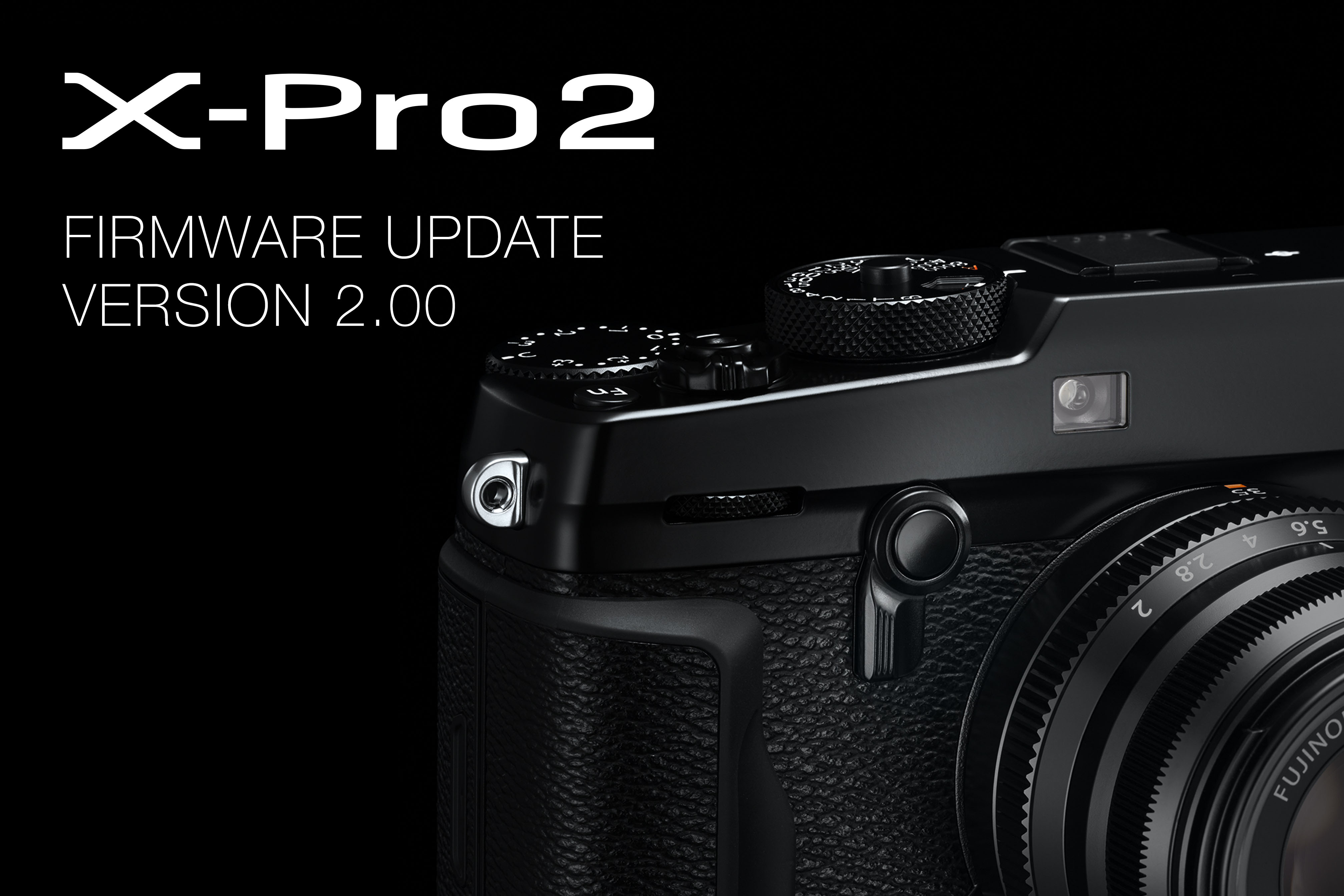
Announcement: New X-Pro2 Firmware Update – Version 2.00

Fujifilm Corporation (President: Kenji Sukeno) is pleased to announce that a free firmware update (Ver. 2.00) for the FUJIFILM X-Pro2 is now available to download. With the added performance provided by this firmware update, the FUJIFILM X-Pro2 rangefinder-style mirrorless digital camera will stand alongside the new FUJIFILM X-T2 D-SLR-style mirrorless digital camera as one of the “double flagship” X Series cameras.

10_x-pro2_bk_frontleft_35mmf2
Key X-Pro2 firmware version 2.00 features:

1. The new autofocus algorithm* that is implemented on the FUJIFILM X-T2 will also be implemented on the FUJIFILM X-Pro2. As a result, more accurate autofocus is now possible, and the AF tracking in AF-C mode will be improved. The number of focus point will be increased from 77 to 91 points (13×7) and from 273 to 325 points (25×13) to improve framing.
* Excludes the new AF-C Custom Settings functions.

2. Compatibility with the new hot-shoe mount flash EF-X500 will enable wireless multi-flash lighting with TTL control up to three groups and high-speed flash sync.

3. AUTO POWER OFF will now have 15 sec, 30 sec, and 1 min. options. AUTO POWER SAVE function, which was previously only available in ECONOMY mode, is now available as an option in HIGH PERFORMANCE and STANDARD modes to allow users to minimize battery power consumption.

4. AF point position interlocked with parallax will be displayed to provide a more accurate and easier-to-use Optical Viewfinder even when Corrected AF frame function is set to OFF.

08_x-pro2_bk_top_35mm_white

More improvements

In our constant endeavor to improve user’s enjoyment of Fujifilm products, the firmware version 2.00 update will provide a total of twenty improvements to the X-Pro2. For a list of all improvements, please visit the link here.

Innovation in display of images: From medical diagnostics to color management

Fujifilm’s skill with images extends to 3D medical diagnostic imaging and to color management. SYNAPSE 3D is an image analysis system that helps physicians detect anomalies earlier and make diagnoses faster. It uses Fujifilm’s Image Intelligence technology to enhance the information value of images. On the color management side, the IS-100 and IS-mini perform color adjustments for motion pictures and videos, from shoot to mastering, with a single, consistent system.
Read more.