Photography

Capture and share memories.

X-Photographer Chris Upton talks X-E2S

BY CHRIS UPTON

Amid all the deserved hype around the launch of the Fujifilm X-Pro2 it was easy to miss the upgrade to the Fuji X-E2, in the form of the X-E2S. In truth this is really an evolution rather than a revolution but, true to form, Fuji have integrated some very welcome features into this incarnation.

Before I run through these it might be worth explaining Fujifilm’s strategy around their, interchangeable lens, CSC (compact system camera) line up. Fujifilm’s launch into the CSC market came with the introduction of the X-Pro1 4 years ago. This model was styled around the retro rangefinder type cameras. It was an instant success due to the beautiful design and stunning image quality. The X-E1 and X-E2 followed in the same vein but in a smaller form factor. Whilst there are benefits of using a rangefinder for certain types of shooting, especially street, there are many photographers who prefer the typical DSLR style body with a central viewfinder. Enter the Fujifilm X-T1 and subsequently X-T10.

xe2sSo the thinking is that Fuji can now offer Pro / semi-pro and enthusiast cameras in both rangefinder and DSLR styled bodies. So in essence the X-E2S lines up alongside the X-T10 with a 16.3mp sensor.

20151108_lakes_0754-Edit

My “affair” with Fuji started in 2013 when I bought the X-E1. I had always wanted a small, light rangefinder style camera to use as a carry round camera to be used alongside my Canon DSLR system. I loved that camera and I still do, but whilst the X-T1 with its fantastic features and design is now my favoured body, the X-E1 is always in my bag.

So when Fuji asked me to test the X-E2S I was intrigued to see how it would compare to my own two models. My thoughts here are not meant to be a definitive technical review, there are plenty of other sites that offer that, but more around the user experience which will hopefully help you decide whether this body might be the one for you.

The X-E2S inherits the rangefinder style design and functionality with a series of new or improved features. The X-E2S is the same small size as the X-E1 / X-E2 and weighs in at a meagre 350g (body only) great for discreet, unobtrusive shooting.

20151108_lakes_0692-Edit

The X-E2S boasts improved viewfinder, autofocus system, handling and a more intuitive interface so let’s have a look at these in a little more detail.

One of the key benefits of the recent Fuji viewfinders is the ability to see in real time the exposure that you’re getting. Adjust the exposure or exposure compensation dial and see the screen go brighter or darker and confirm highlight and shadow control with the live histogram. The display is large with a 0.62x magnification and very bright and Fujifilm claim the EVF features the world’s shortest display time lag. The user can tailor the information appearing to their specific needs and this auto rotates when the camera is turned vertically, a really useful feature.

The X-E2S incorporates the superb new Auto Focus system that was introduced to the X-T1 and incorporated in the X-T10 and the new X-Pro2. This adds Zone and Wide Tracking to Single Point for easy capture of moving subjects. The standard single point mode offers 49 points for fast, precise focusing whilst the Zone mode allows users to select from three different sized zones from the 77 point focus area. The wide tracking feature excels at capturing moving subjects whether they are moving up and down, left and right or towards or away from the camera. This combined with Face and Eye detection options makes this a significant improvement over the old system and offers users one of the best and fastest AF systems available.

20151108_lakes_0552-Edit

The addition of a new, silent, electronic shutter is perfect for candid captures or shooting in quiet places and a top speed of 1/32,000 second means that the fast Fujinon lenses can be used wide open outdoors on a sunny day without the need for an ND filter. The interval timer enables shooting up to 999 frames with intervals from one second to 24 hours.
The camera features Fujifilm’s APS-C 16.3 megapixel X trans-CMOS II sensor. This is unique to Fujifilm and the random colour array and lack of low pass filter helps deliver outstanding image quality and low noise.

For those who like to shoot in low light there is an amazing new top ISO of 51200 though I rarely shoot above 3200 ISO where I have no problem with the quality of the files. If you like to shoot video the X-E2S can capture 1080/60p video and offers the latest set of Film Simulation Modes, including the gorgeous Classic Chrome which gives a slightly muted retro feel. In order to make selecting your most used functions quick and simple you can customize the function buttons on the body. My selections are ISO, self timer (usually set to 2 sec for tripod shooting), focus point, AF mode and metering mode. Of course you can also configure the Quick “Q” menu to your own specification. The new model also features an enhanced grip and a new user friendly interface for the menu system.

20151107_lakes_0314-Edit

20151107_lakes_0402-Edit-2

For those that are new to Fuji or thinking about making the move across there are a few other key points I should highlight.

As with the X-E2 the X-E2S offers the user the opportunity to manage the “exposure triangle” of aperture, shutter speed and ISO together with exposure compensation easily on the camera without the need to dive into endless menu’s. Manual focusing is a breeze when using the focusing aids of digital split image and focus peaking. I find that setting my focus peaking to flash the highlights in red works best. If you shoot JPEGS rather than RAW, or want a very pleasant surprise, the Fuji cameras deliver stunning JPEGS straight from camera. There is a lovely, almost film like feel to them and you can fine tune them in camera to suit your style, they really do have to be seen to be believed.

20151109_lakes_0191-Edit

20151109_lakes_0261

20151111_lakes_0741-Edit-Edit

A final point is that Fujifilm have earned deserved praise for their commitment to users buying into their system to ensure that they are not disadvantaged by the steady stream of technological improvements. In this case existing X-E2 users can update their camera’s firmware at no cost delivering the new AF system updates, performance improvements and the new graphical interface introduced in the X-E2S.

X-E2 firmware can be downloaded for FREE here.

_DSF1624-Edit2

_DSF1812-Edit

_DSF1799-Edit

So in summary whilst the X-E2S does not incorporate all the latest technology from Fujifilm it does offer a lightweight, compact rangefinder style body, awesome autofocus system with a proven 16.3mp sensor delivering stunning image quality at a very keen price making this a very attractive proposition indeed.

_DSF1730-Edit

_DSF1689-Edit

All images were shot using the Fuji X-E2S


Why I chose Fujifilm X – Andrew Billington

Dancefloor Header-1

Guest blogger

Tell us about yourself and what got you into photography?

Headshot-1I had a fairly round about route into becoming a full-time photographer. My background is in theatre and that’s where I worked for 20 years, first as an actor then stage manager. I bought myself a point & shoot digital camera to go on holiday with my wife in 2004 and just wandering around taking photos rekindled the interest I had in photography as a child. My dad had been a keen amateur and I often had a roll of film and an old Zenit 35mm to play with – then it was back home to develop and print the results.

Fast forward to 2005 when I started to take photography seriously again. I bought myself a DSLR and started to take photos around the theatre I was working in. I’ve never been interested in ‘posed’ imagery and a camera seemed an ideal instrument to document the ‘process’ of theatre – rehearsal photographs, technicians at work and actors acting. From there the theatre I was working at started to use some of my photos as marketing materials, the Arts Council UK commissioned me to photograph some things they were doing in schools, and I got some freelance work photographing Ballroom dancing for a couple of publications – all this work came through contacts of people I knew or had met, I didn’t even have a website at this stage!

Theatre-1

Why did you choose to shoot with the Fujifilm X series?

I’m interested in documentary photography and telling stories. Once I started playing with the X-Pro1 (in late 2013) I found a camera that let me do this in a really subtle and intimate way. By this stage, I was a full-time photographer photographing mainly weddings and theatre. Walking into a wedding with an X-Pro1 and a 35mm lens was very freeing – I was no longer the person with the biggest kit in the room. People were not intimidated by such a small and interesting looking camera and I found I could be around any situation and get the shot I was looking for without anyone changing their behavior because the ‘official photographer’ was there.

Wedding-1

Wedding-2

Wedding-3

Most of my work is taken in available light and I’ve never really had a problem getting the results I’m looking for from the Fuji X-series cameras. I work with two X-T1s mostly (with a bit of X100T thrown in) and will shoot on fast primes up to 6400iso without blinking – always I’m looking for the best light in any situation then working out how to tell the story in that light.

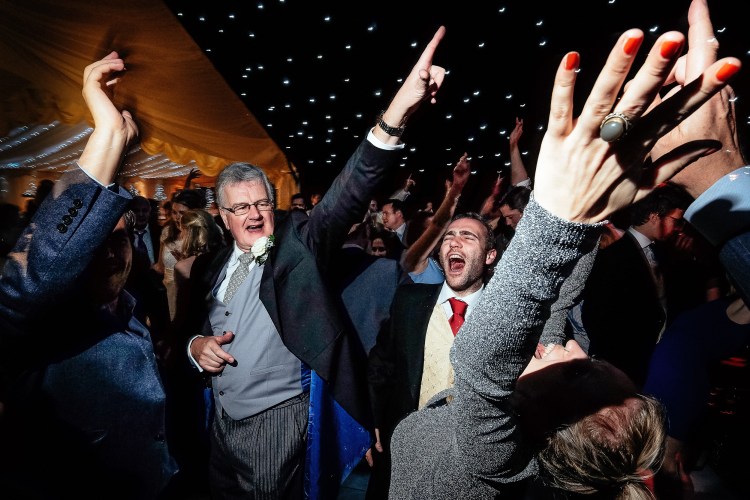
HOWEVER when it comes to the evening of a wedding and everyone is getting down on the dance floor that’s when I break out the flash!

By this stage of the day I figure everyone has relaxed and I can go for a more ‘night clubby’ look with the photos. Dance floors are a dark place, bands or DJs don’t often bring enough light to illuminate them so at this stage I often have to ADD light. But I still want to stay discreet, self contained and mobile. That’s why I choose to use the very tiny Fuji EF-X20 flash on a sync cord attached to my X-T1 (often with the 10-24mm).

Dance_Floor-1

FujiFlash-1

With this set up I can get into the middle of the dance floor action, shoot from any angle and no-one cares you’ve got a camera (even when it’s getting ‘messy’ at the end of the night). If I was shooting with ‘Off Camera Flash’ I’d be limited in the look I would get by where my light stands could go – this way I’m a portable studio. Holding the flash in my left hand (usually high above to the side) and the camera in my right but away from my eye. I ‘zone focus’ so the camera is set manually to focus from 4ft to infinity – at f/10 this is really easy and means that I don’t have to worry about AF in low light but just what’s happening in front of my lens.

Dance_Floor-2

Dance_Floor-3


These are my default setting for Epic Dance Floor shots: ISO 2000, F10, 1/15th, 14mm, get in close and dance your ass off while photographing.


Do you have any tips or tricks you could share with us?

The best thing I could say is to develop your own style and approach to how you photograph. When we start out we all see amazing photographs in a variety of styles and try to copy those in our work – it makes what we do look a little scattergun and inconsistent. Work out what you love photographing, what you are passionate about and a philosophy about how you should approach your photography and then do that. Then do that some more. Then do that better. Then refine it. Do it more. Do it better. Refine it. And on and on it goes.

Every time I pick up a camera I want to create better photographs than I did the last time – better photographs for me equals better photographs for my clients.

Wedding-4

Wedding-5

What’s next for you?

Put simply – see above. Doing more of what I’m doing but hopefully doing it better.

Contact info

To see more of Andrew’s beautiful photography, please visit his website and social channels:

Twitter – https://twitter.com/BillingtonPhoto

Facebook – https://www.facebook.com/Andrew-Billington-Photography-127502644273/

Instagram – https://www.instagram.com/billingtonphoto/

Website – http://documentary-wedding.com


X-A2 review by photojournalist, Brad Hobbs

Processed with VSCOcam with b5 preset
Knickerbocker Avenue, Brooklyn. NY

Guest blogger

bradAbout me

I was born in Margate, Kent on the south east coast of England on the 5th July 1990. I grew up about 40 minutes south of Margate in a small seaside town called Deal.

Growing up in the south east of England, there isn’t much to do unless you like being outside. Being a teenager, I wanted to either be in front of a TV sleeping the days away or out skateboarding. When I turned 13, my dad brought me my first camera and I took around with me everywhere. I mostly concentrated on the boats, beaches and surrounding farm land.

I moved to London in 2010, where I started working at a magazine as an intern for 3 months. Once my internship had ended I was quite lost as to what to do next. After networking around the city I fell into a PR job which kept me occupied for 3/4 years working with some big names in music, sports, movies & television. At some point I thought this would be a job for life but I slowly grew away from it and followed my dreams in photography and writing. Over the past 2 years, my life and career has had its ups and downs like most people, but things have recently really take a turn for the better with a few different ambitious projects.

So what do I think about the X-A2 for my style of photography?

When I first picked up this camera my instant thoughts were how lightweight and compact it is. Using the XC16-50MM kit lens it has fed me with everything I need.

With my style of photography I like to be as close to my subject as possible and to paint a scene of what’s happening around me. The Fujifilm X-A2 helps me capture those moments.

IMG_4194
Broadway, Brooklyn. NY

Once I started learning how to use the settings to their full capability, I found myself shooting at night, which was something I never used to do. The SR+ setting and High ISO settings really help capture what we as humans can see during the darker hours of the day, if not better than what we see. The end results from this camera are so good it is a shame to edit or tweak images.

IMG_1036
Doyers Street, Chinatown. NY

During my time thus far with this camera, I have begun to edit less and take more photos that I am proud of. With the 175º tilting screen, shooting buildings and streets at interesting angles has never been easier. The resolution of the screen makes you want to take more and more images.

This camera is like having a little lightweight best friend around your neck that is never going to disappoint. It maybe even teach you a few things along the way.

So far I have travelled to Glasgow, New York, London, Los Angeles and have never left the house without my camera. On all of these trips and locations the X-A2 makes me proud to be a photographer and proud to be using a Fuji camera.

DSCF8543

To follow Brad’s photographic adventure, please visit his social channels below:

http://www.huffingtonpost.com/brad-hobbs/

https://www.instagram.com/brad_hobbs/

https://twitter.com/brad_hobbs

Using the Fujifilm XF16-55mm f/2.8 for press photography

Guest Blogger strip

By Rachel Megawhat

I began using Fuji cameras at the beginning of 2013. I had begun my photographic career in the days of film, primarily working as a studio fashion and portrait photographer. Through a lot of the time of digital I had been raising a family and working on fine art projects using film  but in 2013 I decided it was time to get a really great new digital camera. The Fujis were suggested to me and I just felt comfortable with them straight away- not least because of the familiar velvia and provia settings. Initially I got a X-E1 and did so much work with that that that I later got an X-T1 as well. I feel that much of the work I have done over the last two years has happened because I am so comfortable with these cameras.

Recently I’ve been trying out the Fuji XF16-55mm f/2.8. My XF18-55mm f/2.8-4 has seen 2 years of near daily use since I got my first Fuji camera, and compared with it, the 16-55/2.8 is a lot bigger lens, quite a lot heavier, and I wondered if the extra 2mm and constant 2.8 aperture could make that much difference.


I really love this lens.


I am a photographer not a writer so the best way to explain it is probably by showing some of the pictures I have taken with the lens.

On VJ day 70th anniversary after photographing the Queen arriving at the Church service, using a longer lens, I had switched back to the 16-55 as the Royal car drove past- given the heightened security it was not made clear which route she would be driving so I was lucky she drove past.

The image on the left is shot at 16mm and then zoomed in to 38mm for the shot on the right. The reflection on her face is a bit unfortunate but I love the way her hand is rested on Philip’s knee.

Last year there was a lot of focus on the Labour party and I covered a bit of this with the 16-55. L-R, Mr Corbyn arriving at the announcement of the Leadership Election, Yvette Cooper in a lift on the way to make a speech and Gordon Brown giving the speech where he walked over a mile, a real test of the camera’s autofocus speed as he literally didn’t stand still.

Like most photographers I see no reason to leave the camera at home if I go away for the weekend so I had the Fuji with me when I went to Weston-Super-Mare to visit Dismaland. It was one of the least dismal days of the year, and gave me the chance to test the lens for landscape shots.

I also tested out the low light action with left: Fat Boy Slim and right: Run The Jewels

One job which is always a welcome break from politicians is the London Zoo photocall. In August they weigh the animals and invite news photographer’s along to record it. This tiny frog was a nice test of the close up capabilities of the 16-55.

I quite often photograph celebrities, often campaigning and this month has seen its fair share with Charlotte Church and Emma Thompson for Greenpeace and Brian May for Badgers

I also covered the AIM Independent music awards with FKA Twigs and Michael Eavis

All in all the 16-55mm has dealt with everything I’ve needed it to do, I quickly got used to the extra weight and I would recommend it to anyone.

See more of Rachel’s work

Rachel’s official website
Follow Rachel on Instagram

Make a home studio – in your bath!

DSCF0214

Written by Roger Payne

The time had come. I’d been trying to justify keeping my X100S and X100T for some time but, in reality, since T had arrived, S had been spending increasingly lengthy spells in the cupboard. So, with a heavy heart, I decided to sell. The obvious route was on eBay, so I cleaned the camera up and took a couple of snaps before preparing my listing.

DSCF0197

My initial shot (above) was very typical of the sort of image you see on eBay – lit with flash from the front, it hardly shows my lovely X100S in the best light, while the background is distracting. I didn’t think it would appeal to buyers, so I decided to try an alternative tack and headed upstairs into my bathroom…

DSCF0179

Admittedly, this isn’t the most obvious room in the house to start taking product pictures but, in reality, it’s got a ready made studio for product shots – the bath. White, with a nice curve, the bath bounces plenty of light around to get even coverage and it has a clean, uncluttered background that won’t distract from the item on sale.

DSCF0184

Using an X-T1 with an XF18-55mm lens, I positioned the X100S at the opposite end to the taps, flicked out the X-T1’s rear screen and used the lens cap under the end of the lens to keep everything nice and straight. The X-T1’s screen is perfect for images like this, although fixed screen X-series models will be fine – you might just have to contort yourself into the bath a little! I chose an aperture of f/11, ISO 1600 and used the two second self-timer for hands-free shooting and took a shot.

DSCF0208

Not bad. Considering this was under tungsten light in my bathroom, I instantly had a better image than my earlier front-on flash lit effort. There was, however, a slight orange colour cast as I’d left the X-T1 on the Auto white-balance setting. I switched to the Incandescent white-balance option and took another.

DSCF0206

Better. The colour cast has now all but gone, but I still thought it could be improved further – the highlight on the lens and on the handgrip were distracting, caused by the main light above and to the left of the camera as you look at it. To overcome this problem, I deployed a diffuser on the bath over the top of the camera. I had a ready-made one, but you could use a large sheet of tracing paper to get a similar effect.

DSCF0192

DSCF0209

Hey presto, the distracting highlights had disappeared! But I still wasn’t completely happy, so I tried one more option, leaving the diffuser in place and attaching an EF-42 flashgun on to the X-T1. I pointed the flashgun head straight up so the light bounced off the ceiling and switched the white-balance back to Daylight.

DSCF0194

The result is below. Good isn’t it? And you’d never know it was taken in a bath. Naturally, you don’t have to use this idea purely for auction site listings, you could be far more creative, but there’s little doubt that this is a great way to boost the look of items you’re selling. I posted the listing and sold the camera for the price I wanted within a couple of days. What did I use the proceeds of the sale for? To buy an X70, of course!

DSCF0214

The Photography Show 2016

DSCF8378

Greetings from Birmingham!

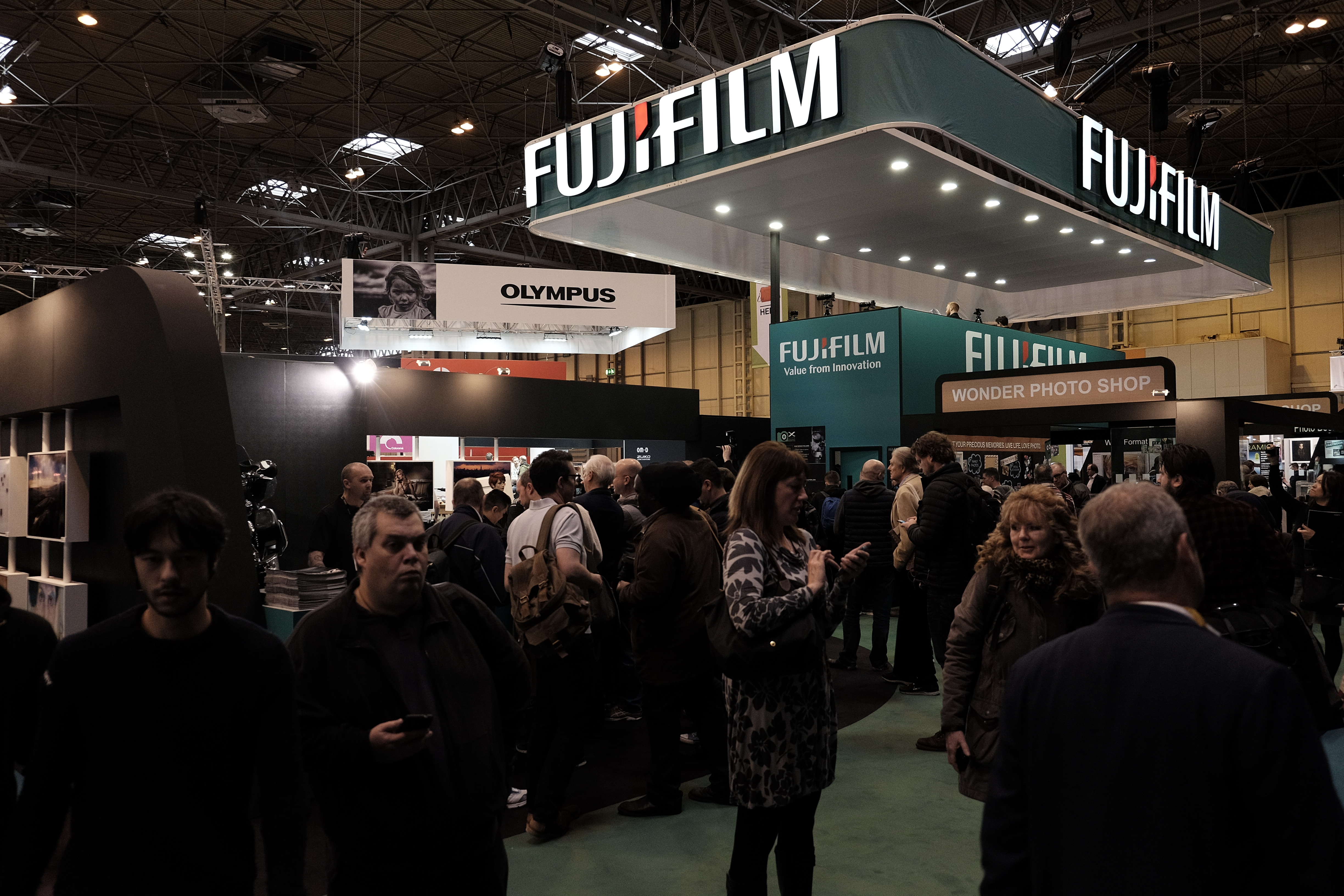
We’re here at The Photography Show at the NEC in Birmingham and it’s been amazing so far.
Our stand is right near the entrance so there’s no excuse to not stop by and pay us a visit. Come and get your hands on the latest kit including X-Pro2, X-E2S and X70 cameras, and we’ve also got an elevated area where you can try out the XF50-140 and XF100-400mm long zoom lenses with X-Photographer Ben Cherry!

Jeannie filling out our Today’s Specials board. Each day we’ve got different X-Photographers presenting around the show.


See inside an X-Pro2 and learn how the Hybrid Viewfinder works

The calm before the storm. The stand about 10 minutes before the show opens
Travel and reportage photographer Chris Upton standing next to a huge print of an image from one of his recent projects.


And we are live. Always a huge rush to get in at the start of the show.

People are able to borrow an X-Pro2 and lens for the day


Lots of people getting their hands on our products and talking to our helpful staff


Hands on with those long lenses


Very important to have a subject to shoot when testing out the cameras


Our range of instax instant cameras are also on display to try out.

Kevin Mullins did an X-Pro2 product demo to around 40 people. Each day at 11:30 we’ll have an X-Photographer doing the same.
Later, Kevin also spoke as part of The Photography Show’s “Turning Pro” masterclass, giving some great advice to photographers thinking about setting themselves up as a business.


And the Kevin-a-thon was rounded off with a talk on the Live Stage about his type of candid wedding photography. Kevin will be talking on the stage on Sunday as well

We rounded the day off with a photowalk around the NEC entitled “Abstract in the landscape”. Professional photographer Paul Sanders encouraged everyone to look for the finer details and less-obvious patterns to create artistic expression where it’s not obviously apparent. Practising in this way means that when confronted with something truly beautiful, photographers will have the ability to still look further to create something unique.

Here’s a few example shots from the photowalk


Come say hello!

The show is open until the 22nd March so please come and say hello. Our full schedule for the remaining days can be found here