GFX Series

‘A World in Color’: unveiling the hidden history with GFX 100II

We live in times when digital archives increasingly shape our understanding of history. Countless moments of the past exist now only in the form of photographs – fleeting, and in many cases, slowly fading with time. In January 2025, Magnum Photos, in collaboration with Fujifilm and the Médiathèque du Patrimoine et de la Photographie (MPP), launched ‘A World in Color – a groundbreaking and ambitious initiative to digitize the agency’s Paris color library archive.

Spanning over six decades, this archive remained largely out of sight, holding approximately 650,000 color slides from Magnum’s iconic collection, dating from the 1950s to the early 2000s. From post-war Europe to revolutionary movements across Latin America, our GFX cameras help digitise previously unseen images by some of the most renowned photographers of the 20th century, offering an unparalleled view of the world’s most defining moments.

How did it start?

Founded in 1947 by a group of visionary photographers, Magnum Photos is one of the most renowned and influential photo agencies in the world. They aimed not only to document the world but also to do so with an unfiltered, humanistic approach, revealing profound truths about society, culture, and politics.

Some time ago, Magnum realized they were sitting on hundreds of thousands of slides, most of which had never been seen. Fidel Castro rallying in the streets of Havana, or post-war Prague uprising against the Soviet invasion in 1968 – for decades, these unique images were locked away in the silence of archive boxes. And the challenge of preserving them for future generations grew more urgent, especially as the physical medium tends to degrade. So, that is where a major preservation project got born – to ensure that future generations could experience these moments in vivid detail.

Bridging the past and the future

A World in Color ‘ marks a new chapter for the long-term collaboration between Magnum and Fujifilm. It offers a rare glimpse into unseen images, as well as a newly commissioned, exclusive series by Magnum photographers, shot using the Fujifilm GFX camera. These color slides hold visual histories that no book or article can convey. And now, they are being brought back into the light.

For a project of this scale, preserving the integrity of the original images while ensuring their future accessibility is paramount. To ensure the highest quality reproduction, Magnum Photos chose the Fujifilm GFX100 II, a medium-format digital camera equipped with an innovative 102MP sensor and the latest image processing engine. It is designed to capture the smallest nuances of color and texture that are vital when digitizing aging slides. Delivering the highest burst-shooting, AF, and stabilization in the history of the GFX Series, it turns the images from relics of the past into living pieces of history that stand up to modern standards of photographic excellence.

Why it matters

Projects like ‘A World in Color’ speak directly to our mission: to innovate continuously while honoring the past, shaping the present, and safeguarding the future. We believe there is more to a photograph than just being a memory, it’s a document of truth and a gateway to understanding. It’s a bridge between generations and a way to preserve the fabric of our collective human experience.

With every frame brought back to life using our GFX technology, we’re amplifying the voices of incredible photographers and preserving unique visual stories so that they can continue to inspire, educate, and move us.

FUJIKINA 2025: a global dialogue

To highlight the project, a yearlong program of exhibitions and talks will take place across six European countries, with Fujifilm’s traveling FUJIKINA events. In each city, a curated exhibition – unique to that country – will unveil unseen photographs from the same region, tracing its history and culture during the 20th century, alongside the new series made in response to the archive. The featured Magnum photographers will be on-site too, sharing personal insights into their creative process during a live talk.

The tour had already had its first stop in Prague this March – with the first new series of images shot by Rafał Milach in response to the unseen Magnum color archives of Czechia. It sees him return to Upper Silesia — an area stretching from southern Poland into areas of Czechia — that he had documented twenty years ago.

Don’t miss the next FUJIKINA in your region:

Arles, the Netherlands

with Gregory Halpern
(keep an eye on the updates)

Learn more here.

Beyond the action: GF500mmF5.6 x Federico Tardito

When we think of iconic moments in sports, what often comes to mind are grand victories and high-stakes moments. But it’s also the subtle, fleeting instances of raw emotion and personal significance that can make a photograph truly unforgettable. For instance, when Oleksandr Usyk took over Tyson Fury in the epic fight for the title of the absolute champion in heavy weight, all eyes were on Fury’s face changing in disbelief – as well as all faces from the front row. Would it be possible to capture that blink-and-you-miss-it expression without today’s high-speed gear? Obviously, not. Neither would have we seen in detail Cristiano Ronaldo’s tears after his penalty miss at Euro 2024, or Yaroslava Mahuchikh crying in a jump after setting a new world record in Paris.

These moments exemplify the power of high-end sports photography equipment. Today, with the introduction of the GF500mmF5.6 lens, a new chapter in sports and action photography is being written.

An Italian sports photographer, Federico Tardito, has tried what’s possible with the large format GFX100 II camera combined with a 500mm focal length of GF500mmF5.6 lens in his recent project. For this test-drive, he chose one of the most challenging and complex team sports to try the autofocus – American football. Armed with the new lens and the GFX100 II, he contacted the Torino Giaguaro team, which plays in the top Italian American football league.

“Unlike football – which is the discipline I usually work with – the players are much closer together and the movements are much less orderly and predictable, not to mention the fact that there are many players moving in front of the subject, which makes tracking the camera and lens anything but easy. (…) After attending a couple of their training sessions to thoroughly understand the movements, and the players and game dynamics, I found myself shooting my first sports competition with a large format. This was finally possible thanks to the GF500mmF5.6.”

The GF500mmF5.6 is the longest telephoto prime among all GF lenses. Despite the very long focal length, it remains extremely lightweight, especially when compared to other 400mm lenses in 35mm format. This makes the lens very easy to handle during the game. Above that, it has a reliable weather sealing, which is a must-have when working outdoors.

“I often work at the maximum aperture to isolate the subjects better, and the performance at maximum aperture of the new lens thrilled me from the first use: the blur effect is truly pleasant and allows for perfect isolation of the subject from the background and scene distractions.”

Despite its small size and light weight, there’s absolutely no compromise about image quality. The GF500mmF5.6 offers one of the best resolution in the line-up. It is also equipped with a powerful 6.0 stops image stabilization system and a high-speed AF drive system with linear motors, which enables comfortable handheld shooting with minimum camera shake and overturns the conventional wisdom of large-format.

“The best part comes during editing. The files from the GFX100 II, paired with the GF500mmF5.6, are truly stunning. The latitude of exposure is incredible and allows for recovering highlights or shadows that are too closed even using only JPEG. The detail is remarkable, and so is the sharpness. The 102MP of the camera allows for an almost infinite freedom of cropping, and different versions of the same frame can be obtained simply by cropping the image differently, which becomes an additional very useful resource during work delivery.

“I chose to work with the Eterna Cinema film simulation. This way, I could take advantage of all the speed of JPEG while maintaining a file rich in detail and extremely workable.”

Find more to the story here.

Federico Tardito

A professional sportrs and portrait photographer, founder of One+Nine Images. Works as a personal photographer for soccer players Leonardo Bonucci and Gigi Buffon. Collaborated with renowned agencies like LaPresse, Insidefoto, as well as famous brands like Nike and Adidas. His photos are published in various international magazines and newspapers, such as Vanity Fair, Vogue, Panorama, The Globe, Sportweek, etc.

Exploring the skies with Tania Malkin: the GFX100S II x aerial photography

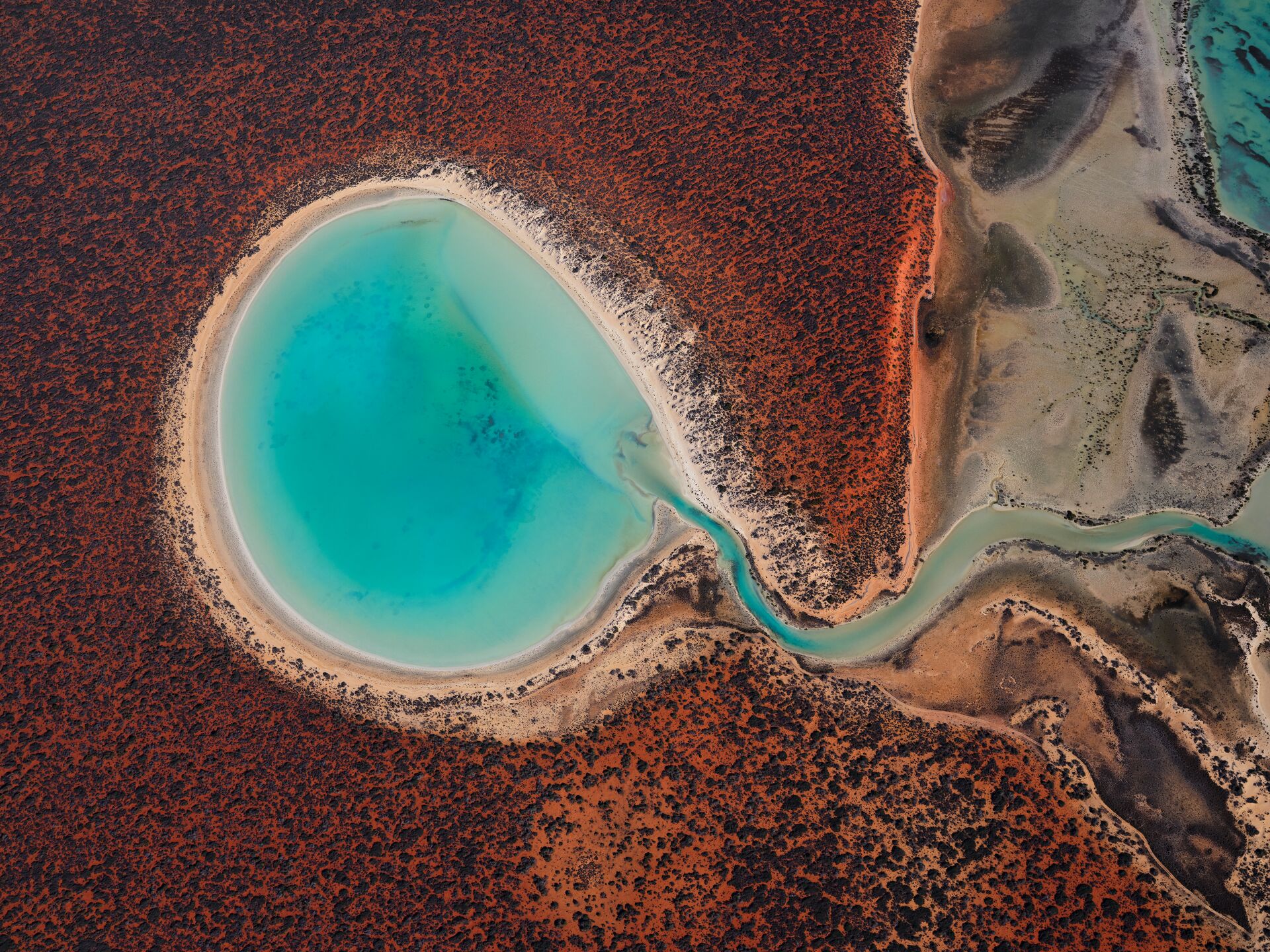
Tania Malkin, a renowned aerial photographer based in Australia, has always had a profound love for landscapes. From the serene beauty of bushlands to the awe-inspiring vistas of Shark Bay, her passion for capturing the natural world is undeniable. Recently, Tania had an opportunity to use the new GFX100S II camera on one of her projects in Western Australia, and her experience has been nothing short of transformative.

Shark Bay, with its diverse landscapes and stunning contrasts where the desert meets the ocean, has always been her favorite spot. And the GFX100S II has proven to be an exceptional tool to capture this from the air.

“I normally take one camera and one lens. Because size is important and I don’t want to be mucking around with equipment. And I like to be able to firstly trust the equipment that I have, and secondly, it needs to be small and compact and not heavy and not impact. I’m holding it solid shooting for 2.5 to 3 hours and I don’t put it down.”

It will be the latest addition to the GFX Series of mirrorless digital cameras incorporating the large-format image sensor approximately 1.7 times larger than a 35mm full-frame sensor. The camera is equipped with the newly developed 102MP sensor, GFX 102MP CMOS II, and our cutting-edge image processor, X-Processor 5. While having these powerful elements, it is still quite compact, weighing approximately 883g. This makes it the lightest among the 102MP large-format cameras in the line-up and allows for effortless handheld shooting, with minimised camera shake.

GFX100S II

With the 102 megapixels, there’s no more need to stitch panoramas to create large artworks and prints. The detail and clarity are mind-blowing. The camera is also equipped with a powerful image stabilizer and a high-speed AF function for enhanced user experience and unparalleled image quality.

“The 8.0 stops IBIS is fantastic because I don’t have to worry that even though I have the amazing autofocus, that the image is still potentially and not going to be sharp. But with the IBIS on the GFX 100S II, I was very confident that the images were going to be sharp, even with the wind resistance and the vibrations from the aircraft.”

“The camera captures the colours and the details of that particular area so beautifully. The sharpness, because of the IBIS, and then the 102MP with the incredible details of the sands and the ocean and the wildlife, the dynamic range that I was getting with the whitecaps on the water, and then the turquoise blue of the ocean with the rich red colours that would normally be out of gamut. It reads everything beautifully. Nothing was blown out. It was just incredible.”

Curious to know more features of the GFX100S II? Check here.

X-Summit Sydney 2024: a quick look at newcomers

Three months after the Tokyo Summit, we’ve just celebrated our second X Summit in 2024 taking place in Sydney. And, of course, with new awesome launches! Today, we introduced our new cameras and lenses in the X and GFX Series, showcasing their advanced features together with professional photographers who got a chance to test our newbies in the field. Here’s a short glimpse into what’s new.

Fujifilm X-T50

The first newcomer introduced at today’s X Summit is a FUJIFILM X-T50 camera. It is sleek and compact, which makes it an ideal camera to carry with you wherever you go, without compromising on quality or performance. It has maintained the classic look but with a new rounded shape for a better holding grip experience. Despite being slightly larger than its predecessor, the X-T50 grip feels snug, making it feel smaller in your hand. The thumb grip extends smoothly outward compared to previous models, providing a better ergonomic feel.

What’s exciting, it’s the first X Series camera to feature a Film Simulation Dial, with 20 simulations to choose from, including the “REALA ACE”. Turning this dial on the top of the camera while shooting lets you enjoy the colours, as if changing film in real-time.

Looking inside, you’ll find the 5th generation X-Trans CMOS 5 HR sensor and the X-Processor 5, enabling high-speed and accurate autofocus and subject detection. The new camera also features a 5-axis IBIS image stabilisation, up to 7.0 stops, achieving clear, high-resolution 40.2MP images. Not to compromise the X-T50’s compact size, we reviewed the structure and arrangement of various parts and units required for IBIS implementation. So, now you have the 7.0 stops IBIS performance in the compact size of X-T30II.

With the 40.2MP I’m finding that I’m able to really zoom in on the image, even when it’s on the screen and it’s showing so much detail. It’s really amazing to both get that detail when you’re shooting wide and you’re shooting close up as well. It just is holding so much data and I’m absolutely loving it,” – Rachel Claire, travel and lifestyle photographer.

FUJINON XF16-50mmF2.8-4.8 R LM WR

This new featherweight zoom lens elevates the capabilities of the X-T50, taking it to the next level. It is compatible with the X-T50 and other 40MP models with the X-Trans CMOS 5 HR sensor. At merely 240g, it is the lightest zoom lens in the XF line-up. Equipped with dustproof and weather-resistant features, it is a perfect choice for all weather conditions. Covering a popular wide-angle of 16mm to a mid-telephoto of 50mm, it offers high-speed, high-definition AF for exceptionally clear shots.

Given it’s a standard zoom that you carry all the time, close-up performance is very important. That’s why we’ve incorporated the maximum magnification of 0.3x and the minimum focusing distance of 24cm, enabling close-up photography at 15cm from the lens tip.

FUJINON GF500mmF5.6 R LM OIS WR

With a focal length of 500mm, it’s the longest telephoto prime among our GF lenses which offers one of the highest-class quality and resolution. Size and weight really make it stand out. The weight of the lens is only approximately 1,375g, while there’s absolutely no compromise about image quality. Chromatic aberration is minimized to the limit. The new lens is equipped with a powerful 6.0 stops image stabilization system, enabling comfortable handheld shooting and significantly minimizing camera shake. Its AF drive system with linear motors allows for fast and high-precision autofocusing that overturns the conventional wisdom of large-format cameras and lenses.

“The autofocus is so good. It just snaps onto the bird, so like when the bird’s in the sky, I get out and bang, you’re on it. And then you just as you move with the bird, the tracking is fantastic,” – Shelley Pearson, bird and wildlife photographer.

“The thing that really stood out for me is that especially being a large-format sensor system, I can fit this in my bag with the lens on the camera. And that’s incredible, because, normally, when I’m traveling I’m always worried about the weight restrictions on airplanes and how to get it into one bag. And then, of course, we’re on a pretty adventurous trip, so being able to carry it around all day and not need to use a monopod – I think that was a really big advantage,” – Matt Krumins, wildlife, nature, and underwater photographer.

“One of the scenarios we had was in rapids in a river, and these birds were just sitting dead still on the logs. And the ability to handhold a long exposure shot to get the movement of the water, but still capture the 102MP of the birds was just fantastic. It’s an F5.6 lens,  but when it’s paired with a large sensor format, it doesn’t actually behave like an F5.6 lens from a depth-of-field perspective. It is great for wildlife,” – Matt Krumins, wildlife, nature, and underwater photographer.

Fujifilm GFX100S II

Since we first launched the GFX100 in 2019 as the first 102MP large format camera, it has become a favourite among many professionals for its outstanding image quality, AF and IBIS. Additionally, we launched the compact GFX100S, a smaller model offering the same user-friendly experience as the GFX100, making it very accessible. Aiming to bring the appeal of large-format photography to more photo enthusiasts, we’ve created the GFX 100S II.

This camera makes no compromises, delivering top-notch performance. It is equipped with the newly developed 102MP sensor, GFX 102MP CMOS II, and our cutting-edge X-Processor 5, maintaining the best of the GFX 100S… and advancing even further. Weighting only 883g, it’s the lightest 102MP model in GFX Series. The GFX100S II offers the highest image quality in the GFX Series. By improving the pixel structure on the new sensor, we’ve extended the standard sensitivity to ISO 80. This means you can now capture images with a wider dynamic range and lower noise.

What’s more? You will definitely make use of the Face/Eye Detection AF and subject detection AF. Advanced AF prediction algorithms have improved the detection accuracy and tracking performance of moving subjects, so you can leave autofocusing to the camera and concentrate on the shutter release opportunity and composition. In addition, we’ve upgraded the IBIS performance too. The gyro and acceleration sensors accurately capture even the slightest movement, and the correction accuracy is improved, providing up to 8.0 stops of anti-shake performance.

Open up more possibilities with Film Simulations

To celebrate the 20th anniversary of our Film Simulation, we’re also launching the Film Simulation special content website. On this platform, you will learn more about all our film simulations, compare their characteristics, and open new possibilities for experiments that you’ve never thought about before. Stay tuned to be in the first row to check it out!