X-Photographer

A series of interviews with professional and high-end amateur photographers that have made the switch to Fujifilm. Learn about all of their different photographic journies that led them to becoming official Fujifilm X-Photographers.

How a frying pan can help with your picture taking

After my last blog encouraged you to make a tripod using a piece of string, I’m going to go a little more surreal this time by explaining how an old frying pan can be used to get dramatic low angle images. The standard route to getting a low viewpoint is either to lie on the floor, use a camera with a tilting screen or mount the camera on a tripod that can be dropped to ground level. The first two options can involve you getting wet and don’t work if you want to use a longer exposure as you’re hand-holding. The latter can be a real fiddle. My frying pan groundpod, however, overcomes all of those issues.


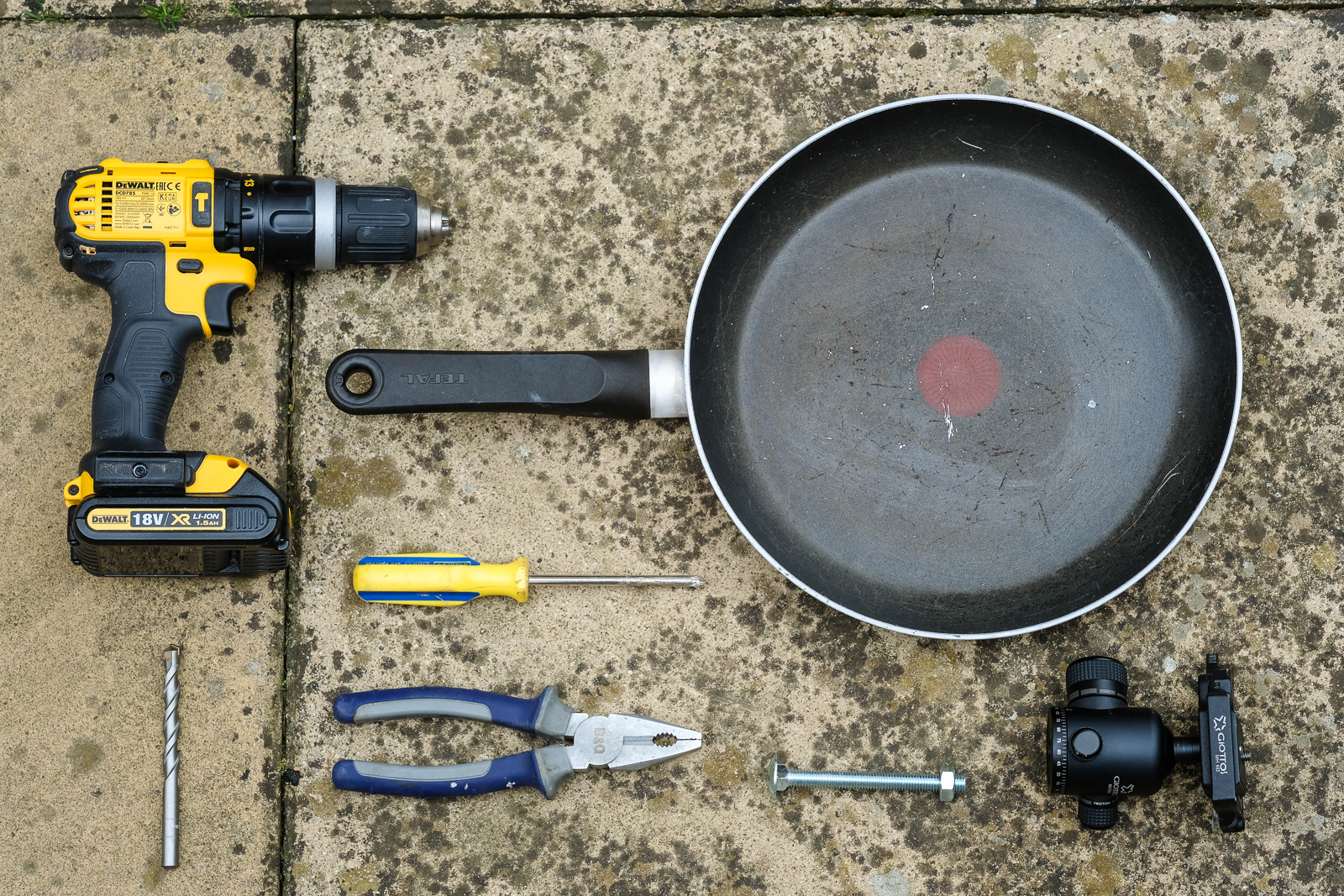
So here’s what you need. An old frying pan, a tripod ball & socket head, a nut & bolt and tools including a drill with a 10mm bit that is suitable for going through metal.

DSCF0004

First up, you need to check what size screw thread the ball & socket head has. The standard size is ⅜” but you can also get little inserts – as I have here – that converts the thread to a ¼”. In either case, these imperial sizes are not readily available in DIY stores as the world has gone metric, but they can be found online. You’ll need both nut and bolt.

DSCF0006

Raise the frying pan off the ground and drill a hole in the centre. It doesn’t have to be absolutely central. Take care if you’re drilling through a Teflon-coated non-stick frying pan like me and, as you’ll discover, this can take some time as frying pans are pretty tough. Once you’re through, tap any sharp edges of metal down with a hammer.

DSCF0014

Now take your tripod head, pass the bolt through the hole and screw it into the base of the head. If you have a long bolt like me, cut the excess length off with a hacksaw and then secure it all with the bolt. Your frying pan pod is now ready for action. Obviously, with a bolt in the base, this can’t be used on a solid surface, but it’s perfect for grass, soil, pebbles, mud and sand. I headed to the beach to try mine out.

DSCF0021

With an X-T10 attached to the tripod head and its LCD screen flipped out it was easy to frame up my shots exactly as I wanted them at the water’s edge. The sides of the frying pan kept both sand and sea away from the camera so I was able to try a variety of images.

DSCF0044

Here’s one of my favourites, I think the sail on the horizon makes it.

DSCF2677

Finally, just a couple of notes. While the groundpod can help you get some great low angle images, I can’t be held responsible for any funny looks you might get while using it – it does look as though you’re frying your camera! Also, if you are taking pictures at the sea be aware that cameras and saltwater are uneasy bedfellows.


img_main01


For more information on the Fujifilm X-T10 click here.


The X-T2 gets a test drive with X-Photographer Damien Lovegrove

damien-lovegrove-profile-200x200Damien Lovegrove is considered by many to be one of the worlds most influential contemporary photographers. He is best known for creating portraits that make women look fabulous. He is a confident director and great fun to shoot with too. Damien’s lighting style is distinctive and his picture composition unique.

Damien is an official Fujifilm UK ambassador and a renowned Fuji X-Photographer.


It was in May 2012 that I ditched my SLRs for a Fuji X-Pro1 and the three prime lenses it launched with. From day one I utilised the mirrorless advantage to leap ahead of my competition. I had been using a Fuji X100 fixed lens camera for a year integrating it into my workflow alongside my SLRs and I loved the pictures I captured with it so the leap to mirrorless was a gentle one for me.

X-T2_BrochureImage_TopThe Fujifilm X-T2 is the camera I’ve been waiting for. It’s no surprise it’s here but what I love most is that the consultation period with X-Photographers has delivered a camera that is spot on mechanically. Everything that could have been improved on the X-T1 from the dial locks to the tilting screen has been perfected on the X-T2.

The Fuji X-Pro1 gave me mirrorless shooting and it rekindled my passion for photography. The X-T1 gave me the extra usability I craved, The X-Pro2 took the image file to the next level and brought the technical specification of the X system bang up to date. Now the the Fujifilm X-T2 has brought it all together and raised the bar again. The sum of all the tweaks and changes in this new camera make a huge difference and leave me not wanting more.


The Fuji X-T2 features that I love the most:

•    The locking buttons on the ISO and Shutter speed dials combined with the higher profile work perfectly. Being able to lock the dials in any position is genius.

•    The bi-directional tilting screen is wonderful. It’s a must for a portrait photographer.

•    The camera size and weight are spot on. The ultra reliable and compact W126 battery has been retained. The weight of the camera in the hand is really important to me. I never want my photography to feel like a chore again.

•    The media door has a newly designed latch that is really secure.

•    The joystick to move the focus position makes the shooting process faster.

•    The 1/250th second flash sync is welcome and is the new setting for all my studio flash working.

I team the Fuji X-T2 with the fast primes because I love a shallow depth of field combined with absolute resolution. A prime lens is lighter on the camera than the equivalent zoom and this suits my way of shooting well. I have the XF16mm f/1.4, XF23mm f/1.4, XF35mm f/1.4, XF56mm f/1.2, and the XF90mm f/2 lenses. There are times when a telephoto zoom is the perfect lens for a shoot and I use the XF50-140mm or the XF100-400mm lenses depending upon the assignment. The zooms offer optical image stabilisation and this really comes into its own at longer focal lengths.


And the results?

I had planned this first sequence of shots about a year ahead of the shoot. I bought the dresses from an Asian manufacturer via the internet and I transported them to the USA in my luggage. The location is in the high deserts of Arizona, USA. I used the XF100-400mm and XF50-140mm lenses to compress the perspective. These frames were all lit with natural sunlight.

1

I spent 12 days touring the USA and in that time I shot about 5000 frames on the Fuji X-T2.

Arielle down on a farm in Utah. There were snakes keeping us company as we shot a wonderful sequence of images. XF50-140mm f/2.8 at f/4
Arielle sits by a cattle coral in Arizona. The dust on the wind has turned the sky a shade of pink. This figure in the landscape style is one I want to further develop in the coming months and the extra resolution of the Fuji X-T2 really comes in handy when making big exhibition prints. XF50-140mm f/2.8 at f/5.6

Since then I’ve added another 4000 frames in Europe to my camera testing routine. The camera feels just right in the hand and there is nothing I would change about the mechanics of the build.


Discover creative resources for photographers written by Damien Lovegrove at Prophotonut and Lovegrove Photography


Introducing The New Fujifilm X-T2

Australia strip BLACK

Imagine a camera that takes the best features of the Fujifilm X-T1 and X-Pro2 and combines them together to create the ultimate photographers and videographers tool.

Well, today we are excited to announce the combination of these cameras in the new Fujifilm X-T2!

The Fujifilm X-T2 is one of the most anticipated cameras in Fujifilm’s history. Not only will the impressive 24.3MP APS-C X Trans CMOS III sensor capture the joy of photographers around the world, but now with the addition of 4K and 2K video formats you will be able to film the emotion too!

Adding to this is a bundle of features that includes an electronic shutter with a limit of 1/32,000 second, an Intelligent Hybrid Phase detection AF, a robust weather resistant body, an impressive 3-way tilting 3.0” LCD and a 2.36 Million dots Electronic Viewfinder and dual SD UHS-II memory card slots that will capture up to 14 frames per second with the Performance Boost Mode turned on.

All of these features sound impressive (and they are), but the list of specs doesn’t stop there. As mentioned earlier the 4K video quality this camera now records is on par with some of the other professional cameras out there. When filming video you can expect excellent sharpness and low noise when recording up to a maximum of ISO 12800.

Fujifilm X-T2 007

Another important feature unique to videographers is the ability to choose a video frame rate. Fujifilm has liaised with various professionals and industry leaders to determine what settings best suit. Within the new Fujifilm X-T2 videographers will be able to select 29.97P, 25P, 24P and 23.98P when filming in 4K and if Full HD is selected; 59.94P, 50P, 29.97P, 25P, 24P and 23.98P at a 100Mbps Video Bit rate.

There are also a lot of settings that can be changed once you press the record button. You will be able to change exposure in ⅓ stop increments, correct the colour and the angle of view. Added to this is the option to change the exposure via the external HDMI port, which is well suited for videographers using external monitors.

Fujifilm X-T2 001

When you first handle the Fujifilm X-T2 you will immediately feel the magnesium alloy chassis that has been redesigned based on photographers feedback. With weather resistant sealing to suit rugged outdoor conditions, this professional body is slightly larger than the Fujifilm X-T1 due to improved control dials that turn easily with or without gloves. The new lock buttons located on the shutter and ISO dials are easily pressed to turn on or off the action of selecting a new setting. Also the enlarged drive mode and photometry selection dials can easily be accessed due to this new ergonomic design.

As shown in the video (above) the 1.62 million-dot 3-inch LCD screen has been redesigned to suit photographers. Now with a 3-way tilting screen, the photographer can turn and rotate the screen to a visible position when holding the camera above their head in a portrait orientation. Previously on the Fujifilm X-T1 the screen was only visible in a horizontal orientation.

Fujifilm X-T2 010

The launch of the Fujifilm X-T1 saw photographers from many different genres switch over to Fujifilm due to the large range of Fujinon lenses available. Sports and wildlife photographers were among the newly acquainted, but this was not only due to the lens selection, but also the features on the Fujifilm
X-T1 like autofocus and UHS-II memory card compatibility. Learning from this the new Fujifilm X-T2 takes autofocus speed and memory card storage to the next level.

The Fujifilm X-T2 is slightly different in the way the camera focuses when compared to the Fujifilm X-T1. This is because of the new Intelligent Hybrid Phase detection autofocus. The new X-T2 will allow you to select up to 325 autofocus points allowing for precise focus. What this means is no matter whether the subject is within the frame, the camera will autofocus very quickly to pick up the subject.

Adding to the list of new features is also a dual memory card slot that is now capable of recording to two UHS-II compatible cards. What this means for photographers is they can record photos up to 14 frames per second (when Performance Boost mode and Electronic Shutter is selected), which will result in a total of 42 Jpeg frames or 28 RAW frames stored at Lossless compression. This option is only available when the VPB-XT2 grip is on the camera.

Not only does the optional VPB-XT2 (Vertical Power Booster Grip) increase frame rate, but it also will accommodate two additional batteries (NP-W126S) at the same time to boost in shooting interval, shutter release time lag and blackout time while extending 4K video recording to a maximum of 30 minutes.

Fujifilm X-T2 011

As mentioned, when you use the optional VPB-XT2 battery grip you can select different frame rates like 14 frames per second, however, if this is too fast 11 frames per second can also be selected.

When 11 frames per second is enabled 75 Jpeg frames or 30 RAW frames stored at Lossless compression can be captured. However, if you require more frames to be recorded before the cameras buffer fills, the frame rate can be dropped to 8 frames per second enabling 83 Jpeg frames or 33 RAW frames to be stored at Lossless compression. Finally, if you need to record an endless amount of Jpeg frames, 5 frames per second can also be selected.

The X-T2’s ISO range of 200 – 12800 (RAW shooting) is exactly the same as the Fujifilm X-Pro2. When recording at high ISO like 3200 or 6400 photographers will find images and video to be very clear resulting in smooth graduation and deeper blacks.

Fujifilm X-T2 014

Studio and wedding photographers will enjoy using the Fujifilm X-T2 as the camera can now act as a commander when firing off multiple flash units when using the newly announced Fujifilm EF-EX500 flash. Found within the camera’s menu is the ability to select ‘COMMANDER’ mode, which enables full manual control of up to three supported Fujifilm flash units. Each supported flash can be manual adjusted to ensure you get the best possible picture.

Fujifilm X-T2 013

It is Fujifilm’s hope to design a camera that will suit a photographer’s requirements and it is refreshing to see that the X-T2 does this. Something many were not predicting though was the ability to film in 4K. Having mentioned this, it is worth thinking about to expand upon your skills to embrace this chance. Not all photographers will embrace this addition and that is okay, but to those who wish to expand on their skills the feature is there for you to explore and the same can be said to videographers when it comes to taking photos.

Fujifilm X-T2 008

This article hasn’t covered all of the specifications nor the implementations of the Fujifilm X-T2, so we would encourage you to follow this global Fujifilm blog which is now supported by Fujifilm Australia, Fujifilm UK, Fujifilm USA and Fujifilm Canada. We also ask you subscribe to the global Fujiguys YouTube channel to learn more about the Fujifilm X-T2 from contributions around the world. Together we are one and together we are here to listen to you the photographer – and now the videographer too.

Holiday Snaps – Freedom From Faff

DSCF6765-2

Holiday snaps – it’s just one of those things right? Even though you LOVE taking pictures, LOVE capturing beautiful scenes of beautiful places, sometimes you simply can’t be bothered to figure out the following:

  • Which lenses should I take?
  • What bag am I going to use to take all this stuff?
  • What ND filters should I take?
  • What about chargers, spare batteries, neck strap, lens cloth (which you have temporarily ‘misplaced’ but don’t want to admit you have lost to your Wife)
  • And what about my tripod, how will it fit in my luggage?
  • Sighs..

This Is Where The Fujifilm X70 Comes In..

If you’re like me and already have a Fujifilm X Series camera, you have become very accustomed to quality photographs and probably shudder at the thought of using anything substandard.

And this could be for many reasons – but for me, it is this simple:

“What if I see something amazing while I’m on holiday? It could be the next picture to go on my wall at home.”

Now I know that if I shot the image on a smartphone there is no way that I would want to print it due to the lower image quality, and so I would always want to have an X Series with me.

With this in mind I decided to take only the X70 on my recent holiday to Mallorca. Now I have to admit that I was a bit nervous about not taking all my camera gear with me. I think this is because it all becomes a bit of a comfort blanket, I would think to myself:

“I’ve got the 10-24mm for my wide shots, my 55-200mm for my tele…” etc.

So ‘only’ having the fixed focal length I thought this might limit me creatively a bit, but all I can say is WOW – it really doesn’t! 

DSCF6686-2
X70 – Old cobbled street in Mallorca – processed in LightroomDSCF6684-2

I was trying to put my finger on what it is that makes this camera stand out from the crowd, and I think it really comes down to these 3 reasons:

The Image Quality Is Superb

This little camera creates beautiful images. It has the same sensor as found in the X-T1 (X-Trans CMOS II) and can easily produce stunning A3 / A2 prints.

And I have even seen great images printed at 2 by 3 metres from this sensor!!

DSCF6703-4

DSCF6705-2

DSCF6657-2


It’s Really Easy To Use

Whether you understand shutter speed, aperture and all that jazz or not, it really doesn’t matter with the X70 because this camera will cater for your abilities.

If you’re still learning the basics of photography you don’t need to worry as the camera has a handy little AUTO switch you can use to keep things simple.

But if you are like me and LOVE playing with all the settings, adjusting your depth of field and all of that then the X70 will be a great choice for you as all of the useful features are either a switch or a dial at your fingertips.

Not only that but the camera itself will charge like a phone in that you can use a USB cable straight into the side of the camera, the battery will then charge internally. It’s a simple thing, but in reality it’s really handy, as every night I’d just plug it in and place it on the bedside table to keep the power topped up.

Another great feature I use all the time is the built-in WIFI. When on holiday or travelling, a lot of us like to share our images with friends through Facebook or similar. With the WIFI feature on the X70 you can transfer over your images from camera to smartphone, edit them in Snapseed or similar and then upload – simple.

DSCF6700-2

The Caves of Drach - Mallorca
The Caves of Drach – Mallorca – looking straight upwards for those wondering

DSCF6693-2


It Fits Into My Pocket

This is perhaps the simplest reason, and yet it is still one of the most important as to why I love this camera.

Unlike any other camera in our range the X70 actually fits into my pocket, which I find truly liberating.

It means that wherever I go, I have my camera with me without having to take a camera bag – which as I’m sure many men out there will agree – our ultimate aim is to carry everything of use within the pockets of our jeans.

My Wife beating me at pool...Again
My Wife beating me at pool…Again
Keeping things healthy at dinner time
Keeping things healthy at dinner time..

pic_04And The Super Technical BONUS Reason…

My Wife LOVES taking couple selfies, and it just so happens that this camera makes that really easy too as the screen flips up fully. 😉

To find out more about the Fujifilm X70 Click Here.

Until next time, happy snapping

Dale 🙂

DSCF6730-2
My first ever tram ride.. It was brilliant!

X-Thusiast Featured Photographer of the Month: Michael DeBeen

Australia strip BLACK

Fujifilm Australia is thrilled to introduce our June 2016 X-Thusiast Featured Photographer: Michael DeBeen. Hailing from Geelong, Victoria, Michael is a horologist, calligrapher and gifted photographer with a penchant for exploring the great outdoors. In this month’s Q&A, Michael shares how he uses the science of photography to capture striking shots in vivid detail with his Fujifilm X-T1.

LittleGepetto“Little Gepetto,” Fujifilm X-T1 + XF56mmF1.2 @ F2.5

How did you develop an interest in Fujifilm photography, and how would you describe your photographic style?

This is a tough question—I’m not sure what was the pivoting point that led me to photography. Throughout my life, I have been attracted to ideas and pursue them obsessively. It is simultaneously a gift and a fault of my personality, and photography is a product of this.

I consider myself technical-minded, and it may have been the science of photography that initially gained my attention. Things like lens and sensor design are fascinating to me. One of the reasons I became interested in Fujifilm was its unique X-Trans sensor array that negates the need for any anti-aliasing filter to minimise moiré.

My first exposure to photography was almost two years ago now, when, after much deliberation, I bought my first camera: the Fujifilm X-T1.

Before my interest in photography sparked, I never considered myself creative. I had a clear structure in my mind where science and arts were on opposite sides of a great divide. It wasn’t until recently when a friend commended my creativity that I realised there isn’t such a divide, and you can’t have one without the other.

While consistency is important to me, I don’t actively seek it in my photographs. I take each photograph as they come and try to find an ideal look for that particular image. It has a little to do with intuition and a lot to do with over-analysis and micro-adjustments. Perhaps some day someone wiser than I will help me understand and articulate my photographic style. Until then, I’ll continue being my usual oblivious self.

_DSF3483_1

“Cappuccino” Fujifilm X-T1 + Fujinon XF56mmF1.2 @ F1.2, 1/2000sec, ISO200.

What’s your favourite location to shoot in Australia? Your favourite subject?

So far, in Australia, my favourite location to shoot is the Great Otway National Park and the Great Ocean Road. It is wonderfully refreshing and calming, even from a non-photography perspective.

I look forward to exploring more of Australia in my future, and discovering more of its sights.
As for my favourite subject, that can change by the day. I appreciate minimalism—especially if I can find something striking without distractions.

Beach

“Beach” Fujifilm X-T1+ Fujinon XF56mmF1.2 @ F1.2, 1/4000, ISO200

Why did you choose the Fujifilm X-T1, and what is your favorite aspect?

Touching on what I mentioned before: The X-Trans sensor contributed to my choice, but it wasn’t the only deciding factor. My priorities for a camera system were quality (both image and physical), functionality, weight/size and support.

The Fujifilm X-T1 ticked all these boxes.

I was (and still am) impressed with the clarity and colour rendition of the X-Trans II sensor. Fujifilm’s choice to implement additional features such as an intervalometer, filmic profiles in-camera and their commitment to support even their dated cameras via software updates is a benefit some other manufacturers often overlook.

The X-T1 was Fujifilm’s current flagship interchangeable lens camera. I liked the X-Pro1 aesthetically, but couldn’t justify it over the technical improvements that the X-T1 offered. I love the idea of the X100 series, but I wasn’t in the market for a fixed lens system.

It is difficult for me to choose one feature over any other as a favourite, but the 0.005-second refresh rate of the electronic viewfinder is at the top of the list.

Which Fujinon lens(es) do you prefer to use with your Fujifilm X-T1 camera?

My favourite X-Mount lens is the Fujinon XF56mmF1.2 (~85mm full frame equivalent). It is such a flattering lens, it’s practically impossible to take a bad photo.

And while I was traveling through Europe, the Fujinon XF23mmF1.4 (~35mm equivalent) was invaluable. It is an incredibly versatile lens.

Could you describe your photographic workflow/process? Do you prefer any particular editing tools, social networks or camera accessories to enhance your work?

There is not much to say other than I still have a lot to learn. That is true of everything in life.

Although the X-T1 is very capable of producing brilliant results straight out of the camera—especially when you consider Fujifilm’s film simulations—I always finalise whatever I envisioned in post-production.

Beyond exposure, my most valued in-camera settings are the RAW file-type and the Adobe RGB colour space. I pay close attention to the histogram. The dynamic range of the X-T1 is admirable, so unless I am in an unusual situation, I will prioritise highlights and do my best to not clip them unless it is unavoidable.

Ideally I try to keep a rounded histogram so that when I get it to my computer I have as much data as possible.

My post-production workflow is probably best described as disorderly. I have not yet found a single software solution that can do everything I need in one neat package. I extensively use Adobe Photoshop CC as a tool to refine, polish and offer greater levels of photo manipulation. To complement Photoshop, I also use Adobe Lightroom and Phase One Capture One Pro 9 regularly.

_DSF3973-2

London Tourist, Fujifilm X-T1 + Fujinon XF23mmF1.4 @ F1.4, 1/2000, ISO800, polarising filter

Do you have any advice to new photographers?

Do not delete your photos! Once you become more confident in your abilities, you will return to them with a fresh perspective, and you will find hidden gems that you previously overlooked. If you are happy using your camera on auto, the best thing you can teach yourself is how spot, matrix and scene metering modes affect your exposure.

Any final thoughts, tips or advice?

A significant influence to my ideas and final results as a photographer is print and framing—how the image will appear on different paper stock, and how it can be complemented by a different frame.

Photography now being a predominantly digital format makes it easy to forget about your photos. Even if you are just starting out, don’t shy away from printing them. It’s important to have a tangible representation of your work.

MichaelDeBeen

You can find more of Michael’s compelling work on his Instagram account here.

Interested in joining the X-thusiast community and sharing your own story? See the full X-Thusiast Gallery and Submission details here.
Inside Bryan Minear’s Camera Bag

X-Photographer strip BLACK

By Bryan Minear

As a landscape photographer, I venture out to shoot – a lot. Much of my work is reliant on timing and interesting light. I’m based in Michigan, which isn’t conventionally known as a photo wonderland, so I am constantly exploring, scouting locations, and biding my time for that special segment of time where the light is just right and I can realize my vision. Most of the time, this involves me running out the door and into my car at the start of golden hour, and my Fujifilm bag (a unique co-branded creation) is perfect for those spontaneous moments.

FXT10347

Admittedly, I’m a bag snob, and I struggled with settling with any camera bag for my minimal kit until now. I could never find one that was just right for what I needed. When I heard that Fujifilm and Domke were partnering to create a never-before-seen version of several Domke classics, I was definitely interested. If the same attention to detail and capability that Fujifilm puts into their products went into the bags, I was going to be in for a treat. Long story short, the camera bag does not disappoint. The FUJIFILM X Series Domke F-803 has just the right amount of storage for me to take my X-Pro2, XF10-24mmF4 R OIS, XF56mmF1.2 R, and X100T – my perfect minimal setup. Even with the kit, the bag still has plenty of room left over for the accessories and extras, like my 10-stop ND filter, polarizers, solar-powered battery backup, and even my lightweight Vanguard VEO 235AB tripod, rendering me completely handsfree.

FXT12571

One problem that I usually have with messenger bags is that they end up being too bulky and uncomfortable, which is not the case with the FUJIFILM X Series F-803.  It has a very low profile and feels perfect when it is slung across your body, all while looking super sexy (yep, I said it). The combination of sand canvas and brown leather make for a really classic look. It pairs so well with the aesthetic of the X Series cameras – you know, for people who care about that sort of thing. On the run and chasing light, I’ll be suited up with my new favorite premium X accessory.

FXT10356

Learn more about X Series Domke co-branded bags here!

Currently only available in the United States.