I began using Fuji cameras at the beginning of 2013. I had begun my photographic career in the days of film, primarily working as a studio fashion and portrait photographer. Through a lot of the time of digital I had been raising a family and working on fine art projects using film but in 2013 I decided it was time to get a really great new digital camera. The Fujis were suggested to me and I just felt comfortable with them straight away- not least because of the familiar velvia and provia settings. Initially I got a X-E1 and did so much work with that that that I later got an X-T1 as well. I feel that much of the work I have done over the last two years has happened because I am so comfortable with these cameras.
Recently I’ve been trying out the Fuji XF16-55mm f/2.8. My XF18-55mm f/2.8-4 has seen 2 years of near daily use since I got my first Fuji camera, and compared with it, the 16-55/2.8 is a lot bigger lens, quite a lot heavier, and I wondered if the extra 2mm and constant 2.8 aperture could make that much difference.
I really love this lens.
I am a photographer not a writer so the best way to explain it is probably by showing some of the pictures I have taken with the lens.
On VJ day 70th anniversary after photographing the Queen arriving at the Church service, using a longer lens, I had switched back to the 16-55 as the Royal car drove past- given the heightened security it was not made clear which route she would be driving so I was lucky she drove past.
The image on the left is shot at 16mm and then zoomed in to 38mm for the shot on the right. The reflection on her face is a bit unfortunate but I love the way her hand is rested on Philip’s knee.
Last year there was a lot of focus on the Labour party and I covered a bit of this with the 16-55. L-R, Mr Corbyn arriving at the announcement of the Leadership Election, Yvette Cooper in a lift on the way to make a speech and Gordon Brown giving the speech where he walked over a mile, a real test of the camera’s autofocus speed as he literally didn’t stand still.
Like most photographers I see no reason to leave the camera at home if I go away for the weekend so I had the Fuji with me when I went to Weston-Super-Mare to visit Dismaland. It was one of the least dismal days of the year, and gave me the chance to test the lens for landscape shots.
I also tested out the low light action with left: Fat Boy Slim and right: Run The Jewels
One job which is always a welcome break from politicians is the London Zoo photocall. In August they weigh the animals and invite news photographer’s along to record it. This tiny frog was a nice test of the close up capabilities of the 16-55.
I quite often photograph celebrities, often campaigning and this month has seen its fair share with Charlotte Church and Emma Thompson for Greenpeace and Brian May for Badgers
I also covered the AIM Independent music awards with FKA Twigs and Michael Eavis
All in all the 16-55mm has dealt with everything I’ve needed it to do, I quickly got used to the extra weight and I would recommend it to anyone.
If you buy an X-Pro2 and register the warranty on our website before the 8th April 2016, you could win a place on one of our fantastic workshops.
1st May – Portrait workshop with Dave Kai Piper – (4 delegates)
Location: Amersham Studios
Being a photography lecturer, Adobe Community Pro and Fujifilm X-Photographer, Dave Kai-Piper will take you on an exciting journey into portrait photography.
His workshop starts off with a conversation with each participant discussing individual goals for the day alongside a group objective. As part of the morning set-up you will have a look at some iconic images from influential photographers. Then he will break down what makes those images work & talk about how different lighting types can create moods and styles. You will learn how to build on simple lighting styles like Butterfly lighting, Split lighting and Rembrandt lighting and then put them into practice using live demonstrations with a stunning model.
Once your objectives are set, you will jump into the studio full of the newest WiFi controllable Broncolor lighting to put your new Fujifilm X-Pro 2 through its paces. You will look at ways to shape, control and create that perfect image. Within this workshop you will also learn the best way to communicate and pose your subject to get the best from your model.
Whether you have spent a lot of time in the studio using lighting or have never used additive / flash lighting in your photography before, each attendee will leave the workshop with a broader knowledge of various techniques from lighting your subject, creating a scene and directing your model.
4th May – Street workshop with Matt Hart – (4 delegates)
Location: Liverpool
Spend the day with Street, Event and X-Photographer Matt Hart in this candid street photography workshop. It is here that Matt will give you an insight into the way he works and how to shoot his style of street photography.
He will show you how to anticipate and capture decisive moments, how to be invisible in public spaces to get the best images and how to to develop confidence shooting street photography. He will show you the best places in Liverpool to capture great street images – so in the future you can come back and have another go!
Matt’s workshops are always fun, informative and relaxed whilst at the same time challenging and have been designed to stretch your imagination.
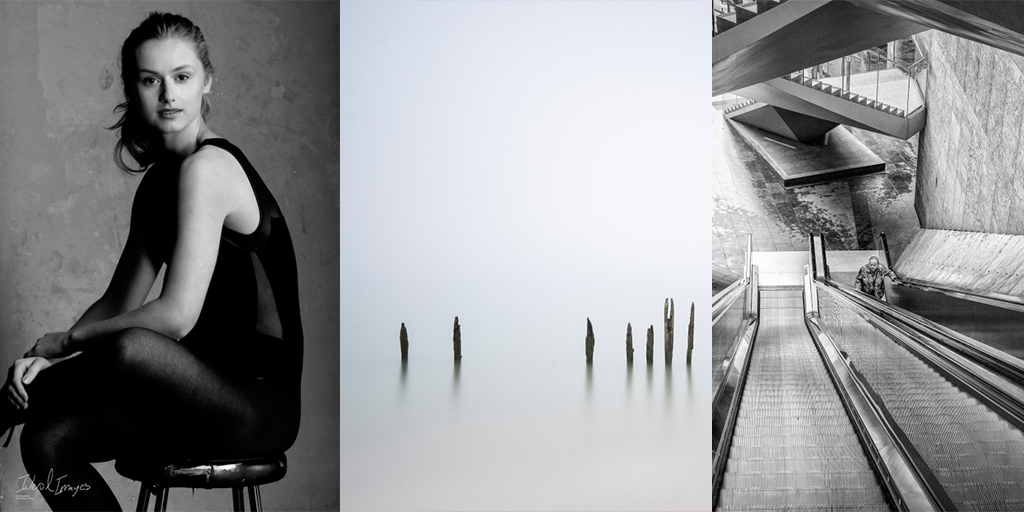
7th May – Landscape workshop with Paul Sanders – (4 delegates)
Location: Dungeoness and surrounding areas
Your day will be spent with Fujifilm X photographer and landscape artist Paul Sanders, he will help you develop your own way of seeing the landscape to create images that resonate with how you feel about the location.
Paul’s specialty is long exposure photography, he will take through a natural and easy to follow workflow that enables you to get to grips with the technical side of this style of photography. He will have some Neutral Density filters and graduated filters for you to use on the day. Filtration is one of the key aspects of landscape photography, it allows you to control contrast, mood and exposure time. Paul will explain all of the pros and cons of using filters and the different types of filters available.
The day will be split into two sessions – one at Dungeness and the other at Winchelsea beach.
Dungeness is the only classified desert area in the UK, its flat bleak landscape has inspired photographers, artist, writers and filmmakers for many years. The beach is a detritus of fishing boats and fleet. The decaying hulls of boats are left on the shingle, nets, huts and machinery make this a photographers dream location. Paul will explain that landscape photography isn’t always about the big vista but also lies within the details and the abstract he will guide you around the area so that you don’t miss anything.
Winchelsea Beach is a long exposure dream, lines of decaying groynes stretch along the beach. These make the perfect subjects for getting to grips with the minimalist style that long exposure work generates. Paul will also pay special attention to composition and exposure time to create beautifully minimal images.
2.3 billion people worldwide lack access to reliable electricity. In Nepal roughly 80% of the population live in rural mountainous regions that have little to no access to electricity. With the devastating earthquakes last year (April 25th and May 12th 2015) the citizens of Nepal were left with a broken country, 9,000 people killed, tens of thousands of people injured and over 2.5 million homeless.
In Nepal, rooftop solar panels are being used in households to provide power for daily electrical appliances and activities; at schools to power computers, laptops and cellphones; and at hospitals and health posts to power patient needs in the rural mountainous communities. Solar integration for agricultural purposes has recently been implemented throughout various parts of rural Nepal to aid in the irrigation and harvest of crops year round.
My goal with my photography is to raise awareness around humanitarian and environmental issues globally. I focus on documenting the candid and capturing moments that inspire a call-to-action. Through a partnership with Photographers Without Borders and SunFarmer, a non-profit organization focused on delivering solar power to developing countries, I returned to Nepal in October 2015 to capture the impact of solar technology and build awareness around the work of SunFarmer on local Nepali communities enduring the difficulties of life without electricity due to energy poverty.
The country continues to rebuild with the citizens of Nepal struggling to survive in the midst of the current political crisis that has left the country with a limited access to petrol, medicine, cooking gas and other essential supplies.
My inspiration for photography began in early childhood when I travelled with my family throughout Asia. I took my first film photography course in high school at the Hong Kong International School, while living and studying abroad in Hong Kong. But it wasn’t until years later after working in the financial services sector and living close to 10-years overseas, did I find my hand in photography. Over the years while living abroad, I’ve gained an understanding and deep appreciation and respect for diverse cultures and places.
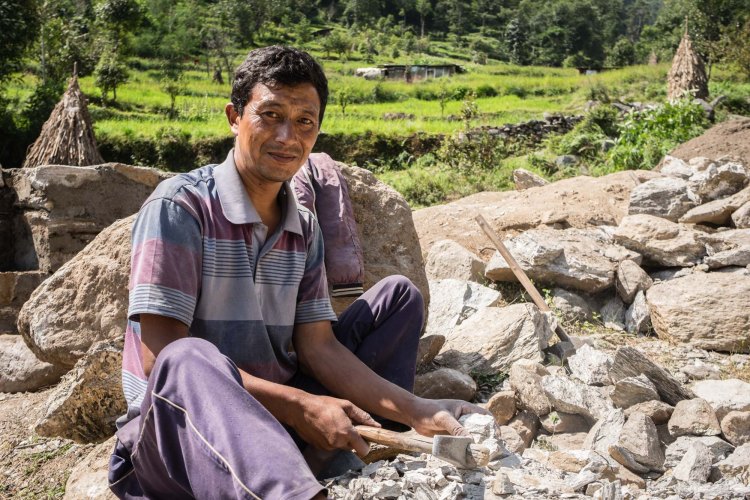
Community member, Lakuri Danda health post, Lakuri Danda, Dolakha, Nepal.
In the pursuit of my passion, I’ve travelled extensively throughout South East Asia with my partner and with a camera always by my side ready to document my environment, culture and people that I encountered. With my photography, I seek out stories that raise awareness and address social, humanitarian, environmental and cultural issues to evoke positive change for the natural world and its inhabitants.
Charikot, Dolakha, Nepal.
How did you get involved with the SunFarmer project in Nepal?
The SunFarmer project came about through a partnership with Photographer’s Without Borders (PWB), a non-profit collective of journalists, photographers, filmmakers and passionate storytellers with a mission to inform and inspire positive change by visually communicating the ways that grassroots initiatives are addressing problems in their communities. I was assigned to document solar energy solutions for SunFarmer in Nepal.
SunFarmer is a solar engineering non-profit that installs solar energy in hospitals, health clinics, schools and agricultural sites throughout the developing world. Nearly 1.3 billion people worldwide are without access to electricity. Without electricity, a modern quality of life is impossible and the growth and prosperity of a country is severely hindered. SunFarmer has a mission to reduce this figure by providing best in class solar at an affordable rate to schools, farms and health posts. The team’s goal is to provide electricity access to seven million people by 2020. In Nepal, SunFarmer has partnerships with various stakeholders that include private organizations, NGOs, government organizations, banks, bilateral organizations, and microfinance institutions. The basic criteria when choosing to work with these organizations are like-mindedness, a vision to provide access to reliable and affordable electricity over a long period of time and access to transmission lines in areas that are difficult to reach often due to rough geographical terrain in the rural parts of the countryside.
Since SunFarmer started in Nepal in 2014, the team has successfully implemented over 100 projects in the country. The value SunFarmer works with is to provide the best in class, affordable energy solutions to their clients. Many developing countries are facing similar situations to that of Nepal with regards to energy and electricity crisis and are equally as important to focus on next. The team is still weighing out the various different countries to focus on next and has made a global announcement on their commitment to rebuilding Nepal at the Clinton Global Initiative. Their commitment will bring 1.5 MW of solar powered electricity to at least 2 countries in the next 3 years.
SOS Children’s Home, Joripati, Bhaktapur, Nepal.
How do you go about determining your focus for a project of this size?
My goal for partnering with SunFarmer was to capture the impact of solar technology as Nepal continues to rebuild after the earthquakes that hit the country earlier in the year.
Kupondole, Kathmandu, Nepal.Rebuilding Nepal in Thamel, Kathmandu, Nepal.Rebuilding Nepal in Thamel, Kathmandu, Nepal.
The vision I had was to share a story that chronicles the lives of the Nepalese families and local community members that we visited throughout Nepal’s countryside and to show their shared hardships, stories and experiences. Through a series of photo essays, I illustrate the struggles faced by the citizens of Nepal as the country continues to rebuild and how solar energy is changing their lives.
Dhan Kumari KC, Lakuri Danda health post volunteer, Lakuri Danda, Dolakha, Nepal.
I’ve lived in many of the world’s major cities and remote areas of Southeast Asia and it has been an invaluable experience that has become a strong influence in the way I shoot and go about determining my focus for long-term projects. Before I pick up the camera, I enjoy seeking out new places and diving into unfamiliar scenarios where I find my way by building strong relationships with the people I end up encountering.
Kathmandu Durbar Square, Kathmandu, Nepal.
Over the years, my curiosity to explore has taken me to the top of the world on a month-long expedition trek across the Everest Region, to the bottom of the Red Sea free diving in Egypt and on to studying meditation and traditional Muay Thai boxing in the mountains of northern Thailand.
My project with SunFarmer took me back to Nepal for a second time. The first time I visited was in April 2012. I landed in Kathmandu on my birthday. My partner and I stayed in Thamel where we purchased our gear and equipment for an expedition trek. It was an incredible, life changing experience. We started at the famous ‘world’s most dangerous airport’ in Lukla, acclimatized in Namche Bazaar Village, crossed the Chola Pass, summited Gokyo Ri and Island Peak and made our way to the Everest Base Camp and back to Kathmandu in one piece.
We ended up spending three months in Nepal and I had a genuine connection with the people, community and country. The Nepalese are a very special kind of people with a strong sense of dignity, compassion and unity.
What did you do to prepare yourself for the trip to Nepal?
Of critical importance to successful assignment photography is the research you do before you book that plane ticket. The more legwork and planning done upfront, the better your images will be when you land.
My first point of contact for the project was SunFarmer’s Director of Impact & Partnerships, who is based in New York. SunFarmer has operations in the US, Canada, and Nepal. Planning began with logistics and safety discussions in late February 2015. Over several months we coordinated the solar site visits at SunFarmer and with SunFarmer’s partner organizations throughout Nepal’s countryside.
Temporary health post in Lakuri Danda, Dolakha, Nepal. Dolakha district is one of the hardest hit April 25th Nepal earthquake disaster zones in Nepal.Inside the temporary health post in Lakuri Danda, Dolakha, Nepal. Dolakha district is one of the hardest hit April 25th Nepal earthquake disaster zones in Nepal.
There are several factors to consider when working on location and in a developing country. Not surprisingly, the first avenue of information is from the Internet. I have a quick look at tourist information and government sites, travel advisory boards, official country tourism boards, news outlets for the most updated look at the country’s political standing and issues, guide books such as the Lonely Planet Guide and Rough Guides for high level country profile information, sites to see and places to stay, and travel sites like WikiTravel, VirtualTourist and Trip Advisor. It is also extremely useful to take a good look at the best time of year to head over to your destination.
Kupondole, Kathmandu, Nepal.Collapsed health post in Lakuri Danda, Dolakha, Nepal. Dolakha district is one of the hardest hit April 25th Nepal earthquake disaster zones in Nepal.
With this information, I also prepare a concept and shot list with details on the shoot objectives, location, setting and contact list. Purchasing a local map and marking off sites and locations of importance will be extremely helpful to ensure you get all the shots you need for the project and your creative curiosity.
Rebuilding the health post in Lakuri Danda, Dolakha, Nepal. Dolakha district is one of the hardest hit April 25th Nepal earthquake disaster zones in Nepal.
What were some of the obstacles you had to overcome while planning the trip?
The biggest obstacle was looking at the best time of year to visit. In Nepal, there are two preferred times a year for travel. Peak season, particularly for trekking is from late September to early December when the air is crisp and fresh with clear skies for the best mountain views. From the end of February to mid-April, it is warm and dry; the rhododendrons are in flower and bloom. This season brings a second wave of visitors. The summer months of June to August are also the monsoon season in Nepal and not an ideal time to visit. The weather is hot and wet. It rains almost everyday with occasional thunderstorms in the evenings.
Another factor to consider is the festival season. Throughout the Nepalese annual calendar, there are several religious holidays. Dashain is a very popular festival in Nepal. It is the longest and most auspicious festival celebrated. In Nepal, it is a celebration of family. People return home from all over the world to spend time with their family and loved ones. All government offices, educational institutions and businesses remain closed during the festival period that falls in September or October and lasts for fifteen days. Making a visit during the festival season can be great for street and travel photography, but is not always the ideal time to visit while on assignment. Many of SunFarmer’s partner organizations remained closed during this time and we had to work around the festival schedule.
Chinatown Shopping Centre, Churchil Complex Sundhara, Kathmandu Nepal.Chinatown Shopping Centre, Churchil Complex Sundhara, Kathmandu Nepal.
Travel and logistics are equally as important to work out long before the project starts. We had to secure well in advance a four-wheel drive vehicle and experienced driver to take us across Nepal’s countryside and up the mountainside to visit the agricultural solar sites and solar water pumps that lift water from the valley below to a tank above the community on a hill. Access to water from tap stands outside each house gives families back time they would otherwise use for collecting water and gives farmers water to irrigate their crops.
How are solar photovoltaic systems used and are they anymore beneficial than the more traditional energy gathering techniques such as hydro or wind for Nepal?
A solar photovoltaic system or PV system is a power system that harnesses the power of the sun which is composed of particles of energy called photons that is converted into electricity via solar panels to power electrical loads. Simply put, solar panels absorb and convert sunlight into usable electricity.
Sanepa, Kathmandu, Nepal.
SunFarmer Nepal team has noted that Nepal has around 720-740 MW of hydro power plants installed in the country and import around 200MW of electricity from India. There is a large demand of around 1300 – 1400 MW of energy for consumption. The supply and demand clearly doesn’t match and there is a large energy deficit in the country. Nepal has not been able to upscale their hydropower installations to meet its citizen’s demands because the demand for energy grows roughly 10% every year. An additional problem is that currently there is only one hydro station that has storage capacity in the country. The remaining hydro plants are run-of-river power. So during the dry season Nepal only has 25% of energy generation leaving the population with around 12-16 hours of load shedding (scheduled blackouts) during the dry months that runs for more than six months. This is why it is important to have a healthy energy mix of renewable energy sources in the country to address the energy crisis, to be independent and to be climate resilient. With the earthquake, most of the hydro stations were damaged. Nepal lost around 150MW of power due to the earthquake.
What were some of the obstacles you had to overcome while filming in remote locations?
In Nepal, 80% of the population lack access to reliable electricity and live in the rural parts of the country. Naturally, the biggest challenge we were faced with was keeping our equipment charged and ready to shoot at all times. A few of the project sites we had on the agenda required a days worth of travel and off-road driving up Nepal’s countryside.
For the project, we had arranged in advance with community directors at each of SunFarmer’s partner locations to join us for the site visits. SunFarmer provided me with a translator and solar operations engineer to interview our subjects. Once on site, I setup my equipment for a series of interviews with the local community members and a series of portraits to follow.
We shot under all environmental conditions, rain or shine, indoors and outdoors. We were blessed with good weather during the tail end of the monsoon season with sunny skies and little rainfall. It became a bit of a challenge to work with the changing sunshine. While shooting outdoors and interviewing our subjects, we had to wait several times for the clouds to pass and the sun to shine to keep a consistent exposure. For portraits, we shot mostly indoors or in a shaded area outside with a 3” Octabox providing warm light to envelop the sitter in their natural environment.
How does travel affect what you bring to shoot?
I try to be a minimalist when it comes to things to carry while traveling on assignment. When I traveled throughout Asia for over 2 years, I had with me two camera bodies (one for backup or video), a laptop for quick edits and social media updates, a cobra flash, a 3’’ octabox, tripod, light stand, transmitter/receiver, extra camera batteries, CF cards, rechargeable AA batteries and a reflector. Today, I wouldn’t go without my Fujifilm X-T1 with X Mount lenses and Voltaic Systems 17-watt solar charging kit.
Traveling has taught me to shoot creatively in difficult situations, think on my feet and problem solve various scenarios that come up. Oftentimes, you will be uncomfortable, but as long as you keep your equipment close, stay safe and keep a flexible attitude and an open mind, travel is the best kind of education that will take you to some of the most intriguing and wonderful places the world has to offer.
Rebuilding Nepal in Thamel, Kathmandu, Nepal.Chinatown Shopping Centre, Churchil Complex Sundhara, Kathmandu Nepal.
What advice would you give to someone interested in documentary photography?
When you first arrive at your destination, begin to quickly familiarize yourself with the lay of the land. Don’t be afraid to walk around while always being cautious of your surrounds and self-aware. Look for interesting vantage points and characters, and keep in mind when the sun rises and sets to scope out areas the day before for where you will need to be during the ‘magic hour.’
Be present, shoot in the moment and become inspired by the rich, diverse cultures of the people that inhabit the world. Everyday we are faced with environmental and societal concerns that challenge us to look inward, encourage us to re-evaluate our actions towards one another and inspire us to look closely at the world we reside in. Be true to yourself and follow your curiosity and passion.
In Nepal, the streets are so full of life with people who are proud to share their stories and life experiences if approached. Their strength of character shines through and it was important to me to capture this in the best light possible. With every photo you take, try to find a way to create images that humanize various situations and cultures. With my photography, I hope to open avenues of understanding between people and cultures and inspire positive change out of difficult situations.
Developing countries must expand access to reliable and modern energy services if they are to reduce poverty and improve the health of their citizens. Nepal is currently facing a petrol crisis on top of their electricity crisis. As a landlocked country, Nepal depends heavily on India for the import of goods into the country. Nepal is facing a shortage in fuel stock with the continuous blockade of supply at the Indian border.
The sad reality I witnessed by working alongside SunFarmer is that the current petrol crisis is worse than the April 25th 7.8 magnitude earthquake that hit the country. Nepal received a lot of support globally with regards to earthquake relief. The earthquake has caused around USD $7 billion in damages, and it is estimated that the current cumulative loss from the blockage significantly exceeds that amount.
Kupondole, Kathmandu, Nepal.
About Kristin Lau
All images in this photo series were shot on the Fujifilm X-T1. To view more of Kristin’s images from Nepal and project “Light for Life: Solar Energy in Nepal,” visit her website: www.kristinlau.com
Kristin Lau is an award-winning Toronto-based documentary photographer from Queens, New York. She’s focused on social documentary, portraiture, and underwater and aerial subjects. Kristin seeks out stories that raise awareness about the environment to evoke positive change for the natural world and its inhabitants.
DeLorme inReach used to track and send location points for the cracked health post in Boch, Dolakha, Nepal.
Exhibition: Thoresby The End Of The Mine features around 50 framed images Venue : Mansfield Museum, Leeming Street, Mansfield NG18 1NG Dates : 9th January – 27th February 2016 Open : Monday – Saturday 10am – 5pm Admission: Free
Today I’m going to take you through some of the advice given to me by UK wedding photographer Kevin Mullins. Kevin’s approach to candid wedding photography translates precisely into his street photography style.
What makes a good “street” shot?
The three key factors that make a good street image are;
good light
good composition
interesting subject
Get all three and you have a great shot. Two of them can result in a good shot. If you can only have one, make sure it’s the interesting subject
Assignment 1 – Shoot with a theme
Start by simply shooting how you want, but with a theme. Try the theme “angles”. When I took this shot below, it was a nice sunny-but-cool day in Cambridge so there were plenty of things to choose from. Look for good light, some sort of interesting subject, and carefully consider the complete composition.
The bright sun meant that to me, the ‘angles’ would need to come from shadows. This guy caught my eye because he was using his phone one last time before getting on his bike. I wondered who he was contacting, or whether he was just checking a map. About 20 mins later we saw a cyclist nearly get taken out by a car so I wonder now if he was sending a ritual “goodbye, just in case” message. X-T1; XF18-55 @ 35; 1/640 sec; f/5.6; ISO 200
Assignment 2 – Frame your subject
Try to use people to frame shots of other people. Pair up with another photographer and go hunting interesting shots together. Use your partner to help provide a frame for the shot. The theme of “angles” was dropped but otherwise everything applied; light, composition, something of interest that tells a story.
Although personally I find the arm in the foreground a bit distracting, it does give a bit more depth to the image and the bright blue of this guy’s jacket and the sign pull your attention away from the frame . X-T1; XF18-55 @ 35; 1/200 sec; f/5.6; ISO 200I like this one because the conversation is framed by the arm on the left, and also the stranger on the right. X-T1; XF18-55 @ 55; 1/200 sec; f/5.6; ISO 200This last one failed the assignment in that it wasn’t framed by a person in the foreground. However, I like it because of the way the light fell on the faces of the people having the conversation. Nice light and begins to tell a story about a meeting in public. X-T1; XF18-55 @ 35; 1/200 sec; f/5.6; ISO 200
Assignment 3 – Spot Metering
The next thing to try is pre-focusing and spot metering. Put your cameras into spot metering and manual focus mode and stand facing a place where people would “break the light”. In other words, pedestrians and cyclists would travel from the bright sunshine, into the shade, or vice-versa. Use the “AF-L” button to pre-focus on the ground where we wanted them to be when we shot and then simply time them right to shoot them just as they cross from the light into the shadow. The camera will adjust for the exposure according to light on the subject, rather than the total light in the scene.
On the X100T, X-T1, X-T10 and X-Pro2 there is a setting that allows you to link the spot metering with the AF box. Activating this allows you to choose the point in your composition to expose for. On cameras without this function the spot metering will only occur in the middle of the frame so you may be slightly limited in your composition.
This shot was actually taken by Kevin himself using his X100T; 1/320 sec; f/16; ISO 640
Assignment 4 – Zone focusing
Get close to your ‘subjects’. Getting close obviously means more chance of affecting the resulting image so it’s key to try to appear like you are not taking photographs. The main reason people need to really see what they are shooting is to make sure you are focusing on the right thing.
Guy working on a market stall. Bikes were everywhere in Cambridge. X-T1; XF18-55 @ 55; 1/90 sec; f/11; ISO 400
Keep your camera in Manual Focus mode, select a nice small (big number) aperture value and then used the focus distance indicator on the screen of the camera to understand where the range of acceptable focus would be.
Focus on the ground a few metres in front of you. Your next challenge is to get in close to people and inconspicuously shoot them getting on with their life. Continuous shooting is also very handy here as it allows you to shoot a few frames, especially good if your subject is moving through your zone focus area.
Assignment 5 – Turn invisible
There is now no need to hold the camera up to your eye so all of your shooting can be at waist level, looking down onto the tilting LCD screen (if your camera has one) to check the overall composition. After a while you will be able to simply look around and be confident that you’re going to capture the interesting subject without them knowing, therefore not influencing or changing the subject, but merely documenting what is going on around you.
Not many people “at work” seemed to really be working. Zone focused and shot from the hip with X-T1; XF18-55mm @ 35mm; 1/64 sec; f/13; ISO 1000One of my last images as we were about to lose the sun completely. This is one of the few guys who looked like they were actually working, although I question his choice of office. X-T1; XF18-55 @ 55; 1/125 sec; f/16; ISO 1250
Summary
The three keys to a good street image are; good light, good composition, interesting subject. All three of these results in a great shot. Two of them can result in a good shot. If you can only have one, it has to be the interesting subject
Shoot with a theme. This will make you consider your shot more carefully and not just fill your card.
Try to frame your subjects with parts of the background, or even make your own frame by using other photographers
Setting your camera on full auto with Spot metering allows you to ignore the exposure settings and let you worry about looking for a good shot
Zone focusing allows you to not worry about accurate focus, but rather understand that if a subject is within a certain “zone” in front of your lens, it’ll be sharp and in focus
Tiltable LCD screens allow you to shoot at waist level and still see the frame. The camera remote app takes this one step further and you look like you are just using your phone while actually shooting people with the camera hanging around your neck.
Keep practicing, hope for something interesting to unfold in front of your eyes and be ready with your camera when it does. Hopefully these techniques will help you get a great shot without anyone even knowing you were there!
Tell us about yourself and what got you into photography? How did you develop your style in photography?
I am a photographer based in Nottinghamshire, UK with a passion for Travel, Landscape and Social Documentary photography.
My love of photography started in my teens when I used the camera to record walking and climbing trips around the UK but especially in the Peak District and Lake District. As my knowledge developed and results improved, the emphasis changed from less walking to more photography. In those days I was shooting 35mm slide film and enjoyed processing my own black & white prints in my darkroom at home. As with many other photographers the shift to digital helped to improve my photography and it’s certainly more comfortable processing images in the digital whiteroom!
Over the years I have been fortunate to travel widely and consequently this has become my favourite genre of photography. I find it an amazing experience to observe and photograph a variety of cultures, people and landscapes, and hope that through my photographs I can bring a little of this to the viewer and inspire others to experience the beauty and diversity of the world for themselves.
Why did you choose Fujifilm cameras?
Having used a DSLR system since their launch I had always hankered after a small rangefinder style camera that I felt would offer more freedom and enjoyment in my photography. When the Fuji X-E1 was launched I bought one straight away thinking it would complement my DSLR and would be a great walk around camera. As soon as I got the camera I was smitten. It was so lovely to use, it felt just right, it was intuitive and it made me want to take pictures. The only area where I needed reassurance was image quality, could an APSC sensor really match my full frame DSLR? Well I should have had no concerns. The combination of camera and stunning Fujifilm XF lenses delivered superb results and there was a further revelation, jpegs! I hadn’t shot jpegs for a long time but when I saw the results I was amazed. They were sharp, the colour rendition was spot on and the overall feel of the image was beautiful, almost film like in their appearance. I bought a couple more lenses, the XF10-24 and the XF55-200 and the brilliant Fuji X-T1, and this opened up more creative opportunities. I started to use the Fuji kit more and more, no longer was it a back up to the big, heavy DSLR. It had earned its stripes and I loved the combination of a smaller, lighter, robust system that was so intuitive and simply a joy to use. Today the DSLR system sits in the cupboard waiting for the inevitable ebay listing as the Fuji accompanies me everywhere at home and abroad.
What & who inspires you?
I love great pictures whatever the subject matter and as a travel photographer you have to be pretty adept at different genres as you will be shooting architecture, people, landscape, detail, street and many other subjects in the quest to capture the spirit of the place. Therefore I have many sources of inspiration. I marvel at the landscape work of Charlie Waite who seems to capture scenes at their absolute best with sublime composition and feeling. David Noton, Elia Locardi, Ric Sammon and Steve McCurry are among my favourite travel photographers and Art Wolfe’s images combine the best of nature and travel with fine art. Sebastio Salgado has to be there for his amazing documentary and people pictures. I just think it’s important to open your eyes to the world out there and draw inspiration from as many sources as possible.
Do you have any tips or tricks you could share with us?
Without doubt the number one priority with Travel photography is planning. We don’t have unlimited time or budget when travelling so we have to make use of every moment. That means understanding key locations, viewpoints, weather conditions, sunrise & sunset times and direction and any local factors such as opening & closing times. The internet is an invaluable resource for this and I will check out tourism websites, Google images, flickr and 500px. You will find some stunning images of your locations that you should use as a starting point. Of course you will want to shoot the iconic views of famous locations but when you have those in the bag look for something different, put your stamp on the place. You will be surprised that it’s so often those images that give you the most satisfaction.
The majority of my images are taken using a tripod. Now whilst some photographers regard a tripod as an unnecessary evil there are many good reasons to use a tripod other than just avoiding camera shake. Sure there are times when I shoot handheld but using a tripod slows you down and makes you think more carefully about your subject, enabling more precise composition. It also helps makes the use of gradual neutral density filters easier with more accurate positioning. Creative opportunities are also opened up by using longer shutter speeds in daylight, including the use of ND filters, to capture movement. But of course it’s the ability to capture the best light of the day at sunrise and sunset that make the tripod an invaluable part of any travel photographers kit.
I love photographing people, but for many the prospect of approaching a stranger and asking to take their picture is a real challenge and that’s why some take the easier route of a long lens grab shot. Whilst there is certainly a place for the candid approach I have found that taking pictures with permission yields far better results. So I would urge you to pluck up the courage and try to make that connection with your subject. I always try and learn a few words in the local language which, even if I get wrong, usually results in smiles and breaks the ice, creating a perfect start for your people photography. Check your equipment before you approach your subject including lens selection, aperture, battery life and frames remaining on your memory card. Also once you have permission don’t just take one shot and move on. Shoot a few images, move around and work with your subject. Resist the temptation to keep chimping your screen but use it to show your subject the results, this works really well with children and of course thank the person when you’ve finished.
What’s next for you?
I have just completed a major Social Documentary project on the closure of Thoresby Colliery, the last pit in Nottinghamshire. Being such a significant event in the county’s industrial and social history I was keen to produce an enduring record of the colliery and to share the images with as wide an audience as possible. So I am delighted to have produced a major touring exhibition which opens in Mansfield, Nottinghamshire and runs until 27th February and have also published a book, “Thoresby The End Of The Mine”. Full details of both can be found on my website www.chrisuptonphotography.com So in the short term I am busy publicising and promoting but I am also looking forward to a few trips abroad including Venice, India and Andalucia.






 I am a photographer based in Nottinghamshire, UK with a passion for Travel, Landscape and Social Documentary photography.


