Reportage

Help! I don’t know whether to buy and X100T or an X70.

By Kevin Mullins

KevinMullins-Headshot-200x200When I first received the Fujifilm X70 I looked at it and thought…….hmmmm.  Then I scratched my head and glanced sideways at my X100T which was looking back at me with suspicion and concern.

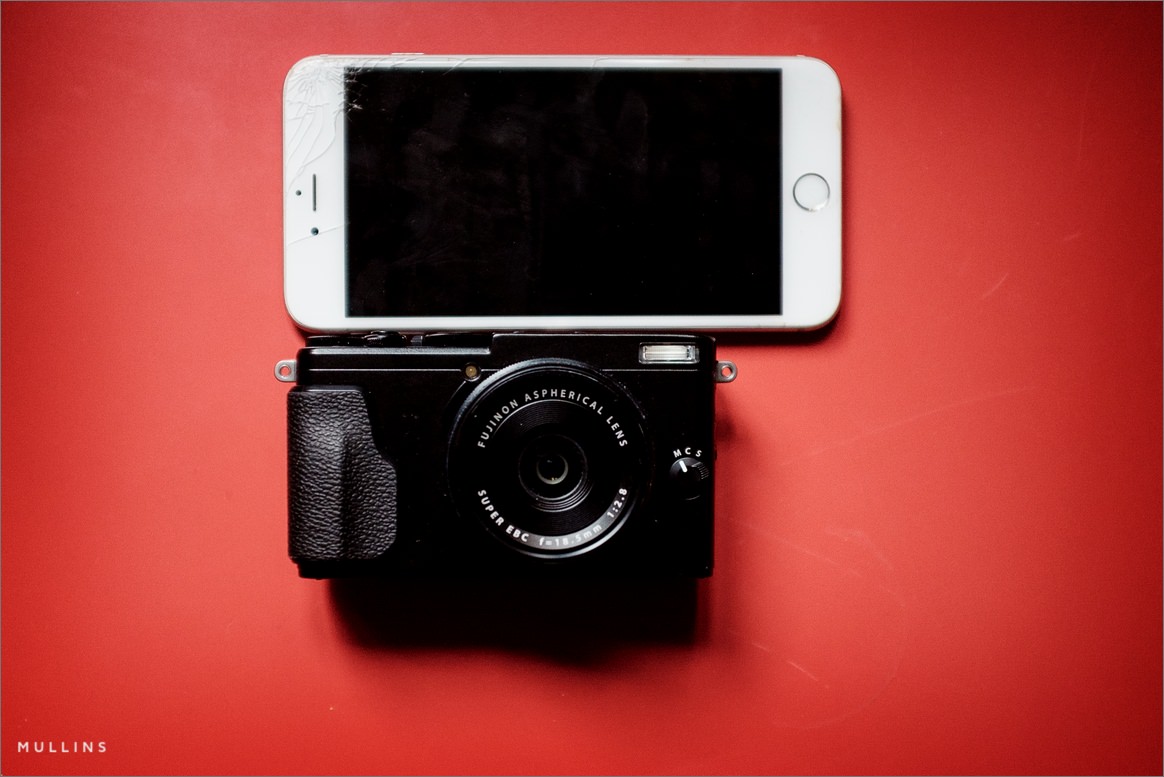
I have to admit that I also had suspicion and concern when I first picked up the X70.  It’s teeny.  In terms of length and width it’s almost a third smaller than my mobile phone.

My X100T, on the other hand, is larger.

So I challenged myself to see if size really does matter and, more importantly, does the X70 live up to its big brother X100T when it comes down to image making.

fuji-x70-review-1-2

Brief Differences and Similarities between the X70 and X100T

This isn’t a review of either camera but it makes sense for me to point out the fundamental differences, and similarities between the two cameras.

Both cameras share the same 16-megapixel APS-C X-Trans II sensor but that, possibly, is where the similarities end.

We already know about the size difference, but really the biggest differences are the interface to shooting and the lens and so I will concentrate on these during this post.


“Beat the fear of Street photography by allowing people to come to you, instead of you to them.
Then just… Click.
No pressure.


The Lenses

The X100T has an excellent 23mm F2.0 lens.  Way back when I was shooting DSLR, my preferred focal length was 35mm (full frame equivalent), and actually it still is.

I LOVE the lens on the X100T and this is one of the critical changes because if you also LOVE the lens on the X100T, you need to know that the lens on the X70 is different.

The lens on the X70 is a slower F2.8 but wider 18.5 mm focal length or 28mm (35mm equivalent).

So straight away, we can see that the X100T is going to be better at low light shooting, albeit marginally.

However, the size and weight of the X70 means we can shoot at slower shutter speeds to mitigate this to a certain extent (depending on the subject matter of course).

For me, I love that 35mm FF focal length and I’m getting used to the slightly wider view from the X70.

cheltenham-festival-2016-7

Taking Pictures

I instinctively lifted the X70 to my eye when I first got it out of the box.  Big mistake as there is no viewfinder in the camera (you can purchase an external viewfinder attachment that slots into the hotshoe).

For me, the reason I never really gelled with the Fujifilm X-M1 was because of the lack of viewfinder.  But then the X-M1 was bigger…..and didn’t have the X-Trans II Sensor.

I’ll give it a try I thought.

And you know what, I have learnt to really like the LCD shooting experience of the X70.  I’m not a hundred percent convinced I wouldn’t prefer a viewfinder as at least an option, but obviously one of the reasons this camera is so small is because of the removal of the viewfinder.

Instead of the traditional way of shooting, in the X70, you have a remarkably versatile tilting screen, which even tilts vertically above the camera to allow you to take “selfies”.

When shooting with the X100T I have to use the viewfinder, or shoot from the hip using a zone focus technique.

I can still use zone focusing with the X70 of course, but the benefit of the flip down screen is plain to see.  Additionally, the X70 implements some neat touch screen features where you can use your finger to very quickly touch, focus & shoot.

That’s a great advantage when out on the street shooting.


“I adore elderly people holding hands and I strive to look for pictures like that.
Pretty much, I just want to be like that with my wife when I’m elderly too.”


Which camera would I use?

This is the question I’ve been asking myself a lot.  When would I use one over the other?  And I actually sat down and came up with a list of scenarios where I would use either the X100T or the X70.

In really low light I’m going to need the X100T.  I don’t use flash, and I find that I use the Optical Viewfinder on the X100T a lot when shooting in low light.

For that reason, and also because of the build and form factor, the X100T will remain one of my primary cameras as a wedding photographer.

However, the X70 really comes into its own when I pick up a camera to go and shoot street photography.

In fact, for me, its superseded all other cameras in the range when it comes to shooting on the street.

I like to get in close and I like to observe and prepare to shoot.  Unless I need to use different lenses (for example, I may use a MF lens on the X-Pro2 or X-T10 for rapid zone focusing and shooting), the X70 is an ideal camera for shooting on the street.

The fact that you don’t even have to press the shutter button is a marvellous thing in itself and lends the camera perfectly to candid street shooting.

The X70 isn’t going to replace my X100T, but at the same time, my X100T will be a lot less active for my personal and street photography work.


“These images below were shot using Auto Focus, at F2.8 without the flip screen down.
Simply pointing and shooting from the hip.
One handed (as the other was occupied with Guinness at the time).”


To see more of Kevin’s inspirational images, click here.


India – The Good, The Great and The Downright Scary – Part 2

This is a two part blog into the adventures of Tom Corban and his trip through North & Northwest India, if you missed the original post you can view it here. 


As the trip went on and the temperature increased, I appreciated not having a rucksack covering my back. I began to realise that I was missing something. It was really brought home to me when we went north into the Himalayas to do some mountain biking. We were cycling downhill on a narrow bumpy mud track with a steep cliff face going up on one side and a sheer drop of over 1 kilometre on the other and I realised that there is only so much weight you want bouncing around on you, irrespective of how you are carrying it. I started fantasizing about my X-E2 with its kit lens, but more about that later.

Spiti Valley, Himachal Pradesh, India. Jo finishing a 26 km cycle ride which started at 3940 m, descended to 3413 m, then climbed back to 3627 m. Quite an achievement at that altitude.

One of the nice things about this trip was that it was a holiday. There was no pressure and no deadline for any images. This gave me the chance to experiment with the Fuji kit without worrying about making any errors. It may sound unprofessional to some people but I have been so impressed by the Fuji Jpegs that I now rarely shoot RAW files. I had not really explored the various film settings and tended to use the Standard and Velvia settings almost exclusively. Having now experimented with the film settings, I am developing a soft spot for the Black and white with a yellow (or in some instances red) filter and I have found that in the right setting the Chrome can be stunning. I had an almost childish delight in finding out what the camera could do.

A man sits on blue steps outside his house in Jodhpur Old City, Rajasthan, India. Jodhpur is also known as the blue city because of the large number of houses and walls painted blue which, according to the locals, repels termites which are a problem in the area.

We had decided to limit our travel to the north and north west of the country, travelling by train, bus and in the more remote areas, camel and 4 wheel drive. I was interested to see how the Fuji kit stood up to the rigour of travel and how it performed in some challenging environments. I was aware that my photography had already changed as a result of using Fuji cameras but it became much more noticeable on this trip. I made fewer images and I have become, on the whole, slower.  This is not a bad thing as I find that I am getting the results I want with the Jpegs straight out of the camera.

Delhi, India. India Gate at sunset, The 42 m high archway stands in the center of New Delhi and commemorates the 70,000 Indian soldiers who lost their lives fighting for the British Army during World War 1. It also bears the names of British and Indian soldiers killed in the Afghan war of 1919. The structure sits in a large expanse of green lawns which are popular for picnics and cricket on summer evenings.

Slower behind the camera and then less time in front of the computer suits me well. I have also found that I have fewer “technical” rejects. I find that the focusing on the X-T1 is not as fast as the Canon 5D mk 3 so in some circumstances I have more out of focus shots than I would expect. However, for me this is more than made up for by the fact that I have far fewer unsharp photographs caused by camera shake in low light settings because of the wider aperture of the Fuji lenses, the lack of a mirror and the vibration it causes and the ease of holding the camera steady.

Phul Mahal (The Palace of Flowers) in the Mehrangarh Fort,Jodhpur, India. Built in the mid 18th centuryit was probably used as a private audience hall. A stunning room but with with very little light showing what the X-T1 can do in difficult lighting conditions.

Perhaps if I were doing a lot of fast action work I would be more tempted to use the full frame camera but as things stand the Fuji suits me fine.

In low light settings such as religious services in Varanasi, the Fuji kit showed its strengths. Wonderfully sharp lenses and a camera that I could hold in my hands at slow shutter speeds.

Sunrise on the Ganges at Varanasi, Uttar Pradesh, India. Garlands of flowers and candles given as offerings float on the river as the sun rises.

The weather sealing stood up well in some difficult situations with temperatures of over 50 C in the desert and below freezing in the Himalayas, as well as rain, sand and huge amounts of fine powder dye during the Holi celebrations in Jaipur. There was a little wear on the camera body and the rubber cover that protects the HDMI, remote release and USB sockets has become a little misshapen with the heat but it’s a solid body built to last.

A man bathes in the river Ganges at Varanasi, Uttar Pradesh, India. Hindu's consider the Ganges to be the most sacred river in India and thousands visit the Holy city of Varanasi to cleans their sins in the spiritually purifying water. Environmentalists are concerned about the high levels of pollution in the river caused by the increase in population and the resultant increase in pollutants discharged into the river.
A man bathes in the river Ganges at Varanasi, Uttar Pradesh, India. Hindu’s consider the Ganges to be the most sacred river in India and thousands visit the Holy city of Varanasi to cleans their sins in the spiritually purifying water. Environmentalists are concerned about the high levels of pollution in the river caused by the increase in population and the resultant increase in pollutants discharged into the river.

Did I make the right decision to take the Fuji Kit with me on this trip?

Absolutely. It’s a joy to use. The full kit fitted into a small waist bag with the lens hoods still on the lenses, I had no difficulty keeping the sensor clean, the Jpegs were wonderful straight out of the camera and the film simulations are good (I mean really good). I can also hold it in my hands at low shutter speeds, the lenses are sharp and I had no trouble with chromatic aberrations.

With a kit that performed like that, what more could I possibly want?

Well my X-E2 with its kit lens really.

I said earlier that we had been lucky on this trip. Whilst that’s true, we did have some difficult times. We had a bag with my Fuji X-E2 and Jo’s phone in it stolen on a sleeper train from Varanasi to Agra. I had taken my X-E2 on a various trips around Europe during the past couple of years and was really fond of it. It was the sort of camera and lens combination that you could carry unobtrusively and I loved wandering around new cities with it. Heat, rain, fog – just tuck it under your jacket. As our India trip went on, I found myself wanting it as a second camera.  I know that this sounds a bit excessive but the option of occasionally leaving the full kit in the hotel and just spending some time wandering around with a smaller, lighter camera and the kit lens was very appealing and certainly would have been useful when we were cycling.

It had never been an option before as there was never anywhere secure that was large enough to lock up my full frame camera and lenses and, as a result, I would carry everything with me all the time. You do get used to it but it’s an ongoing nuisance and wonderfully liberating when you get home and don’t have to carry a heavy bag everywhere. To my delight, I found that the small safes that hotels all over the world use was large enough to fit all my Fuji kit in and still leave room for a backup hard drive and a few other odds and ends.

It’s a real game changer as it gives me the option of going out with the full kit or just the X-E2. Well it would give me that option if someone had not stolen the X-E2!  I will clearly have to replace it. Mind you I have not seen the X Pro2 yet but it certainly looks good on paper and the reviews are encouraging. Now, back in England, I find myself wondering if the X Pro2 will be the camera that finally makes me sell my Canon kit and move to Fuji completely.

Shimla, Himachal Pradesh, India. Young women in traditional dress during Himachal Day. Himachal Day celebrates the creation of the State of Himachal Pradesh after independence in 1948. Hima means snow in Sanskrit and Himachal literally means "The land of snow"
Shimla, Himachal Pradesh, India. Young women in traditional dress during Himachal Day. Himachal Day celebrates the creation of the State of Himachal Pradesh after independence in 1948. Hima means snow in Sanskrit and Himachal literally means “The land of snow”

And if you’d like to read more from Tom check out:  To Glastonbury and beyond featured here at fujifilm-blog.com.

See more of Tom’s work at http://www.tomcorban.co.uk/

Let me tell you a ‘Toy’ Story

X-Photographer strip BLACK

chrisupton-168pxBy Chris Upton

I think it’s fair to say that we are all guilty of not using all of the features on our cameras. We prefer to stick to what we know or what we think we need. One of those features that I had dismissed as a bit gimmicky was the Advanced Filters. Sure I had looked at them and fired off a few shots but they weren’t for me, I preferred to produce my creative images in Lightroom or Photoshop.

However that was all to change on my recent trip to Lisbon.

Now I wouldn’t quite describe Lisbon as beautiful, it’s certainly not a Venice, Paris or Prague. But it is definitely characterful. Very hilly, lots of little streets and alleyways, buildings that have seen better days contrasting with some stunning architecture, oh and of course there are the trams. These trams have been part of Lisbon’s travel network for almost 150 years and are one of the city’s major tourist attractions.

As a travel photographer there are always the iconic images that are on my shoot list but I also try to look a little further to see how I can put my own interpretation into a place. On this trip the light was pretty harsh and the sky plain blue and so my attention turned to wandering the streets early in the morning looking for some detail shots, little cameos that communicated a feel about the place. When I’m in this creative mode I often shoot square. It’s a format that I love and one that lends itself really well to the more creative approach.

So having switched my camera to shoot RAW & JPEG and selected the 1:1 format, which helps me compose in camera, I took a few images. I was fairly pleased with the results and I knew how I might develop them in post processing but then it occurred to me that I might try the Advanced Filters just to see the effect.

Now if you’re not too familiar these modes are presets which automatically apply a certain feel to the image and include Miniature, Pop Colour, High Key, Low key, Dynamic Tone, Soft Focus and a series of Partial colour filters.

However the first in the menu is Toy Camera and switching to this I took a few shots, looked at the screen and smiled. The combination of the scene in front of me and the effect of the filter, slight underexposure, a warm tone and dark vignette together with the square format just seemed to work perfectly together.

Well that was it, I tried a few more, and loving the effect I shot many more images this way. I also tried some of the other filters and quite liked those too but my preference was for the Toy effect and I came back with enough images to create a little Blurb book. A perfect outcome and something a little different to what I had originally envisaged from the trip.

So I would urge you to open your mind to the creative opportunities that our Fujifilm cameras offer us, you might just be pleasantly surprised.

Toy Camera mode – “loving the effect I shot many more images this way”


India – The Good, The Great and The Downright Scary – Part 1

Jaipuri, India.
Jaipuri, India.

By Tom Corban

It spread through the air like static electricity, conducting from one person to another. Fear truly is contagious.

Everyone was running away from the rather skinny looking snake. Skinny or not, the guides and camel tenders were visibly frightened. You could feel the fear in the air.

We had just spent our first night in the Thar desert close to the border with Pakistan, sleeping on the sand dunes with four other travelers we had met the night before. The blankets we had been sleeping on had been piled up ready to be put on the camels. It was then that the snake was spotted.

Three Camels at dusk in the Thar Desert, Jaisalmer District, India. The desert, also known as The Great Indian Desert is the worlds 17th largest Desert. It was here where we had the encounter with the snake.

Armed with sticks, shovels and an axe, the camel tenders returned. One of them went forward and nervously lifted the corner of the top blanket. No snake. He lifted it higher, then pulled it off the pile as he quickly backed away. The others moved in with clubs and axes ready to pounce. Still no snake. They retreated again. This process was repeated four times before the snake was found. Each man swung his stick or axe clubbing the ground wildly before running away, looking back to see if the snake was chasing them. The snake however had disappeared into the sand. We asked Mulla (our guide) how dangerous it was. “It’s a Lundi snake, very dangerous, very poisonous” he said.  The men, armed with shovels, moved in. I thought they were just going to chase it away but the process of digging, hitting and running away continued until the snake eventually received a blow from a stick and a man with an axe moved in to finish it off.

When we got back, we looked up “Lundi snake”. Lundi is the Urdu name for a sub species of Saw Scaled Viper. It is described as a very fast moving snake that strikes quickly & repeatedly, with reports of it chasing its victims relentlessly, and in India alone, it is responsible for an estimated 5,000 human fatalities a year.

Once the snake was no longer a threat, the camels were saddled up and our companions from last night started on their way back to Jaisalmer.

A monk sits on the steps at a Jain Temple in Jaisalmer, India. The temple, which was constructed in the 12 century, is built of yellow sandstone and is famous for its intricate stonework.

Jo, I and Mulla set off in the opposite direction, further into the desert. There are many things one can do on a camel but being comfortable is not one of them, well not at first anyway. It also seems a slow way of traveling but before you know it you have covered a considerable distance and things that were on the horizon are now beside you. It’s a bit like traveling by canal boat in Britain but with more pain and less tea. It was scorching by the time we stopped for lunch and took shelter from the sun as it was far too hot to move when the sun is at its height. Even at 5pm when we stopped at an oasis to water the camels, it was still 42.9 C degrees in the shade. We finally stopped for the night on a small group of sand dunes. As Mulla made us tea, we watched 8 Desert Eagles circle in the thermals above us. Eventually they lost height and settled in a tree from where they kept us company till the morning. We spread the camel blankets out on the dune and looked at the stars till we fell asleep. Even though we woke many times during the night, each time the night sky was stunning.

The next morning Mulla said that there had been a lot of Lundi snake activity during the night and there were snake tracks around the camels. He said that he was relieved that the camels had not been bitten as it would have killed them. We showed him some tracks where something had come up the dune to where we had been sleeping and passed just over a metre away from where my head had been. “That Lundi snake” he said. “A big one”. “But we were sleeping there!“ we exclaimed. “You very lucky” he said.


We were very lucky a lot on this trip. We had started off in Delhi before going to Varanasi, Agra and then Ranthambore National Park near Jaipur. We were told that you should book at least 6 safaris to stand a good chance of seeing a tiger. We booked 6. We saw 8 different tigers including a mother and her two 9 month old cubs.

A tiger emerging from the grass at Ranthambore National Park, Sawai Madhopur, India. The reserve was the private hunting reserve of the Jaipur Royal Family until 1955. The reserve is thought to have 43 adult tigers and 14 cubs although it is difficult to be certain as it is an "open" reserve which forms part of a larger "tiger corridor" in the region.
A tiger emerging from the grass at Ranthambore National Park, Sawai Madhopur, India. The reserve was the private hunting reserve of the Jaipur Royal Family until 1955. The reserve is thought to have 43 adult tigers and 14 cubs although it is difficult to be certain as it is an “open” reserve which forms part of a larger “tiger corridor” in the region.

We met funny and generous people who went out of their way to look after us and show us around. We were accepted into an Indian family to experience the Holi festival with them in Jaipur.

A child covered in coloured dye during Holi Festival, Jaipuri, Rajastan, India. Holi is a Hindu festival celebrating the beginning of spring. Bonfires are lit the night before Holi and offerings made to ensure a good harvest. The main Holi festival takes place the following day when people throw coloured dye on each other. It is often celebrated privately within family groups but in the streets anyone is fair game. Holi provides an opportunity to disregard social norms and young men have been known to act disrespectfully as the day goes on. Advice is given for single women to avoid going out alone and for tourists to be off the streets by early afternoon.

We then went on to Spiti valley where we met the Lama of the Kee Monastry who showed us around, unlocking rooms and ushering us in as he went. In one room there was a metal encased Stupa about 10 ft high,decorated with emeralds and other precious stones containing ashes of the 6th to the 13th Dali Lamas. Afterwards he took us into his private room and gave us tea and cake before giving us his blessing and waving us off.

Kee Monastery (also spelled Ki and Key), Spiti Valley, Himachal Pradesh, India. The Buddhist monastery, believed to be a 1000 years old, sits on a hilltop at an altitude of 4,166 meters. It has a collection of ancient scrolls and murals and is the biggest monastery in the Valley.

On previous trips through Nepal, Vietnam and Cambodia I had taken my Canon kit. It had worked well but it was heavy and took up a lot of room. On the Nepal trip for instance, we had hired an extra porter as we were going into the Annapurna Sanctuary. It’s a long walk if you are carrying heavy gear and are not used to the altitude.

Spiti Valley, Himachal Pradesh, India. Buddhist prayer flags at Dhakar Monastery with the floor of the Spiti valley in the background.

This time I wanted to travel lighter so I took the Fuji kit. This consisted of an X-T1 and three lenses. The XF 10-24 f4 lens, the XF 16-55 F2.8 and the XF 50- 140 f2.8. I also took a XF 1.4 Teleconverter and a Nissin i40 flash.

Spiti Valley, Himachal Pradesh, India. Farming in the Spiti valley near Kee (also spelled Ki and Key), The Valley is a high altitude cold desert. It is very remote and covered in snow for much of the year. Although this photograph shows tractors they were the only ones we saw in the valley where, because of the steep slopes, the type of cultivation is terraced and tractors are of little use.

In practice this meant that I could carry the complete kit with ease in a waist pack. It was a bit of a tight fit when everything was in it, but when I was using the camera it was easy to change lenses or get the flash out. I found it much easier to manage the Fuji kit than it was to manage the Canon 5Dmk 3 with its lenses, where I needed a much bigger camera rucksack. Although the Fuji lenses I was using are not much smaller than the Canon Lenses, the X-T1 is significantly smaller than the Canon full frame. This meant that everything fitted into the waist bag even the lens hoods! The lens hoods may not sound like a big deal, but to me they are. Previously I had tried everything I could think of to accommodate lens hoods for my Canon lenses, ending up with collapsible rubber ones that I would keep in the top part of my camera rucksack and put on when I was using a particular lens. It was less than ideal. Changing lenses would usually require taking the rucksack off, opening the bottom compartment to change the lens and then opening the top compartment to get the lens hood.

Shimla, Himachal Pradesh, India. Housing on the hillside around Shimla. The town, built on seven hills, was the summer capital of British India, becoming the capital of Himachal Pradesh after independence.

With the X-T1 body and the Fuji lenses with the lens hoods fitted, all within the belt pack, changing lenses became much easier. It was certainly a lot safer when changing lenses in crowded environments where there were warnings of pickpockets operating.

The other thing that is worth mentioning is that although in practice there was not much difference in size and weight of the Fuji lenses compared to the Canon ones, the Fuji ones have an aperture of f2.8 as opposed to the f4 on my Canon lenses. As a travel kit, I found it worked wonderfully. I had a good range of focal lengths and a comparatively wide aperture when I needed it.

Kalpa, Himachal Pradesh, India. Tribal women in traditional dress in Kalpa village. The Indian government has given 'Tribal Status" to the area in order to give special focus on the social and economical development of most deprived class of society i.e Scheduled Tribes. The region is very remote with no air, rail or waterway links. Roads which can often be closed by snow, swept away by floods or closed by landslips, are the only means of communication.
Kalpa, Himachal Pradesh, India. Tribal women in traditional dress in Kalpa village. The Indian government has given ‘Tribal Status” to the area in order to give special focus on the social and economical development of most deprived class of society i.e Scheduled Tribes. The region is very remote with no air, rail or waterway links. Roads which can often be closed by snow, swept away by floods or closed by landslips, are the only means of communication.

Part 2 of Tom Corban’s adventure through India can be found here. 

And if you’d like to read more from Tom check out:  To Glastonbury and beyond featured here at fujifilm-blog.com.

See more of Tom’s work at http://www.tomcorban.co.uk/


Why I chose Fujifilm X – Andrew Billington

Dancefloor Header-1

Guest blogger

Tell us about yourself and what got you into photography?

Headshot-1I had a fairly round about route into becoming a full-time photographer. My background is in theatre and that’s where I worked for 20 years, first as an actor then stage manager. I bought myself a point & shoot digital camera to go on holiday with my wife in 2004 and just wandering around taking photos rekindled the interest I had in photography as a child. My dad had been a keen amateur and I often had a roll of film and an old Zenit 35mm to play with – then it was back home to develop and print the results.

Fast forward to 2005 when I started to take photography seriously again. I bought myself a DSLR and started to take photos around the theatre I was working in. I’ve never been interested in ‘posed’ imagery and a camera seemed an ideal instrument to document the ‘process’ of theatre – rehearsal photographs, technicians at work and actors acting. From there the theatre I was working at started to use some of my photos as marketing materials, the Arts Council UK commissioned me to photograph some things they were doing in schools, and I got some freelance work photographing Ballroom dancing for a couple of publications – all this work came through contacts of people I knew or had met, I didn’t even have a website at this stage!

Theatre-1

Why did you choose to shoot with the Fujifilm X series?

I’m interested in documentary photography and telling stories. Once I started playing with the X-Pro1 (in late 2013) I found a camera that let me do this in a really subtle and intimate way. By this stage, I was a full-time photographer photographing mainly weddings and theatre. Walking into a wedding with an X-Pro1 and a 35mm lens was very freeing – I was no longer the person with the biggest kit in the room. People were not intimidated by such a small and interesting looking camera and I found I could be around any situation and get the shot I was looking for without anyone changing their behavior because the ‘official photographer’ was there.

Wedding-1

Wedding-2

Wedding-3

Most of my work is taken in available light and I’ve never really had a problem getting the results I’m looking for from the Fuji X-series cameras. I work with two X-T1s mostly (with a bit of X100T thrown in) and will shoot on fast primes up to 6400iso without blinking – always I’m looking for the best light in any situation then working out how to tell the story in that light.

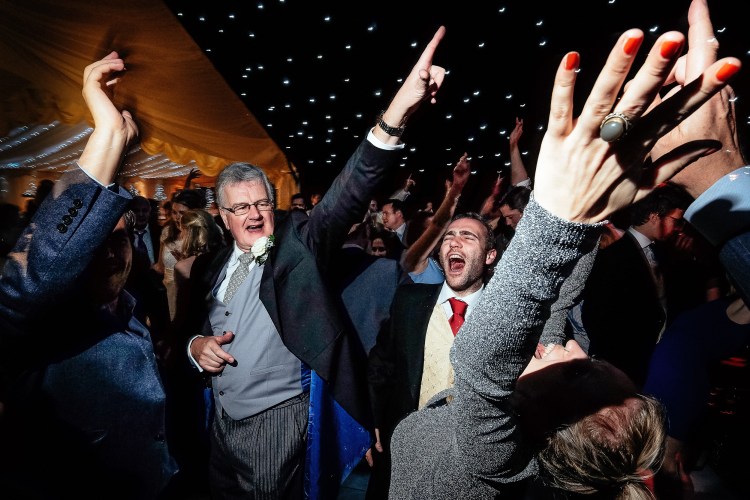
HOWEVER when it comes to the evening of a wedding and everyone is getting down on the dance floor that’s when I break out the flash!

By this stage of the day I figure everyone has relaxed and I can go for a more ‘night clubby’ look with the photos. Dance floors are a dark place, bands or DJs don’t often bring enough light to illuminate them so at this stage I often have to ADD light. But I still want to stay discreet, self contained and mobile. That’s why I choose to use the very tiny Fuji EF-X20 flash on a sync cord attached to my X-T1 (often with the 10-24mm).

Dance_Floor-1

FujiFlash-1

With this set up I can get into the middle of the dance floor action, shoot from any angle and no-one cares you’ve got a camera (even when it’s getting ‘messy’ at the end of the night). If I was shooting with ‘Off Camera Flash’ I’d be limited in the look I would get by where my light stands could go – this way I’m a portable studio. Holding the flash in my left hand (usually high above to the side) and the camera in my right but away from my eye. I ‘zone focus’ so the camera is set manually to focus from 4ft to infinity – at f/10 this is really easy and means that I don’t have to worry about AF in low light but just what’s happening in front of my lens.

Dance_Floor-2

Dance_Floor-3


These are my default setting for Epic Dance Floor shots: ISO 2000, F10, 1/15th, 14mm, get in close and dance your ass off while photographing.


Do you have any tips or tricks you could share with us?

The best thing I could say is to develop your own style and approach to how you photograph. When we start out we all see amazing photographs in a variety of styles and try to copy those in our work – it makes what we do look a little scattergun and inconsistent. Work out what you love photographing, what you are passionate about and a philosophy about how you should approach your photography and then do that. Then do that some more. Then do that better. Then refine it. Do it more. Do it better. Refine it. And on and on it goes.

Every time I pick up a camera I want to create better photographs than I did the last time – better photographs for me equals better photographs for my clients.

Wedding-4

Wedding-5

What’s next for you?

Put simply – see above. Doing more of what I’m doing but hopefully doing it better.

Contact info

To see more of Andrew’s beautiful photography, please visit his website and social channels:

Twitter – https://twitter.com/BillingtonPhoto

Facebook – https://www.facebook.com/Andrew-Billington-Photography-127502644273/

Instagram – https://www.instagram.com/billingtonphoto/

Website – http://documentary-wedding.com


X-A2 review by photojournalist, Brad Hobbs

Processed with VSCOcam with b5 preset
Knickerbocker Avenue, Brooklyn. NY

Guest blogger

bradAbout me

I was born in Margate, Kent on the south east coast of England on the 5th July 1990. I grew up about 40 minutes south of Margate in a small seaside town called Deal.

Growing up in the south east of England, there isn’t much to do unless you like being outside. Being a teenager, I wanted to either be in front of a TV sleeping the days away or out skateboarding. When I turned 13, my dad brought me my first camera and I took around with me everywhere. I mostly concentrated on the boats, beaches and surrounding farm land.

I moved to London in 2010, where I started working at a magazine as an intern for 3 months. Once my internship had ended I was quite lost as to what to do next. After networking around the city I fell into a PR job which kept me occupied for 3/4 years working with some big names in music, sports, movies & television. At some point I thought this would be a job for life but I slowly grew away from it and followed my dreams in photography and writing. Over the past 2 years, my life and career has had its ups and downs like most people, but things have recently really take a turn for the better with a few different ambitious projects.

So what do I think about the X-A2 for my style of photography?

When I first picked up this camera my instant thoughts were how lightweight and compact it is. Using the XC16-50MM kit lens it has fed me with everything I need.

With my style of photography I like to be as close to my subject as possible and to paint a scene of what’s happening around me. The Fujifilm X-A2 helps me capture those moments.

IMG_4194
Broadway, Brooklyn. NY

Once I started learning how to use the settings to their full capability, I found myself shooting at night, which was something I never used to do. The SR+ setting and High ISO settings really help capture what we as humans can see during the darker hours of the day, if not better than what we see. The end results from this camera are so good it is a shame to edit or tweak images.

IMG_1036
Doyers Street, Chinatown. NY

During my time thus far with this camera, I have begun to edit less and take more photos that I am proud of. With the 175º tilting screen, shooting buildings and streets at interesting angles has never been easier. The resolution of the screen makes you want to take more and more images.

This camera is like having a little lightweight best friend around your neck that is never going to disappoint. It maybe even teach you a few things along the way.

So far I have travelled to Glasgow, New York, London, Los Angeles and have never left the house without my camera. On all of these trips and locations the X-A2 makes me proud to be a photographer and proud to be using a Fuji camera.

DSCF8543

To follow Brad’s photographic adventure, please visit his social channels below:

http://www.huffingtonpost.com/brad-hobbs/

https://www.instagram.com/brad_hobbs/

https://twitter.com/brad_hobbs