mariiabezpala

From Banepa to Willich: a quiet exchange with lasting impact

The journey from Nepal to Germany is not a common one. It’s also not the kind of trip that makes headlines. No delegation, no ribbon-cutting, no press-conference. Just a nurse stepping off a long flight, carrying with her years of hands-on experience, a notebook filled with questions, and determination to bring change to her patients at home.

Sister Gayatri works at Scheer memorial Adventist Hospital in Banepa, Nepal – a modest institution with limited resources but an outsized mission: to raise the standard of care in a region where too many people still go without. This May, she arrived in Willich, Germany not as a visitor but as a collaborator. An experienced endoscopy nurse, she is taking part in a work-shadowing program, with a focus on knowledge transfer and training in endoscope reprocessing, damage prevention, and product use. Sister Gayatri is receiving a detailed introduction to our ELUXEO series, but just as importantly, she’s experiencing how teams work together, how systems are built, and how small improvements can lead to long-term impact.

She is here to observe. To learn. To ask why certain protocols exist, and how others could be adapted. In a workshop that repairs and reprocesses some of the most advanced endoscopic tools, she listens closely, takes notes, and asks questions that cut to the heart of daily practice. And the value of this exchange is mutual. Her perspective – shaped by years of practical improvisation in a resource-limited setting – brings invaluable insight to our processes.

In the language of healthcare, this kind of exchange is called ‘capacity building’. Alongside transferring technology or introducing new tools, this collaboration focuses on practical knowledge that helps hospitals build systems they can maintain and adapt to their realities. The most valuable lessons here are often the simplest: how to organize a workflow, or how to prevent damage to delicate instruments – the kind of experience-based learning that lays the groundwork for long-term progress.

‘It was a great experience to see the wide range of products Fujifilm has to offer. Endoscope reprocessing is a very important issue for us and has high priority. In Nepal, we are not yet able to meet the requirements as they currently exist in Germany, but we hope that other companies will eventually provide support in this area in the future to raise standards in our country,’ – Sister Gayatri.

Her visit is part of a broader collaboration focused on a simple but powerful mission: to share expertise to further improve the quality of medical care in places where resources are limited. As a total healthcare company, we are committed to address critical gaps in access to medical care for people across the globe, helping ensure that every patient, no matter where they are in the world, can be treated with the best care possible.

From small steps to major milestones

Our relationship with Scheer Memorial started quietly, in 2019, with a simple request – a replacement device. At that time, we sent it right away, also donating some devices that we knew were indispensable to provide a service to the local community.

A lot has happened since then. Thanks to Fujifilm’s support, the hospital now has two fully equipped endoscopy rooms – an extraordinary advance in a region where the population often has limited access to medical care. An impressive success is a colon cancer screening program now starting in the district of Ramechhap – one of the few in Nepal. It’s an ambitious step for a rural hospital, but also a hopeful one. This shows how technology and commitment can work together to improve the quality of life of an entire region. 

Shared values, big impact 

Our partnership with Scheer Memorial is not unique in mission, but it is personal in practice. It represents work that often happens behind the scenes, away from the spotlight: small, steady efforts that build over time.

Your support enables us to provide services in line with international standards and brings us closer to our goal of becoming a leading healthcare facility,’ – Scheer Memorial Adventist Hospital.

There is still a long way to go. But with visits like Sister Gayatri’s, and ongoing collaboration between our teams, we’re reminded that global health progress doesn’t always come in breakthroughs. Sometimes, it arrives in a suitcase. In a quiet question. And in a firm belief that the best change maker is knowledge – passed from one hand to another.

We look forward to further strengthening this partnership, making a long-term difference, and putting more smiles on faces around the world! 

‘A World in Color’: unveiling the hidden history with GFX 100II

We live in times when digital archives increasingly shape our understanding of history. Countless moments of the past exist now only in the form of photographs – fleeting, and in many cases, slowly fading with time. In January 2025, Magnum Photos, in collaboration with Fujifilm and the Médiathèque du Patrimoine et de la Photographie (MPP), launched ‘A World in Color – a groundbreaking and ambitious initiative to digitize the agency’s Paris color library archive.

Spanning over six decades, this archive remained largely out of sight, holding approximately 650,000 color slides from Magnum’s iconic collection, dating from the 1950s to the early 2000s. From post-war Europe to revolutionary movements across Latin America, our GFX cameras help digitise previously unseen images by some of the most renowned photographers of the 20th century, offering an unparalleled view of the world’s most defining moments.

How did it start?

Founded in 1947 by a group of visionary photographers, Magnum Photos is one of the most renowned and influential photo agencies in the world. They aimed not only to document the world but also to do so with an unfiltered, humanistic approach, revealing profound truths about society, culture, and politics.

Some time ago, Magnum realized they were sitting on hundreds of thousands of slides, most of which had never been seen. Fidel Castro rallying in the streets of Havana, or post-war Prague uprising against the Soviet invasion in 1968 – for decades, these unique images were locked away in the silence of archive boxes. And the challenge of preserving them for future generations grew more urgent, especially as the physical medium tends to degrade. So, that is where a major preservation project got born – to ensure that future generations could experience these moments in vivid detail.

Bridging the past and the future

A World in Color ‘ marks a new chapter for the long-term collaboration between Magnum and Fujifilm. It offers a rare glimpse into unseen images, as well as a newly commissioned, exclusive series by Magnum photographers, shot using the Fujifilm GFX camera. These color slides hold visual histories that no book or article can convey. And now, they are being brought back into the light.

For a project of this scale, preserving the integrity of the original images while ensuring their future accessibility is paramount. To ensure the highest quality reproduction, Magnum Photos chose the Fujifilm GFX100 II, a medium-format digital camera equipped with an innovative 102MP sensor and the latest image processing engine. It is designed to capture the smallest nuances of color and texture that are vital when digitizing aging slides. Delivering the highest burst-shooting, AF, and stabilization in the history of the GFX Series, it turns the images from relics of the past into living pieces of history that stand up to modern standards of photographic excellence.

Why it matters

Projects like ‘A World in Color’ speak directly to our mission: to innovate continuously while honoring the past, shaping the present, and safeguarding the future. We believe there is more to a photograph than just being a memory, it’s a document of truth and a gateway to understanding. It’s a bridge between generations and a way to preserve the fabric of our collective human experience.

With every frame brought back to life using our GFX technology, we’re amplifying the voices of incredible photographers and preserving unique visual stories so that they can continue to inspire, educate, and move us.

FUJIKINA 2025: a global dialogue

To highlight the project, a yearlong program of exhibitions and talks will take place across six European countries, with Fujifilm’s traveling FUJIKINA events. In each city, a curated exhibition – unique to that country – will unveil unseen photographs from the same region, tracing its history and culture during the 20th century, alongside the new series made in response to the archive. The featured Magnum photographers will be on-site too, sharing personal insights into their creative process during a live talk.

The tour had already had its first stop in Prague this March – with the first new series of images shot by Rafał Milach in response to the unseen Magnum color archives of Czechia. It sees him return to Upper Silesia — an area stretching from southern Poland into areas of Czechia — that he had documented twenty years ago.

Don’t miss the next FUJIKINA in your region:

Arles, the Netherlands

with Gregory Halpern
(keep an eye on the updates)

Learn more here.

The New Basic Colonoscopy Training Course | A Talk With Saskia Papa

This autumn witnessed the launch of our first, eagerly anticipated, standardised Basic Colonoscopy Training Course in the Growth Emerging Markets (GEM) region. It is  going to provide healthcare professionals across 16 countries with the same high quality learning experience, including special techniques and skills for painless colonoscopy.  

This intensive 2-day course, developed together with Prof. Mostafa Ibrahim, utilizes the innovative mikoto colon simulator, so participants receive hands-on training using one of the most advanced simulators available. But what makes this project especially impactful is the team behind it – a diverse group of experts from different countries, all driven by passion for elevating healthcare standards and patient well-being. We’ve talked to Saskia Papa, a Training and Education Manager in Fujifilm Healthcare Europe, for some personal insights.

What makes this training special?

– In the past, we did courses for physicians in different countries, but now it’s something so much bigger. Now, there is a consistent, standardized approach. The ultimate goal is to make high-quality training accessible and reliable across borders. Our medical advisor, Prof. Mostafa Ibrahim introduces the course in each country, involving a local expert to ensure that unique differences of each country are taken into account, and the course is adopted effectively. At the same time, the standard approach helps us ensure the same high quality of training for everyone.

Another thing that makes this course stand out is the mikoto colon simulator that is utilised. At the moment, I think it’s the most realistic training simulator for colonoscopy. And what’s important, it gives you instant feedback: if you’re hurting the “patient”, you’ll hear a “be-e-ep”, or an “ouch”. You can also watch the video back, as everything is recorded and you can see your own progress over time. With different difficulty levels, you can stepwise learn more difficult anatomies that patients may have… I believe it is a unique opportunity for self-learning.

What’s your personal goal behind the project?

– The most important goal for me is to ensure the access to this training course for every young endoscopist in these contries, who wants to improve their skills and learn more. I would like to support that and contribute to it as much as I can.

It is a very nice collaboration so far. People get really indulged with the training content, they learn things from the experts they didn’t know. There is immediately this positive atmosphere of getting people connected, and our local teams keep in touch with the participants. That is forming a community of people who share knowledge, support each other, and continually learn and grow together.

We strive to develop a community of skilled, passionate healthcare professionals in different countries who can be both supportive and inspired by each other’s experiences.”

What is planned for the future?

– What we do now is just the beginning. With time, we may expand the course to other countries as well. We are also looking forward to developing standardized courses for more advanced techniques.

What inspires you most in such projects?

– I remember we were with our EndoRunner van, and we had three working stations there. At one of the European congresses, a doctor came to try working at the mikoto station. She liked it so much! She spent the entire day with it. She said then: “I never had an opportunity before to practice with such a realistic simulator”. During that day, she was there non-stop, and you could see that she really improved her skills. In the beginning it was hard for her, after more attempts and working on it, she made progression. Also, recently, when we were at the ESGE camp in Zagreb, one of the trainers came to me and said: “I had here really beginners but even after 1 day, I could see that some of them have already improved.” It is very inspiring to get this kind of feedback. It drives me to do more.

Saskia Papa
A Training and Education Manager in Endoscopy team, Fujifilm Healthcare Europe.

Women4Inclusion: celebrating diversity with the new issue

What does it mean to be seen, heard, and understood? For many, this isn’t a given – it’s a fight. We believe in embracing the unique experiences that make each of us who we are. And the latest issue of our Women4Women magazine, brings this ethos to life.

This edition, Women4Inclusion, is truly special. Bigger than ever, it gathers voices of our employees and external contributors from all across the globe telling their journeys towards diversity, equity, and inclusion. These voices, from different cultures, backgrounds, and industries, unite in a common belief that true strength lies in the unique selves, each having a seat at the table. Their stories are raw and unapologetic. Each brings something deeply personal and transformative, showing what it means to live and breathe diversity.

You’ll meet people whose lives and work break down societal biases, those finding strength in their community, or those who had to hard-earn self-acceptance confronting prejudice and discrimination. They all remind us that identity is not something to be hidden or explained but something to be embraced fully.

“Diversity, Equity, and Inclusion are not themes, but calls to action for each of us. The stories we find in this magazine release an incredible positive force, and it is this force that we must express to aspire to a better society,”

Yoshiki Kimura, President & Managing Director at Fujifilm Europe.

“By shedding light on the stories of real people, exploring their experiences, and examining the effects of diverse and inclusive practices, we aim to inspire our readers, calling them to action. Within the pages of our Women4Inclusion, we will delve into various aspects of culture, habits, perspectives and actions that are key to achieving a more diverse and inclusive society. We firmly believe that sharing these narratives will challenge preconceptions, stimulate authentic conversations and ultimately pave the way for positive change at Fujifilm,”

Luana Porfido, European Head of Corporate Communication & ESG Management, Fujifilm Europe GmbH.

Also, we are proud to feature photos of our X-Photographers — Valentina Tamborra (Italy), Dorota Kaszuba (Poland), Ewa Meissner (Poland), Karolina Jonderko (Poland), Silvia Pogoda (Poland) — as well as works of a talented photographer from the UK, Amin Islam McDonald. Their photos capture raw emotion of people on the margins with a striking honesty and frame diversity in its most authentic form, each bringing their unique style.

We invite you to take a moment, read these stories, and let them inspire you to look beyond the familiar, to recognize and value the full spectrum of human differences, and more than that — to join us fostering a culture of belonging where people from all backgrounds feel welcomed and valued. Inclusion doesn’t just happen because diverse individuals are present. It happens when people feel they are truly part of the team — and this is an ongoing journey we are all part of.

Beyond the action: GF500mmF5.6 x Federico Tardito

When we think of iconic moments in sports, what often comes to mind are grand victories and high-stakes moments. But it’s also the subtle, fleeting instances of raw emotion and personal significance that can make a photograph truly unforgettable. For instance, when Oleksandr Usyk took over Tyson Fury in the epic fight for the title of the absolute champion in heavy weight, all eyes were on Fury’s face changing in disbelief – as well as all faces from the front row. Would it be possible to capture that blink-and-you-miss-it expression without today’s high-speed gear? Obviously, not. Neither would have we seen in detail Cristiano Ronaldo’s tears after his penalty miss at Euro 2024, or Yaroslava Mahuchikh crying in a jump after setting a new world record in Paris.

These moments exemplify the power of high-end sports photography equipment. Today, with the introduction of the GF500mmF5.6 lens, a new chapter in sports and action photography is being written.

An Italian sports photographer, Federico Tardito, has tried what’s possible with the large format GFX100 II camera combined with a 500mm focal length of GF500mmF5.6 lens in his recent project. For this test-drive, he chose one of the most challenging and complex team sports to try the autofocus – American football. Armed with the new lens and the GFX100 II, he contacted the Torino Giaguaro team, which plays in the top Italian American football league.

“Unlike football – which is the discipline I usually work with – the players are much closer together and the movements are much less orderly and predictable, not to mention the fact that there are many players moving in front of the subject, which makes tracking the camera and lens anything but easy. (…) After attending a couple of their training sessions to thoroughly understand the movements, and the players and game dynamics, I found myself shooting my first sports competition with a large format. This was finally possible thanks to the GF500mmF5.6.”

The GF500mmF5.6 is the longest telephoto prime among all GF lenses. Despite the very long focal length, it remains extremely lightweight, especially when compared to other 400mm lenses in 35mm format. This makes the lens very easy to handle during the game. Above that, it has a reliable weather sealing, which is a must-have when working outdoors.

“I often work at the maximum aperture to isolate the subjects better, and the performance at maximum aperture of the new lens thrilled me from the first use: the blur effect is truly pleasant and allows for perfect isolation of the subject from the background and scene distractions.”

Despite its small size and light weight, there’s absolutely no compromise about image quality. The GF500mmF5.6 offers one of the best resolution in the line-up. It is also equipped with a powerful 6.0 stops image stabilization system and a high-speed AF drive system with linear motors, which enables comfortable handheld shooting with minimum camera shake and overturns the conventional wisdom of large-format.

“The best part comes during editing. The files from the GFX100 II, paired with the GF500mmF5.6, are truly stunning. The latitude of exposure is incredible and allows for recovering highlights or shadows that are too closed even using only JPEG. The detail is remarkable, and so is the sharpness. The 102MP of the camera allows for an almost infinite freedom of cropping, and different versions of the same frame can be obtained simply by cropping the image differently, which becomes an additional very useful resource during work delivery.

“I chose to work with the Eterna Cinema film simulation. This way, I could take advantage of all the speed of JPEG while maintaining a file rich in detail and extremely workable.”

Find more to the story here.

Federico Tardito

A professional sportrs and portrait photographer, founder of One+Nine Images. Works as a personal photographer for soccer players Leonardo Bonucci and Gigi Buffon. Collaborated with renowned agencies like LaPresse, Insidefoto, as well as famous brands like Nike and Adidas. His photos are published in various international magazines and newspapers, such as Vanity Fair, Vogue, Panorama, The Globe, Sportweek, etc.

Understanding the big picture: Wako Chemicals at DGHM 2024

What is the first thing you imagine when thinking about climate change? Usually, our mind jumps to the dramatic images – melting glaciers, rising sea levels, and extreme weather events. It’s all true. These are the visible, large-scale effects that grab our attention. However, there’s also another side to this story, one that’s equally important yet often overlooked: the impact on the microscopic world of microorganisms, including bacteria, viruses, fungi, so the unseen majority. They are everywhere – in the air, soil, water, and even inside our bodies. Thus, such global changes as climate change, shifting ecosystems, or the rise of drug-resistant pathogens have profound impact on microbiology and infection biology.

By recognizing and addressing these effects, we can better protect our health. And the 7th Joint Microbiology & Infection Conference of the German Society for Hygiene and Microbiology (DGHM) and the Association for General and Applied Microbiology (VAAM) offered a unique platform for this. From June 2nd to 5th, our Fujifilm Wako Chemicals Europe team met with internationally renowned speakers and young scientists in Würzburg to exchange information on current developments in diagnostics and clinical practice in microbiology.

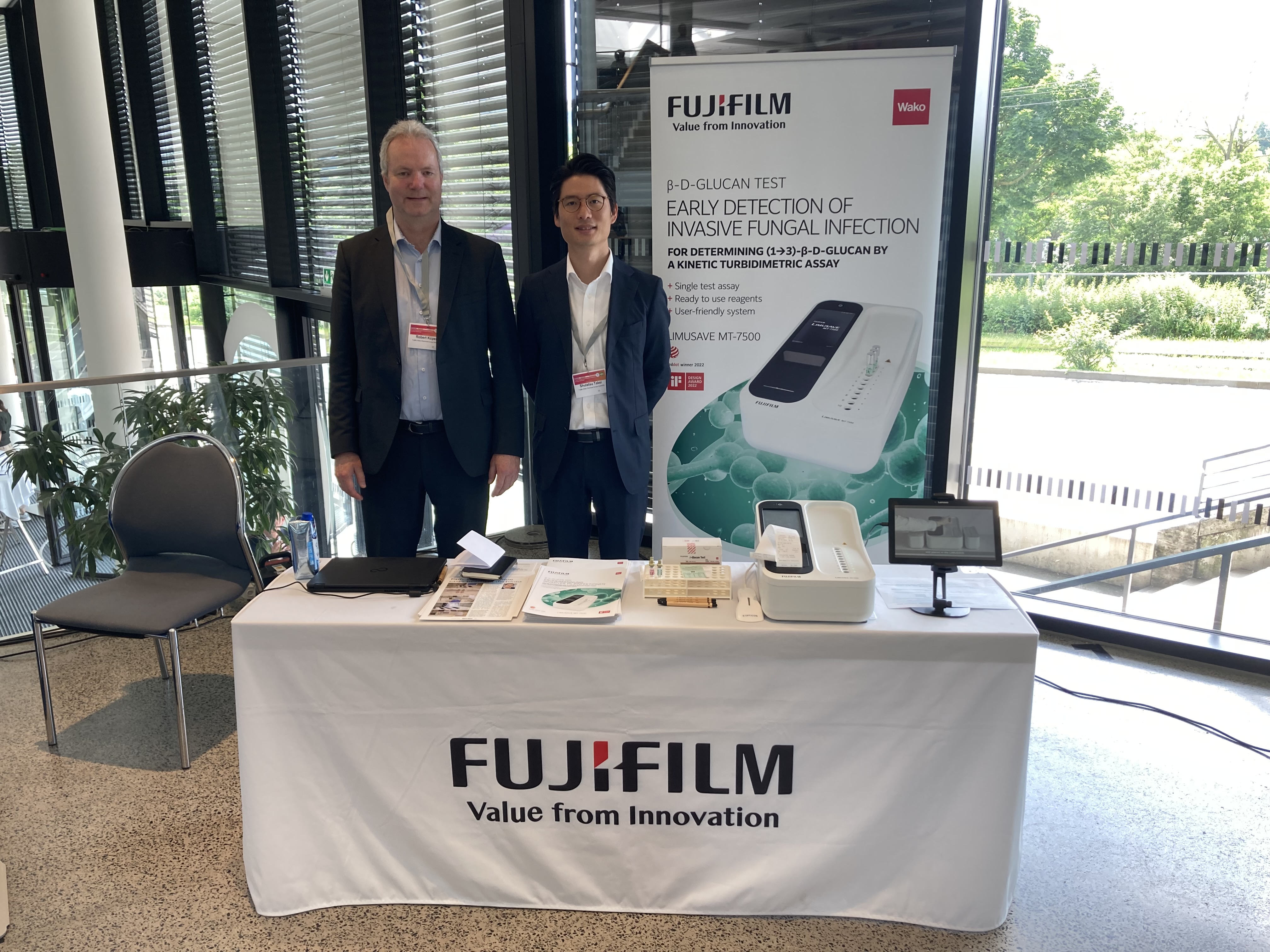
This year, we were excited to showcase our innovative invasive fungal infection diagnostic system LIMUSAVE MT-7500. It is a state-of-the-art system for measuring the pan-fungal biomarker beta-D-Glucan. This device has 10 measuring stations and can be expanded to 30. This means it can flexibly handle a low to high volume of tests simultaneously. More to that, LIMUSAVE MT-7500 measures the analyte quantitatively by a single test procedure, allowing for immediate and simple on-site testing by labs at medical centers.

Find out more about the LIMUSAVE MT-7500 here.