Guest Blogger

Let me tell you a ‘Toy’ Story

X-Photographer strip BLACK

chrisupton-168pxBy Chris Upton

I think it’s fair to say that we are all guilty of not using all of the features on our cameras. We prefer to stick to what we know or what we think we need. One of those features that I had dismissed as a bit gimmicky was the Advanced Filters. Sure I had looked at them and fired off a few shots but they weren’t for me, I preferred to produce my creative images in Lightroom or Photoshop.

However that was all to change on my recent trip to Lisbon.

Now I wouldn’t quite describe Lisbon as beautiful, it’s certainly not a Venice, Paris or Prague. But it is definitely characterful. Very hilly, lots of little streets and alleyways, buildings that have seen better days contrasting with some stunning architecture, oh and of course there are the trams. These trams have been part of Lisbon’s travel network for almost 150 years and are one of the city’s major tourist attractions.

As a travel photographer there are always the iconic images that are on my shoot list but I also try to look a little further to see how I can put my own interpretation into a place. On this trip the light was pretty harsh and the sky plain blue and so my attention turned to wandering the streets early in the morning looking for some detail shots, little cameos that communicated a feel about the place. When I’m in this creative mode I often shoot square. It’s a format that I love and one that lends itself really well to the more creative approach.

So having switched my camera to shoot RAW & JPEG and selected the 1:1 format, which helps me compose in camera, I took a few images. I was fairly pleased with the results and I knew how I might develop them in post processing but then it occurred to me that I might try the Advanced Filters just to see the effect.

Now if you’re not too familiar these modes are presets which automatically apply a certain feel to the image and include Miniature, Pop Colour, High Key, Low key, Dynamic Tone, Soft Focus and a series of Partial colour filters.

However the first in the menu is Toy Camera and switching to this I took a few shots, looked at the screen and smiled. The combination of the scene in front of me and the effect of the filter, slight underexposure, a warm tone and dark vignette together with the square format just seemed to work perfectly together.

Well that was it, I tried a few more, and loving the effect I shot many more images this way. I also tried some of the other filters and quite liked those too but my preference was for the Toy effect and I came back with enough images to create a little Blurb book. A perfect outcome and something a little different to what I had originally envisaged from the trip.

So I would urge you to open your mind to the creative opportunities that our Fujifilm cameras offer us, you might just be pleasantly surprised.

Toy Camera mode – “loving the effect I shot many more images this way”


India – The Good, The Great and The Downright Scary – Part 1

Jaipuri, India.
Jaipuri, India.

By Tom Corban

It spread through the air like static electricity, conducting from one person to another. Fear truly is contagious.

Everyone was running away from the rather skinny looking snake. Skinny or not, the guides and camel tenders were visibly frightened. You could feel the fear in the air.

We had just spent our first night in the Thar desert close to the border with Pakistan, sleeping on the sand dunes with four other travelers we had met the night before. The blankets we had been sleeping on had been piled up ready to be put on the camels. It was then that the snake was spotted.

Three Camels at dusk in the Thar Desert, Jaisalmer District, India. The desert, also known as The Great Indian Desert is the worlds 17th largest Desert. It was here where we had the encounter with the snake.

Armed with sticks, shovels and an axe, the camel tenders returned. One of them went forward and nervously lifted the corner of the top blanket. No snake. He lifted it higher, then pulled it off the pile as he quickly backed away. The others moved in with clubs and axes ready to pounce. Still no snake. They retreated again. This process was repeated four times before the snake was found. Each man swung his stick or axe clubbing the ground wildly before running away, looking back to see if the snake was chasing them. The snake however had disappeared into the sand. We asked Mulla (our guide) how dangerous it was. “It’s a Lundi snake, very dangerous, very poisonous” he said.  The men, armed with shovels, moved in. I thought they were just going to chase it away but the process of digging, hitting and running away continued until the snake eventually received a blow from a stick and a man with an axe moved in to finish it off.

When we got back, we looked up “Lundi snake”. Lundi is the Urdu name for a sub species of Saw Scaled Viper. It is described as a very fast moving snake that strikes quickly & repeatedly, with reports of it chasing its victims relentlessly, and in India alone, it is responsible for an estimated 5,000 human fatalities a year.

Once the snake was no longer a threat, the camels were saddled up and our companions from last night started on their way back to Jaisalmer.

A monk sits on the steps at a Jain Temple in Jaisalmer, India. The temple, which was constructed in the 12 century, is built of yellow sandstone and is famous for its intricate stonework.

Jo, I and Mulla set off in the opposite direction, further into the desert. There are many things one can do on a camel but being comfortable is not one of them, well not at first anyway. It also seems a slow way of traveling but before you know it you have covered a considerable distance and things that were on the horizon are now beside you. It’s a bit like traveling by canal boat in Britain but with more pain and less tea. It was scorching by the time we stopped for lunch and took shelter from the sun as it was far too hot to move when the sun is at its height. Even at 5pm when we stopped at an oasis to water the camels, it was still 42.9 C degrees in the shade. We finally stopped for the night on a small group of sand dunes. As Mulla made us tea, we watched 8 Desert Eagles circle in the thermals above us. Eventually they lost height and settled in a tree from where they kept us company till the morning. We spread the camel blankets out on the dune and looked at the stars till we fell asleep. Even though we woke many times during the night, each time the night sky was stunning.

The next morning Mulla said that there had been a lot of Lundi snake activity during the night and there were snake tracks around the camels. He said that he was relieved that the camels had not been bitten as it would have killed them. We showed him some tracks where something had come up the dune to where we had been sleeping and passed just over a metre away from where my head had been. “That Lundi snake” he said. “A big one”. “But we were sleeping there!“ we exclaimed. “You very lucky” he said.


We were very lucky a lot on this trip. We had started off in Delhi before going to Varanasi, Agra and then Ranthambore National Park near Jaipur. We were told that you should book at least 6 safaris to stand a good chance of seeing a tiger. We booked 6. We saw 8 different tigers including a mother and her two 9 month old cubs.

A tiger emerging from the grass at Ranthambore National Park, Sawai Madhopur, India. The reserve was the private hunting reserve of the Jaipur Royal Family until 1955. The reserve is thought to have 43 adult tigers and 14 cubs although it is difficult to be certain as it is an "open" reserve which forms part of a larger "tiger corridor" in the region.
A tiger emerging from the grass at Ranthambore National Park, Sawai Madhopur, India. The reserve was the private hunting reserve of the Jaipur Royal Family until 1955. The reserve is thought to have 43 adult tigers and 14 cubs although it is difficult to be certain as it is an “open” reserve which forms part of a larger “tiger corridor” in the region.

We met funny and generous people who went out of their way to look after us and show us around. We were accepted into an Indian family to experience the Holi festival with them in Jaipur.

A child covered in coloured dye during Holi Festival, Jaipuri, Rajastan, India. Holi is a Hindu festival celebrating the beginning of spring. Bonfires are lit the night before Holi and offerings made to ensure a good harvest. The main Holi festival takes place the following day when people throw coloured dye on each other. It is often celebrated privately within family groups but in the streets anyone is fair game. Holi provides an opportunity to disregard social norms and young men have been known to act disrespectfully as the day goes on. Advice is given for single women to avoid going out alone and for tourists to be off the streets by early afternoon.

We then went on to Spiti valley where we met the Lama of the Kee Monastry who showed us around, unlocking rooms and ushering us in as he went. In one room there was a metal encased Stupa about 10 ft high,decorated with emeralds and other precious stones containing ashes of the 6th to the 13th Dali Lamas. Afterwards he took us into his private room and gave us tea and cake before giving us his blessing and waving us off.

Kee Monastery (also spelled Ki and Key), Spiti Valley, Himachal Pradesh, India. The Buddhist monastery, believed to be a 1000 years old, sits on a hilltop at an altitude of 4,166 meters. It has a collection of ancient scrolls and murals and is the biggest monastery in the Valley.

On previous trips through Nepal, Vietnam and Cambodia I had taken my Canon kit. It had worked well but it was heavy and took up a lot of room. On the Nepal trip for instance, we had hired an extra porter as we were going into the Annapurna Sanctuary. It’s a long walk if you are carrying heavy gear and are not used to the altitude.

Spiti Valley, Himachal Pradesh, India. Buddhist prayer flags at Dhakar Monastery with the floor of the Spiti valley in the background.

This time I wanted to travel lighter so I took the Fuji kit. This consisted of an X-T1 and three lenses. The XF 10-24 f4 lens, the XF 16-55 F2.8 and the XF 50- 140 f2.8. I also took a XF 1.4 Teleconverter and a Nissin i40 flash.

Spiti Valley, Himachal Pradesh, India. Farming in the Spiti valley near Kee (also spelled Ki and Key), The Valley is a high altitude cold desert. It is very remote and covered in snow for much of the year. Although this photograph shows tractors they were the only ones we saw in the valley where, because of the steep slopes, the type of cultivation is terraced and tractors are of little use.

In practice this meant that I could carry the complete kit with ease in a waist pack. It was a bit of a tight fit when everything was in it, but when I was using the camera it was easy to change lenses or get the flash out. I found it much easier to manage the Fuji kit than it was to manage the Canon 5Dmk 3 with its lenses, where I needed a much bigger camera rucksack. Although the Fuji lenses I was using are not much smaller than the Canon Lenses, the X-T1 is significantly smaller than the Canon full frame. This meant that everything fitted into the waist bag even the lens hoods! The lens hoods may not sound like a big deal, but to me they are. Previously I had tried everything I could think of to accommodate lens hoods for my Canon lenses, ending up with collapsible rubber ones that I would keep in the top part of my camera rucksack and put on when I was using a particular lens. It was less than ideal. Changing lenses would usually require taking the rucksack off, opening the bottom compartment to change the lens and then opening the top compartment to get the lens hood.

Shimla, Himachal Pradesh, India. Housing on the hillside around Shimla. The town, built on seven hills, was the summer capital of British India, becoming the capital of Himachal Pradesh after independence.

With the X-T1 body and the Fuji lenses with the lens hoods fitted, all within the belt pack, changing lenses became much easier. It was certainly a lot safer when changing lenses in crowded environments where there were warnings of pickpockets operating.

The other thing that is worth mentioning is that although in practice there was not much difference in size and weight of the Fuji lenses compared to the Canon ones, the Fuji ones have an aperture of f2.8 as opposed to the f4 on my Canon lenses. As a travel kit, I found it worked wonderfully. I had a good range of focal lengths and a comparatively wide aperture when I needed it.

Kalpa, Himachal Pradesh, India. Tribal women in traditional dress in Kalpa village. The Indian government has given 'Tribal Status" to the area in order to give special focus on the social and economical development of most deprived class of society i.e Scheduled Tribes. The region is very remote with no air, rail or waterway links. Roads which can often be closed by snow, swept away by floods or closed by landslips, are the only means of communication.
Kalpa, Himachal Pradesh, India. Tribal women in traditional dress in Kalpa village. The Indian government has given ‘Tribal Status” to the area in order to give special focus on the social and economical development of most deprived class of society i.e Scheduled Tribes. The region is very remote with no air, rail or waterway links. Roads which can often be closed by snow, swept away by floods or closed by landslips, are the only means of communication.

Part 2 of Tom Corban’s adventure through India can be found here. 

And if you’d like to read more from Tom check out:  To Glastonbury and beyond featured here at fujifilm-blog.com.

See more of Tom’s work at http://www.tomcorban.co.uk/


Testing the Fujifilm X-T1

Guest Blogger strip BLACK

By David Anderson

Maybe I’m an old dog, but the must choose sides thing in the DSLR vs. mirrorless debate, in my cantankerous opinion, is pointless, manifestly boring and would only be cool if you gave me popcorn and the opposing sides guns.

I like DSLR’s and think they’re pretty highly evolved now and do what they’re supposed to do without much fuss or fanfare. I’ve been working with them since they were the new thing and being unfavorably compared to film cameras.

That said, a lot of what I see happening in the new world of mirrorless and Fujifilm in particular, is getting hard to ignore and I’m intrigued by the possibilities of both lighter weight and the electronic viewfinders.

So, has the mirrorless come of age?

Really, having never touched one, the best way to find out is to try one and after a little shameless begging for a camera to review for my blog, Leigh Diprose of Fujifilm Australia hooked me up with a Fujifilm X-T1 and lenses for a four-week test.

Fujifilm, with the X series, may seem relatively new to all you hipster kids from the internet land, but a lot of us old codgers know the name well thanks to some brilliant film cameras of the past like the mighty medium format 6×9 range finders, 6×8 studio cameras and the epic, wish I never sold it, X-pan that Fujifilm made for Hasselblad in the 90’s.

I’ve also pounded thousands of rolls of Fujifilm through various 35mm SLR’s and medium formats with ASTIA being a favorite for magazine portrait work, VELVIA for landscapes and the at the time revolutionary 800 ISO NPZ colour neg for anything low light that still needed nice colour.

Out of the box, and after a few tentative test frames the X-T1 is already living up to that heritage.
Initial photos have great colour and sharpness, and I’m well on my way to being smitten all over again.

Fly-Rod-2

Viewfinder

The best thing about mirrorless, in my opinion, is the electronic viewfinder and this is where mirrorless systems and the X-T1 in particular really set themselves apart from a DSLR. It’s so vast looking in there, I found myself looking around as much as through and after a little customization in the menu’s I had everything set-up and singing.

Yes, it takes a minute to get used to the electronic view after a lifetime and millions of photos through an optical finder, but I can already imagine that this is the way all cameras will be heading given all the amazing possibilities of the technology.

There are two things that really stand out with the vast viewfinder of the X-T1. The first is seeing your exposure, as set, before pressing the button. In manual shooting, this is a revolution compared to the old exposure scale in an optical finder and FAR more accurate. I also found myself doing far less chimping once I got confident that what I saw WAS what I would end up recording. This was doubly so when I was shooting in black and white mode where the viewfinder reflected this.

Having the actual picture flash up in the finder after taking the shot took longer to get used to, and initially I turned the mode off a couple times out of frustration, but by the end of my test I became a real fan of the feature and found myself shooting less and chimping much less to get the same results.

Small-Stream-2

The second stand out is manual focus.

Generally, I always shoot landscape stuff off a tripod, in manual focus and have been using Live View to get the proper depth of field I need to cover front to back sharpness. This works very well on a DSLR, but is slow, because it means I need my glasses on to see the rear screen and off to compose through the viewfinder. Tedious.

On the X-T1, I set-up the viewfinder to give me the smaller magnified side box with focus peaking in red and found it a very fast and very accurate way to get proper focus without bothering with the glasses or rear screen.

As a bonus, once the diopter was calibrated for my vision (or lack thereof) I could also check the accuracy of my focus on the finished shot through the viewfinder without touching my glasses.
This is a really cool feature in hard sunlight where the screen can be hard to see.

Handling

While all the touchy feely stuff on the X-T1 is spot on, the retro vibe a great fashion statement, the camera is actually a very ergonomically sound and thoroughly modern piece of gear.

I found the control layout, after a little familiarisation time, very efficient and perfect for the way I normally shoot in full manual mode as there is no need to drop the camera or dig into menus or look at a dial setting to know where I was.

After walking around Melbourne and shooting random street stuff with my family I can also see why the wedding shooters seem so happy with the Fujifilm stuff because it’s almost invisible. I’m a fairly big guy and when I work with a couple DSLR’s hanging off me and a vest full of lenses it’s hard to hide the fact that I’m taking pictures and sometimes felt very intrusive, but with the Fujifilm X-T1 I felt unnoticed and it’s obviously a better set-up for getting candid pictures.

Street-photography

With apologies to my brain, I did the math on weight and found that a Fujifilm system that closely as possible matched my Nikon kit weighed in at around half or maybe a bit more if I included the number of spare batteries to match up numbers of shots out in the field. Obviously, the weight’s not a big issue in a studio, but out in the mountains on the river or trail, it’s a huge advantage.

Lenses

Fujifilm Australia also sent me three lenses to try on the X-T1, the XF16-55mmF2.8 R LM WR, XF35mmF2 R WR and XF56mmF1.2 R.

The zoom I found the most surprising as I don’t often use zooms, preferring the predictable image quality and light weight of a prime. I did find the XF16-55mmF2.8 R LM WR a very, very sharp lens with exceptional image quality in the extreme corners of the frame – by the time, it was stopped down a bit. The XF16-55mm lens was heavier when compared to the two primes, however saying that it is still MUCH smaller and lighter than it’s Nikon or Canon counterparts.

I can see this lens when matched with the XF50-140mmF2.8 R LM OIS WR being the great value and a great set-up for traveling.

The XF35mmF2 R WR had amazing and hard to believe image quality given how tiny it is. Despite looking almost like a toy, it feels very solid in the hand and focuses silently and quickly. Though not a tree shooter as such, I did a lot of walk around stuff with this lens and it’s extremely discrete when coupled with the X-T1.

My favourite though is the XF56mmF1.2 R lens. As a long time portrait photographer, I’m a real fan of this focal length because it keeps you near enough to the subject to interact but is still long enough to get some isolation. At sub F2 settings, this lens will challenge anyone who thinks that great bokeh is solely for the full frame club as it renders incredible out of focus areas.

Ed0316-A

In sharpness and detail I felt it out resolves images I shot on my Canon 1Ds MKIII with the legendary EF85mm f1.2 L lens thanks to the X-T1’s lack of an AA (Anti Aliasing) filter. At the other end of the aperture spectrum, the 56mm was awesome for landscape shots captured at F8 through to F11 where it’s possible to get razor sharp images corner-to-corner and front to back.

All three lenses felt very solid, well made with fast, accurate autofocus and great handling and it’s worth mentioning that, from what I can see, Fujifilm has the best range of dedicated APS-C sensor lenses available with few options missing when compared to the full frame systems.

The Sensor

Resolution is a double-edged sword. On the one hand, it can give you incredible detail in your shots with room to crop and the ability to print big at will, but with the other hand, it can slap you back to the stone ages if you don’t dot your I’s and cross your t’s with perfect technique.

The 16 Megapixel APS-C sized sensor in the X-T1 is probably a good compromise for most enthusiast shooters in that it has enough grunt to print a well-shot image large and would easily handle any screen requirements.

It doesn’t surprise me, given Fujifilm made some of the best films ever, that the colour of the X-Trans CMOS sensor is first rate. With the various film simulation modes, I got excellent Jpegs straight from the camera with ‘VELVIA’ being the favourite for landscape and fishing stuff and the black and white mode for portraits.


It’s also a sensor that punched above its weight in terms of detail in my testing and I would put it in the same class as a Canon 21//22 Megapixel full frame if matched lens for lens. That said, I think what I read about the X-Pro2’s 24MP sensor would be better again and more like what I’m used to seeing from my Nikon D810.

Ed0316-B

Conclusion

However it might compare to a DSLR, another mirrorless or anything else, the Fujifilm X-T1 is an absolute joy to use and I didn’t put it down for 4 weeks.

Is the camera better or worse than anything else – yes, no or whatever, it doesn’t matter, because in function, feel and image quality the little Fujifilm is awesome and you couldn’t punch the smile off my face when I had it around my neck. Well done Fujifilm!


About the Author:

David is a grumpy, semi-retired old music and magazine photographer with poor hearing, little hair and too many kids that would rather fly fish than do anything else. His work has been featured widely in most mainstream Australian magazines and many more from around the world. You can follow David on Instagram, Facebook and read more articles on his blog.

My goal? To never use RAW processing again.

By Camille McMillan

I used to love the magic of the dark room, the processing of the film, the image appearing on the paper in the chemistry.  I have never found that magic with Capture One or any form of RAW processing.

Transparency film that was always a magic experience, dropping the film at the lab and wait the hour ( back in the day ) and there would be the magic object in your hand.

I cut my teeth on E6 ( Tranny ). E6 taught me how to expose and the importance of understanding what a 3rd of a stop can do to an image.

Using my old school knowledge, I now put it to work by getting the final image straight out of camera (SOOC) with my Fujifilm digital system.

_DSF3462

There is a walk near my house which is a 3 hour loop that I intend to walk regularly. I’m intending to revisit the same locations as the seasons change. This particular walk is a kind of recce… once I have walked it a few times I will know the places I wish revisit again and again.


“This day in March was not a dynamic day in terms of light… it was overcast, fog and cloud coming in, the smell on impending snow and that blank white-box sky”


For the walk I explored the B&W + R film simulation mode as I didn’t want colours distracting from the shapes & forms.

I set the camera to sharp +1, highlight +2, shadow +2 and on the compensation dial -1/3rd; an old E6 habit that still holds true with jpegs and my approach to photography.

Maybe I’m lazy, perhaps impatient… but my spot metering days are long gone with my old Leica, I now shoot with a Matrix exposure instead.

Using a 3rd of a stop pull with the compensation dial is normally enough to hit the ‘correct’ exposure, but the 3rd of a stop bracket makes for 3 very different ‘moods’ of image

This means the image on the left is actually the cameras “correct” exposure. I’m bracketing everything under the ‘correct ‘ exposure….

For me, none of the images are wrong in terms of exposure, it’s all subjective and each has a very different mood and feel.

Left – The cameras ‘correct’ exposure feels very ethereal in the mist, probably a more commercial image than the other two, but the image is not as strong in terms of forms.

Middle – My ‘correct’ exposure is good with the foreground detail, plenty of details in the shadow.. but I’m leaning towards the one on the right

Right – This image is full of shadow, details in the trees are being lost… there is however more texture in the middle greys, the middle distance. The tree trunks in the middle ground bring out the vertical lines.


“Image right is the finished image… no processing required.”


This was my approach with the entire walk – looking for textures, strong lines, old roads and man made marks in nature.

_DSF3568

Most of my work now is in 1:1 or 16:9. The square goes way back to Bronica and Hasselblad days, the 16:9 has only been a year or so, I’m still training my eye to see in that view ratio.

I love the freedom of going between the two formats.  As we all know, the X100T is fixed focal length, but with the use of 1:1 and 16:9 I am in effect using two focal length lens ( kind of ).

Because of the crop, the square is giving me a kind of 50mm feel ( if not focal distance, that’s what my feet are for, moving back and forth )

The 16:9 feels wider than 35mm and has that very cinematic feel to it.

Somehow the two aspect ratios work better together as a body of work than squares and 3 :2 ( traditional 35mm )

I did the walk one week later using colour, and in that walk I used ISO bracketing instead …. but that’s a whole other blog..

_DSF3847
Classic Chrome, -1/3 of a stop, sharp +1 highlight +2 shadow +2

Stretch yourself – by Paul Sanders

3

by Paul Sanders

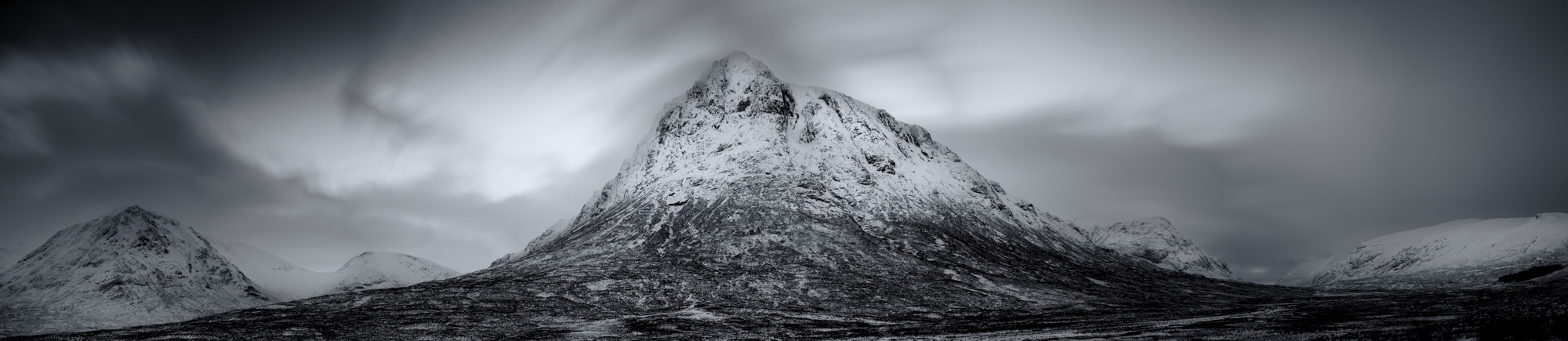
paul sanders mugshotThere are many times that using a wide angle or telephoto lens just won’t get the results you want. They’re either too wide or too tight but you know in your heart that your viewpoint is correct.

It’s frustrating and causes many photographers to give up and go home without a shot they’re happy with. However you should persevere and with the introduction of photo-stitching software built into Lightroom and Photoshop you should try the third option which is to shoot a stitched panorama.

By stitching together individual images you can render your scene in greater detail and make extremely large prints without the image breaking up.

For those who want a bit of background early examples of a panorama include the Bayeux Tapestry, at nearly 70 meters in length it’ll take some stitching to get a photograph that will rival that!

I’ve shot panoramas for a number of years and find the discipline fascinating. The normal guidelines of composition do apply, but they also don’t – you have much more area for the viewer to explore, more details being captured and there can be cameo roles for people in the different areas of the image. These all come together to create a story or feeling that literally absorbs the viewer – well that’s the idea anyway!

To shoot your very own panoramic image:

Firstly, if you can – use a tripod

It’ll make stitching the images together far more straightforward. Make sure your tripod is level too – most come with a spirit level but luckily most of the Fuji X series have horizon levels built in. If you press the display/back button on the back of the camera a few times this normally brings it up on screen if it has one. To check that the camera and tripod are level, gently pan the camera from left to right and check the display to see if the level line is straight throughout the motion. When attaching the camera to the tripod – set it so that you are shooting a series of upright images (portrait orientation). You’d be forgiven for thinking that you should shoot three or four landscape images – although you can if you wish, but you will end up with a very strip like image. I have found the upright method to be far more rewarding.

Untitled

Your focal length is generally a little longer than when shooting conventional landscape images.

For example, I recently shot a panorama in Paris using the XF50-140mm, to get the same result normally I’d have needed to use a XF10-24, but the detail in the bridge and the compression of perspective would have been lost.

In a perfect world you would use a panoramic tripod head and set the nodal point of the lens.

Basically this means the middle of the lens sits over the middle of the tripod – but with good stitching software you can get away without it being set, if you’re careful. The reason for this is that if you have the nodal point set correctly the perspective doesn’t alter as you rotate the camera, but when the lens is off-centre perspective from the lens to the subject distorts ever-so slightly.

Once you have chosen your composition and have panned the camera backwards and forwards a few times to check your image works, you must set your focus and exposure. Once set, do not alter them, otherwise you get very awkward tonal changes between the different images. The same applies to graduated filters – although you can adjust them slightly.

Finally you are ready to shoot!

Start on the left-hand side of your shot and take your first picture. Then turn the camera using a panning motion through about 15 degrees, or using the framing grid on the screen – move it round by 1/3 of the frame – this will give you enough overlap to avoid the distortion caused by turning your camera. Repeat this shooting process until you have completed your full composition.

4

Once have finished your series – shoot a blank frame so you know where the start and finish is.
You may need to fine tune your shot so always check the image on the back of the camera to make sure you’ve got every aspect of the shot you need.

When you get home the process is very simple.

Load your images into Adobe Lightroom – highlight the pictures that make up your panorama – take your cursor across the top menu bar to the heading ‘Photo’ then scroll down to ‘Photomerge’ and select ‘Panorama’. Lightroom will show you a rough render of the image then simply press OK and a few seconds later you’ll get the stunning panorama you planned.

Occasionally Lightroom doesn’t quite do the job, so if that happens – open the images in Photoshop, use your cursor to navigate through File – Automate – Photomerge – Panorama – the same process will happen only this time you will have a layered Photoshop document to work with.

It will take a little practice to create the perfect image but it’s great fun to try. For more inspiration look at the work of Horst Hamann or Nick Meers

X-Photographer Chris Upton talks X-E2S

BY CHRIS UPTON

Amid all the deserved hype around the launch of the Fujifilm X-Pro2 it was easy to miss the upgrade to the Fuji X-E2, in the form of the X-E2S. In truth this is really an evolution rather than a revolution but, true to form, Fuji have integrated some very welcome features into this incarnation.

Before I run through these it might be worth explaining Fujifilm’s strategy around their, interchangeable lens, CSC (compact system camera) line up. Fujifilm’s launch into the CSC market came with the introduction of the X-Pro1 4 years ago. This model was styled around the retro rangefinder type cameras. It was an instant success due to the beautiful design and stunning image quality. The X-E1 and X-E2 followed in the same vein but in a smaller form factor. Whilst there are benefits of using a rangefinder for certain types of shooting, especially street, there are many photographers who prefer the typical DSLR style body with a central viewfinder. Enter the Fujifilm X-T1 and subsequently X-T10.

xe2sSo the thinking is that Fuji can now offer Pro / semi-pro and enthusiast cameras in both rangefinder and DSLR styled bodies. So in essence the X-E2S lines up alongside the X-T10 with a 16.3mp sensor.

20151108_lakes_0754-Edit

My “affair” with Fuji started in 2013 when I bought the X-E1. I had always wanted a small, light rangefinder style camera to use as a carry round camera to be used alongside my Canon DSLR system. I loved that camera and I still do, but whilst the X-T1 with its fantastic features and design is now my favoured body, the X-E1 is always in my bag.

So when Fuji asked me to test the X-E2S I was intrigued to see how it would compare to my own two models. My thoughts here are not meant to be a definitive technical review, there are plenty of other sites that offer that, but more around the user experience which will hopefully help you decide whether this body might be the one for you.

The X-E2S inherits the rangefinder style design and functionality with a series of new or improved features. The X-E2S is the same small size as the X-E1 / X-E2 and weighs in at a meagre 350g (body only) great for discreet, unobtrusive shooting.

20151108_lakes_0692-Edit

The X-E2S boasts improved viewfinder, autofocus system, handling and a more intuitive interface so let’s have a look at these in a little more detail.

One of the key benefits of the recent Fuji viewfinders is the ability to see in real time the exposure that you’re getting. Adjust the exposure or exposure compensation dial and see the screen go brighter or darker and confirm highlight and shadow control with the live histogram. The display is large with a 0.62x magnification and very bright and Fujifilm claim the EVF features the world’s shortest display time lag. The user can tailor the information appearing to their specific needs and this auto rotates when the camera is turned vertically, a really useful feature.

The X-E2S incorporates the superb new Auto Focus system that was introduced to the X-T1 and incorporated in the X-T10 and the new X-Pro2. This adds Zone and Wide Tracking to Single Point for easy capture of moving subjects. The standard single point mode offers 49 points for fast, precise focusing whilst the Zone mode allows users to select from three different sized zones from the 77 point focus area. The wide tracking feature excels at capturing moving subjects whether they are moving up and down, left and right or towards or away from the camera. This combined with Face and Eye detection options makes this a significant improvement over the old system and offers users one of the best and fastest AF systems available.

20151108_lakes_0552-Edit

The addition of a new, silent, electronic shutter is perfect for candid captures or shooting in quiet places and a top speed of 1/32,000 second means that the fast Fujinon lenses can be used wide open outdoors on a sunny day without the need for an ND filter. The interval timer enables shooting up to 999 frames with intervals from one second to 24 hours.
The camera features Fujifilm’s APS-C 16.3 megapixel X trans-CMOS II sensor. This is unique to Fujifilm and the random colour array and lack of low pass filter helps deliver outstanding image quality and low noise.

For those who like to shoot in low light there is an amazing new top ISO of 51200 though I rarely shoot above 3200 ISO where I have no problem with the quality of the files. If you like to shoot video the X-E2S can capture 1080/60p video and offers the latest set of Film Simulation Modes, including the gorgeous Classic Chrome which gives a slightly muted retro feel. In order to make selecting your most used functions quick and simple you can customize the function buttons on the body. My selections are ISO, self timer (usually set to 2 sec for tripod shooting), focus point, AF mode and metering mode. Of course you can also configure the Quick “Q” menu to your own specification. The new model also features an enhanced grip and a new user friendly interface for the menu system.

20151107_lakes_0314-Edit

20151107_lakes_0402-Edit-2

For those that are new to Fuji or thinking about making the move across there are a few other key points I should highlight.

As with the X-E2 the X-E2S offers the user the opportunity to manage the “exposure triangle” of aperture, shutter speed and ISO together with exposure compensation easily on the camera without the need to dive into endless menu’s. Manual focusing is a breeze when using the focusing aids of digital split image and focus peaking. I find that setting my focus peaking to flash the highlights in red works best. If you shoot JPEGS rather than RAW, or want a very pleasant surprise, the Fuji cameras deliver stunning JPEGS straight from camera. There is a lovely, almost film like feel to them and you can fine tune them in camera to suit your style, they really do have to be seen to be believed.

20151109_lakes_0191-Edit

20151109_lakes_0261

20151111_lakes_0741-Edit-Edit

A final point is that Fujifilm have earned deserved praise for their commitment to users buying into their system to ensure that they are not disadvantaged by the steady stream of technological improvements. In this case existing X-E2 users can update their camera’s firmware at no cost delivering the new AF system updates, performance improvements and the new graphical interface introduced in the X-E2S.

X-E2 firmware can be downloaded for FREE here.

_DSF1624-Edit2

_DSF1812-Edit

_DSF1799-Edit

So in summary whilst the X-E2S does not incorporate all the latest technology from Fujifilm it does offer a lightweight, compact rangefinder style body, awesome autofocus system with a proven 16.3mp sensor delivering stunning image quality at a very keen price making this a very attractive proposition indeed.

_DSF1730-Edit

_DSF1689-Edit

All images were shot using the Fuji X-E2S