#X-Series

Extension tubes open up a whole new world!

Ben Cherry Macro

Ben CherryWith travel photography, one of the issues is prioritising equipment. You simply can’t carry everything you could possibly want to bring. If you do then it often hampers the overall travel experience as you’re weighed down by equipment and have to constantly look after it. For me, on my current trip that meant I couldn’t justify bringing a dedicated macro lens, especially when I had the XF56mm and XF50-140mm covering the similar focal lengths offered by the two available macro options. Instead I chose to pack both the 11 and 16mm extension tubes (MCEX-11 / 16). Offering camera-lens communication that allows autofocus, these simple compact devices can turn nearly any lens into a macro option (but please check lens compatibility).

My primary role in Costa Rica is to work as a researcher for a scarlet macaw program, so macro functions weren’t really at the top of the list. However the wildlife in this region is remarkable and macro functionality quickly became important. One of the sites we regularly see is a trail of leaf cutter ants marching through the forest taking supplies from the canopy to their nest. Following the tiny motorway, which has been carved out of the rainforest floor you’ll eventually find yourself at the base of a tree that’s being harvested.

Although I am focusing on leaf cutter ants, the general principles apply to all types of macro photography.

Leaf Cutter F4

Leaf Cutter F4-2
It is possible to get macro photos with wide apertures, these were taken at F4 with the XF50-140mm and X-T1, using ISO 3200(!) because the rainforest undergrowth was so dark (ominous clouds were gathering) and the ants were moving so fast, I needed fast shutter speeds, 1/600, 1/400 to help freeze the motion as I wasn’t using any flash.


Macro Photography fundamentals

For this type of photography you generally want to be using very high F Stops e.g. F22. The reason for this is when you start to focus on very close objects; the depth of field becomes very thin with more regular F Stops like F4, 5.6, 8. Even the maximum aperture on your lens is often not enough to get most of the frame sharp. One technique employed is to focus stack. Taking multiple pictures of a static subject, moving the focus throughout the frame and then stacking the pictures in postproduction. This wasn’t an option for me unfortunately as the ants were moving continuously (so fast when you’re looking at a macro frame!).

Leaf Cutter F22 normal flash
Using flash helps to stop these fast moving insects in their tracks. Note that the bokeh does degrade because of extension tubes. Taken with X-T1, XF50-140mm and stacked extension tubes. I used a Nissin i40 to light the scene from just above the camera.


Extension tubes – what are they?

They are simply extensions of the lens barrel, extending the distance between the rear lens element and the sensor. This shifts the focus, so for example instead of focusing at over 10 metres according to the lens, you’re actually focused 0.5 metres away when using an extension tube. There are two extension tubes available from Fujifilm a 11mm and 16mm. This gives you three options as you can stack the two together. The greater the distance, the closer the focusing.


Some lenses have very close native focusing distances

There are non-macro focused lenses that do actually have very close minimum focusing distances. For me, the two lenses spring to mind – the XF10-24mm and XF16mm. Though not particularly helpful for ‘normal’ macro photography because of they’re wide-angle lenses. However, I really like using both of these lenses for placing my subject within its environment, the benefit of these two is that my subject can be an elephant or an ant, both lenses are capable.

XF10-24mm macro

A frog from Borneo
Above were taken with the XF10-24mm
Taken with the XF16mm


Downsides to extension tubes?

Well as you might have seen on some of the images, the bokeh can regress from the wonderfully smooth circles we are all used to from Fujifilm lenses, to something more like heptagon! The high image quality we are also used to does degrade somewhat, but this is to be expected when you’re pushing a lens from what is designed for. What you have to remember is that these are ultra lightweight, convenient macro inducers that save you money and carrying around another lens.

I am only touching the fringes of what is possible with macro photography, there are many out there who know a lot more about macro, but the benefit of extension tubes for those on the go is obvious.


Macro Creativity

With a little time and patience you can really start to create some interesting images. Though the images below are nothing particularly new, it was nevertheless satisfying to produce them. Using an off camera flash, placed behind the ants shooting back towards the camera backlights the ants and produces some interesting silhouettes/shadows thanks to the leaf cuttings.

Ben Cherry Macro backlight

Ben Cherry Macro backlight-2

I hope this has been helpful. Here is a short video of how I went about creating these images. Filmed and edited by Ellice Dart. If you liked this blog and video then please leave a constructive comment below.

Happy Shooting.


Ben is an environmental photojournalist, zoologist and Fujifilm X-Photographer. His passion is showing the beauty and fragility of the natural world. Find more of his work at:

Shooting ‘Lifestyle’ with X-Photographer Kerry Hendry

Kerry Hendry - webOfficial X-Photographer Kerry Hendry was recently asked to shoot a product-lifestyle photoshoot for a very special client – us! Here she shares some useful tips and techniques to help you produce similar, stunning results.


The brief

Shooting the ‘X-Lifestyle’ was the brief – featuring lovely creative hipsters, out and about with their beautifully styled beards and retro looking cameras. The desired outcome: a collection of images that can be used worldwide for marketing the (fabulous) X-series cameras.

Planning

My mind was immediately racing with ideas – where, when, models, styling – what if it rains?

I love the creative side of life – and working out how you can translate the images in your mind into reality.  What look am I going for? Styling? Locations? Where to capture the best light – and how?

Aim high – super ambitious ideas will challenge and stimulate your creativity. Get out of that comfort zone and work out the ‘how’ !

And so it began – working up a mood board of ideas, selecting outfits, booking models, styling and location ideas.  For that true ‘hipster’ style Cheltenham was perfect, and as I only live a few miles away I know the town like the back of my hand.

Know your kit – I probably shouldn’t say this but I only ever read the manual if I get stuck or if I’m working out a new feature. Fuji X-Series are very intuitive and once you ‘get’ the Fuji way – you’ll never look back. Make sure you know all the key features to squeeze the very last drop of performance out of your camera

Making it Reality

Models were booked, outfits agreed, hair & make up booked, locations recce’d – and double recce’d!  We were super lucky to have a two very special locations on board to work with.

Light & Locations – ensure you recce your locations at the time you want to shoot them. We deliberately ended up at the boating lake as late in the afternoon/evening as possible to get the best light

For the first day we shot at The Boathouse & boating lake at Pittville Park in Cheltenham and for our second day of shooting, I managed to arrange early morning access to one of the most beautiful locations in town – the Sandford Park Lido – a 50m Art Deco open air pool in the centre of Cheltenham.

Be clear what you want to achieve with styling, less is often more – better to have 2 or 3 key outfits ready to go than a room full of clothes to wade through. Think accessories – shoes, jewellery, hats – all great props

Location, location, location

Some locations are perfect – no outside interference, no people in the background, no traffic, no kids playing football around you.  Others – you have to be a bit more creative, or dodge the traffic at least!

Engage & Direct – unless you have the luxury of a seasoned model (and sometimes even then), you will need to direct the shoot. If you can’t find the words to describe what you want, show them! It’s always entertaining to see a photographer try and model, which always breaks the ice

www.kerryhendry.co.uk DSCF8224

We shot in peaceful parks, standing on a traffic island on a busy road, shooting across two lanes of traffic, waist deep in wild flowers – not to mention balanced on the edge of the boathouse deck trying not to fall in.  Boats drift artfully, photographers just sink.

www.kerryhendry.co.uk DSCF7774

Experiment with depth of field – we all love the fast Fuji lenses with the delicious wide apertures, but do experiment. Putting your subject in context for a commercial shoot can be important, so look at your backgrounds and stop it down from time to time

www.kerryhendry.co.uk DSCF8324

Work it – if you are just setting out, don’t be afraid to use some of the assisted options – face detection, the tracking autofocus, it’s all there to help you achieve the best photos possible

www.kerryhendry.co.uk DSCF0166

Deliver – rule No 1 of any commercial shoot – deliver what the client needs. Listen, plan, deliver – only then cut loose and add those bonus images

Above all have FUN. Fuji to me is freedom – freedom to be individual, freedom to create, freedom to experiment.

www.kerryhendry.co.uk DSCF7595

After two days of shooting the team was exhausted – most important thing of all – one very happy client (and no one fell in the lake!)

I hope you find these tips helpful and may they inspire you push the boundaries a little more and try something new in your own photography. Go on, sprinkle some Fuji magic!!!


About Kerry

Kerry Hendry is a fine art equestrian photographer who is passionate equestrian commissions and adventures. Her equine images have been widely published in national media and sell worldwide. A keen rider from a very young age, Kerry combines her three main passions in life: horses, photography and travel.

Visit Kerry Hendry’s official website here
Visit Kerry Hendry’s official Facebook page here
Visit Kerry Hendry’s X-Photographer gallery here

Upcoming event

You can meet Kerry at Wilkinson Cameras Digital Splash show in Preston, on Sunday 11th October.
Kerry will be giving two talks which will cover her adventures with the Fuji-X system – looking at landscape, portrait and fine art equestrian photography:


Why do you love photography?

1 (121)

So I’ve been thinking.. Why do we love photography so much? I thought I’d put brain-to-keyboard to see if I could justify it all.


Firstly let me say welcome back to our blog! As with anything I’m sure you won’t agree with all of my reasons for loving photography, but I wanted to share my thoughts to see whether you agree, disagree or even have different reasons why photography is great. So don’t forget to share your reasons for loving photography in the comments section below..

We are emotionals.

The first and foremost reason we love photography is not because of a particular brand, it’s not because of a particular photographer or even because we love being creative. It is simply that pictures make us feel something; something that words fail to describe – It could be the love shared between newly-weds at their wedding, that picture that takes you back 20 years or even the shot taken just as your son wins his first sports day race.

It is a moment, caught in time and a feeling, caught in time – forever.

10463791_10154255879545534_6150971098107823474_o
And here is the picture that takes me back 20 or so years (on the right!)
We are observers.

Just think when you have had a hard day in the office or a tough time at home, everyone needs a release – some people run miles & miles until their feet ache, some try their hand at baking, but for you and me – we keep our eyes wide, wide open to see life and to capture it in its most fleeting yet beautiful moments, as it happens.

10959427_10155186013300534_6218363277761802904_n

We are storytellers.

Because it’s so easy to pick up the basics in photography and pretty much everyone has a camera of some sort, we write our own lives down for others to see & remember, it’s just that we don’t use words to do it – we use pictures.

And this isn’t anything new either, this has been going on for many a year. The only difference is that it’s easier for people to take part in it. If you think about it, most families have a few old tea stained images that show members of the family that you wish you could’ve met. And it tends to jog the memory of people that did know them. You might find out that your old Great Aunt May was in fact a star musician in her day playing the sousaphone! You are part of this trend for your family’s family in years to come. They can look back and say “Wow what super pictures your Great Grandad Dale used to take!”.. 😉

11333999_10155654524060534_2721496617978110973_o

We are light chasers.

We love to chase good light and when we can’t find it, we create it. Once we’ve found a good subject, we want it to look its best or sometimes its worst depending on the emotion you’re trying to portray. This is where creating or finding the right light is so important. I think this is why the great photographers are great – they find the light and sculpt it to fit their intimate needs. Whether it be a beam of light, lighting a dark cold corridor for dramatic effect or the soft lighting from a window to create beautiful, natural looking portraits. This is one of the most fun and creative things a photographer can work with, after all it’s all about light.

10945093_10155295265865534_5264280997394703249_o

10460865_10155080157000534_7647043384773184242_o (1)

We are creatives.

My final reason is that it allows us to explore our imaginations once more; just like when we were kids playing with Transformers pretending to save, or in my case, destroy the world. And we can create any world we like, any emotion just by working with our own creativity and developing it.

Imagine if every photographic idea you’ve ever had was an individual ball in your very own ball pool, just dive in and lose yourself in your own creatively until you hone your style.

1534989_10155011540260534_1247545834587891144_o

10887486_10154978404765534_7655395448031080396_o

 We are photographers

And there we have it, my top reasons why I believe people love photography. Agree? Disagree? Or have a different reason? Why not share it with us below.

Happy snapping & keep enjoying photography, whatever the reason may be! 😉


Product photography with the X-A2

3

By LAURA HARVEY

Photos are super-important for anyone selling online – our customers aren’t able to pick up our products. They can’t get a feel for our cards, prints or mugs as they would in a traditional bricks and mortar shop.


Although we have stockists in the real world, we also sell our products online via our own website, as well as on marketplaces such as notonthehighstreet.com and etsy. These are ultra-competitive marketplaces, with a lot of products all shouting for attention. Type ‘birthday cards’ into etsy and you get 184,757 (and counting) results.

Having an eye-catching design and an appealing price can only take you so far. You need strong SEO and, just as importantly, professional-looking product shots.

This isn’t only important for catching a customer’s eye, but also for getting the attention of the people running these sites, who will promote products with superior photography.

That’s why we love using the X-A2.

I had been using an old DSLR, which did a job for us, but was a bit of a pain for my partner Jack, who has very little camera experience (he claims to have taken GCSE Photography many years ago, but you’d never know) to use on a day-to-day basis.

The X-A2 is far more intuitive, operating more like the compacts he’s used to from family holidays and so on.

Having a camera we can both use makes taking product shots – and promotional photos for our social media posts – a breeze.

We work from home, in a spare room converted into a store room for all our cards, packaging material, mug press, printers, blank mugs… you get the picture. Oh and this room also doubles as our photo studio. This means that when we need to photograph our products, we have to do a quick transformation of our designated packing area into a mini photo studio. The quicker we can do this, the better. So being able to stick the X-A2 on to our tripod and shoot away is a real bonus.

Of course, we’re not just limited to the studio and with the X-A2 being so lightweight and compact, it has joined us on our travels this summer, including a long-awaited visit to Wimbledon (on the hottest day of the year, no less) which meant I was able to get some great photos that I will treasure forever.


In a nutshell, here are our 10 favourite things about the X-A2

Image quality.

What can we say? When we want a bright, sharp image to show off our colourful designs the X-A2 does not let us down. This gives our customers the closest experience possible to actually picking up the products in their own hands.

1

Reduced noise at a low ISO.

I knew that the photos I had taken with my DSLR had more noise on them than I’d like, even at ISO 100, but it wasn’t until I blew up an old image and one taken on the X-A2 side by side that I noticed just how grainy the old photos were in comparison. When your main selling tool is a product shot, quality is everything and could make a huge difference to the overall appearance of our online shop.

Selfies.

You can flip the screen over the top of the camera body and take a mean selfie (Jack particularly likes this feature. Boys…)

Exposure preview.

Being able to preview the exposure before shooting is really time-saving. Our studio doesn’t always have the best light, it’s natural and changes in seconds. With the X-A2 I can keep adjusting and previewing the exposure quickly and easily, which saves heaps of time.

Liveview.

The liveview screen is ultra clear, exceptionally responsive and tiltable. I hadn’t really fully appreciated the point of an tiltable liveview screen until I started using the X-A2. Our studio space-cum-photography studio is pretty pokey, with stacks of cards, boxes of envelopes and postage tubes all coming in and out all the time. Being able to tilt the screen rather than stand back and crouch down makes photography a pleasure rather than a chore.

IMG_0141

It ain’t heavy.

How can a camera packed with so much clever stuff be so lightweight? It must have come from the future. Going back to the DSLR after using this is like trying to pick up a Rottweiler when you’re used to a Pomeranian.

Hip to be square.

The square format mode is a big bonus for us. The standard photo format on our website and notonthehighstreet.com is square, so this not only saves us time in cropping, but also helps us to shoot specifically with these websites in mind. Seeing the crop in camera first, rather than having to imagine a square crop from a landscape or portrait image is a huge benefit for us.

Battery life.

We kicked the heck out of the battery, really going to town on what we thought would be real energy-sapping sessions of lengthy liveview use, but the X-A2 just kept on keeping on.

Wireless transfer.

Being able to zap the files straight over from the X-A2 to our computer, tablet or phone not only makes us feel a bit like Tom Cruise in Minority Report, but saves time and, teamed up with the square format, makes Instagram a doddle.

It looks cool.

Well, it does, doesn’t it?


2

After a few weeks of launching new products – and mainly studio-based work, we’re keen to get the X-A2 out on the road to get some great new content for our blog. Watch this space…


Laura Harvey is the founder and designer at Paper Plane

Paperplanedesigns.co.uk | Facebook | Twitter | Instagram


Learn more and buy now

X-A2_Front_Right_Silver16-50mm_FlashClick here to find retailers selling the Fujifilm X-A2

The Ugandan gorillas and chimpanzees

by Peter Delaney

Bio

11830097_1148874931796385_1664940048_n

In 2001, I made a decision to quit a career in finance to pursue my dream of travelling Africa in a 4×4 Landcruiser. The sheer size and magnitude of this continent was overwhelming. I travelled the forests of Bwindi to the peaks of Kilimanjaro, to the shores of Lake Malawi and the red dunes of the Kalahari. I have spent many months in the African wilderness looking for that unique photograph to showcase the rich variety of wildlife and beautiful landscape that Africa has to offer.

Africa has become the new chapter in my life and I have dedicated the last 15 years photographing this diverse continent.

My dedication to the craft has been rewarded with publications in the National Geographic, Deutsche Geo and many others. My photographs have won numerous awards including the prestigious BBC Wildlife Photographer of The Year in 2011 & 2013.

Photography has become my life, it maybe a cliché, but it’s true. I live and breathe photography. No matter where I am, “my minds eye” is making photographs. It has taught me to see the world in a different light, and for that, I am so grateful.

Recent assignment and what I was hoping to capture

In June, I spent a week on assignment for a client who asked me to photograph Ugandas Gorillas and Chimpanzees. The brief was to photograph the impact of conservation tourism on local communities and the Wildlife. It was a fantastic opportunity to photograph Mountain Gorillas, whose numbers are less than 1000 worldwide, and Chimpanzees whose numbers are under increasing threat from habitat lost due to logging and oil drilling.

chimpanzee-wild-rainforest-14

When I photograph my subjects there are few things on my mind. First and foremost is the well being of my subjects, I never want them to feel threatened that they may enter a “fight or flight” scenario. The other is that I photograph my subjects aesthetically, so that my photographs resonate with the viewer.

fishing-boat-lake-victoria-3

On assignments there are always opportunities to photograph different subjects, on my photography wish list I have always wanted to photograph Fishermen casting nets from old wooden boats.
On this trip I had an hour waiting for our transport to a nearby island. It was a surreal morning with huge storm clouds approaching over calm waters. Local fishermen were fishing close by. I had one chance to get the photograph that I always wanted. I am glad to say I succeeded.

What kit did I take why?

Since 2007, up until last year, all my work was photographed with pro DSLR body.

To be honest, I was never truly happy with this bulky equipment, I would often come back from trips and be dissatisfied with the lack of sharpness and detail. This was mainly due to vibrations from the mirror and shutter.

chimpanzee-wild-rainforest-5

I have been monitoring the mirrorless platform intensely over the last few years. When Fujifilm brought out the X-T1 and a lens roadmap, I got in contact with Fujifilm South Africa. I had a wonderful meeting with their team and I was convinced by their passion, commitment and dedication not just to the products, but to the Fujifilm community too. The support I have received from Fujifim has been amazing and I’m so excited about the release of the upcoming “big lens” from Fujifilm. I am sure it will live up to my expectations.

On this trip I packed the following gear:

  • 2 x Fujifilm X-T1’s
  • XF18-55mm
  • XF50-140mm
  • Laptop
  • Hard drives
  • SD cards
  • Spare batteries & chargers
chimpanzee-wild-rainforest-11

I knew photographing the Mountain Gorillas and Chimpanzees was not just going to be a challenge physically for me, but also to push my Fujifilm equipment to the limits.
I have to admit, I was a little bit apprehensive but I needn’t have been. I cannot emphasise enough how well the X-T1 and the 50-140mm coped with low light, high contrast and wet, humid conditions. It performed beautifully.

mountain-gorilla-rainforest-2

Carrying these cameras and lenses around for hours while trekking the Chimpanzees and Gorillas I never once felt tired, or that my equipment was too heavy and cumbersome as it use to be in the past with my old DSLR.

chimpanzee-wild-rainforest-7

Since I was working for a client, knowing whether the trip was a success or not was down to their reaction. I found my client to be ecstatic with the results, and so was I.

This trip put to bed any lingering thoughts I had about making the switch to Fujifilm “exclusively”. I love my Fujifilm equipment and I love being part of the Fujifilm family as Fujifilm’s X-shooter in South Africa.

chimpanzee-wild-rainforest-9

General tips

First and foremost, enjoy your Photography.

Secondly, no matter how good you think you are as a photographer, you can always be better, never stop learning.

Thirdly, respect your subject, be ethical in your approach and remember your reputation is everything.

chimpanzee-wild-rainforest-6

What’s next for me ?

I’m just back from a self imposed year off as I became a father for the first time. And I am now slowly weening myself off fatherhood and getting back out into the field.

Because I love to travel and explore, I am planning trips to Asia, Europe and of course my beloved Africa. I have further work booked with clients who love giving me challenging briefs. I am hoping to work with Fujifilm South Africa next year coinciding with the release of their “big lens”. I love sharing my stories and passion for my photography so I will be giving short presentations both locally and internationally.

Website
Blog
Facebook
Twitter
Instagram
Email – delaneypeter@icloud.com

A journey to Marrakesh

9. DSCF5376 mercato medina - sitoby Jesper Storgaard Jensen

About me

Jesper Storgaard Jensen bwI’m Danish, born in 1964, and have been living in Rome since 1997. I have always loved writing and at a certain point, after my arrival in Rome, I started to collaborate with magazines producing travel articles. It was from this that the Danish Daily wanted to publish a travel article of mine from an Italian island. Unfortunately the PR-photos were of a too poor quality. In other words, I had to do the photos myself. This is when I purchased my first ever 5-mega-pixel camera. That was back in 2003, and since then, my interest in photography has been steadily increasing. I had been working for the Danish Embassy in Rome for ten years, but in 2009 I took the jump to become a full time freelance journalist and photographer shooting travel, culture, food & wine and interviews. Everything with my own imagery.

The journey to Marrakesh

We – a total of eight persons – were doing a 7 day on-the-road-trip round Morocco, two days of which were spent in Marrakesh. As I needed to travel light, I packed only my Fuji gear – Fuji X-E2, the 18-55mm kit lens and the 35 mm lens for portraits & food. I must say that I find this a excellent combination and the overall weight is significantly reduced compared to DSLR gear.

7. DSCF5387 medina - sito

Travelling in a country with a completely different culture to my own I wanted to play it safe. So I asked most people if I could take their photo, especially regarding portraits, which I guess is quite obvious. There were occasions where some scenes were too good to miss, and in these circumstances I fired from the hip, looking elsewhere.

6. DSCF5536 Amir Marrakech - sito

5. DSCF5591 street portrait marrakech sito

8. DSCF5345 pink all over - sito

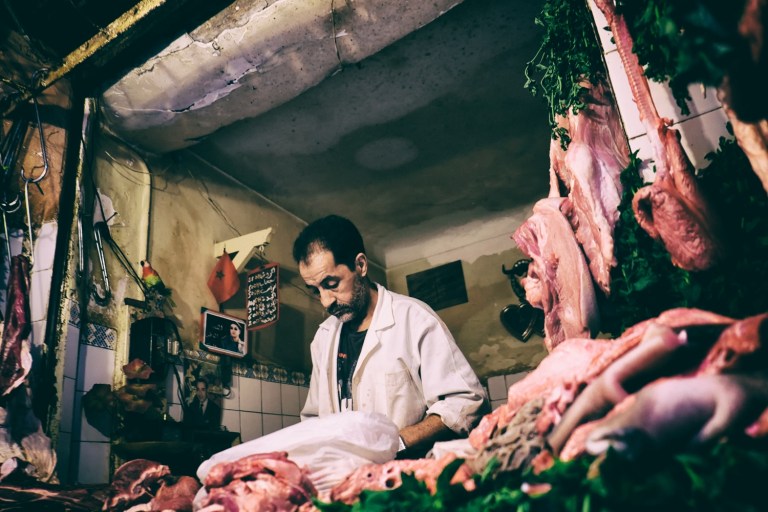
Generally speaking, Marrakesh is a very photogenic location. There are so many varied situations, so wonderfully exotic, with such incredible faces, emotions, the colours, the textures. Everything seems to be calling you to be immortalized.

3. DSCF5470 butcher marrakech - medina

11. DSCF5408 medina nr. 2 - sito

2. DSCF5480 man with hat - sito

1. DSCF5566 medina - sito

Future projects

Aside from my daily work, I like to have detailed, lengthy photographic projects and I’ll soon be leaving Rome for my summer holidays. I’ll be driving through the south of Italy to the island of Pantelleria, south of Sicily. During that month of holiday I’m planning on doing a project called “People I met”, taking portraits of people I’d casually meet during that month. On a long term basis, I’m working on a project where I’ll be photographing different kinds of Roman artisans in their working environments. This project will be continuing into 2016.

Contact

Web
Instagram
500 px
Picfair