I first fell into motorsport photography almost by accident, through an interest in the competitive motorsport of ‘drifting’. Having tried my hand at driving in the sport for a brief spell, I hung up my race helmet and picked up a camera.
For the uninitiated – drifting is like all the best bits of a race rolled into one; the close calls, the smoke, the sliding, the excitement and the crashes. Competitors have to ‘drift’ powerful rear wheel drive cars around a predefined series of corners at high speed and angle according to criteria set out by three judges – this is often done in ‘tandem’ with another car for added excitement! I’ve photographed everything from historic classics to rallying and GT racing and, if anything, you have to have your wits about you more when shooting drifting than any of the above – it’s without a doubt one of the most exciting, emotional and unpredictable motorsports to spectate and photograph. There’s never a dull moment.

This year I was hired as the official photographer for the Extreme Drift Allstars series – a six-stop championship that tours across Europe showcasing the best drivers on the continent on some truly interesting and challenging circuits. The demands of the job, and shooting drifting specifically, are pretty hard on the kit that I use. My camera and lenses need to be durable, reliable, and perform without fault. Autofocus speed is critical, as is the ability to take a knock or two and stand up to the environment.
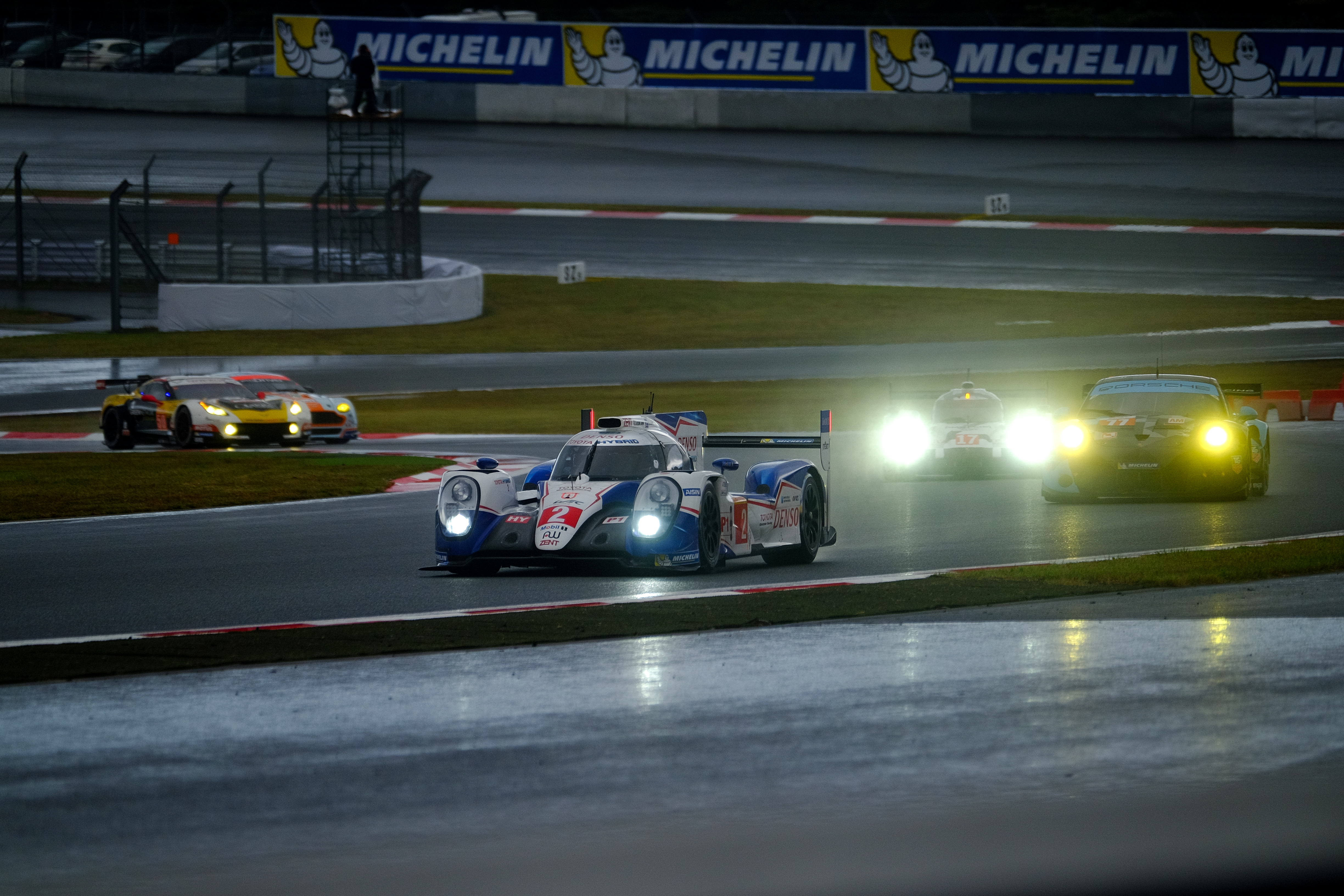
There’s rarely an event that passes when I don’t get covered in bits of rubber, dirt, dust, champagne (from the podium, of course!), pelted with debris, or find myself ducking for cover! Shooting track-side isn’t to be taken lightly, and the consequences for not being on your toes at all times are severe. My images are used for PR and marketing purposes, so I have to work fast and efficiently to capture, process and output work that represents the series and drivers in the best possible light. When Fujifilm approached me and asked me to put the X-T1 Graphite Edition, XF50-140mm F2.8R LM OIS WR and XF16-55mm F2.8R LM WR lenses through a test of speed and durability I knew exactly the circumstances to do so in!

My usual kit comprises of one or two full frame professional DSLRs, a 70-200mm f/2.8, and a selection of fast prime lenses. Straight away, my bag is noticeably lighter with the X-T1 in place of my usual DSLR setup. When using the 50-140mm and running the camera in High Performance Mode I find the VG-XT1 Vertical Battery Grip a welcome addition – not only does it increase the number of frames you can squeeze off before a recharge, it also balances the weight of the light X-T1 body with the bigger lens too. I always carry my little X100S with me when travelling too, and I’d previously tested the X-T1 with the excellent XF 23mm f/1.4 R while shooting street photography in Budapest last year and was very impressed with how it coped. The X-T1’s recent v4 firmware and autofocus upgrades intrigued me further – how would it fare when shooting fast action?

Before hitting the track I set the X-T1 up to suit my style of shooting. Most of my on-track images are taken in shutter-priority mode, which allows me to control the shutter speed to dictate the level of motion blur in the image. Setting this up on the X-T1 is easy – simply rotate the lens aperture ring to ‘A’ and then select the shutter speed using the top dial. The front control wheel by your right index finger then fine-tunes the shutter speed in ⅓ stop increments. Depending on the speed of the corner I’m shooting, around 1/250sec to 1/320sec is ideal to freeze a car approaching, whilst retaining motion in the wheels to avoid it looking parked.

I use back-button focusing with my DSLR as it allows me to switch between how I focus easily. I managed to set the X-T1 in a similar fashion, however it requires setting the camera to Manual Focus to decouple focusing from the shutter button. I then simply press the AF-L button once for single shot AF, hold it down for continuous focus or don’t press it at all if I want to manually focus – all independent of the metering and capture functions which are still taken care of by the shutter button. However, this doesn’t behave in exactly the same fashion on the X-T1 as I’m used to, as when depressing the shutter button and AF-L buttons simultaneously I found that only the first shot was in focus. I’ve found that all cameras require at least some form of adjusting to, so this wasn’t a huge deal, and is hopefully something that Fujifilm can look at in a future firmware update. Reverting back to focusing using the traditional shutter button half-press to focus, the camera acted exactly as expected.
Attaching the 50-140mm to the X-T1, the first thing that I noticed was the nice little touch of having a small window in the lens hood through which to adjust a circular polariser. I use a CPL 95% of the time and having to remove the lens hood each time to adjust it is a pain! The second thing that impressed me about this lens is the speed and accuracy at which the AF locks on. There is very little discernible difference between the X-T1 and my DSLR in this regard.

When tracking cars coming towards me at speed the X-T1 performs flawlessly, only thrown off balance when flare bounces off the car’s surface, or when presented with a low-contrast area. What really surprises me is how quickly any AF misjudgments are quickly corrected by the camera too. The X-T1 rattles off frames at an impressive 8 frames per second and the AF would only lose track for a single frame, or two at most, before locking back on. At the levels of magnification offered by this focal length any slight inaccuracy is amplified, but this lens and camera combination knocks it out of the park – the results are tack-sharp. Colour me impressed.

Tracking using the EVF was one area that concerned me before trying the X-T1. It’s obviously not quite the same as tracking through an optical viewfinder, but it’s as close as you’ll get and doesn’t cause a problem. Both traditional optical viewfinders and the X-T1’s electronic viewfinder go dark when firing the shutter, which makes tracking a car whilst shooting an acquired skill, as you lose line of sight momentarily every time an image is recorded. I don’t know if it’s possible, but if Fujifilm’s engineers could program in a way to keep the EVF always live whilst the image is being recorded then the X-T1’s viewfinder would snatch the advantage away from the traditional optical viewfinder for shooting sports!
Using AF-C + Single Point for my initial tests worked well, but relied upon my ability to track the car with a single AF point, set to the smallest possible size for accuracy. I was keen to see what the X-T1 could do in some of the more automatic AF tracking modes.


Switching to AF-C + Zone mode, I am able to select the area of the frame that I want to track the car in, perfect for compositions when the car is outside of the 3×3 central zone used in AF-C + Single mode. Panning the cars as they pass side-on, the AF system doesn’t have to work too hard as they maintain a constant speed and line and the distance between myself and the car doesn’t change much, however I can see that it’s doing its job as the AF points track the car as it shifts around the frame. Adjusting my position so that I shoot the cars approaching and passing offers more of a challenge to the AF system, and slowing down the shutter speed to capture more motion blur tests my panning technique too. By keeping your feet shoulder-width apart, locking your elbows into your hips and rotating just the top half of your body, you’ll soon start to see consistent results when panning, and you can start to have fun by playing with really slow shutter speeds.

Shooting with the 16-55mm is fast and accurate. Wider focal lengths tend to be more forgiving than telezooms when it comes to AF accuracy; as the subject is smaller in the frame any misfocusing is less easily noticed, however even zoomed right in it’s clear to see that the 16-55mm isn’t struggling.


The long end of the 16-55mm is perfect for those parts of circuit which permit me to get that bit closer, whereas the wide end is ideal for capturing the cars as part of the environment, for shooting the interiors of the cars as the driver buckles in, or when I’m lucky enough to get a passenger ride during the practice sessions!

I always look to capture more than cars sliding around the track – when I deliver a set of images I want to record the details and the emotion of racing too. Shooting on the startline is something that you can’t really do in many other motorsports, but with drifting I’m literally able to poke my lens into a driver’s window as he sits waiting for the light to turn green. It’s where I produce some of my favourite work; all the driver’s anticipation and emotion shows in their eyes, however it’s also very challenging to capture strong images here. You have just seconds with each driver before you have to be clear of the car, so being prepared with the right settings is crucial. Some cars are very dark inside whereas some are bright white and bounce the light around. Sometimes you’re shooting through the sloping windscreen glass while adjusting a polariser too – this makes judging the exposure settings beforehand tricky.

This was one area where the X-T1 delivered some really surprising results, all thanks to the EVF. Setting the 50-140mm lens to f/2.8 and selecting ISO 800 generates a fast enough shutter speed in most circumstances while retaining good image quality. I’m not bothered about blowing highlights or blocking areas of shadow for these images, and my exposure is based purely on the driver’s skin and eyes. With the EVF to my eye, I move into position as I adjust the exposure compensation dial until I see the results I want and press the shutter. The EVF helps me get it right on the first take without reviewing the LCD, adjusting and reshooting. I don’t even have to check the screen afterwards as I know what I’ve captured before I even press the shutter – perfect!

While I was already a big fan of the X-T1 as an all-round performer, I was apprehensive to shoot motorsport with it. My primary concern was autofocus performance, however the X-T1 quickly settled any reservations I had. The XF50-140mm F2.8 R LM OIS WR really impressed, and the X-T1’s EVF simply cannot be faulted for helping you get the shot right first time in tricky conditions. While the X-T1’s control layout is incredibly intuitive and ergonomically pleasing to use, it did take me some time to adjust to its traits and quirks, but this is true of any camera. After a day or two shooting with it, I got faster and better with it, and before long was getting the same results that I’m using to getting with my regular kit.


My secondary concern revolved around using such a small and light camera in an environment which I know to be tough on kit, but the X-T1 rolled with the punches and stood up to everything I threw at it just as well as any pro DSLR I’ve used.
Size definitely isn’t everything, and the X-T1 is not to be underestimated!
TO SEE MORE OF JORDAN’S WORK
Website www.jordanbutters.co.uk
Facebook: www.facebook.com/jordanbuttersphoto
Instagram: www.instagram.com/jordanbutters
Twitter: www.twitter.com/jordanbutters
 Click here to find retailers selling the Fujifilm X-T1
 Click here to find retailers selling the Fujifilm XF16-55mm
 Click here to find retailers selling the Fujifilm XF50-140mm



 Damien Lovegrove left his role as a cameraman and lighting director at the BBC back in 1998 after 14 successful years to create the renowned Lovegrove Weddings partnership with his wife Julie. Together they shot over 400 top weddings for discerning clients worldwide. In 2008 Damien turned his hand to shooting beauty and portraiture and has since amassed a dedicated following for his distinctive art. Damien now divides his time between teaching the next generation of photographers and photographing personal projects. His book
 David Cleland is a landscape and reportage photographer based in Belfast, Northern Ireland.
 MacLean Photographic was founded in 1996 and takes its name from owner Jeff Carter’s full name – Jeffrey Stuart MacLean Carter.
 Kevin is pure documentary wedding photographer. He started shooting weddings professionally in 2008 and since then has photographed weddings right across the UK and Europe. Shooting in a documentary style he strives to tell the story of the wedding through photojournalism, rather than “traditional” contrived wedding photography.
 Kerry is an award winning fine art equestrian photographer, shooting commissions across the UK and worldwide. Her work has also been published in a number of UK and international magazines, websites and blogs. Kerry was also the first female UK photographer to be named as a Fuji X-Photographer, joining a group of brand ambassadors worldwide.
 Matt is a black & white street and event Photographer based in Liverpool, England.