Photography Subjects

Hints and tips on specific types of photography

How To: 3 Ideas for Capturing the Beauty of Spring

Spring is a wonderful time of year for photography, as nature comes back to life and offers us a wealth of colors and subjects. Here are three ideas for perfect spring photos and the right camera settings for the Fujifilm X-T4.

Capture blossoms

In spring, many trees and shrubs are in full bloom, providing a great opportunity for colorful and beautiful photos. To capture the beauty of the blossoms, it is recommended to use a large aperture to achieve a shallow depth of field and highlight the main subject. The Fujifilm X-T4 offers a maximum aperture of f/1.2, which is ideal for this type of photo.

Camera settings for flower photography:

  • Aperture: f/1.2 – f/2.8
  • ISO: 100 – 400
  • Shutter speed: Depending on the brightness of the day and movement of the subject, between 1/60 – 1/200 seconds.
  • Focus: Set the focus on the main subject to bring it into sharp focus, and use the bokeh effect for an attractive background blur.
Capture landscapes in full bloom

Spring is also a great time to take landscape photos to capture the beauty of nature. When photographing a wide landscape with flowering trees or fields, it is recommended to use a small aperture to achieve a greater depth of field and capture more details in the landscape.

The Fujifilm X-T4 offers a maximum aperture of f/16, which is ideal for these types of photos.Spring is also a great time to take landscape photos to capture the beauty of nature. When photographing a wide landscape with flowering trees or fields, it is recommended to use a small aperture to achieve a greater depth of field and capture more details in the landscape. The Fujifilm X-T4 offers a maximum aperture of f/16, which is ideal for these types of photos.

Camera settings for landscape photography:

  • Aperture: f/11 – f/16
  • ISO: 100 – 400
  • Shutter speed: Depending on the brightness of the day, between 1/125 – 1/500 seconds
  • Focus: Use manual focus to focus on the main subject, or autofocus to focus on the landscape. Also use hyperfocal distance to achieve a greater depth of field.

Macro shots of flowers and insects

In spring, there are many insects and flowers that provide an excellent opportunity for macro shots. For such shots, it is advisable to use a high depth of field to bring the subject into focus and capture details. The Fujifilm X-T4 offers a maximum magnification of 0.5x, which is ideal for these types of photos.

Camera settings for macrophotography:

  • Aperture: f/8 – f/16
  • ISO: 200 – 800
  • Shutter speed: Depending on the brightness of the day, between 1/125 – 1/500 seconds
  • Focus: Use manual focus or autofocus with spot metering to focus on the main subject. Also use focus peaking mode to check the focus point and make sure the subject is in focus.

Additional tips for perfect spring photos:

  • Use the natural light of the day for natural and soft lighting in your photos. Avoid direct sunlight or strong shadows, which can affect colors or overexpose the subject.
  • Experiment with different perspectives to capture the subject from different angles and create interesting compositions.
  • Use RAW mode to have more flexibility in post-processing your photos.
  • Also use the Fujifilm X-T4’s Film Simulation mode to create different color effects and moods in your photos.

With these tips and camera settings, you can take beautiful and perfect photos with your Fujifilm X-T4 this spring. Have fun with your photography!

Tutorial: Street photography

w360_6415757_tutorialbannerfordotmailerToday I’m going to take you through some of the advice given to me by UK wedding photographer Kevin Mullins. Kevin’s approach to candid wedding photography translates precisely into his street photography style. 

What makes a good “street” shot?

The three key factors that make a good street image are;

  • good light
  • good composition
  • interesting subject

Get all three and you have a great shot. Two of them can result in a good shot. If you can only have one, make sure it’s the interesting subject

Assignment 1 – Shoot with a theme

Start by simply shooting how you want, but with a theme. Try the theme “angles”. When I took this shot below, it was a nice sunny-but-cool day in Cambridge so there were plenty of things to choose from. Look for good light, some sort of interesting subject, and carefully consider the complete composition.

The bright sun meant that to me, the ‘angles’ would need to come from shadows. This guy caught my eye because he was using his phone before getting on his bike. I wondered who he was contacting, or whether he was just checking a map. About 20 mins later we saw a cyclist nearly get taken out by a car so I wonder now if he was sending a ritual “goodbye, just in case” message. X-T1; XF18-55 @ 35; 1/640 sec; f/5.6; ISO 200
The bright sun meant that to me, the ‘angles’ would need to come from shadows. This guy caught my eye because he was using his phone one last time before getting on his bike. I wondered who he was contacting, or whether he was just checking a map. About 20 mins later we saw a cyclist nearly get taken out by a car so I wonder now if he was sending a ritual “goodbye, just in case” message. X-T1; XF18-55 @ 35; 1/640 sec; f/5.6; ISO 200

Assignment 2 – Frame your subject

Try to use people to frame shots of other people. Pair up with another photographer and go hunting interesting shots together. Use your partner to help provide a frame for the shot. The theme of “angles” was dropped but otherwise everything applied; light, composition, something of interest that tells a story.

Although personally I find the arm in the foreground a bit distracting, it does give a bit more depth to the image and the bright blue of this guy’s jacket and the sign pull your attention away from the frame  . X-T1; XF18-55 @ 35; 1/200 sec; f/5.6; ISO 200
Although personally I find the arm in the foreground a bit distracting, it does give a bit more depth to the image and the bright blue of this guy’s jacket and the sign pull your attention away from the frame . X-T1; XF18-55 @ 35; 1/200 sec; f/5.6; ISO 200

I like this one because the conversation is framed by the arm on the left, and also the stranger on the right. X-T1; XF18-55 @ 55; 1/200 sec; f/5.6; ISO 200

This last one failed the assignment in that it wasn’t framed by a person in the foreground. However, I like it because of the way the light fell on the faces of the people having the conversation. Nice light and begins to tell a story about a meeting in public. X-T1; XF18-55 @ 35; 1/200 sec; f/5.6; ISO 200

Assignment 3 – Spot Metering

The next thing to try is pre-focusing and spot metering. Put your cameras into spot metering and manual focus mode and stand facing a place where people would “break the light”. In other words, pedestrians and cyclists would travel from the bright sunshine, into the shade, or vice-versa. Use the “AF-L” button to pre-focus on the ground where we wanted them to be when we shot and then simply time them right to shoot them just as they cross from the light into the shadow. The camera will adjust for the exposure according to light on the subject, rather than the total light in the scene.

On the X100T, X-T1, X-T10 and X-Pro2 there is a setting that allows you to link the spot metering with the AF box. Activating this allows you to choose the point in your composition to expose for. On cameras without this function the spot metering will only occur in the middle of the frame so you may be slightly limited in your composition.

This shot was actually taken by Kevin himself using his X100T; 1/320 sec; f/16; ISO 640

Assignment 4 – Zone focusing

Get close to your ‘subjects’. Getting close obviously means more chance of affecting the resulting image so it’s key to try to appear like you are not taking photographs. The main reason people need to really see what they are shooting is to make sure you are focusing on the right thing.

Guy working on a market stall. Bikes were everywhere in Cambridge. X-T1; XF18-55 @ 55; 1/90 sec; f/11; ISO 400

Keep your camera in Manual Focus mode, select a nice small (big number) aperture value and then used the focus distance indicator on the screen of the camera to understand where the range of acceptable focus would be.

Focus on the ground a few metres in front of you. Your next challenge is to get in close to people and inconspicuously shoot them getting on with their life. Continuous shooting is also very handy here as it allows you to shoot a few frames, especially good if your subject is moving through your zone focus area.

Assignment 5 – Turn invisible

There is now no need to hold the camera up to your eye so all of your shooting can be at waist level, looking down onto the tilting LCD screen (if your camera has one) to check the overall composition. After a while you will be able to simply look around and be confident that you’re going to capture the interesting subject without them knowing, therefore not influencing or changing the subject, but merely documenting what is going on around you.

Not many people "at work" seemed to really be working.  Zone focussed and shot from the hip with X-T1; XF18-55mm @ 35mm; 1/64 sec;   f/13;   ISO 1000
Not many people “at work” seemed to really be working. Zone focused and shot from the hip with X-T1; XF18-55mm @ 35mm; 1/64 sec; f/13; ISO 1000

One of my last images as we were about to lose the sun completely. This is the only guy who looked like he was working, although I question his choice of office. X-T1; XF18-55 @ 55; 1/125 sec; f/16; ISO 1250
One of my last images as we were about to lose the sun completely. This is one of the few guys who looked like they were actually working, although I question his choice of office. X-T1; XF18-55 @ 55; 1/125 sec; f/16; ISO 1250

Summary

  • The three keys to a good street image are; good light, good composition, interesting subject. All three of these results in a great shot. Two of them can result in a good shot. If you can only have one, it has to be the interesting subject
  • Shoot with a theme. This will make you consider your shot more carefully and not just fill your card.
  • Try to frame your subjects with parts of the background, or even make your own frame by using other photographers
  • Setting your camera on full auto with Spot metering allows you to ignore the exposure settings and let you worry about looking for a good shot
  • Zone focusing allows you to not worry about accurate focus, but rather understand that if a subject is within a certain “zone” in front of your lens, it’ll be sharp and in focus
  • Tiltable LCD screens allow you to shoot at waist level and still see the frame. The camera remote app takes this one step further and you look like you are just using your phone while actually shooting people with the camera hanging around your neck.

Keep practicing, hope for something interesting to unfold in front of your eyes and be ready with your camera when it does. Hopefully these techniques will help you get a great shot without anyone even knowing you were there!

A journey to Marrakesh

9. DSCF5376 mercato medina - sitoby Jesper Storgaard Jensen

About me

Jesper Storgaard Jensen bwI’m Danish, born in 1964, and have been living in Rome since 1997. I have always loved writing and at a certain point, after my arrival in Rome, I started to collaborate with magazines producing travel articles. It was from this that the Danish Daily wanted to publish a travel article of mine from an Italian island. Unfortunately the PR-photos were of a too poor quality. In other words, I had to do the photos myself. This is when I purchased my first ever 5-mega-pixel camera. That was back in 2003, and since then, my interest in photography has been steadily increasing. I had been working for the Danish Embassy in Rome for ten years, but in 2009 I took the jump to become a full time freelance journalist and photographer shooting travel, culture, food & wine and interviews. Everything with my own imagery.

The journey to Marrakesh

We – a total of eight persons – were doing a 7 day on-the-road-trip round Morocco, two days of which were spent in Marrakesh. As I needed to travel light, I packed only my Fuji gear – Fuji X-E2, the 18-55mm kit lens and the 35 mm lens for portraits & food. I must say that I find this a excellent combination and the overall weight is significantly reduced compared to DSLR gear.

7. DSCF5387 medina - sito

Travelling in a country with a completely different culture to my own I wanted to play it safe. So I asked most people if I could take their photo, especially regarding portraits, which I guess is quite obvious. There were occasions where some scenes were too good to miss, and in these circumstances I fired from the hip, looking elsewhere.

6. DSCF5536 Amir Marrakech - sito

5. DSCF5591 street portrait marrakech sito

8. DSCF5345 pink all over - sito

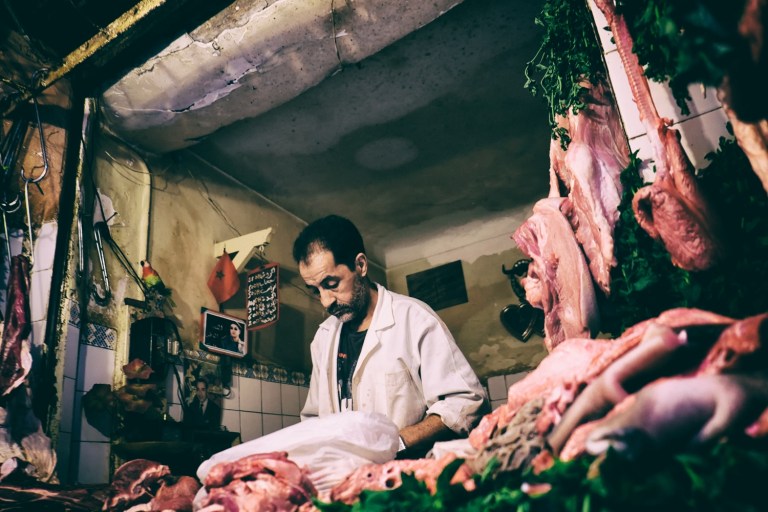
Generally speaking, Marrakesh is a very photogenic location. There are so many varied situations, so wonderfully exotic, with such incredible faces, emotions, the colours, the textures. Everything seems to be calling you to be immortalized.

3. DSCF5470 butcher marrakech - medina

11. DSCF5408 medina nr. 2 - sito

2. DSCF5480 man with hat - sito

1. DSCF5566 medina - sito

Future projects

Aside from my daily work, I like to have detailed, lengthy photographic projects and I’ll soon be leaving Rome for my summer holidays. I’ll be driving through the south of Italy to the island of Pantelleria, south of Sicily. During that month of holiday I’m planning on doing a project called “People I met”, taking portraits of people I’d casually meet during that month. On a long term basis, I’m working on a project where I’ll be photographing different kinds of Roman artisans in their working environments. This project will be continuing into 2016.

Contact

Web
Instagram
500 px
Picfair

X-Photographer’s Spotlight – Greg Whitton

Tell us about yourself and what got you into photography?

Profile1Well, I’m married to Lisa and as we don’t have any children, it leaves us plenty of free time to enjoy stuff outside of the home. We met through our walking group as we both have a love for the outdoors and it is that which helped me discover a love for photography. Initially I started heading to the hills with mates and just enjoyed climbing hills and mountains, but over time I came to appreciate the landscape and I was ended up trying to capture more than just snapshots of our hiking activities. This then developed into a strong affinity with photography.

Greg_Whitton_Photography_Fuji_2015-8

How did you develop your style in photography?

I don’t think I really have a style, although just the other day someone said they could single out a “Greg Whitton shot” from others. I wasn’t sure how to take that but they assured me it was a good thing. I’m not sure I really believe it. I’m very much a photographer who strives to capture epic landscapes, typically made that way due to the pattern of weather in them. They tend to be very moody. I’m not a heavy user of post-processing, although I would say that I think I use most of the tools that Lightroom offers. Typically my images follow the same processing workflow which takes two or three minutes. It’s perhaps why they are easier to single out, they exhibit the same characteristics. I’m using colour a lot more these days. By that I mean I’m playing with individual colour channels to achieve a ‘mood’ that I want. It’s surprising just how effective this is, a minor nudge of the blue primary colour channel for example can do wonders.

Why did you choose Fujifilm cameras?

A friend of mine introduced me to them. He was searching for his ‘perfect camera’ and seemed to have a new camera every week, Nikon, Sony, Ricoh, etc. I was using Canon, a 5DmkII. Eventually he got a Fujifilm X-E1 and was raving about the image quality. It was small and lightweight, and it wasn’t full frame. Naturally I didn’t really believe him. However, I started to notice I wasn’t using my own set up very effectively. I was hiking a lot and it was just too heavy. I wasn’t carrying it around my neck and was leaving it in my rucksack. As a result I was missing a lot of shots (I very much tend to shoot handheld on the fly as things happen quickly in the mountains). He showed me some of his RAF files and I have to say, I was impressed. I decided to experiment and bought an X-Pro1 and a bunch of lenses in a cashback deal. I took it on one dual shoot with the Canon. The Canon was on the tripod the whole time for ‘the big shot’ while I ran around the summit of a mountain with the X-Pro1 shooting handheld. When I got home to check the results, I had more useable images from the Fuji than I did from the Canon. When comparing images that were shot side by side, the Fuji had better clarity, less noise and were sharper. That was it, that one shoot persuaded me to ditch the Canon and go full Fuji. I don’t regret it a single bit.

Greg_Whitton_Photography_Fuji_2015-2

Do you have a photographic philosophy you live by?

Simply shoot what you love and don’t listen to others.

Greg_Whitton_Photography_Fuji_2015-12

Key inspirations – What & who inspires you?

Colin Prior is one of my photographic heroes. My photographic eye has certainly been influenced by his amazing body of panoramic work. In recent years I’ve followed Julian Calverley because his use of mood in landscape photography is almost second to none. I’ve also become a bit of a fan of David Ward. Every image I see from him fills me with wonder. He can make the most benign foreground subject so incredibly intriguing and unique. It blows my mind sometimes.

Greg_Whitton_Photography_Fuji_2015-7

Do you have any tips or tricks you could share with us?

Oh crikey, not really. If I told you how I got most of my images you’d realise just how un-professional I am! My few words of wisdom would extend to, if you enjoy shooting the outdoors, then you must do it because you love the outdoors. Try to appreciate them for what they are and don’t get hung up on ‘the shot’. I go out to enjoy the outdoors first. A good photograph is a bonus.

Greg_Whitton_Photography_Fuji_2015

What’s next for you?

Winning Outdoor Photographer of the Year has given me a massive boost in self confidence and opened one or two doors. But I’m learning that it still doesn’t mean people are knocking down your door for stuff. You still have to be pro-active to make the most of it. I’ve been really busy since then, but it’s not all photography, I have a full time job to do too. So, you’d be surprised how little I’ve been able to capitalise on the accolade. I do have a book coming out in August, ‘Mountainscape’ published by Triplekite. It is a book that contains many of my favourite mountain images from the UK, from vistas to more personal work. It’s available to pre-order from www.triplekite.co.uk. Beyond that I’m hoping to launch workshops later in the year (folks can sign up for news on them by contacting me through the website). Mind you, if anyone wants to commission me for anything else, I’m all ears!

I’m looking forward to the next generation of cameras from Fuji, I think we are going to be treated to something special. Recently we’ve seen huge advances in resolution & technology in the digital photography world, mind you, we don’t seem to have been held back by lower resolution, I won a major competition with only 16 megapixels to play with, it was the overall image that won, not how detailed it was. Others have achieved much more with much less. It is an exciting time for digital photography and it’s great to be involved.

Contact info

Website
Twitter

Greg_Whitton_Photography_Fuji_2015-5

X-Photographer’s Spotlight – Chris Weston

Tell us about yourself and what got you into photography?

chris westonWhen I was about 15 years old, I lived in Boston. Unfortunately, not the colourful, vibrant city in the United States but the quiet market town in Lincolnshire, England – historically linked to its American namesake but a place best known for its Dutch-like landscape and the agricultural prowess of its inhabitants. What I am trying to say is, I grew up in a part of England that required much of one’s imagination.

At school one day, I was asked to select my preferred employer for a 2-week work placement. The options weren’t good. Potato planting, bulb cleaning or strawberry picking were three of the more attractive options, as I recall. Seeing my inner turmoil, in a way only dads can, my father asked me what I wanted to do for a career. Without hesitation I replied, “I want to be a photojournalist”.

From where that statement came, I have no idea. Not a clue. I mean, I remember wanting to be (at various stages and in no particular order) a fireman, a policeman, a jet pilot, a train driver, a ski jumper and, of all things, an accountant … but a photojournalist? That was a new one. Even so, at my father’s behest and with the blessing of a somewhat perplexed headmaster, I began my first ever assignment.

_DSF610172

How did you develop your style in photography?

While I was on an assignment, about a year after I turned professional, I had a light bulb moment. I was in Tanzania photographing the annual wildebeest migration, as it passed across the Grumeti River. It was a slow day and photographic opportunities were few and far between. I don’t know if you’ve ever paid a lot of attention to wildebeest but they’re not Africa’s most alluring creatures. African’s describe them as, “The animal God created out of the leftover parts of other animals”. Don’t get me wrong, I like wildebeest but they don’t do much. Their day consists of walking in a wide circle eating grass. And that’s about it. Two days into a three-week long project, I was struggling for ideas. How do you continually photograph what amounts to a large brown antelope grazing in a big brown field?

And then it struck me. I started to think about migration and what it really is. Migration is the movement of animals from point A to point B. Movement. Migration is movement and that not wildebeest was the real story. I started to make photographs that captured the story of the migration – wildebeest moving, individually, in a line, in large herds. Suddenly, my photography had purpose and it has been guided by the light from that bulb ever since. We’re not just photographers we’re storytellers. In place of a pen we have a camera but irrespective of the tool our aim is the same: to amuse, emote, inform, educate, and entertain. I believe that inside all of us is a story that is aching to be told, tales that make photography a unique and intensely personal experience.

_DSF1284

Why did you choose Fujifilm cameras?

For the past couple of years, I have been advocating that the next major shift in camera design will be the exit of the mirror. The mirror is perhaps the single most-limiting factor in an SLR camera, which is rather surprising given that it has been the mainstay of camera design for nearly 80 years.

First of all, the mirror causes cameras to be far bigger and heavier than necessary. Secondly, to accommodate the mirror, the lens needs to be pushed further forward, increasing the distance between the rear lens element and the sensor (or film) plane, which diminishes the quality of the light transmitted by the lens.

Thirdly, the mirror slapping up against the chamber introduces vibration that, when combined with relatively slow shutter speeds, softens edge detail, reducing image quality further. This is particularly true when using ultra-high resolution DSLR cameras. Finally, mirrors are noisy. The constant slap-slap-slap cuts through the silence of dawn and dusk, echoing across open savannahs and bouncing off woodland trees, startling anxious wildlife into panic.

So, when Fuji announced the launch of the X-T1 mirror-less camera, I was intrigued enough to contact Fujifilm UK. My main question to Fuji was: Is the X-T1 up to the rigors of professional wildlife photography? They answered my question with a question: loaning me an X-T1 body and a couple of lenses they said, “You tell us!” I’ve been using the X-T1 ever since and my investment in Fujifilm products continues to grow.

_DSF5175

Do you have a photographic philosophy you live by?

For me, a photograph begins with a caption. That may sound a little back-to-front but if you think about it, really it isn’t. For example, imagine trying to build a house with no architectural drawings. Where would you start? How would you even know what materials you needed? Nobody would approach house building this way, yet the idea that fully formed, well-composed photographs just happen seems to be accepted as the exception to the rule. It’s not. Photographs are designed and crafting an image begins with having something interesting you want to say.

Knowing what to say comes from knowing your subject. The better you know your subject, the more stories you have to tell. I became a wildlife photographer because I’m fascinated by the natural world. How it works, how it fits together and how everything is connected. I often find myself intrigued by inane questions like,  “Why are zebras black-and-white striped when they live in a yellow savannah?”

It’s by asking questions and finding answers that I’m able to hit upon new ideas for images, find ways of making interesting photographs of ordinary subjects or different ways to photograph the same subject over and over. It’s how I learn about the natural world and develop a better understanding of wildlife and nature and, to some extent, my part in it all. And knowing yourself, how you feel about things and how things move you is as important a part of the process as the technical aspects of photography.

_DSF561872

Key inspirations – What & who inspires you?

Perhaps intriguingly, I’m more inspired by people and events outside of photography. In photographic circles, I admire the work of Michael Nichols, particularly, and, in the very early days, I learned a lot of the basics from Art Wolfe. However, today, science (especially quantum mechanics) and extraordinary people and thinkers, such as astronaut Chris Hadfield, author Yuval Noah Harari and physicist Brian Cox inspire me.

_DSF1764

Do you have any tips or tricks you could share with us?

There are so many thoughts, ideas and techniques that have led me to where I am that it’s hard to narrow them down to a few. So, instead, how about I offer Fujifilm readers a completely free e-book titled Nature Photography: Insider Secrets. To get a free copy simply click on this link: Top Wildlife Tips

_DSF4607

What’s next for you?

I’m on an amazing personal journey of discovery, looking at how creativity through photography can inspire how we live, as individuals and within communities and society as a whole. It’s a story that I want to share with the world and I’m currently talking to Fujifilm about how we can make that happen. Watch this space!

_DSF1679-2

Contact info

Website
Facebook

Thoresby. The end of an era

By Chris Upton

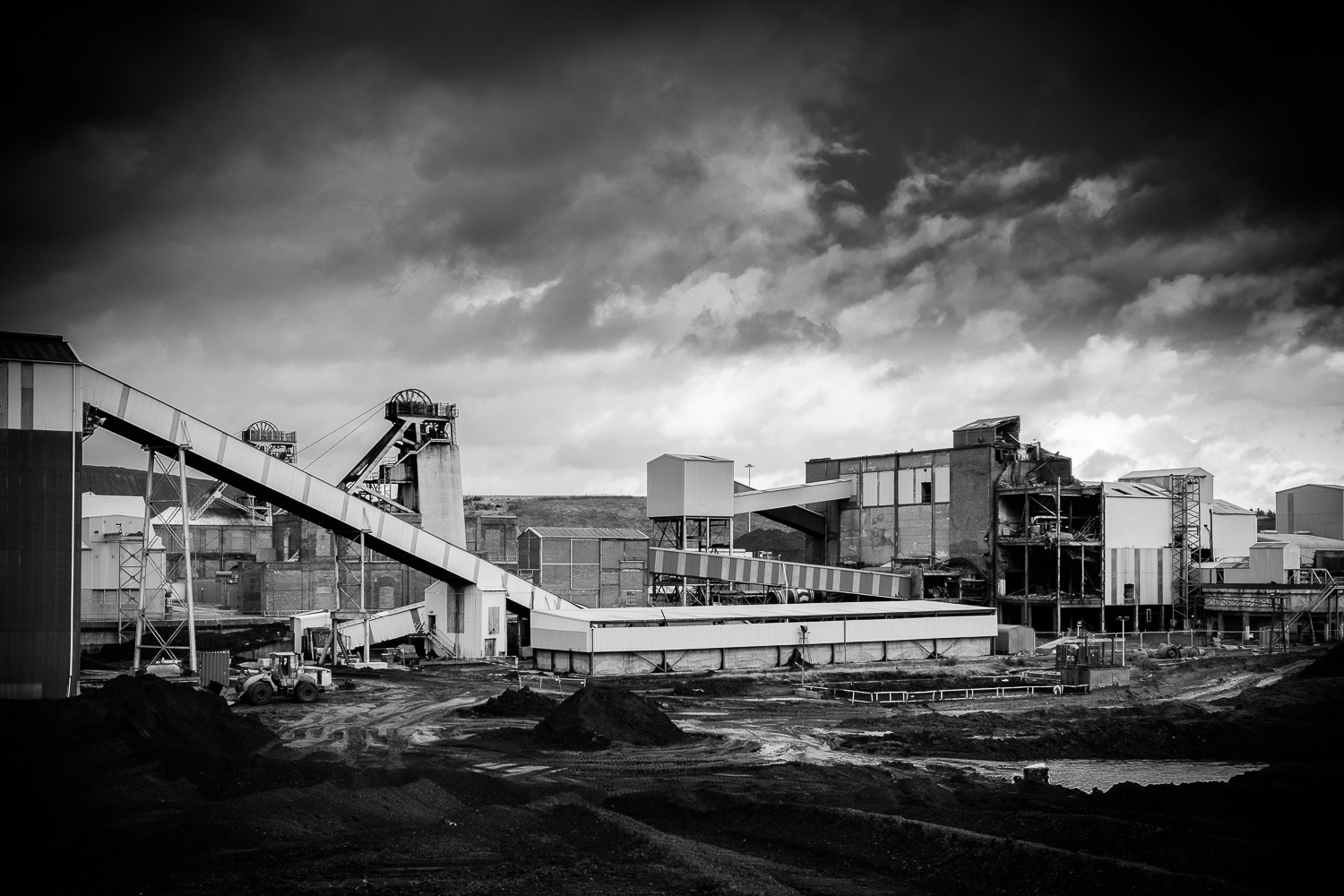
personThe 10th July 2015 was a landmark date in the history of Nottinghamshire. When the last shift at Thoresby Colliery finished on that day not only did it mark the end of 90 years of mining in the village of Edwinstowe but it signals the end of mining in Nottinghamshire.

The pit opened in 1925 and over the years has employed tens of thousands of local people. It was one of 46 coalmines in Nottinghamshire, which supplied more than 14 million tonnes of coal per year at their peak in the early 1960s.

The first two shafts were sunk to 690m in 1925 and subsequently deepened in the 1950s to the current pit bottom at around 900m depth.

Thoresby Colliery was the first to have fully mechanised coal production and also the first to achieve an annual saleable output of more than a million tons, it became a star performer in the British coal mining industry.

In the late 1980s it raised output to exceed 2 million tons, regularly smashing it’s production records, and the colliery became known as the Jewel in the crown of Nottinghamshire mines. A crown sits proudly on the headstocks in recognition of this achievement.

When the coal industry was nationalised in 1947 it employed a million men at 1,503 pits; prior to the miners’ strike in 1984, there were 180,000 miners at 170 pits. Today there are just two deep mines left, employing about 5,000 men, at Thoresby and Kellingley in Yorkshire. Kellingley will suffer the same fate as Thoresby and closes in the autumn.

UK Coal say market pressures have led to the closure of Thoresby Colliery. Coal generates more than a third of Britain’s electricity, but it is cheaper to import coal from countries such as Russia, South Africa and Colombia than to mine it in the UK.

For the past few months I have been recording the colliery, it’s buildings, plant and people for posterity. It was my aim to create a comprehensive record of the pit at a specific point in time immediately prior to its closure.

It was a chance conversation after giving a camera club lecture that started the ball rolling. A chap in the audience worked at Thoresby and was unfortunately in the first wave of redundancies. He asked if I would be interested in visiting the colliery to take a few pictures. It was a fantastic opportunity and I jumped at the chance. He put me in touch with the Health and Safety manager, I explained what I would like to do and we were off and running. It was at this point, after I had gained their agreement to document the colliery, that the full extent of the task dawned on me.

Starting the project

I visited the colliery on seven occasions, at different times of day, in different lighting conditions, including dawn and dusk. I planned each shoot but found that an outline plan whilst retaining a degree of flexibility to react to opportunities worked best.

At the outset I just toured the site to give me an understanding of the buildings, the machinery, the operation and the people. I took snaps to create a digital scrapbook to help me plan my approach. Essentially I was imbibing the atmosphere much as I would do when visiting a foreign destination for the first time. I wanted to get a real feeling for the place before I started the photography in earnest.

Health & Safety manager Grant was so supportive of my visits giving me more time than I could have wished for.  Even coming in at 3.30am for a dawn shoot and returning to work late in the evening to get “the best of the light” didn’t diminish his enthusiasm. In fact he joked that, after watching me, he would now be able to take the best holiday snaps ever! I hope he does.

20150617_thoresby_0049-Pano

Gear used

All of the images were shot on a Fujifilm X-T1 or X-E1 camera using a selection of Fujifilm XF lenses including the 10-24, 18-55 and 55-200 zoom lenses and 14, 23, 35 and 56mm primes. I also used a Nissin i40 flash for some shots, though preferred to use natural light wherever possible.

For my portraits, the unobtrusive Fuji equipment allowed me to concentrate on building a rapport with my subjects rather than intimidate them with a large DSLR and f2.8 lens combination. Miners might be tough guy’s and supermodels they certainly are not but they seemed to relax pretty quickly in front of my Fuji lenses.

20150701_thoresby_0111

20150319_thoresby_0288-Edit-2

There were several challenges to overcome not least the light levels that were typically pretty low in all of the buildings. Because of the poor light I used a tripod fitted with a ball and socket head for as many shots as possible. My cameras are fitted with arca swiss type plates so that I can switch from landscape format to portrait very easily and without having to waste time readjusting the tripod.

The mix of different light sources from tungsten, to fluorescent and natural meant it was difficult to assess the ideal colour temperature. However the decision early on to convert all the images to black & white certainly helped counter that problem!

In a coal mine dust was another inevitable and unavoidable issue. As the miners told me it’s not only the dust you can see that is the problem and I was very careful when changing lenses and using two bodies certainly helped. Thankfully the in camera sensor cleaning worked well and I was pleasantly surprised at the minimum amount of dust spotting required.

20150422_thoresby_0189-HDR-Edit

Working on a project

As my photography has progressed I have found that I prefer to look at a series of images that tell a story rather than seeing individual impactful pictures. Whilst I have adopted this storytelling approach in my travel and landscape photography this project was a whole different ballgame. This wasn’t going to be a six or ten image set but a large body of work that had to be planned and created in a certain style. I found this experience fascinating, though at first it was pretty daunting. However after a couple of visits I had captured some shots I was very pleased with and the plan started to fall into place. I think the discipline required in a project such as this has helped me to improve my photography and it felt good to be succeeding in this new genre of social documentary photography.

In an attempt to capture the “feel” of the colliery, and to bring completeness to the project, I also recorded various sounds around the pit and organised a series of interviews with miners past and present. I will be producing mini AV’s including these sounds and using the miner’s comments in my presentations.

20150115_thoresby_0097-Edit

20150115_thoresby_0006-Edit

Stretch yourself

It is very easy to stick to what we know in photography and limit yourself to a particular genre. Whilst my experience as a travel photographer, where you are required to be adept at many different genres, undoubtedly helped me there were aspects of this project that were not so familiar. As a result I feel I have grown as a photographer and I would urge you to move out of your comfort zone and try something new. There will be similar opportunities in your area, seek and ye shall find!

20140723_thoresby_0046-Edit

Capturing a piece of history

As I progressed through the project I realised that I was not only taking pictures for myself but that I was actually recording a piece of history, an enduring record of a place that, in just a few months time, would be gone forever. With that came a feeling of responsibility, not only to do myself justice but also to represent the life and work of the mining community. Apart from my family photographs, this project is the most important and worthwhile piece of work that I have ever created. Whilst there is clearly interest in the work now, what will its importance be in another 10 or 20 years?

20150115_thoresby_0052-Edit

A personal perspective

This project has been a fantastic experience. It has improved my photography, taken me into a different genre and enlightened my knowledge of an otherwise mysterious industry.

It has been a pleasure to work with the team at Thoresby, without whom I would not have been able to produce this body of work. Whilst the colliery may not draw its workers from the immediate village area, as in years gone by, their camaraderie, team spirit, hard work and no nonsense attitude in this tough and uncompromising industry epitomise the best of British workers. The closure of Thoresby truly is the end of an era.

20150513_thoresby_0257

20150513_thoresby_0267

What next?

I feel it is important to showcase my images to as wide an audience as possible, especially in the local area. Therefore, after securing feature in the local and national press, I will be staging a major exhibition in Nottinghamshire and am planning to produce a book – more details to follow.

To see more Thoresby images and to keep updated on the project developments please visit my website  www.chrisuptonphotography.com

20150422_thoresby_0301-Edit-3