


By Chris Upton
Halloween, the time of ghosts, ghouls and bewitching conditions to create wonderful atmospheric autumnal images!
After a few summer months of long, warm days, harsh light and of course some rain (I am in the UK!) we are longing for misty mornings, low raking light and sunrise and sunset at sensible times of day. For many photographers, especially landscapers, autumn is simply the best time of the year.
So how do we make the most of these opportunities and capture some stunning images?

THE WEATHER
Well it all starts with the planning and we’ll begin with the weather. Keep an eye on the forecast and if you’re looking for a misty start ideally you need cool temperatures after a period of wet, mild weather with little or no wind. Check the sunrise time and be prepared to be on location at least 30 mins prior. When the sun pops up it starts to warm up the landscape and gradually burns off the mist. Depending upon the amount of mist it may take a while to clear so you may have an hour or more to capture your shots.

I use BBC Weather, Met Office and WeatherPro apps to check the forecast though it’s not foolproof and the conditions might not turn out as you were hoping for. In those circumstances it’s important to keep a positive view and think about the things you can shoot.
This was the case recently when I went down to the River Trent for what I hoped would be a misty sunrise. When I arrived it was thick mist and even when the sun came up it didn’t burn off. Walking along the bank I noticed the leaf, grass and reed details and decided to shoot some high key images. So although I didn’t get what I had expected I was pleasantly surprised by the results.


Whilst strong sunlight is best early and late, during the day bright overcast conditions with its soft lighting will enable you to capture the beautiful autumn colours without harsh shadows and excessive contrast. Take care to avoid large areas of bland blue or grey sky which add nothing to the image.
In certain circumstances the weather can be especially challenging. However “every cloud ….…” The fact is that “bad weather” can provide you with great opportunities to capture some unique shots as many photographers don’t venture out in inclement conditions. The benefit of much of the Fujifilm equipment is that it’s weather sealed (check yours) so as long as you can keep the front element dry you’re good to go! It’s a good idea to have an umbrella handy, though the ability to grow another hand would be extremely useful too! I recommend the Gustbuster umbrella which is large, robust and is tested to withstand winds of 55mph.
These next few shots were taken on an extremely challenging day in the Lake District. It was pouring with rain, visibility was poor and light levels were low. Despite sheltering under a large umbrella that flipped inside out twice (hence the Gustbuster purchase) it felt like a contest between me and the elements and I was determined to get some pictures.


This shot was also taken in pouring rain. The soft, diffused light and low contrast really suited a long exposure and providing you meter carefully to retain detail in the highlights you can get super images in these conditions.

EARLY & LATE
Usually the best times to shoot atmospheric landscapes is at the beginning and end of the day, that magical period when the sun is rising or setting but is still below the horizon giving a soft, warm light.
Mornings take more effort and you have to walk to your location in the dark but there are fewer people around and there is something special about witnessing the start of a new day especially when the conditions are just right. Plan to be at your location at least 45 minutes before sunrise. If you want to get a starburst effect as the sun pops over the horizon shoot at f16 or f22 but make sure your front element or filters are clean!
For sunset ensure you stay until at least 30 minutes after the sun has gone down because that’s the time when the sky is backlit with, hopefully, an amazing display of colour.


Another benefit of shooting early or late is that usually the wind drops at these times enabling you to capture lovely reflections.

The blue hour is a great time for city shots but don’t stop then because city streets late at night can provide many other opportunities especially when it’s wet and the pavements reflect the vibrant artificial lights. Try converting to black and white to give a colder, more intimidating feel to the image.


LOCATION, LOCATION
Great autumn shots can be had all around the country in local parks, woods and by the rivers. However, in the UK, there are a few stunning locations such as Perthshire, Lake District, Thorp Perrow N. Yorks, Peak District, Clumber Park, Westonbirt Arboretum, Ashridge forest, and Stowe.
Rivers, canals, lakes and marshes all offer great potential for atmospheric misty shots. Look for some added interest like boats, jetties or rocks to aid your composition.

Fields heavy with morning dew also produce mist. Add backlit trees and you have the recipe for some stunning pictures. Think about your viewpoint, try and find an elevated view so that you are above the mist.
Other great places for spooky, ethereal shots are graveyards!
Here are a couple of images I took in Edinburgh using the multiple exposure feature on my X-T1. When you set the drive dial to ME you shoot the first image as normal and the screen will then show you the image and ask if you are happy with it. If you are you get a faint overlay of your original image to help you superimpose with the second. Take that shot and your combined image shows on your screen. However if you’re not happy with the second shot you can delete that one, keeping the first, and then reshoot.
In these shots I took one image of the row of grave stones then the second shot was a close up of the inscription from one of the stones. If you’ve not tried this give it a go you can get some great effects!


Why not also try the Advanced Modes for achieving some creative pictures? Many photographers bypass these but I would urge you to give them a try, the high key or soft focus mode are especially good for misty shots.
Of course the colour at this time of year can be amazing and forests and woods can provide countless opportunities with shafts of early morning light streaming through the trees illuminating the forest floor or feathering the light across branches laden with morning dew. Keep to the edges of the woods to get the best effects.


EQUIPMENT
The choice of lens can also have a dramatic effect on your image. I find that this time of year is ideal for using a longer lens which I use to compress perspective or isolate detail. Perfect for enhancing a misty scene adding drama and intrigue to your shot.
As the light is low at this time of year or day ensure that you use your lens hood to cut out any unwanted flare and again make sure your lens and filters are spotless.


You will be amazed at the difference a Polarising filter makes to your autumn pictures, reducing glare and increasing colour saturation. A circular polariser allows you to fine tune the effect but take care not to overdo it especially if you have blue skies in your picture.
Other filters that are useful are Neutral Density filters in 3, 6 or 10 stops to extend the exposure time and 2 and 3 stop Neutral Density Graduated filters to control the dynamic range in your picture, usually darkening the sky or areas of water.

TECHNIQUE
In order to achieve the best quality files I prefer to shoot at low ISO (usually 200) and for a landscape will select f8 or f11 unless I want to intentionally reduce the depth of field.
Depth of field (the area of the picture that is acceptably sharp in front and behind the point of focus) is determined by focal length, aperture and focus point.
With a small aperture eg f11 and a wide angle lens eg 14mm focusing at 1m everything will be sharp from 47cm to infinity. There are various DOF apps you can use on your smartphone to ensure accuracy. Alternatively you can simply focus ⅓ into the scene and check your EVF, zooming in to assess sharpness.
Using the AF joystick on the X-Pro2 and X-T2 makes focus point selection a breeze and it’s another favourite feature of mine. Trying to use AF in mist is challenging to most cameras so I recommend switching to Manual focus. There are several different manual focus aids on Fuji cameras, I prefer focus peaking and set my highlights to Red, white highlights in mist might prove a little tricky!
Low ISO and small apertures usually mean a longish shutter speed which makes a tripod an essential part of my kit. But there are many other benefits to using a tripod not least that it slows you down so that you can search the frame carefully and fine tune your composition. Using Neutral Density Graduated filters is also much easier when your camera is tripod mounted. That said there are many people who prefer the freedom of shooting handheld and are happy to use wider apertures or higher ISO’s. There really is no right or wrong as long as you capture the image you’re looking for.
Although I have a cable release I prefer to use the 2 second timer unless I am using B (Bulb mode) for long exposures or want to capture a specific point in time ie waves.
For metering I will use Evaluative or Spot depending on the subject and the style I am looking for. Be aware that mist will fool your camera into underexposing resulting in dull, grey images. You will need to use your exposure compensation to increase the exposure by by around 1 stop though this may vary depending on the amount of mist in the shot. The live histogram on your camera will help you ensure the correct exposure, aim to expose more to the right without clipping the highlights.
One of my favourite features on the X-Pro2 and X-T2 is the front exposure compensation dial which you rotate to deliver up to 5 stops more or less exposure, once you have set the top dial to “C”.


As I shoot in RAW I leave my White Balance set to Auto and then fine tune later in Lightroom if required. That said I find that my Fujifilm cameras deliver excellent white balance on auto. Just be aware that with mist your images may look a little cool. So if you are shooting JPEGS try Daylight setting or, if you want to really warm up those rich autumnal colours try Cloudy. Your Fuji camera may allow you to auto bracket the WB, you get three different settings from the same image!
Finally don’t forget to prepare yourself for your autumn shoot. It’s essential to be comfortable when standing around for long periods in the cold allowing you to concentrate on the images rather than trying to keep warm. Boots or wellies (with decent soles), down jacket, hat and gloves are essentials as are a flask and some energy bars. Oh and if you’re venturing out into the great outdoors on your own make sure you tell someone where you’re going. Most of the best locations have no mobile signal!
So I hope that this has given you some inspiration to wrap up, get out shooting and make the most of the best time of the year!


 After being awake for 30 hours, we arrived at dusk. On the way into Yosemite, we stopped off at tunnel view. It was my first glimpse of California that wasn’t being hidden away by the night. The rock faces lit up underneath a sea of endless stars. In that moment, it all felt like a dream. I was now experiencing this miraculous destination that I had experienced so many times before through someone else’s eyes. We spent an hour shooting before heading to drop off our bags and get settled in our condo. At 4:30 AM, we were off to glacier point to prepare for our first sunrise.
 I stared into the face of half dome, brilliant and gleaming in front of me. In some ways, I was taking a photo that millions of people had taken before me – but at the same time, I took pause to remember that the beauty of photography is that each moment captured is infinite and unique in its own way.
 The sun began to glow, and I was able to catch the last few stars in the sky over half dome. My X-Pro2 clicked away on a timelapse and my X-T2 shifted in my hand as I tried to find my perfect composition. I was awaiting the shot that I was planning on taking since the trip’s inception.
 I framed up a shot with a 10-stop ND and 3-stop ND Grad to get some cloud and water movement. Shooting long exposures during the day is one of my favorite things to do because it gives me some time to enjoy the scene around me. Oftentimes I get so caught up in getting the shot that I don’t “see” things for myself. The photos are the best way to relive the moment, sure. But it’s equally as important to live in the moment and enjoy your surroundings.
 As the light started to drop in the sky, I shifted into creative mode trying to make the absolute most of the light that I have left. I set up another timelapse in front of the half dome with my X-Pro2, and with my X-T2 and XF16mmF1.4 R WR attached, I began walking around finding different compositions to maximize my last few moments.
 Over the course of the next few days I experienced close to all that Yosemite and the surrounding area had to offer: Taft Point, the 7,503 ft lookout point, Tioga Pass, and the desert-laden Eastern Sierras that lie just outside of Yosemite proper. The trip was full of friendship, laughter, and best of all, amazing scenes to photograph.


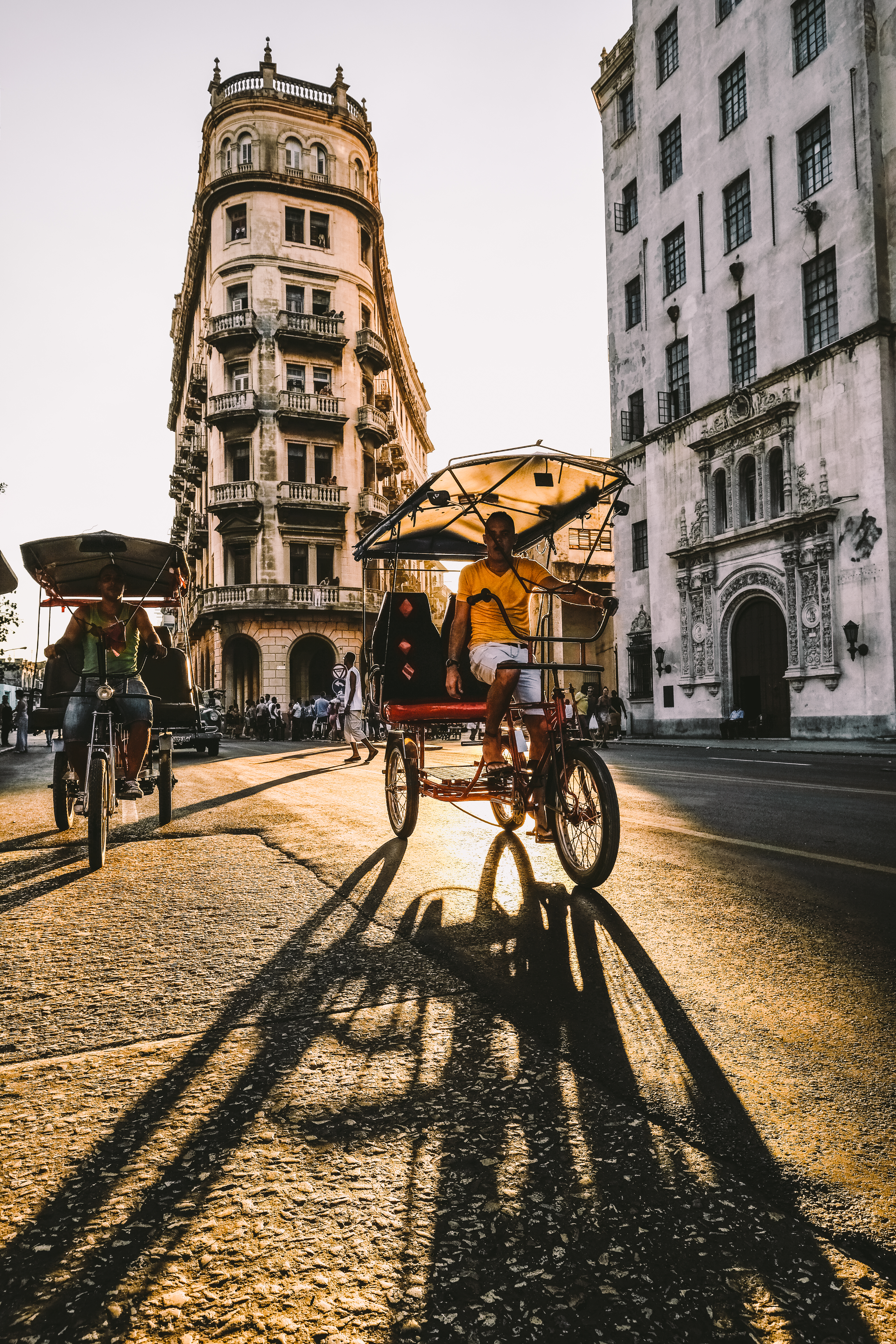
 My favorite part about Havana was the wide variety of subjects scattered throughout the city. It seemed as if every corner I turned there was something new, whether it was a Dalmatian contently sitting on a gritty front porch or a bike taxi that seemed to ride by just in time for perfect light, it seemed as if there was always something that caught my eye.
 I particularly enjoyed shooting the neighborhoods that surrounded the capitol building, Capitolio. I did just about everything in my power to capture the lifestyle of the locals with this interesting structure in the background. From persuading locals two stories above to give us permission to shoot from their balconies, to running behind cars, to playing soccer with local kids to get their approval, I took all measures to capture various perspectives of the Capitolio with fresh subjects in the foreground on each occasion. Thankfully I had a wide variety of range of FUJINON glass to pair with my X-Pro2 and X-T1; the XF55-200mmF3.5-4.8 R LM OIS and XF10-24mmF4 R OIS were my go-to lenses for these photos.
 Another one of my favorite locations in Cuba was Barrio Chino, or China Town. This area was very unique and boasted what I called the Cuban version of New York’s iconic Flat Iron building. I immediately loved this spot after catching an incredible golden hour that saw the sun light up the surrounding area of the building with a warm, glowing light that made for some of the best shots on my X-Pro2 XF10-24mmF4 combo from the trip.
 One of the most noteworthy elements of Havana are the many random puddles that form throughout alleys that provided mirror-like reflections of the colorful cityscapes, classic cars, and great city vibes. The locals would stare at me in confusion when I would stop traffic to kneel down and use the tilt-screen on the X-T1 XF10-24mmF4 combo to capture perfect angles of the glassy puddle reflections.
 As I was composing a reflection shot with my X-T1 on an overcast afternoon among a vibrant alleyway, my cousin called for me and told me I had to stop whatever I was doing and see how beautiful a baby was down the street. My first instinct was to continue to try and get my shot as that sounded a little off, but I got up and quickly walked around the block to catch the little girl and her father just before they were going to enter a home. The young dad had his daughter in his arms, and we she turned around she looked like something out of a National Geographic cover. I had never seen eyes like hers. They had a bright aqua tint of blue that could be seen from a block away. He kindly let me snap a few photographs, and I every time I looked into my electronic viewfinder of my X-Pro2 and I couldn’t believe how stunning this little girl’s features were. Cuba is full of surprises… this experience was a sure reminder of that.
 I’ve never really been an advocate of guided tours under any circumstances. Cuba is one of those destinations that only has so much information that can be found online. In order to experience and capture it properly, you can’t really have a comfort zone. You have to be willing to put yourself out there with a positive and friendly vibe and hope for the best in most instances. We were even invited into a family gathering for drinks in a broken down backyard after approaching a couple locals in hopes of entering their compound to find something interesting to shoot. I lost count of the amount of complexes, homes, and lots we entered (all after asking what seemed like owners or tenants). These were the best memories, and provided some of the best perspectives that will be extremely difficult to replicate.
 One hot afternoon the sunset was quickly approaching, and we were determined to find a rooftop vantage point to capture the moment the light brought warmth to the tattered cityscape of old Havana. After entering a building and passing by locals on each story, all with wide smiles of confusion but acceptance on their faces, we made it towards the top floor. When I looked down, there was the unique spiral staircase I had ever seen. I captured an organic image of the staircase with my X-Pro2 XF10-24mmF4 combo and we made for the roof. Unfortunately there are not very many tall buildings in Cuba; making it a bit difficult to get a great view of the sun setting on the water with the cityscape in the foreground. I completely forgot about the shot I had anticipated when several kids entered through the roof and showed us their pigeon traps, introducing us to some of their birds. I had never seen anything like this, and it really made me appreciate how a simple lifestyle brought joy to these kids. There were no iPads, no PlayStations, it was all about going out and having fun with the neighborhood kids like the old days.
 Growing up, I’ve always loved the game of soccer. I’ve played my entire life, and jumped in on just about every pick up game we came across. Towards the later end of the afternoon we decided to check out a neighborhood called Citio just outside of Havana. Apparently this neighborhood was extremely dangerous for tourists, and upon entering all eyes were on us. After passing by a few young kids playing soccer, I hopped in passed the ball around with them. The ball they had might as well have been a rag… it was completely trashed and lopsided. I offered to buy the kids a new ball, and the look on these kids’ faces was something I’ll never forget… we walked almost 2 miles looking for a store that was open. Along the way, the kids seemed to know all the other youngsters in the area, and our group grew with every few blocks we walked. When we finally found a store with someone inside, we begged the tenant to open her store for us to buy the ball for the kids. My friend Joon and I each bought them a ball that were less than $20 USD each, but it may as well have been a brand new MacBook Pro for these kids. They couldn’t believe it and were so excited to get out and play with one another. Even though we skipped shooting for a couple hours, that was one of the best memories from our trip.
 In conclusion, I highly recommend giving Cuba a visit before it becomes increasingly commercialized. Your experience in the country is up to you. I spent the majority of my time in Old Havana in hopes of capturing an unseen photo, and there are tons of interesting places to see. I was lucky enough to capture my experiences behind my FUJIFILM X Series gear, which never disappointed once. With all the impromptu moments, seconds of good light, and organic situations the X-Pro2 and X-T1 paired with a wide variety of FUJINON glass executed everything I could have asked for.


 By Naomi Butters


