Lenses

Capturing Croyde and Lundy Island with the XF10-24mm & X-E2 combo

Follow Dale as he takes a journey round Devon’s beautiful Croyde Bay & Lundy Island.

As you may or may not know the XF35mm is my ‘everyday’ lens but when it comes to landscape photography the XF10-24mm is my next ‘must-have’ lens. I used to use the XF14mm lens – which by the way is superb, but I’ve realised that I just cannot get enough of that ultra-wide 10mm setting.

I have only been delving into the landscape photography world of late and am still very much finding my feet. When looking back through my landscapes I have noticed that I clearly love the slightly stranger viewpoints, mainly from a wide-angle, ground-up perspective. It may be that the world is just more interesting down there!?

DEVN0154
Focal Length: 10mm (XF10-24mm) – ISO200 – f/4.5 – 1/950 – Ilfracombe Harbour

I like trying to ‘add a little epic’ to my landscapes. The way I have found myself doing this is to locate a small object, whether it be a footprint, a rock etc and get it right up close to the lens. This distorts its perspective and makes it a real important part to the composition. It’s very easy to miss the small details in a beautiful view, so doing this can really shake-up the images and give a new feel to your photography.

DEVN0064
Focal Length: 10mm (XF10-24mm) – ISO200 – f/4 – 1/950 – Lundy Island

We’ve always been told practice makes perfect right? Well, I don’t know if it makes ‘perfect’ but it certainly helps with repetition. I find that the more I shoot, the more I know how a shot is going to turn out before I’ve even turned the camera on. It can give great insight as to whether I should get set up for a shot or move on to a new area / viewpoint.

DEVN0116
XF35mm – ISO200 – f/4 – 1/2900 – Lundy Island – Had to sneak my XF35mm lens into this blog somewhere! 😉

In an effort to create better landscape images I have been using the Rule of Thirds more and more consciously. Across the board this has rewarded me with more “That’s a keeper!” shots.

In addition to this, I’ve been thinking more carefully about where to ‘put’ the horizon line. I usually just ponder which is more interesting – the sky or the foreground? If the sky is more interesting it takes up two thirds of the image and vice versa. I thought the scene below had a more interesting foreground to shoot, so the foreground takes prominence.

DEVN0033
Focal Length: 10mm (XF10-24mm) – ISO200 – f/11 – 1/420 – Ilfracombe Harbour

On the opposite side of things, I found this sky (below) to be more dramatic and I loved how the church had an on-the-edge-of-the-world feel to it. So, I gave the sky two thirds of the frame and the church the lesser attention to increase this on-the-edge-of-the-world theme. I post-processed this one to give it a more matte-like / painted finish.

DEVN01212
XF35mm – ISO200 – f/11 – 1/420 – Lundy Island

The XF10-24mm isn’t just for landscape either, it worked perfectly inside the Lundy Island lighthouse to capture the whole winding staircase – which on a different note, was very steep!

DEVN0096
Focal Length: 10mm (XF10-24mm) – ISO6400 – f/4 – 1/56 – Lundy Island

Sunsets, anyone?

The next few images are some of the best I could get while shooting in the ‘golden hour‘. It’s not an area I have had great amounts of experience with, but, I wanted to share a few tips that could save you some stress as I found out the hard way.

Firstly, give yourself lots of time to get to the location you are going to shoot. Set up and relax way before the sun has started setting. Otherwise, you may find yourself fumbling with ND grad filters and tripods like I was.

I always thought a sunset was a peaceful, enjoyable thing, but when you are trying to shoot it the sun seems to set faster than you can say Usain Bolt!

DEVN0163
Focal Length: 18mm (XF10-24mm) – ISO200 – f/9 – 1/38 – Croyde Bay

The second piece of advice is to know where the sun is going to set. One night I literally found myself running across a beach. I had the camera attached to a tripod while dangerously navigating slippery rocks pools and small sand holes that the kids had dug during the day! I must say though it was some of the most exciting photography I have done in a long time.

DEVN0170
Focal Length: 24mm (XF10-24mm) – ISO200 – f/8 – 1/60 – Croyde Bay

On the bright side, the running down the beach to capture the sunset actually made a picture in itself. Again, emphasising the foreground subject by getting on my hands and knees to put the lens right up close. DEVN0176

I hope you have enjoyed taking my very short tour of some truly photogenic places. Here are some other shots I captured from the trip away that you may like. Any questions, feel free to leave a comment below.

Happy Shooting

Dale

‘Coming round the mountain’ with Dale and his X-E2.

Who doesn’t love a little adventure from time to time? 

My adventure begins with simplest of texts: “Fancy coming to Wales for a week, for free?” sent from my Mum on a weekday morning. Well who could pass on an opportunity like that? I hadn’t done a great deal of landscape photography and knew that this was a great chance to up my skills in this area.

I mentioned my trip to a few colleagues and they suggested I grab some ND Graduated filters to give me more control over the exposure of sky and land. I had never used an ND Filter before, but was excited to give them a go. I knew I couldn’t afford anything decent so I simply bought some £15 (delivered) ND filters with holders on Ebay.

So a few weeks later, fully prepared with all the bits and bobs (tripod, batteries, etc) we set off. I had only been to Wales once as a kid and didn’t remember it that well. All I knew was that I would see LOTS of sheep. Here was a little snap I caught and loved of one of the first sheep I saw there.

Blowing raspberries?

After settling into our holiday home, we planned out the week ahead. This included going into the underground mines, climbing Snowdon, visiting Anglesey and other holiday-type locations.

Destination number one had to be Snowdon as the weather forecast was looking good and we wanted the best visability when we made it to the top. My Fiancée and I decided to take the Snowdon Ranger path as it was recommended as beautiful and not too difficult.

Here are some of the shots going up the mountainside.

WALE0712
ISO 200 – f/7.1 – 1/105 – XF10-24mm
WALE0724
ISO 200 – f/6.4 – 1/120 – XF10-24mm
WALE0788
ISO 200 – f/11 – 1/100 – XF10-24mm

You may notice that the sky has that slight layered darkness to it, that is the ND grad filters. They help darken the sky area so the whole picture can be exposed correctly. Without them the sky would have been bright white and the colours would’ve been washed out. One problem I did face with the ND filters was that because they were cheap, they had a tendency to give a magenta colour cast on the image. To combat the issue, I used Photoshop to target problem areas using a Solid fill layer set to overlay and then picked a more suitable colour.

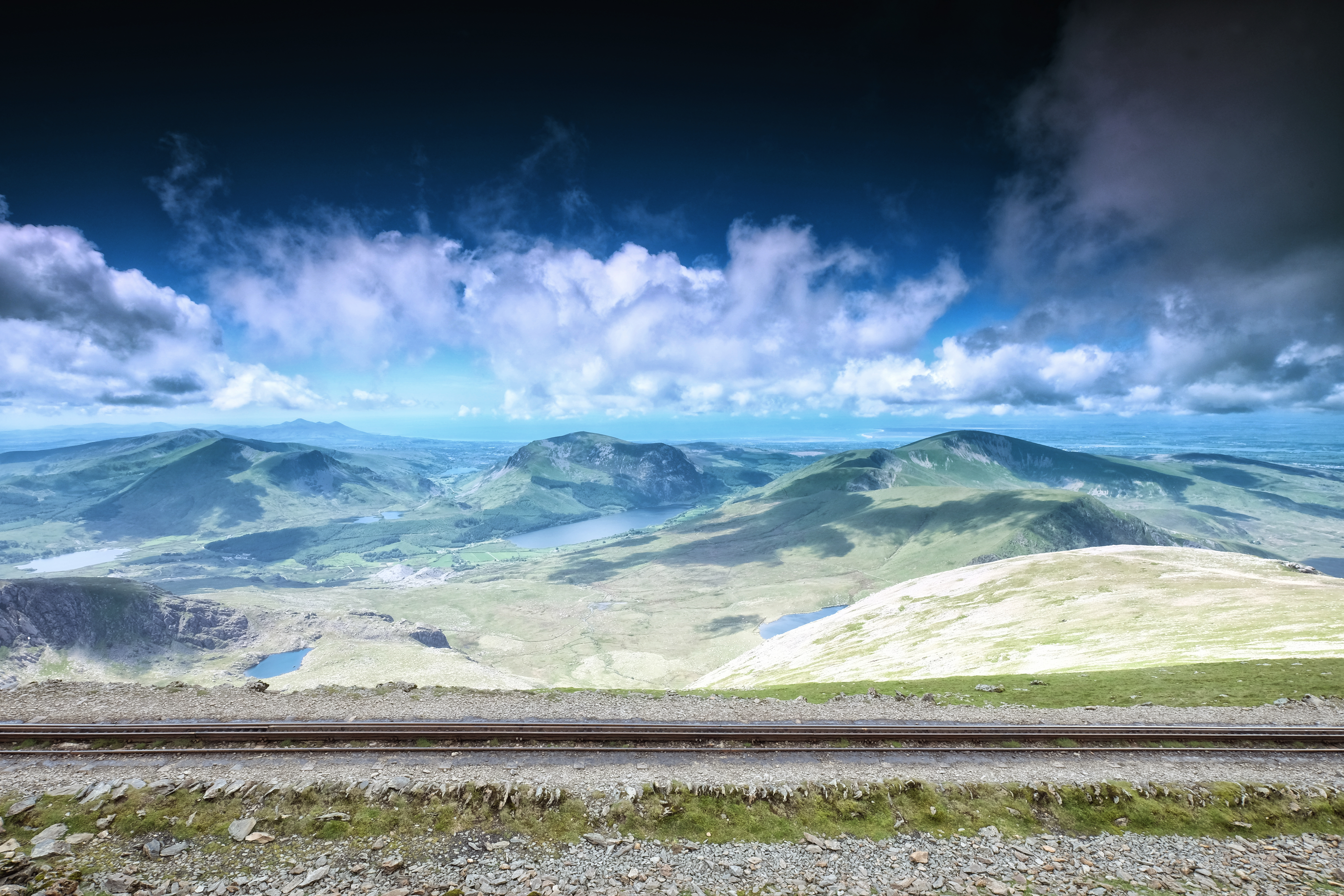
Once we made it to the top we saw the train that runs alongside the Llanberis path. A beautiful train though it was, I am glad we walked up for the sense of achievement and also the train did seem rather old and clunky! Made for a great snap though.

WALE0744
ISO 200 – f/9 – 1/90 – XF10-24mm
WALE0769
ISO 200 – f/6.4 – 1/750 – XF10-24mm

Here is the view from the very top. I boosted the colours a bit in Photoshop but it really was that clear and that beautiful. I highly recommend taking a visit if you can.
WALE0737

Now I love visiting Castles, something about the history and the medieval era interest me somewhat. So it is not surprising that we had to take a trip to the recommended – Conwy Castle. Unfortunately I didn’t get many good shots of the castle itself as I would have wanted to take them from the sea as a landscape shot and we didn’t come in from that side. However, it did give me an excellent viewpoint to trial the ‘Miniature’ mode on the camera. Here are some of the shots taken from the top.

WALE0488
ISO 200 – f/5.6 – 1/125 – XF56mm
WALE0496
ISO 200 – f/2.5 – 1/750 – XF56mm
WALE0490
ISO 200 – f/4 – 1/180 – XF56mm

One of my favourite days out had to be travelling round Anglesey. It was my turn to drive out of the family and I must say it was truly excellent. The roads were full of interest with their twists & turns, cliff edges and mountainous surroundings and the views were simply picturesque – everywhere. I remember I kept saying “We will get a picture here on the way back”, I said that about 20 times as pretty much every corner I turned there was another shot waiting to be taken.

One of the first places we stopped was a little place on the coast that I cannot remember the name due to it being “Oh that looks nice, let’s stop here for a minute and take some snaps”. A couple of hours later we were still there enjoying the views and wandering along the coastline.

Here are a few shots from this ‘unknown’ location using the ND grad filters again.

WALE0613
ISO 200 – f/4 – 1/800 – XF10-24mm
WALE0637
ISO 200 – f/4 – 1/1800 – XF10-24mm
WALE0650
ISO 200 – f/9 – 1/120 – XF10-24mm
WALE0623
ISO 200 – f/5 – 1/600 – XF10-24mm
WALE0644
ISO 200 – f/6.4 – 1/90 – XF10-24mm

Once we had eaten some lunch here we knew it was time to move on to get the ‘necessary’ holiday ice-cream’ from a beach nearby, we chose the beautiful Beaumaris Pier in Anglesey (shot below).

WALE0559
Pier at Beaumaris – Anglesey

We also visited some other piers and beaches on the day. Here are two shots that I was really lucky to find. The first image is of a pier, my feet/shoes were pretty soaked after this one as the sea water was coming up from under the wooden beams! I have post-processed this image firstly into black and white and then colourised it with a blue tone to add to the drama of the shot.

WALE0841
ISO 200 – f/9 – 1/250 – XF10-24mm

The second image was shot on a pier that had this impressive looking building attached, I just loved the look in black and white with all the lines created in the flooring. Again using the ND grad filter to pull some contrast into the sky.

WALE0831
ISO 200 – f/4 – 1/550 – XF10-24mm

The final part of the day was to track down a good lighthouse image. I found the best one near to us to be South Stack Lighthouse. It was pretty difficult to find and quite a walk to it but it was well worth the effort. As mentioned previously in this blog the ND grad filters gave a magenta cast to all my images. With this particular image I didn’t filter much of it out as I loved the colour with this composition.

WALE0681

I have come to the end of my mini adventure and I hope you enjoyed being a part of it. Hopefully it will inspire you to go out and venture among these beautiful landscapes and just have fun.

Dale Young


Fujifilm XF18-135mm Weather Resistant lens first impressions

Image by Ben Cherry

So I got my hands on the new XF18-135mm lens a few weeks ago and I had planned to prepare a blog post about my thoughts and also contain some images showing off just how versatile a lens this was.

However, my colleagues in Japan politely asked me to hold it off because the sample lens I was using was a very early pre-production version and the image quality it would produce wouldn’t do justice to the full production version.

Personally, I think this was just a typically Japanese polite way of saying “don’t publish those images, they are terrible” 🙂

So instead of posting my thoughts (which I will do in time once I have a REAL lens to use) I am simply posting the thoughts of a couple of photographers who have also been using pre-production lenses, but were not politely asked to not publish any image 😉

Please bear in mind that all images on both of these 3rd party blogs were NOT shot on final versions, but I am sure you will find David, Ben and Kerry’s comments interesting:

David Cleland

Image taken by David Cleland

When Fujifilm make announcements about new cameras or lens I always react with acute excitement. Ever since the release of the weather sealed Fujifilm X-T1 I have been longing for the release of their first weather sealed lens. When Fujifilm announced the XF 18-135mm lens with image stabilisation I couldn’t wait to have a completely weather sealed system for out in the Northern Ireland mountains.

Read more »


Ben Cherry

Image taken by Ben CherryImage taken by Ben Cherry

I was lucky enough to be contacted by Fujifilm UK to use one of the prototypes of the XF18-135mm F3.5-5.6 R OIS WR lens to obtain some wildlife shots. Being a part of the Fujifilm X-Photographers is a real honour, and to be asked to try out a prototype lens is an opportunity I am extremely grateful for. Within two hours of the first email being sent I had thought up some ideas on how I could get some wildlife shots.

Read more »


Kerry Hendry

Images by Kerry Hendry

I am not going to write a super in-depth technical assessment of the lens – there will be many who will do that once the fully finished product is released. But, I have been using the lens on almost every shoot over the last 6 weeks or so. I’ve shot racing, polo and also some landscapes – so have given the lens a real ‘hands on’ test. And I love what I’ve seen.

Read more »

Sun, sights & sunburn with the X-E2

I know what you’re thinking, sun on a bank holiday?…. Never.

It sure took me by surprise, so much so, that I didn’t want to waste one drop of it. It was time for my X-E2 to come on a sun-filled adventure to a local Cavalcade. 

I had the chance to borrow the XF56mm lens over the bank holiday weekend and I really wanted to give it a good go. I decided the best way to do that was to only take the XF56mm thus eliminating any other lens choices. I like doing this from time to time as it forces me to think harder about my composition and gets me moving in and out of the action far more regularly.

After battling through the traditional English queuing system for the car park and entrance, I saw a small tent with various furry animals with a few scary ones thrown in for good measure. I snapped this cute little Hedgehog relaxing in a lady’s hat. I can also confirm that he was actually surprisingly soft!

DSCF0133

I also caught this seemingly unimpressed Owl, but I loved the colours in the background that I had to share it with you.

DSCF0128DSCF0143

After moving from the animal kingdom, I took to an area filled with small miniature ‘lands’ and fairgrounds, most of which were handmade by the stall owners. Some were really quite impressive. I knew I could get some serious bokeh effects here using the f/1.2 aperture. Here are some of the results I got.

DSCF0175DSCF0172DSCF0166DSCF0173

After having a go on some remote controlled boats, having a race with my fiancée, and ‘letting’ her win, we stepped outside the modelers tent and saw this clown doing his thing. I love this next shot because of the people in the background watching him go by. 

DSCF0215

One thing you’ve just got to love about days out like this, there are simply SO many subjects to take pictures of. As we strolled across the fiery grass I came across lots of random but interesting scenes. Here are a few of my favourites.

DSCF0211
Find the best expression & give it attention in the composition
DSCF0220
Look to fill the frame for maximum colour impact
DSCF0232
Shoot candid shots whenever you get a chance

A little later in the afternoon after grabbing an ice-cream and putting on some much needed (yet too late) suncream. We could hear the in-house speakers beckoning us to a central location where cars of all shapes and sizes were going to present. This was probably the trickiest part of the day (photography-wise) as the sun was very high, beating down and creating a very bright, high-contrast scene. I wanted to slow the shutter speed down to capture some movement here but had to stray away from the idea due to this brightness. What I needed to have brought with me was an ND (Neutral density) filter. This is best described as ‘sunglasses’ for the lens. Here are some of the shots that came out pretty well.

DSCF0199 DSCF0203 DSCF0190

All in all, this was the perfect day for photography, great light, great subjects and a cracking good lens! The XF56mm never failed to focus once and is sharp as a button. I hope that you all have as good an experience as I did. We would love to see your bank holiday images popping up on our Facebook page and Twitter accounts!


The ‘Bear’ Necessities

1504372_10154010549280534_5836271885610257265_oEver wondered how the X-E2 performs in low-light? I took a trip to a local jam night to find out. 

So, what’s with the title? Well, it is the perfect combination of wanting to carry as little as possible to not hinder my evening and the fact the pub was called The Bear.

DSCF0019
ISO 6400 – f/2 – XF35mm

My aim was simple, have a great night and take some great shots. I really wanted to push the camera and give it a good run in low-light, and inside this pub it wasn’t hard as it was noticeably dark. This allowed me two options; shoot at high ISOs or use fill-in flash. I choose to have a little combination of the two.  When I first arrived, I just took some time to take in all areas of the bar, the lighting, the people, everything and anything that might be interesting as the night went on.

DSCF0043
Can you see why it’s called ‘The Bear’? ISO4000 – f/14 – XF35mm
My brother catching me at work

After taking in the environment, I knew I needed to get a good spot for the music. The best I could muster was a front row ‘stand’ as I couldn’t find a seat at the edge of the stage area.  The lighting in the stage area was still very dimly lit on one side, but quite bright on the other. This made for some excellent contrast, which if you didn’t guess already, I love a bit of contrast in my images.

DSCF0045 DSCF0012DSCF0020


I took a break from the music and went outside with friends, aiding another perfect opportunity to catch some good candid shots. Here is a handy hint I discovered: For great candid shots without being noticed, bring a friend. You can aim the camera at them but focus beyond them to get the ‘actual’ subject you want to capture. Here is a shot that reflects this ‘technique’.

DSCF0034

As the evening went on I just kept snapping away trying to get a blend between abstract and street style. Generally I kept the aperture wide open to ensure the stunning bokeh you get from the 35mm lens, and also to keep the ISO down as much as possible.

DSCF0046

I love the simple, yet powerful message scribbled on a window pane in this shot below.

DSCF0030

After having such a great evening with the X-E2 and XF35mm combo, I thought my luck was all but spent for good photography, then, on the walk home I got just a couple more shots that I was pretty happy with. As it was getting dark and the shutter was very slow, I kept my elbows tight into my sides and always shot the image on my out-breath.

DSCF0049

I also caught some wedding dress makers working very late, maybe it was a short deadline? These are the kind of self generated questions I love when shooting street photography.

I hope you have enjoyed this little blog and it inspires you to keep your camera on you at all times. You really can push the camera and retain excellent quality images that can be enjoyed by all. Here are all the ‘keeper’ shots from the night.


Testing the FUJIFILM XF23mmF1.4 lens

By Matty Graham

Fujifilm’s XF23mm has been hugely anticipated by X-series users, and after testing the optic, it’s easy to see why. With an effective focal length of 35mm, this is a ‘go anywhere, do anything’ lens. Suitable for street photography, landscapes and even portraits.

X-Pro1 - XF23mm - ISO 1600 F/2.5 - 1/640
X-Pro1 – XF23mm – ISO 1600 F/2.5 – 1/640

What most users will do when they unbox the lens, is flick the aperture ring straight to F1.4. I can’t blame them, the larger F-number gives beautiful bokeh, and amazing images, as well as the confidence to work in low light, without the worry of camera shake and blurry images. With most lenses that sport a fast aperture of F1.4 it feels like you’re attaching a dumb-bell to your camera. However, the XF23mm only weighs 300g, making it more than manageable on the X-Pro1 that I used here.

X-Pro1 - XF23mm - ISO 400 F/1.4 - 1/850
X-Pro1 – XF23mm – ISO 400 F/1.4 – 1/850

The aperture ring takes you through from F1.4 to the minimum aperture of F16. Instead of the typical AF/MF switch, the XF23mm features a push/pull ring that switches between manual and autofocus. There are also distance and depth-of-field scales on the barrel.

When using wider optics like this, there are usually two main areas of concern – barrel distortion and vignetting. However, the XF23mm aces both categories with virtually no distortion and vignetting is handled extremely well – even at F1.4.

X-Pro1 - XF23mm - ISO 800 F/1.4 - 1/2400
X-Pro1 – XF23mm – ISO 800 F/1.4 – 1/2400

The quick, sharp focusing that this lens offers is down to the internal focusing (IF) technology, which delivers speedy and discreet autofocus – let’s face it, you don’t want the lens to be buzzing away as you try to find focus during a candid street photography situation. Because of this internal focusing, the front of the lens doesn’t rotate. This benefits landscape photographers who use graduated filters.

X-Pro1 - XF23mm - ISO 500 F/8 - 1/60
X-Pro1 – XF23mm – ISO 500 F/8 – 1/60

When it comes to results, the XF23mm really delivers. The lens is sharpest at F8 and when I say sharp, I mean razor sharp – professional photographers looking to invest in a lens of this type will not be let down by the results.

Excellent build-quality, simple ease-of-use and results to die for; what more could you ask for?

Enjoy the bokeh…

X-Pro1 - XF23mm - ISO 800 F/1.4 - 1/2000
X-Pro1 – XF23mm – ISO 800 F/1.4 – 1/2000