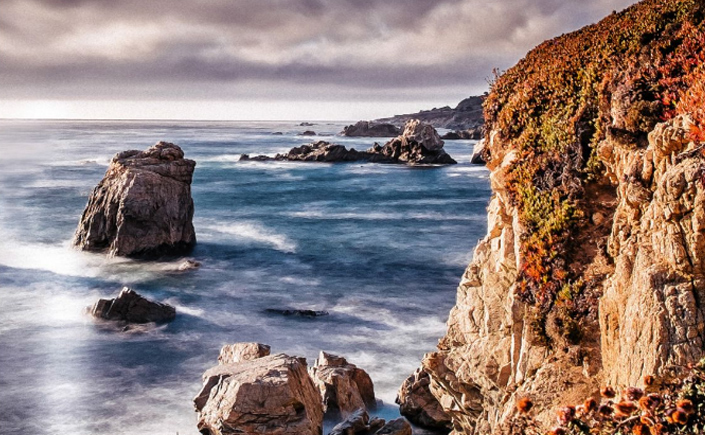
Tom Applegate travelled through Europe earlier this year, taking a Fujifilm X-T1 to document his journey. See a selection of his shots and read how they were taken.
Daniel the Camera Bag from Millican is up for grabs and he could be yours. Just answer a simple question to be in with a chance of having him on your shoulder!
The shoot with Jimmy White came about through a long running association I have with a media company in Liverpool that specialises in sport personalities biographies – basically I shoot the book covers for them. It’s a collaborative thing on some of the shoots we both think of ideas/concepts etc ideas for the shoot and book cover and how it should look.
Kit used and settings?
This shoot was slightly different as I was out on tour with The 1975 at the time, so my car was packed full of equipment. My Fuji bag was packed full as I took everything with me on tour! But the main lenses I used on the shoot with Jimmy were my trusted 23mm & 56mm lenses, combined with my XT1 bodies. I love both of these prime lenses.
How much time did you have?
For this shoot, I had a couple of hours. Unfortunately things never go to plan and although I left Glasgow at 5:45am to drive to Liverpool for 9:00am, I hit major road works just outside Liverpool town centre, which made me half an hour late.
Luckily for me, Jimmy was late too.
The worse thing I can find as a photographer is rushing to set up while the client is waiting for me to start shooting. It’s my pet hate if I’m honest. I like to be ready and waiting as the subject walks in, with all my lighting tests done.
How accommodating was he?
Jimmy was fantastic. A really nice guy, he went along with all the ideas that we asked him to do.
Did you use any additional lighting?
I have to set up my portable studio whenever I shoot a book cover like this, so I carry everything with me. Backdrop stands, backdrops (white and black) light modifiers and finally my lights, which I carry up to 4 Bowens heads with me.
I’m like a pack horse!!!
How much interaction do you have in a situation like this with the subject?
There was a lot of interaction with Jimmy on the day. He was totally up for the ideas that I asked him to pose for. He was truly a great guy!
Would you do anything different next time?
Yes, I’d make sure to get there earlier and set up before the subject arrives haha. Even look at the traffic reports!
Any tips for amateurs trying to get this style of shot?
Make sure your lighting ideas work! It’s no good changing your mind on the day when your subject arrives. Also, do your research; try replicating lighting techniques that you have seen on other models shoots online or in magazines.
About Tony
Tony has shot some of the biggest rock bands on the planet today – Foo Fighters, Red Hot Chilli Peppers and The 1975, with over 20 years photographic experience.
In February 2014, during my first ever trip to Japan to attend the CP+ Show in Yokohama, I was also lucky enough to be present at one of the early planning meetings for the X100T, along with a few carefully selected professional photographers – Yukio Uchida (Japan), Bert Stephani (Belgium), Gianluca Colla (Italy) and Kevin Mullins (UK). Each one of the photographers used Fujifilm CSCs for their work, but also an X100S for personal work, and some professional work where it suited. After spending a few days talking about how our equipment affects their working lives in a positive light, they were given very specific instructions to tell us exactly what they didn’t like about them.
Less than seven months on and I’m holding in my hands a pre-production version of a camera that was based on many of the subjects discussed in this meeting.
How do you make something “more perfect” ?
There were two sides to the meeting. First up, the Japanese developers worked through a list of their ideas to understand what the photographers thought of them.
I paraphrase of course but here’s kind of how the conversation went:
Developers: Do you want a full-frame sensor? Photographers: No because the camera would need to be bigger and that would degrade the purpose of the camera
Developers: Would you like an f/1.8 or larger aperture lens? Photographers: As above. No because the camera would need to be bigger.
Developers: Would you like a tilting screen? Photographers: As above again.
At this point you could see that the Japanese product developers are getting a bit nervous. How can you further evolve and develop a product if the users of the product are already perfectly happy with the existing one?
Developers: Does it need an Electronic Shutter? Photographers: Not sure… what would be the benefits? Developers: Shooting much faster shutter speeds, even with the aperture wide open – no need for the ND filter
OK finally we have our first TICK!
Developers: Would you like better movie functions? More frame rate options, manual exposure control? Photographers: Yes, as long as it doesn’t have any effect on the camera’s ability to shoot stills
And another TICK. We’re really cooking now.
Developers: What about Wifi? Photographers: Would be useful, as long as the camera doesn’t get any bigger
Developers: How would you like to be able to use manual focus while shooting OVF? Photographers: We’re listening…
The developers pulled out a concept modified X100S with a special LCD panel installed outside the Optical Viewfinder. They went on to explain how this LCD display would actually be inside the camera and the user can switch on or off the ability to fine-tune the focus without switching from OVF.
I’ve had a go with this on the pre-production version and I can really see the value. I’m a big fan of coloured focus peaking so to be able to have it while looking through an OVF is really nice. It’s quick to toggle on or off, much faster than switching between OVF and EVF, so you can pay attention to the frame and just check the focus when you need it.
They then went through a pretty long list of changes / enhancements etc… of which a lot made it into the X100T I’ve got in my hand.
“We will consider”
In my experience, one thing that Japanese people hate to do is to outright say the word “no”. Every suggestion for a change to any of our cameras always gets one of these two responses:
“We will do this” – this actually means “We have already done this”
“We will consider” – And they do!
Next up in the meeting it was the photographer’s turn to suggest changes, all of which met one the answers above. Here are a few things I remember our guests asking for. This is not to say that these were not already in consideration by the development team.
Ability for the user to customise the Q menu – check
Standardise the main layout of the camera controls – time will tell on this but the X100T button layout is more like the X-T1 than the X100S, particularly on the user’s right thumb.
The rear controls of the X100T are more like an X-T1 than an X100S
Various different film types to be considered to be added to the list of Film Simulation modes – Classic Chrome making it into the range
More Function (Fn) buttons – check
Black version available at launch – check
Everything above, but retain the same size, shape and pretty much weight as the X100S and X100 – check
It’s not to say that the entire product was built from that one single meeting. Of course not. The team in Japan do an amazing job considering requests from Fujifilm staff and professional photographers all over the world. It is this constant ability to listen to feedback and then build on it that makes this an incredibly exciting and rewarding place to work.
On top of these changes, here are a few others that I’ve heard customers ask for that have made it in:
Allow users to select the AF area with the 4-way controller, without pressing the Fn Key.
AUTO ISO “profiles”
Ability for Exposure compensation to still work when the camera is in M mode, as long as the ISO is set to AUTO
Aperture ring moves in ⅓ increments.
Increase the grip on the manual focus ring
And finally some nice changes that made it over from the X-T1:
Coloured Focus Peaking
Remote shooting / wireless image transfer
Awesome updated GUI that rotates based on camera orientation
Interval Shooting
3 stops Exposure Compensation
Here’s what my X100T will look like when I get it. Much love for the WCL-X100
Conclusion
The whole experience opened my eyes to what an amazing company it is that I work for. Staff and customers alike have a voice that is constantly helping to shape future development to produce the perfect products.
Many of these changes have been added to already-released cameras via free firmware updates. In my opinion this is a great move by Fujifilm as we are relatively new (this time round) to the professional end of the market and building trust is very important to help us gain a good reputation.
But whether we’re able to update existing models, or evolve the models with newer, improved versions, the reason it is working well is because everything is being carefully developed based on what actual users want. I’ve now seen this with my own eyes, and hold the proof in my hands.
改善 (kaizen) – Good change.
Come and see the X100T
The Fujifilm X100T will be available to get your hands on in the Touch & Try section of the Fujifilm stand at Photokina 2014 – Tuesday 16th September to Sunday 21st September at the koelnmesse Trade Fair and Exhibition Centre in Cologne, Germany.
We recently held a small internal training course for the Fujifilm UK team and we asked professional photographer Paul Sanders to join us and help teach us more about landscape photography. After spending some time with Paul and listening to him talking about his work and his thought process in regards to photography, it became apparent that Paul had a very interesting story that I’d love to share.
Below is Paul’s story from being a trainee photographer in 1991, up to his current passion, hobby and luckily for him, profession – Fine Art Landscape Photography. If you have any thoughts or questions for Paul, please feel free to leave a comment at the bottom of this blog.
Fine Art Landscape Photographer Paul Sanders
“I’ve been involved in news photography since 1991 when I started as a trainee photographer at The Daventry Express in Northamptonshire. I’m incredibly driven and knew straightaway that I wouldn’t settle for life on a weekly newspaper, I wanted the big time, the only place I could see myself working was for a national newspaper and one in particular; The Times. I think essentially it was because The Times is in my opinion the best newspaper in the world for it’s reporting and accuracy. I got my head down, worked hard sacrificed everything, relationships, family, friends and social life all in the single minded pursuit of my dream job.
X-T1 with XF10-24 @10 – F8 – 120 Seconds – ISO200
“By 1998 I was working for the international wire agency Reuters in London and in 2002 I got the call from The Times to join their team. When The Times changed from broadsheet to the more modern compact format I was given the job of revitalising the way pictures were used in the new format. Finally on 1 April 2004 I was made Picture Editor, I had total responsibility of the entire visual content and a team of the finest researchers and photographers working with me. To say I was in my element was an understatement. However success at that level comes with a high price. Daily I would view between 17 and 20 thousand images, direct photographers, manage budgets, layout pages and train young hopefuls. By 2010 I had reached breaking point, I suffered with chronic insomnia and depression, my marriage started to break down and the wheels came off my train. I hid this all from the world until December 2011 when I announced that I was leaving the job I had pursued for years.
“When you have a breakdown your body and mind are telling you to change a few things, I needed to slow down, take stock and recover. My recovery began with shooting large format landscapes. I’d wander the country 5×4 camera and tripod over my shoulder trying to be Ansel Adams or Joe Cornish and failing miserably. The process of shooting film again slowed me down, enabling me to organise my mind a little and start to get in touch with the joy of photography. In many respects my early foray into landscape work was such a failure because I wasn’t being true to myself – I wasn’t connecting with my subject at all.
X-Pro1 with XF14mm – F16 – 140 Seconds – ISO200
“During 2013 I had an epiphany in seeing, I realised that actually it was ok to shoot the images I wanted, not the classic views, but using my emotional and spiritual connections with the landscape to create images that resonated with my soul. I had switched from 5×4 to DSLR during 2012, to save weight and money. Still I was finding it hard to work, I would always think can I be bothered, many times I would lug my equipment to a location and not bother getting it out of the bag; it was too much hassle. I wasn’t enjoying my work at all.
“However what I had realised was that to truly see what I wanted, the sitting, watching and listening had really opened my eyes and my heart to the images I wanted to create. What I needed was a camera that didn’t get in that way of my connection or creativity.
X-Pro1 with XF14mm – F22 – 1/2 sec – ISO 200
“In early 2014 I handled the Fuji X-T1 for the first time and instantly fell in love, I actually had goose bumps on my skin, such was my connection with this camera. It was a bit like the moment Harry Potter picked up his wand for the first time!
“As soon as they came to market I bought two, a variety of lenses, and swapped out much of my DSLR equipment totally committed to these tiny miracle workers.
XT-1 with XF55-200 @ 100mm – F4.5 – 1 second – ISO320
“My energy and creativity were revitalised, the camera wasn’t in the way, it was literally a plug in to my imagination allowing me to record what I wanted in the way I wanted without the weight or cumbersome nature of my previous equipment. I pushed myself out of my comfort zone and shot the images I had been feeling. I stopped trying to be accepted by the majority and concentrated on being true to myself. If no one likes my work really it doesn’t matter to me at all. If people do and I sell a few pictures then that’s a bonus.
“I still sit for hours watching and feeling the landscape in front of me, but now I feel that I am truly connected with my work through the little Fuji. The X-T1 isn’t a barrier like my Canon, it’s a conduit. They are virtually invisible to me, instinctively my hands fall in all the right places, there’s a wonderful simplicity to them which helps me as I’m quite simple in many ways too. The less complex the process of making pictures the less I have to be concerned with. I have no desire to pixel peep or get bogged down in the technical arguments about shadow detail or sharpness, I just want to create images that please me.
X-T1 with XF55-200 – F16 – 180 Seconds – ISO200
“The work I shoot now totally reflects how I feel about the world and myself, I can pour my soul into those little black bodies and know that they are keeping it safe for me.”
For those who don’t know, Aspire Photography are based in the Lake District. Set amongst the beautiful and dramatic landscape, along a windy road and built within converted stable yard, you have to walk over an old cattle grid to enter. This may not sound like a very poetic or creative start, but hang on a mo. As you walk over the cattle grid something really rather magical happens. You can’t see it, you can’t smell or taste it, but you can feel it. It’s as though invisible fairies are perched on the gates and sprinkle you with fairy dust as you walk into the entrance.
You may be thinking that I’ve had a bit too much to drink, or perhaps been out in the sun for too long, but bear with me.
Aspire Photography (rather, multi-award winning Aspire Photography) are a very special group of photography trainers, running courses for all different levels throughout the year. They specialise in styled shoots and empowering photographers to understand how they can become better photographers, and how to run a successful photography business. They also have a strong, but by no means exclusive, female engagement. It’s not just down to things looking pretty, or sets being styled to the most amazing standard. What Aspire teach is that it’s a totally safe environment to ask questions, to challenge your limits and to play – to really play with photographic techniques and leave with a portfolio of new images and a fresh outlook on your personal style of photography.
One of the reasons we wanted to engage with the Aspire “tribe” is because the X-Series of CSC cameras has really connected with female photographers – they love how light the system is, the amazing image quality and the damage limitation the price point has on their business expenditure.
The day started with Kerry Hendry, our first UK female photographer, talking us through her journey from Nikon to Fujifilm. Why did she decide to make the switch? What did it mean to her style of photography? We then move on to the technical aspects of the X-T1, X-Pro1 and lens line-up. There’s a mixture of attendees. Some are curious and open to the idea of the X-Series and others are already X converts but want to know how to get more out of their camera.
After lunch the real fun begins, and I mean the opportunity to play! Three models have been dressed to embrace the Midsummer’s Night Theme and amazing stages of beautiful woodland fantasy scenery were created to make an amazing photographic landscape. Everyone was encouraged to interact with the models, to capture stunning still images that would demonstrate the creative capabilities of the camera and to have fun. The images from the day, from all the attendees were stunning.
I interviewed both Kerry and Catherine to understand their view of the day:
Going back to using Fuji has been a remarkably natural progression for me. I shot grainy Fuji film as a teenager and fell in love with the Fuji way right back then.
I am the one who misses the smell of film in the fridge! More recently I’d gotten drawn into the whole ‘bigger is better’ perception – and that’s all it is, a perception – and it just didn’t feel right. I was looking to find my photographic mojo again – and bought a Fuji X-E2 and one kit lens, and I’ve not looked back.
I adore the unique image quality the Fuji’s produce, after all, quality is still the primary influencer. The smaller, lighter system gives allows me to feel free again – to try new things, to capture landscapes without 10kg of kit in my bag. Travelling light in any respect is liberating – and for me, using Fuji kit has made me excited about photography again, given me new inspiration – and it also seems to bring a smile to my face.
I’ve worked with Aspire for almost a decade, in a marketing capacity and as a photographer – the Aspire way really does change your life!
The team teaches you to look at your strengths, concerns, opportunities, your creative ‘wish list’ and so many other aspects of becoming a better photographer – whether that’s as a hobby or with the aim to going pro. And then of course, they help you achieve these goals.
On the Aspire/Fuji courses we leave the every day aspects of life – pressures, distractions and worries – at the Aspire gate.
Once you drive onto the estate it’s all about freedom to express your creativity within – while learning and developing too.
On the Fuji days of course we talk kit – and there’s the opportunity for guests to try and of the cameras and lenses they like – including all the latest releases.
Many courses will talk theory, but there’s no better way that putting what you learn, or new things you want to try, straight into practice on a professionally styled shoot.
It’s the perfect opportunity to capture amazing images for your portfolio, or simply immerse yourself in a friendly, explorative environment in which to learn.
Think gorgeous models, magical styling, likeminded new friends to work with, technical expertise to quiz – and of course Fuji freedom & fun!
Catherine –
Aspire Photography Training designs educational programs that teach and inform whilst inspiring those to push the boundaries of their photography.
We train those that have a keen interest in photography and those who are passionate about photography. Whether you are a hobbyist or seasoned professional we have a range of courses to suit all. We have been a significant influencer on some of the best businesses in the UK. Education is at the core of all we do.
We believe the Fujifilm X-Pro1 range will revolutionise the perception of what a professional photographer should look like and already is essential gear for a professional to have over their shoulder. Women and men alike are leaping to change over to the X range, all for differing reasons. We have witnessed photographers reach out to the X-range to seek sheer quality of the product, we also have seen many photographers change to the X-range to liberate themselves from an overweight camera bag, enabling them to deal with any scenario with ease. The Fuji X-Pro1 is high on Aspire’s agenda, we will be giving this camera and system a great deal of conversation, time and training space. The X range is making it’s mark with the professional photographers who are at the coal face of weddings, commercial and portrait shoots, mainly due to the freedom given and the sheer level of technical ability it gives them on a daily basis.
Aspire Photography Training is all about looking ahead, liberating and thinking out of the box. In fact we don’t even have a box, just a broad and open mind to all the possibilities photography can give you when you choose to think creativity.
The next Aspire and Fujifilm workshop takes place on Wed 20th Aug, in the Lake District.
It’s that time again. A new Fujifilm X Magazine issue is ready to your reading and viewing pleasure.
Interview with Merhdad Samak-Abedi
This issue features an interview with pro photographer Merhdad Samak-Adebi who travels the world as part of his job (working for a German airline) and therefore is lucky enough to get the opportunity to shoot his passion – landscape photography.
Merhdad Samak-Abedi interview
Merhdad Samak-Abedi interview
Merhdad Samak-Abedi interview
Take a walk around Varese, near Milan
This issue’s “X Marks The Spot” features some fantastic street photography by Italian photographer Emanuele Toscano in and around Varese, Italy.
Emanuele Toscano
Emanuele Toscano
Emanuele Toscano
Be inspired
Issue 6 also contains the other usual features; “What to Shoot Now” provides you with inspiration on what subjects to shoot during the summer holiday months, “Get more from your X series” takes a look at bracketing functions that feature on most Fujifilm X cameras and the “Exhibition” shows a fantastic array of colourful images, plus the stories behind them, shot by our readers.
What to shoot now
Get more from your X series
X Magazine exhibition – Colour
Competition time
Fujifilm X Magazine competition – win a Fujifilm XQ1 underwater kit
And finally, you could win a fantastic XQ1 underwater kit in our competition. For a chance to win, send us your best holiday shot. More details in the magazine itself!

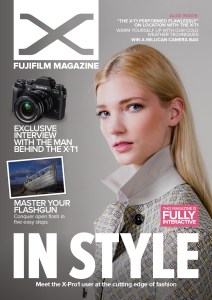 Issue 7 of the Fujifilm X Magazine is now available to view online, or download to your mobile or tablet via the Android or Apple app.


 As temperatures cool down, photo opportunities hot up! We offer tips and advice to help you make the most of the colder conditions.


 “I’ve been involved in news photography since 1991 when I started as a trainee photographer at The Daventry Express in Northamptonshire. I’m incredibly driven and knew straightaway that I wouldn’t settle for life on a weekly newspaper, I wanted the big time, the only place I could see myself working was for a national newspaper and one in particular; The Times. I think essentially it was because The Times is in my opinion the best newspaper in the world for it’s reporting and accuracy. I got my head down, worked hard sacrificed everything, relationships, family, friends and social life all in the single minded pursuit of my dream job.


 After lunch the real fun begins, and I mean the opportunity to play! Three models have been dressed to embrace the Midsummer’s Night Theme and amazing stages of beautiful woodland fantasy scenery were created to make an amazing photographic landscape. Everyone was encouraged to interact with the models, to capture stunning still images that would demonstrate the creative capabilities of the camera and to have fun. The images from the day, from all the attendees were stunning.