black and white photography

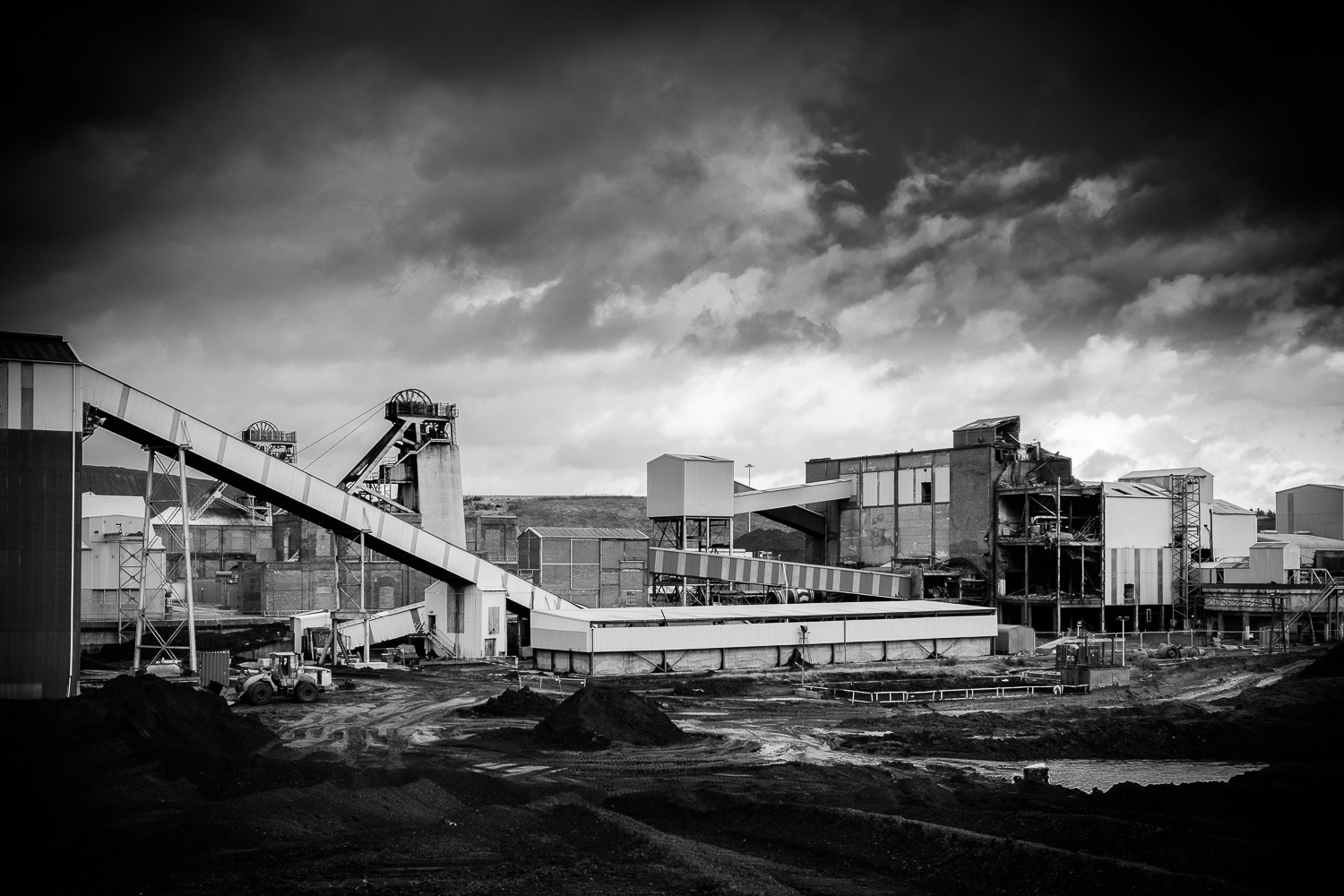
Thoresby. The end of an era

By Chris Upton

personThe 10th July 2015 was a landmark date in the history of Nottinghamshire. When the last shift at Thoresby Colliery finished on that day not only did it mark the end of 90 years of mining in the village of Edwinstowe but it signals the end of mining in Nottinghamshire.

The pit opened in 1925 and over the years has employed tens of thousands of local people. It was one of 46 coalmines in Nottinghamshire, which supplied more than 14 million tonnes of coal per year at their peak in the early 1960s.

The first two shafts were sunk to 690m in 1925 and subsequently deepened in the 1950s to the current pit bottom at around 900m depth.

Thoresby Colliery was the first to have fully mechanised coal production and also the first to achieve an annual saleable output of more than a million tons, it became a star performer in the British coal mining industry.

In the late 1980s it raised output to exceed 2 million tons, regularly smashing it’s production records, and the colliery became known as the Jewel in the crown of Nottinghamshire mines. A crown sits proudly on the headstocks in recognition of this achievement.

When the coal industry was nationalised in 1947 it employed a million men at 1,503 pits; prior to the miners’ strike in 1984, there were 180,000 miners at 170 pits. Today there are just two deep mines left, employing about 5,000 men, at Thoresby and Kellingley in Yorkshire. Kellingley will suffer the same fate as Thoresby and closes in the autumn.

UK Coal say market pressures have led to the closure of Thoresby Colliery. Coal generates more than a third of Britain’s electricity, but it is cheaper to import coal from countries such as Russia, South Africa and Colombia than to mine it in the UK.

For the past few months I have been recording the colliery, it’s buildings, plant and people for posterity. It was my aim to create a comprehensive record of the pit at a specific point in time immediately prior to its closure.

It was a chance conversation after giving a camera club lecture that started the ball rolling. A chap in the audience worked at Thoresby and was unfortunately in the first wave of redundancies. He asked if I would be interested in visiting the colliery to take a few pictures. It was a fantastic opportunity and I jumped at the chance. He put me in touch with the Health and Safety manager, I explained what I would like to do and we were off and running. It was at this point, after I had gained their agreement to document the colliery, that the full extent of the task dawned on me.

Starting the project

I visited the colliery on seven occasions, at different times of day, in different lighting conditions, including dawn and dusk. I planned each shoot but found that an outline plan whilst retaining a degree of flexibility to react to opportunities worked best.

At the outset I just toured the site to give me an understanding of the buildings, the machinery, the operation and the people. I took snaps to create a digital scrapbook to help me plan my approach. Essentially I was imbibing the atmosphere much as I would do when visiting a foreign destination for the first time. I wanted to get a real feeling for the place before I started the photography in earnest.

Health & Safety manager Grant was so supportive of my visits giving me more time than I could have wished for.  Even coming in at 3.30am for a dawn shoot and returning to work late in the evening to get “the best of the light” didn’t diminish his enthusiasm. In fact he joked that, after watching me, he would now be able to take the best holiday snaps ever! I hope he does.

20150617_thoresby_0049-Pano

Gear used

All of the images were shot on a Fujifilm X-T1 or X-E1 camera using a selection of Fujifilm XF lenses including the 10-24, 18-55 and 55-200 zoom lenses and 14, 23, 35 and 56mm primes. I also used a Nissin i40 flash for some shots, though preferred to use natural light wherever possible.

For my portraits, the unobtrusive Fuji equipment allowed me to concentrate on building a rapport with my subjects rather than intimidate them with a large DSLR and f2.8 lens combination. Miners might be tough guy’s and supermodels they certainly are not but they seemed to relax pretty quickly in front of my Fuji lenses.

20150701_thoresby_0111

20150319_thoresby_0288-Edit-2

There were several challenges to overcome not least the light levels that were typically pretty low in all of the buildings. Because of the poor light I used a tripod fitted with a ball and socket head for as many shots as possible. My cameras are fitted with arca swiss type plates so that I can switch from landscape format to portrait very easily and without having to waste time readjusting the tripod.

The mix of different light sources from tungsten, to fluorescent and natural meant it was difficult to assess the ideal colour temperature. However the decision early on to convert all the images to black & white certainly helped counter that problem!

In a coal mine dust was another inevitable and unavoidable issue. As the miners told me it’s not only the dust you can see that is the problem and I was very careful when changing lenses and using two bodies certainly helped. Thankfully the in camera sensor cleaning worked well and I was pleasantly surprised at the minimum amount of dust spotting required.

20150422_thoresby_0189-HDR-Edit

Working on a project

As my photography has progressed I have found that I prefer to look at a series of images that tell a story rather than seeing individual impactful pictures. Whilst I have adopted this storytelling approach in my travel and landscape photography this project was a whole different ballgame. This wasn’t going to be a six or ten image set but a large body of work that had to be planned and created in a certain style. I found this experience fascinating, though at first it was pretty daunting. However after a couple of visits I had captured some shots I was very pleased with and the plan started to fall into place. I think the discipline required in a project such as this has helped me to improve my photography and it felt good to be succeeding in this new genre of social documentary photography.

In an attempt to capture the “feel” of the colliery, and to bring completeness to the project, I also recorded various sounds around the pit and organised a series of interviews with miners past and present. I will be producing mini AV’s including these sounds and using the miner’s comments in my presentations.

20150115_thoresby_0097-Edit

20150115_thoresby_0006-Edit

Stretch yourself

It is very easy to stick to what we know in photography and limit yourself to a particular genre. Whilst my experience as a travel photographer, where you are required to be adept at many different genres, undoubtedly helped me there were aspects of this project that were not so familiar. As a result I feel I have grown as a photographer and I would urge you to move out of your comfort zone and try something new. There will be similar opportunities in your area, seek and ye shall find!

20140723_thoresby_0046-Edit

Capturing a piece of history

As I progressed through the project I realised that I was not only taking pictures for myself but that I was actually recording a piece of history, an enduring record of a place that, in just a few months time, would be gone forever. With that came a feeling of responsibility, not only to do myself justice but also to represent the life and work of the mining community. Apart from my family photographs, this project is the most important and worthwhile piece of work that I have ever created. Whilst there is clearly interest in the work now, what will its importance be in another 10 or 20 years?

20150115_thoresby_0052-Edit

A personal perspective

This project has been a fantastic experience. It has improved my photography, taken me into a different genre and enlightened my knowledge of an otherwise mysterious industry.

It has been a pleasure to work with the team at Thoresby, without whom I would not have been able to produce this body of work. Whilst the colliery may not draw its workers from the immediate village area, as in years gone by, their camaraderie, team spirit, hard work and no nonsense attitude in this tough and uncompromising industry epitomise the best of British workers. The closure of Thoresby truly is the end of an era.

20150513_thoresby_0257

20150513_thoresby_0267

What next?

I feel it is important to showcase my images to as wide an audience as possible, especially in the local area. Therefore, after securing feature in the local and national press, I will be staging a major exhibition in Nottinghamshire and am planning to produce a book – more details to follow.

To see more Thoresby images and to keep updated on the project developments please visit my website  www.chrisuptonphotography.com

20150422_thoresby_0301-Edit-3


X-Photographer’s Spotlight – Matthew Maddock

Tell us about yourself and what got you into photography? How did you develop your style in photography?

I’ve been interested in photography since I was young. I always had a fascination with images and imagery and would love to be able to draw, but I just couldn’t do it so photography became my outlet for getting images onto the page. Developing a style is something I’ve written about in the past and I think it is a trap I think a lot of people fall into, myself included, whereby we try hard to develop a particular style that we think will make us stand out. The problem is that whilst you’re trying to develop that style you end up jumping from one thing to the other with no real direction. I’ve found that by just doing what I like my own natural preference for shooting comes out in the end, which then organically becomes your “style”.

I sometimes like to use the lighting equipment as an element in a shot, even deliberately put it into the shot and work with it. I’ve had a number of criticisms for it online, but it’s what I like to do and eventually has become a part of my style. I don’t really care what others think if I like the image myself.

my-style-1

Why did you choose Fujifilm cameras?

Initially I was looking for a complement to my Nikon dSLR that I could carry around every day, mainly for pictures of family when the Nikon would just get in the way.  I went through series of mirrorless cameras until I picked up the X100, which instantly had me hooked.  I purchased the X-Pro1 as soon as it came out, it came with me on jobs, and I soon realised that I wasn’t using my dSLR any more and sold all my dSLR gear.  Since then I find using mirrorless, and the Fujifilm X-Series in particular, a much more natural way to shoot.  It made me slow down and think before I took an image, it means I shoot far fewer frames, but keep many more of them.  I actually find it quite an awkward experience going back to shooting with a dSLR if I ever pick one up these days.  Live preview, and in particular an instant image preview without having to take your eye from the viewfinder makes for a much smoother shooting experience.

why-fujifilm-1

Do you have a photographic philosophy you live by?

Shoot what you enjoy. For me photography is a passion, if I was forced to shoot things I didn’t like just to earn money I would no longer want to do it. I’d rather be a part-time photographer and enjoy what I did than be full-time and moan about it. If I ever became a full-time photographer I’d have to specialise in a field that I wanted to shoot in and work hard until I was well known enough to only shoot those types of images.

Photography for me is a never ending journey of improvement, if you’re not improving then you’ll get left behind. I see shots I took even just a year ago and find them difficult to look at as I find so many elements in them that I know I could have done better if I shot them now. That’s not necessarily a bad thing because if I ever get to the point that I’m comfortable then I’m pretty sure I would soon get bored.

philosophy

Key inspirations – What & who inspires you?

The people who inspire me have changed over the years, and it very much depends on what type of thing I’m doing, there are far too many to mention. My real passion is environmental portraiture, initially that was in a reportage style, but I tend to prefer to set things up now and shoot with portable studio flash or speedlights. My current inspiration comes from a variety of photographers who really understand and know how to control light, Tim Wallace, Damien Lovegrove and others, but there are many amazing images shot by amateurs. You only have to look through Flickr or 500px to see images that in many cases are better than a great number of full-time professionals.

Although it can be hard, I try not to simply copy what others are doing, but use their work as inspiration for my own.

Never underestimate the strength that a good model can bring to a shoot. The model is so often forgotten in favour of the photographer, but a good model can bring at least as much to the image as a photographer, especially if you are inexperienced at shooting people. I often bounce ideas off a model before a shoot and it can very much become a collaborative work.

inspiration

Do you have any tips or tricks you could share with us?

I’m a strong believer in educating yourself. I spend a lot of time looking at images, reading and learning about photography. Workshops, reading and watching videos online have proven to be the most useful things I’ve done. Before you go out and buy something that you think will help you improve, learn to use what you have and then you will understand better why you need that new camera or lens rather than buying it thinking it will improve your photography. I’m good with the technical, but struggle with the artistic side of things. Zack Arias told me a couple of years ago to set myself small projects and run with that for a while, shooting only lines, circles, or only things that a red, then only red lines, etc. It does help.

Take as little with you as possible when you do shoot. For personal projects I rarely take more than one camera and one lens with me. Not only will you be thankful by the end of the day that you didn’t carry around a bag full of gear, but you will have spent more time taking photographs because you’re not concerned with which camera or lens combination to choose as you have no choice! That lack of choice also forces you to sometimes think outside of the box and get a more interesting shot than you otherwise would not have taken. The landscape below was shot with a 75mm equivalent lens. Not a traditional Lake District landscape shot, but personally I feel it is more interesting.

Finally, you don’t need to show off every image you take. When starting out and you don’t have a lot to show off it is tempting, and I used to post up a huge gallery of images from a shoot just to get stuff out there, you’ll regret that later! These days I may only even put one single image from a shoot into my portfolio.  It only takes one great image to capture the imagination of a client, a whole page will just confuse them.  Sometimes I may not even post up anything from a shoot at all, but that doesn’t mean I didn’t learn something from doing it. If I’m making up a gallery from a shoot I try to limit it to the best 5-6 images.

tips-tricks

What’s next for you?

Not long ago I realised that many of the images in my portfolio were old and out of date, often without much cohesion. I’ve been working hard on personal projects aimed at refreshing my portfolio over the past year or so, deleting and weeding out the old and replacing them with new images. I’m getting there, but there are a few more ideas I have before it is at the point I’m aiming for, so I’ll be busy planning and shooting those. Planning a shoot is one of the most important aspects for me and I often use Pinterest boards to pull an idea together.

Once that is done it’s going to be about getting my updated portfolio of images out there and in front of people who can offer me more paid work. I’m also planning another series of workshops around the country based on using the Fujifilm X-Series cameras with off-camera flash for on-location shooting.

what-next-1

Contact info

portfolio
twitter
facebook
google+
instagram


Live tutorial: Street photography with Matt Hart

https://youtu.be/WK0r4dACJZg

X-Photographer Matt Hart shares his own hints and tips to shooting Street photography in this 30 minute talk from ‘The Photography Show‘ UK.

Want more?..

For more of Matt’s work, please see the links below:

Blog: https://matthewhartphotography.wordpress.com/

Facebook: https://www.facebook.com/matthewhartphotography

Twitter: @matt6t6

Website: www.lighttraveler.co.uk


Top 10 fashion portrait tips by Brian Rolfe

By Brian Rolfe

I love shooting fashion portraits, easy to plan, far less work than an editorial or commercial job! Give me a good model, quite often no team, just me, the model and an idea of what we want to create and almost without fail we’ll come away with some great shots that look uncontrived and natural. These are my tips for approaching this kind of portraiture…! !

#1 Put together a mood board beforehand that gives the general idea of what you’re aiming for, this doesn’t have to be an exact guide of the result you’d like but more of an overview so that everyone is on the same page. If you’ve not yet got a clearcut style then it’s good to find an image that’s close to what you want to create.!

#2 Pick the right model for the style you’re shooting, it sounds obvious but casting a very commercial girl next door type model when you want an editorial style with attitude is generally not going to work.!

#3 Remember models are people too, take the time to chat with them, get to know them a
little. Fashion portraits and people photography in general is as much about your personality as it is a model’s, create a relaxed and enjoyable atmosphere and it will show in your results!!

#4 Try not to over direct, I always find a good professional fashion model allowed to pose free will usually create magic you never thought of yourself, that pretty much goes for fashion portraits as well as editorials.!

pic06729

#5 Don’t ever put your camera down while the model is in front of you, you may just miss a candid shot that is a killer! I’ve done it and you will kick yourself.!

#6 Don’t get hung up on having a full team, some of my favourite shoots have been with no make up, hair or styling aside from what the model brings with her or him. I’ve shot models in an old pair of my jeans and that’s it.!

#7 Keep things simple, good lighting doesn’t need multiple light sources and expensive
modifiers, one light or daylight works best for a fashion portrait.!

pic15890

#8 Play with angles, shoot from the floor, move around the model and experiment.!

pic23805

#9 Keep make up natural or even shoot without any at all, a blank canvas and unstyled hair bring a realism to the shoot.!

#10 I generally keep styling basic for this kind or shoot, denim, t-shirts, vest tops, basics underwear, again give your model some ideas in advance or get something in yourself if you don’t have a stylist.! !

Have fun!

pic27446

 About Brian

pic22648Brian Rolfe is a professional photographer based just outside of London with a clean and classic style specialising in beauty, hair, fashion and portraiture.

Inspired by the classic photography of the sixties and the supermodel era of the eighties and nineties, he takes a simplistic approach, preferring to work with one or two lights and keep retouching to a minimum in order to enhance rather than overpower an image.

Edinburgh Street Photography Workshop with Matt Hart

Spend the day with renowned Fujifilm X Photographer Matt Hart, exploring the exciting streets of Edinburgh picking up tricks and tips from Matt along the way. This will be delivered in a relaxed and often, very entertaining way. You will also have personal guide Ami Strachan for the day to reveal all the best locations to shoot street in Edinburgh.

_MKH4542-Edit

The course will give you an insight into the way Matt works and his style of Street Photography. You will learn how to anticipate and capture decisive moments throughout the city.  And, having a guide for the day will help to future-proof your knowledge of the area. So, if you choose to come back – you’ll know all the best spots!

What you will learn:

  • The skill in spotting a possible subject.
  • What  to look for in a great scene.
  • How to blend in and be invisible.
  • See and compose a subject with a scene or background.
  • Capture a subject without intrusion.
  • Develop confidence in shooting in the street.
  • Photography in public places safely.
  • Use different depths of field for different types of shot.
  • Use varying speeds for different effects.
  • How to review your own work.

_MKH4531-Edit

After the event you will be able to post your work and talk to Matt through his Social Media pages or by e mail; this can include online critique and coaching when requested.

When and where?

The workshop will take place on Sunday the 8th of March from 10:30am till 4:30pm with a break for lunch. Don’t worry – there will be plenty of comfort breaks for those who need them throughout the day.

In addition to Matt’s expertise, a Fujifilm representative will also be on hand with a selection of the latest cameras and lenses to try, and will be there to help answer any of your technical questions.

The exact location will be made known when a ticket is purchased and will be distributed via email.

For more information on cost or to book, please visit the event page here.

Images from past events can be found here.

About Matt

matt_hart__headshot_186x280Matt is a black & white street and event Photographer based in Liverpool England.
His journey through photography has been over 40 years mostly using film. He still shoots film, but more recently he prefers the freedom and flexibility of the digital medium striving to retain the integrity of the original image. Matt’s stock images have been used in advertising all over the world, his work has also been published in many books and magazines, including many photography magazines.

X-Photographers Spotlight – Matt Hart


Guest post: The Beginning

By Steve Best

Who am I? Good question.

I’ll be succinct.

I’m a clown photographer.

But mainly I’m a stand-up comedian – www.stevebest.com. I have been one for many years. I have plied my trade all around the world, having toured with many a famous person.

I have also co-founded Abnormally Funny People, which is a group of gifted stand-up comedians strutting their funny stuff. All but one of them is disabled (that’s me!) I’m the ‘token’ able-bodied comedian  www.abnormallyfunnypeople.com

I also take pictures. Mainly of comedians. I have published a book with 436 pictures of comedians. One comedian on each page, with a joke of theirs, and a few weird and wonderful facts about themselves.


I’m very proud of this book. Nothing like it has been done before – www.comedysnapshot.com.

So, what now? And why is Fuji posting this blog? Let me explain a bit more…

The first book wasn’t really intentional. When I set out I took a few pictures with a camera phone just for posterity. Here’s one of Ross Noble. The fuzziness kind of suits him.

Ross Noble
Ross Noble

I had a Ricoh Caplio GX100 camera with me. It was a great little point and shoot. Of course it had its limitations. It was pretty slow to start up. And it wasn’t great in low light situations. Most of the pictures in the first book were taken with the Ricoh.

Sean Lock
Sean Lock

So, I had a collection of comedians, which every now and then I plonked up on Facebook. Make it into a book, many people said. One such person who said this was my next door neighbour (ish – 3 doors down), Javier Garcia, who is a wonderful sports photographer, and owner of www.backpageimages.com

So I did it. Just like that. Well not quite. Jeez, it was bloody hard, and rather costly.

The person who really, really, really, really helped me… really, was Drew De Soto. Drew used to be a comedian. He’s still pretty damn funny. He runs a graphic design company,www.navig8.co.uk and in fact was running it while being a comedian. We met again when I was on my quest for the answers to my questions from the comedians. I tracked Drew down. He then asked me the question,
‘Where are you going to design it?’
‘Err, on line?’ I answered back with a kind of question.
‘Come into my office,’ he said.
And the rest is history, so historians would say.

You’re still asking where does Fuji come into this.

While being taught InDesign (actually learnt about 4% of what it can do) and Photoshop (5%) and how to kern (the process of adjusting the spacing between characters in a proportional font, usually to achieve a visually pleasing result), Drew would often pop out to take a picture with, wait for it, the Fuji X100. He loved it. All apart from the slight focusing problem, rectified somewhat with new firmware, and even more rectified with the X100s, which I will one day get him. Although I hear the X100T is out…

So the book came out, and I had become hooked on taking photos. I was still gigging, still bumping into comedians that I somehow hadn’t snapped for the first book. I’ll do another book then, I thought. I wanted to up my game. Park Cameras was down the road to Drew’s offices, so most lunchtimes I’d wander in and touch and stare. Mainly Fuji. But not exclusively. In fact I looked at Ricoh too, as I was pretty familiar with their kit. I took the bull by the horns and phoned up Ricoh to see if they would give me a camera as I had used their GX100 for the first book. Unfortunately the Fuji X100s was in my head as I started talking to the PR person at Ricoh.

‘I love your cameras’ I said, and began to explain my project of the Comedy Snapshot sequel
‘It’s not something we usually do, but what camera would you be looking at?’ She asked.
‘The X100s.’
There was a small pause.
‘That’s not a Ricoh,’ she replied with a little laugh in her voice
There was another pause
‘I’ve mucked this up, haven’t I?’ I said
‘Yes, I think you have.’

I didn’t phone Fuji for fear of doing the same thing in reverse. Instead I spent two weeks of lunches in Park Cameras.

The X100s, the X-Pro1 or the X-T1?

Fuji were doing an offer for the X-Pro1 – the body and a lens, and you’d get a free lens in the post. I went for it, I got the X-Pro1 and the XF18mm F2, and true to their word a few weeks later the XF35mm 1.4 was handed to me by the postman. What a beast! The camera, not the postman…

So off I went taking pictures for the next book with my X-Pro1. And of course a few other shots for the hell of it. Here’s a few. The ‘sheer hell of it shot’ made it to the Sunday Observer.

Arthur Smith
Arthur Smith
Tina T'urner
Tina T’urner
David Baddiel
David Baddiel
The Observer
The Observer
La Voix
La Voix

The X-Pro1 is a great camera. And both lenses are superb. It’s wonderful in low light, even with smacking the ISO up high. It’s not too bulky, it’s quiet, and damn sexy looking… I updated the firmware. But for some reason I kept going back to Park Cameras to touch the other Fuji cameras. I needed another body. I wanted another body.

I looked at the X100s and the X-T1 again. I had no more money left.

I knew a comedian who knew a man at Fuji.

Johnny Murph
Johnny Murph

He showed my book to him with the tag that I was doing another, all shot on Fuji. The man at Fuji liked my first book, and loved some of my recent pictures taken on the X-Pro1. Would they be interested in loaning me the X-T1 and the 56mm 1.2 lens?

I waited a few weeks.

The man from Fuji, he say ‘YES’. The deal was done, no meet up, no handshake, no signatures, just coolness and a willingness to take a shot. This is not to say to say that Fuji are lending out cameras willy nilly. I think I was just a little lucky, the right man, the right place, the right face. Two weeks later a brand spanking new X-T1 and 56mm F1.2 lens was delivered by the same postman that had delivered the X-Pro1.

It really is an amazing camera and lens.

The next blog will be a bit more technical on how and where I take the pictures. But for now here’s some pics taken on the X-T1 with the 56mm lens.

Russ Haynes (Monkey with a Gun)

DSCF6440-2

David Berglas and Dynamo
Tom Mullica
Tom Mullica

DSCF6490-2

This blog post was taken, with permission, from Steve’s own blog that can be viewed here. You can also follow @stevebestcomic on Twitter