Consumer

Holidaying with an X100S

When I was lad, the family holiday was one of only two annual outings for dad’s camera. No prizes for guessing the other. It was packed in its ever ready case, along with a 36 exposure roll of Kodachrome ready for two weeks on the British coast; typically Cornwall or Norfolk. For the life of me, I can’t remember what the camera was, but it had exposure settings around the lens, an ASA dial I could never work out how to turn and manual film advance. If I was lucky, I was allowed to wind it on to the next frame after each shot. Sometimes I even got to take a picture.

I got the chance to shoot the odd landscape. ISO 200, 1/110sec at f/11

It seemed like a fiendishly complex piece of equipment which, of course, it wasn’t. The lens was fixed, there was no flash and the viewfinder was essentially just a small window with a piece of coloured glass in it. But that camera helped make photography special. I found myself thinking about dad’s camera just a few weeks ago when I was away with my own family in the Cotswolds. As a complete break from the norm, I’d opted to take just one camera – the Fujifilm X100S – to capture our five day stay. Although I was confident it would deliver great shots, I felt nervous travelling so light. I usually have to forsake taking essential items of clothing just to ensure I’ve got all the requisite camera gear, but this time I was bold and left the hefty gadget bag at home, desperately trying to be upbeat about my minimalist choice.

Clever cows and calves in the Cotswolds… ISO 200, 1/240sec at f/2

For the first 24 hours, I thought I’d make the biggest mistake of my photographic life. When I was taking pictures I wanted a longer zoom, an off-camera flash, a tripod, anything other than what I actually had. But then I realised I was just approaching my recording of the holiday in completely the wrong way, and rather than wishing the X100S was something it wasn’t, I started playing to its strengths. Talk about a lightbulb moment.

Accept the X100S for what it is and your photography changes. Not close enough to the subject? Walk towards it. Too close? Take a step back. Can’t get the framing you want? Walk around until you find a better angle. And, best of all, can’t get exactly the shot you want? Don’t worry, just leave it, a better picture opportunity will be right along shortly. This all sounds like a very ‘free love’ approach to picture taking but I can assure you that after using the X100S on holiday I didn’t come home harbouring an unhealthy obsession for cheesecloth or guitar strumming.

Great colours from the X-Trans sensor. ISO 400, 1/220sec at f/4

Modern photographers can be lazy. Zoom lenses (Fujinon ones included) are so wonderfully sharp these days and exposure systems so scarily accurate that having to put in some effort to find a good shot can seem too much like hard work. But the X100S rewards those who put in that effort. The fixed lens is every bit as good as you’ve read in all the other blogs before this one and the X-Trans sensor delivers supreme quality images – I never had any qualms simply upping the ISO to get the shots I wanted. Sure, it’s not perfect, but show me a camera that is. In the case of the X100S I found that the focusing does hunt a little and I’d like to see another programmable function button, but these are minor asides in a majorly good performance.

X100S: Holiday pictures to make you smile! ISO 320, 1/10sec at f/4

The shots you see here aren’t supposed to be works of art, they’re a record of our holiday and that makes them special. They’re also different to any other holiday photographs I’ve ever taken; fewer landscapes, more people and some miscellaneous bits and bobs that remind me of a great few days with the people that matter most to me. And that’s all because of the Fujifilm X100S.

Win a signed paperback copy of Fujifilm X100S: From Snapshots to Great Shots by Kevin Mullins

Kevin Mullins has published a fantastic book that will help any X100S user get the most out of their camera. Fujifilm X100S: From Snapshots to Great Shots gives you the perfect blend of photography instruction and camera reference that will take your images to the next level. Beautifully illustrated with large, vibrant photos, this book teaches you how to take control of your photography to get the image you want every time you pick up the camera.

  • Learn the top ten things you need to know about shooting with the X100S
  • User the camera’s advanced settings to gain full control over the look and feel of your images
  • Learn the best tricks and techniques for getting great street photographs, landscapes and portraits.
  • And lots more…

Win a signed copy

kev-sig

We have a two copies that have been signed by Kevin Mullins to give away to two lucky people. There’s 2 ways of entering, and they’re both really simple:

The competition is now closed.
The winners will be notified and announced shortly.

Can’t wait?

You can click here to buy Fujifilm X100S: From Snapshots to Great Shots from Amazon

About the Author

Kevin Mullins is an accomplished wedding photojournalist based in the United Kingdom. He has been shooting with, and advocating, the Fuji X-Series of cameras since their launch and uses the series with all commercial assignments. Kevin is officially recognised by Fujifilm as an “X-Photographer” and often speaks on the Fuji-X-Series at conventions and seminars. When not shooting weddings, Kevin educates other photographers in the areas of photography business management and wedding photojournalism.

http://www.kevinmullinsphotography.co.uk/

Jens Franke combines street photography with portraiture to capture images that are both intimate and mysterious

Münzstraße März 2013Jens Franke is a professional designer and photographer from Stuttgart. His passion for photography started during his exchange semester in Rio de Janeiro. He was so impressed about the versatility and tensions between the different population groups living together in one mega city.

To share his impressions he started a blog where he posted his personal view on the city. Back in Germany, his aroused wanderlust took him to exciting destinations in Columbia, Morocco, Europe and the US.

Capturing fleeting emotional moments of people, whether of happiness, sadness, joy, anxiety or loneliness became his goal of each journey.

Stuttgart

Rotebühlplatz März 2013
X-E1 with XF35mm – f/1.4, 1/125sec, ISO800

With all the possible exotic places in mind, and having grown up in the Bavarian Alps, I thought Stuttgart would be quite a boring place to live when I was here for the first months. To keep myself entertained I started to watch out for the subtle adventures of every day life. My camera got the main pretense for my everyday strolls through the little neighborhoods here. It worked out for me! I sensitised my view and step by step I got used to the rhythm of the city. Sometimes i feel like Daniel Quinn in Paul Auster’s fiction `City of Glass` when he is loosing himself in the city of NY.

Friedrichstraße Februar 2013
X-E1 with XF35mm – f/1.4, 1/4000sec, ISO200

I really like Austers quote in this book: “In other words: It seems to me that I will always be happy in the place where I am not. Or, more bluntly: Wherever I am not is the place where I am myself. Or else, taking the bull by the horns: Anywhere out of the world.”

Herderstraße Januar 2013
X-E1 with XF35mm – f/8, 1/125sec, ISO800

While I started photographing the people in the streets of Stuttgart, I got more and more interested in individual portraiture and the story behind the people. In my last Exhibition “Little Districts”, I combined street photography and portraiture to enable my visitors to see my city from both an intimate and a mysterious perspective at the same time.

Königstraße Januar 2013
X-E1 with XF35mm – f/1.4, 1/60sec, ISO400

Morocco

Marrakech, Medina, Januar 2014
X-E1 with XF35mm – f/4, 1/40sec, ISO400

During the last two years I’ve traveled to Morocco four times to capture the glimpse of the Moroccan spirit close to the western Saharan border and the region around Marrakech. But a lot more I wanted to illustrate the people in their every day life – Moroccos inhabitants are the real points of interest of the country!

Marrakech, Januar 2014
X-E1 with Contax C/Y Sonnar 85mm – f/2.8, 1/320sec, ISO400
Marrakech, Medina, Januar 2014
X-E1 with Contax C/Y Sonnar 85mm – f/2.8, 1/125sec, ISO400
Sidi Ifni, Januar 2014
X-E1 with XF35mm – f/1.4, 1/1200sec, ISO400
Tafraoute, Januar 2014
X-E1 with XF35mm – f/2.8, 1/3000sec, ISO200

Technique

Most of my current images are taken with this Lineup:

  • Fuji X-E1
  • Every Day Lens: Fujinon XF 35mm f/1.4 R
  • Fujinon XF 56mm F1.2 R
  • Fujinon XF 18mm 1:2 R

I really like the unobtrusiveness of the X System. With my blacktaped E1 I got barely noticed on the street and my whole equipment fits in a small camera bag. Since Street Photography is often a matter of performance i also like the intuitive controls and the customizable function keys. I made my X-E1 behaving like the Contax G2 which handling i loved. I set the focus via thumb and set the lightning via pressing the shutter halfway down. For a better handling i use the additional and pretty ergonomically handgrip.

I also enjoy the analog developing process and some of my other work is photographed by analogue medium and 35mm cameras.

Links:

To see more, you can visit Jens Franke’s website here or follow him on Facebook here.

The camera really does matter – Philip Ewing shares his experience with the X100s


About the author

Philip Ewing has been an enthusiastic amateur photographer since his 35mm days on the university student newspaper. Today he works as a journalist in Washington, D.C. You can find more photos at
http://metrocommutr.tumblr.com/

Photographers love to insist the camera doesn’t matter – our creative vision is what truly makes a picture, as the old bromide goes – but inside the family, we know a camera can make a huge difference.

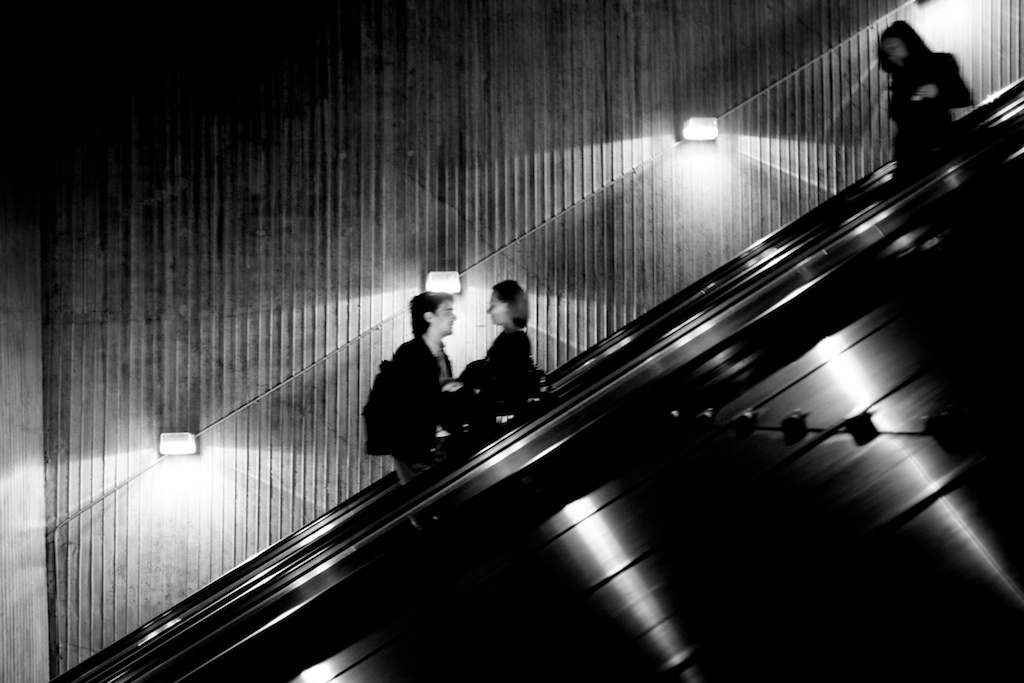
When I decided to make a serious go at a photo project documenting my daily life on Washington, D.C.’s Metro underground system, I did not begin with a clear sense for what the images should be. Sometimes you can imagine a photo beforehand and getting it is just a matter of execution. Sometimes you sense there’s a picture out there … you almost smell it … but you don’t know exactly what it is or how to capture it. This was one of those.

madness
1/30 – f/2 – ISO1600

So starting last year, I began taking a camera with me every day on trips to work and around town. There were — and are — many more failures than successes. Plus my DSLR, along with the fast prime lenses I needed for dimly lit subterranean stations, was killing my back and shoulders. The files from my compact point-and-shoot didn’t have the detail or depth I wanted. Fortunately, there was a huge wave of anticipation about the then-new X100S, and I got on board. It has turned out to be an investment that has paid many unexpected dividends by enabling me to create pictures I didn’t know were there until the moment they presented themselves.

unamused
1/30 – f/2 – ISO1600

The unobtrusive little camera is light enough to carry all day, so you’ll actually take it with you, but it doesn’t force you to sacrifice sharp optics or a good sensor. It’s effectively silent, preserving your discretion in quiet train cars where an SLR shutter sounds like a gunshot. True, the X100S has a few quirks and faults and it isn’t the only tool I use to capture images. But the X100S is the one I carry 90 percent of the time, and it more than any other has helped translate the “sense” of a picture into an actual image.

crowded
1/30 – f/2.8 – ISO1250

As it turned out, the other keys to the Metro project were the two most basic things in photography: People and light. If any of the pictures have been successful, it has been because good light hit an interesting person at just the right time. The trick was figuring out those places and moments and just being there to try to catch them.

passenger
1/1000 – f/5.6 – ISO400

When a woman in a big woolen scarf emerged from a field of silhouettes as she stepped into a sunlit escalator — click. When a sunbeam inside a train car made a circuit over the passengers as we went around a bend, I set the camera to underexpose the scene and make a certain rider pop against the shadows. Dialing up 1/60th, f/2.8 and ISO 1250 with the Velvia film simulation mode can make the harsh-lit interior of a train car into a miniature stage for our human comedy.

escalator
1/1000 – f/4 – ISO400

There’s another aspect of using the X100S that has taken me by surprise: Its effect on others. Strangers stop you to ask about it — “It’s been years since I’ve seen somebody out using an old film camera!” they say. Once, I was photographing outside a Metro station and a D.C. police officer walked over. My heart began to race as I silently rehearsed a speech about my rights to take pictures in a public place. But there was no summons that day. “Hey,” he asked — “what kind of camera is that?”

museum
1/1000 – f5.6 – ISO400

See more of Philip’s photography here.

Testing out the TCL-X100 Tele-Conversion Lens for Fujifilm X100/X100S

When I first read about the forthcoming Tele-Conversion Lens for X100/X100S, being a very keen user and huge fan of the Fujifilm X100S, I was really looking forward to getting my hands on it and seeing what it can do.

I’ve used the WCL-X100 quite a bit and really love the results. Personally I can’t see any difference in the image quality and I’ve found those extra few millimetres can make all the difference when taking a few steps backwards is not an option.

Assuming the same could be said for the TCL-X100, I knew we’d have a product that will be highly regarded by the X100 community – you know who you are!

Image comparison

Here’s two comparison images of my kids. My eldest is like a statue with my “do not move your feet!” instructions. The other not taking this highly technical and scientific experiment as seriously as I’d like.

The River Ouse looking rather attractive – showing some more of the edge detail.

Another two showing edge detail.

Bokeh effect of the TCL-X100 compared to the XF35mmF1.4

James Limpua, a Facebook user, requested a comparison between the XF35mm and the X100S with TCL-X100. So here goes. X100S + TCL-X100 (+ in-built ND filter) are on the left, X-T1 with XF35mmF1.4 are on the right. Both shot at f/2.0.

Is digitally cropping pretty much the same as using this conversion lens?

A user has asked the question in the Comments section about whether Digital Cropping could have the same effect as using the TCL. I took a couple of example shots last night to demonstrate why the TCL is not just about bringing things closer, but actually narrowing your field of view.

Here’s two shots of my Millican bag. In both cases I lined the edge of the bag up with the 1/3rd gridlines on my camera. Obviously this means I was standing further away when I shot with the TCL.

As you can see, when I shot with the TCL on, the narrower field of view effectively makes the background appear much closer. One practical benefit of this is it allows you to cut out unwanted background distractions. Also, the longer focal length give a slight compression to the subject which is often more flattering. IF you notice in the samples, the bag looks slimmer in the TCL shot.

My verdict

IQ
Just like the WCL, as far as image quality is concerned, I personally can’t notice any loss of IQ when using the TCL-X100.

Autofocus
I have read people saying that the AF tends to miss more often with the TCL on but I have not experienced this. Although I’ve not used it in low light yet and I’ve only tested it on the X100S, not the X100.

Size and weight


My X100S is my absolute “go to” camera because it fits in my coat pocket, or in a small bag along with other things. The TCL does change that dynamic slightly, although it’s nothing I can’t overcome by storing it in my other pocket. If I’m really travelling light, unless I know I have a specific reason to have 50mm equiv, I’m probably going to leave this at home.

Overall
I think that after a fairly high investment (for a hobby) in an X100/S body, to be able to have the flexibility to change between 3 different focal length, leaf shutter, prime quality lenses (when factoring the WCL) for only a few hundred pounds extra per converter lens is a great move by Fujifilm.

You could live without it, and half the fun of the X100S is using your legs to zoom in or out and always thinking about what would fit into your 23mm (35mm FF equiv) frame, but this is certainly something that I will buy to turn my already awesome X100S into a better portrait camera.

As usual, please leave a comment below or send me a Tweet if you have any questions at all.

Learn more

For more information, including full specifications and where to buy, visit the TCL-X100 product page on the Fujifilm UK website.

Disclaimer

I may work for Fujifilm UK but I’m also a keen enthusiast photographer, and getting keener by the day. This blog is my opinion on the TCL-X100 and should not be considered the “official word of Fujifilm”.

Interview with Tom Lazar – Street Photographer

Photographer Tomasz Lazar finds that the Fujifilm X100S is the best choice for his brand of street photography

Tomasz Lazar is a photographer from Poland and a graduate of the West Pomeranian University of Technology. His black & white documentary images of street culture have won numerous accolades, including placing in the Sony World Photography Awards and the International Photography Awards. “I also took second place in ‘People in the News’ category of the 2012 World Press Photo contest and received Picture of the Year at BZ WBK Press Foto 2012,” he tells X Magazine.

X100S Lens: fixed 23mm Exposure: 1/15 sec  ISO: 400
X100S Lens: fixed 23mm Exposure: 1/15 sec
ISO: 400

 While Tomasz was still at university he planned a trip to Spain with his girlfriend, but didn’t own a camera. “I was given [a camera] by my parents, a Nikon D50 – and that’s how it all started,” he said. “After coming back from Spain I wanted to learn more about photography. I read books, looked at photo albums, talked to people about it – and I still remember the first photography book I bought, by Jeanloup Sieff. I really felt that photography was what I loved and what I would like to do in the future. I’ve always liked to talk to people and listen to their stories, but photography also enabled me to capture their stories.”

Street life

After a year living in Warsaw, Tomasz is now based in Szczecin, and tries to constantly be on the move. “I travel around Poland and Europe, and try to visit New York at least once a year,” he explains. As a long-time member of the un-posed photography group, which focuses on street photography, Tomasz devotes most of his time to taking pictures. To Tomasz, the street is an almost magnetic place, which he describes as being like a ‘living organism’. “Everything is constantly changing,” he says. “Street photography gives you a kind of freedom but also allows you to converse with people and observe situations.” He also points out that despite the name, you don’t have to be on a street to take street photography. “Street is a combination of factors that are relevant to each other – moments that together, give you this kind of mood.”

Whether on the street or not, Tomasz is always searching for images that, in his words, ‘enchant reality’. “The photographer Ernst Haas said of photographs, ‘the less information, the more allusion; the less prose, the more poetry’, which works to stimulate the imagination,” Tomasz explains. “This is what I’m really looking for. Some people say that I’ve got my own black & white style in photography, but I think that I can try different approaches to develop my consciousness. With my pictures I like to tell stories about places and people or try to show the mood.

Question time

Tomasz has come to the conclusion that there are two kinds of photo projects: “One kind answers questions, but the other aims to force the viewer to think, and actually asks questions. My Theatre of Life is such a project – its point is to raise questions and make the viewers consider what to do next, what impact is had on our lives by technological development and the media.” Theatre of Life is a project that Tomasz has been working on since 2008, an exploration of surrealism. “It’s an essay on my experiences and thoughts about what surrounds me,” he says. “As a result of fast-changing technological developments, many people seem to feel disconnected from the world. Some seek refuge and create alternative realities: some dress in costumes, play role-playing games or pretend to be heroes from movies or Japanese anime. We all find our ways to cope, but these ‘off’ moments are what interest me.”

Tomasz frequently works in black & white, enjoying the dark and mysterious perception that people have of monochromatic pictures. “I also like to use natural light mixed with a flashlight,” he says. “I’ve learned a lot of my black & white technique from the classical darkroom – such as how to develop and work on the images. I like to work on all the details to make the picture better. To make really good black & white, everything is important: composition, light, people’s faces – and that’s why I like monochrome images.”

Tomasz often works with the Fujifilm X100S and has high praise for the camera’s capability at delivering black & white images. But it’s not just the inner workings of the cameras that Tomasz enjoys: he loves their style and size as well. “I like the way they are built. When I’m going on assignments for The New York Times I take the X100S: it is small, but the quality of the images, even set to high ISO, is very good. That’s why I like to work with it on the streets and during my journalism work.”

Trying the X-E2

During a series of workshops run by Fujifilm Poland Tomasz was able to spend some time with the new X-E2. “Last year I was working on Beer Project, a collection of images about beer culture in Prague for Fujifilm using the X-E1, and for me it was a very good camera – but after holding the X-E2 I can tell it is even better. For me, lenses and cameras are like kitchen knives, pots and pans for cooking: different projects mean I’ll choose different cameras and lenses.”

Along with a decent camera in his pocket, Tomasz recommends any keen street photographers find themselves a good pair of walking shoes – “because sometimes you can spend more than eight hours shooting” – and also advises that in order to be as creative as possible photographers shouldn’t close their minds to other genres. “I’ve tried many types of photography – I share the view of Alec Soth from the Magnum agency that you should try everything, because you never know when you might need this kind of skill,” he says. “Besides, this opens up your mind and makes it easier to become a ‘humanist’”.

VISIT TOMASZ’S WEBSITE HERE

X Magazine Issue 3This interview was first published in issue 3 of the Fujifilm X Magazine. Click here to read it for FREE.