Street

X-Pro2 in Barcelona

016_derekclarkphoto-x-pro2
X-Photographer strip BLACK

By Derek Clark

My aim for a recent trip to Barcelona was to travel light. Last year I was in New York shooting jazz musicians for a book I’m working on and I had to carry a lot of kit. The Fuji gear was light, but I also had a laptop, flashes, light stands and a background too. But traveling light was a high priority for this trip to Barcelona.

I packed the X100T with the WCL-X100 (giving me the full-frame equivalent of 28mm & 35mm), plus the X-Pro2 with the 35mm f2 and the 18-55mm f2.8-f4 zoom. The zoom was the tough choice as I prefer primes, but I wanted to take something longer than the 35mm. The 56mm f1.2 was an option and I also considered the 16mm f1.4 because Barcelona has so much great architecture and I knew a really wide angle would be useful. But I had to be strict about travelling light and so opted for the 18-55mm. In the end, I probably shot 95% of the X-Pro2 pictures with the 35mm f2 and 95% of the X100T pictures with the WCL (so 50mm and 28mm in FF).

“I fell in love with the optical viewfinder all over again”

X-Pro2 & The 35mm f2

I have to say upfront that the X100T is probably my all time favourite camera, even though at this point it has been overtaken in performance by newer models. But it’s still a design masterpiece in my opinion that just begs to be held and used.

X100T & The WCL
X100T & The WCL

That said, I’m in love with the X-Pro2. The camera feels great in my hands, especially with the Gariz half case (Fuji half case also available). The performance is amazing and I’m still being surprised on a daily basis by how great the focus is (especially with moving subjects). Autofocus has reached new heights on mirrorless cameras and I can think of two major DSLR brands that could be an endangered species if they don’t wake up, see what’s going on and adapt quickly.


“The X-Pro2 takes things to another level”

X-Pro2 & The 35mm f2

Shooting on the streets of Barcelona was a blast! The X100T is my favourite street camera, but I have to say that the X-Pro2 did out-perform it and produced far more keepers. I’ve always been happy with the image quality on the X Series cameras, more than happy in fact. But the X-Pro2 takes things to another level wth the 24 megapixel X-Trans III sensor giving a welcome increase in resolution. But I’m glad to say it is without doubt the same Fuji look and feel, which is more important than megapixels!

X-Pro2 & The 35mm f2

Film Simulations have always been a big part of the X Series cameras. A while back Fuji gave us Classic Chrome, which was unexpected, free, and became an overnight success. I use it most of the time and love it. These are my settings for Classic Chrome.

-1 Highlight tone
+2 Shadow Tone
+3 Colour
-3 Noise Reduction
+2 Sharpness

unnamed-1
X-Pro2 & The 35mm f2

But when light gets low I find this can be a little harsh and the shadows can get blocked up, so I reduce the Shadow Tone setting to -1 or even 0. Sometime I’ll switch over to Provia as it’s a good general all rounder and much more forgiving.

I don’t often use Velvia (too saturated for me), but I found myself quickly switching to it when photographing rooftops against an orange Barcelona sunset.

X100T & The WCL
X100T & The WCL

Another film simulation fanfare came along with the X-Pro2 in the shape of Acros. The original black and white film simulations were pretty good, but I didn’t shoot a lot with them unless I was in RAW+JPEG to have the option of the colour version later.

I just preferred to do my B&W conversions in Lightroom or Silver Efex Pro. But with Acros I find myself wanting to shoot in-camera B&W a lot. In fact I have to force myself to switch out of it again.

X-Pro2 & The 35mm f2

X Series cameras have always had the option of bracketing three film simulations at a time, but I wish we could shoot two at a time with our own recipe of Highlights, Shadows, NR, Colour and Sharpness baked in, but without the delay of bracketing (where you can see the processing in the viewfinder). Classic Chrome and Acros…ahh. But I digress.

X-Pro2 & The 35mm f2 (Acros)

Acros is beautiful, especially with a bit of highlight & shadow tweaking. There’s a grain in Acros files that just gives the pictures a timeless documentary look, and that’s without using the grain feature of the X-Pro2. On the subject of the in-camera grain feature. The two settings of light and heavy are great, but the same again with larger grain would be nice too!

I like high contrast black and whites, so my settings for Acros are:

-1 Highlight tone
+3 Shadow Tone
-3 Noise Reduction
+2 Sharpness

Don’t worry if you like to see tons of detail in the shadows, because Acros can do low contrast B&W too, plus you still have the option of adding a red, green, or yellow filter as well (I mostly use Red).


Derek explores the Acros mode further in ‘Jazz With Fuji’s Acros & The X-Pro2 – SOOC

The Hybrid viewfinder is now an Advanced Multi-Hybrid Viewfinder, similar to the X100T’s where you can have a tiny screen in the bottom right corner (as an option) that shows a zoomed area of the focus point to assist with manual focus. I use this now and again and it works really well.

X-Pro2 & The 35mm f2

I fell in love with the optical viewfinder all over again on this trip. I wear glasses, but peer over the top of them when looking through the viewfinder (I’m so happy to see a built in diopter on the X-Pro2), so I can’t get my eye right up close. With the OVF I can see the frame lines and some space around them which allows me to see what’s about to enter my picture.

With the EVF I need to move my eye around, looking at the corners of the frame individually, but there isn’t always time to do that. Plus the Harsh sunshine of Barcelona can make it hard to see the EVF because your eyes are adjusted for the brightness, which makes it hard to see if your exposure is ok. That’s when I like to dial in my exposure 100% manually and switch to the optical viewfinder. It’s not as big as the X100T’s OVF, but it’s still big and bright and the frame lines are easy to see. Using the OVF just feels more old school and I like that!
X100T
X100T

‘My Menu’ is another great feature that allows you to store frequently used menu items on a single page. The best part of this is that it pops up as soon as you press the Menu/OK button. Sometimes it’s the simplest things that make all the difference!

X-Pro2 & The 35mm f2

Fuji have took a great camera like the X-Pro1 and improved everything that needed improving. Then they added all the best bits from the other X-Series cameras and threw in a few features that we didn’t even know we needed. The fairies then sprinkled just the right amount of magic dust and hey presto – The X-Pro2. It’s an absolute joy to use!

X-Pro2 & The 35mm f2

I now have a dilemma. Do I upgrade my two X-T1’s for two X-T2’s or sell them both and buy another X-Pro2? But while I’m thinking about that one, Fuji – how about a 24mp X100 with identical features and an identical button layout as the X-Pro2.


To see more of Derek’s work, click here. 


The Fujifilm First Timer

dscf7762

guest-blogger-strip-blackBy Naomi Butters

Being married to a photographer has its ups and downs. On the plus side, you never have to worry about a bad photo being taken and your life is filled with (sometimes too many) images and memories! However, it does have its downsides too – mostly that it led to me becoming lazy when it comes to recording my own memories. While I take the odd snap with my phone (which rarely does justice to what I’m seeing), up until recently I’d not picked up a camera myself for around 11 years!

Determined to do something about this I decided that this year I was going to embrace the passion my husband enjoys so much and I would learn to take better photos. But first, I needed to find myself a new camera…


One of the things that frustrate me about DSLRs are their size. They’re big, even the entry-level models. You can’t take a photo discreetly when you’ve got a massive camera in front of your face! They’re also heavy and when you’re a girl who likes to carry a handbag, carrying a weighty camera as well… Well it doesn’t happen! And, don’t get me started on lenses! You basically leave the house with more equipment and luggage than a mother with a newborn.

So when Jordan suggested the Fujifilm X-Series I was intrigued. He loves his X100S and it’s usually his go-to camera for our city break adventures. It’s the perfect size to carry around when he’s having a break from his ‘work’ cameras.

I’ve used the X100S before, but I wanted something that I could zoom with, in order to shoot a variety of subjects – from days out with friends to landscapes and portraits. Jordan suggested either the X-E2S or the X-T10 and, after looking at them online, I opted for the X-E2S – there wasn’t much between the two and I simply preferred the viewfinder location and layout of the X-E2S.

When the camera arrived I spent an evening getting used to the camera – I must have taken around 100 photos of our dog, Archie! Fuji sent me two lenses to try: the XF35mmF2 R WR and the XF18-135mmF3.5-5.6 R LM OIS WR. I have to admit – I had no idea what the differences were between them did or how to best use them! I’m not sure Archie enjoyed sitting for photos for hours either, although he’s used to it!

X-E2S
FUJIFILM X-E2S – Silver

In July, we travelled to Italy for our summer holiday, making stops in Venice and Florence. These locations offered the perfect opportunity for me to get comfortable taking photos, improve my skills and, for once, prove that I don’t just go on holiday by myself by getting some shots of Jordan too!

I’ll admit, at first I was nervous. I know that sounds silly but when you’re married to a photographer, you’re aware that your images will come under scrutiny! But with a bit of guidance I quickly started to enjoy taking photos with the X-E2S.

If you’ve ever been to Venice you’ll know it’s full of beautiful scenery around every corner and crossing every bridge, there’s a stunning view or timely gondola approaching ready for you to take that perfect shot. Jordan suggested I use the 18-135mm lens as it has a good zoom and would be versatile when walking around the city. Although the lens was long, it didn’t add much weight to the camera and I could fit it in my small hand bag. Bonus!

dscf7946

Usually when Jordan and I go away, I take in a landmark, maybe take a photo on my phone and then move on to the next point of interest. However, Jordan can take at least ten minutes at a landmark, capturing shots from various angles. I once lost him in New York because he’d stopped to wait for that decisive moment and I’d walked several blocks before I noticed he wasn’t with me!

However, with a camera in front of my face and the view of the grand canal in front of me, we both spent several minutes trying out different angles and compositions. At first, Jordan had to tell me how to set the camera up – adjusting the aperture and ISO were things I’d never done with my phone! However I quickly got the hang of it and started to feel comfortable in using the camera on my own.

dscf0132

Although the larger lens was great for wide angles or zooming in on a distant subject, I did find the smaller 35mm f/2 a lot lighter and easier to use. I liked that the aperture was marked on the lens so I could quickly check what I’d selected without looking at the screen. I left the camera in aperture-priority mode and, with some go-to apertures explained (f/2 for portraits, f/8 to f/11 for landscapes, etc), I really enjoyed taking close up shots and wider views of the city.

The exposure adjustment dial made it straightforward to adjust the exposure without messing around with the settings directly too; simply + for brighter, or – for darker, easy! Before long I was showing Jordan what I’d captured on the back of the camera with confidence. The X-E2S captures bright colours and details beautifully.

I also made good use of the built-in Wi-Fi feature. After downloading the Fujifilm app to my phone it was simple to ping images across and upload them to Facebook or Instagram really quickly. #nofilter!

dscf0225

By the end of our holiday in Italy, I was mirroring Jordan’s photography poses, delving deeper into apertures and lighting and thoroughly enjoying my new camera.

I always enjoyed capturing moments with my phone, but was left wanting by the image quality, let alone if I wanted any printing – forget it! The X-E2S made it simple for me to enjoy taking high quality photos without the bulk and attention garnered by using a DSLR.

I’ve had more photos printed in the couple of months since getting the X-E2S than I have in total up until this point!

If you like the idea of taking better photos but don’t want to get weighed down with kit, or bogged down with the technical side of things then I thoroughly recommend the X-E2S. It has the ability to create some amazing images – I look back at some of the scenes I captured and can’t believe they’re my photos!

dscf0652


Help! I don’t know whether to buy and X100T or an X70.

By Kevin Mullins

KevinMullins-Headshot-200x200When I first received the Fujifilm X70 I looked at it and thought…….hmmmm.  Then I scratched my head and glanced sideways at my X100T which was looking back at me with suspicion and concern.

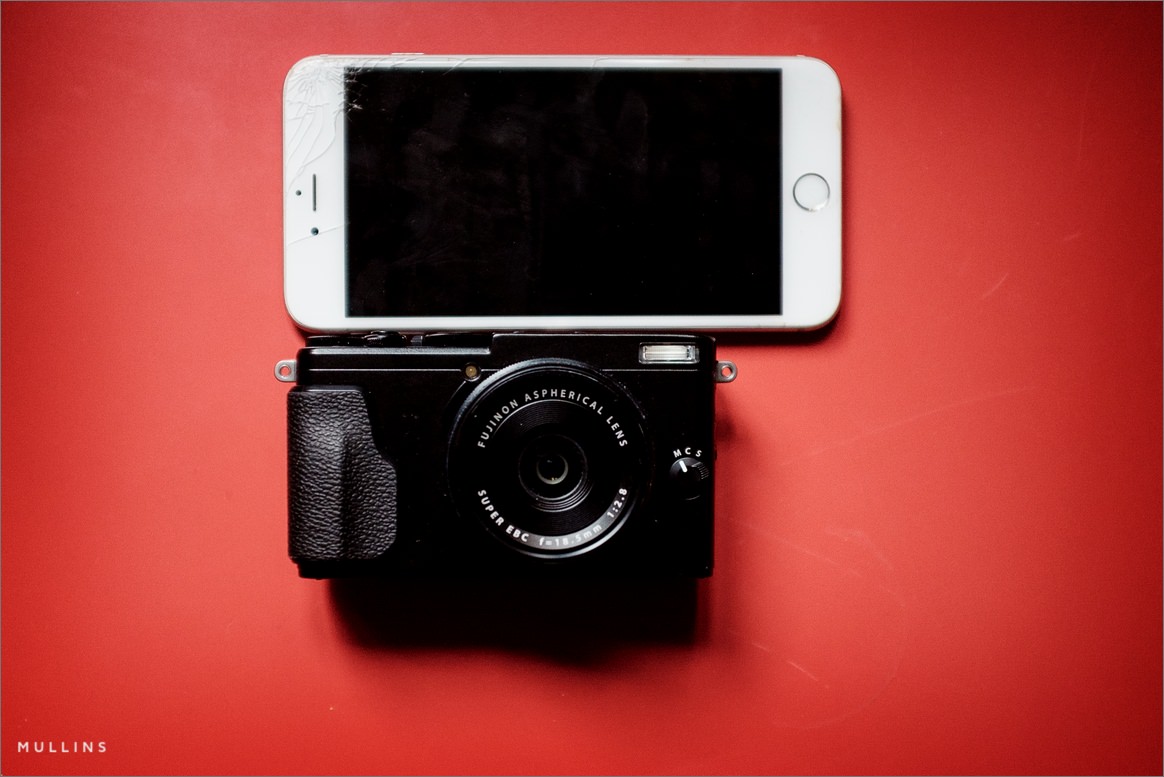
I have to admit that I also had suspicion and concern when I first picked up the X70.  It’s teeny.  In terms of length and width it’s almost a third smaller than my mobile phone.

My X100T, on the other hand, is larger.

So I challenged myself to see if size really does matter and, more importantly, does the X70 live up to its big brother X100T when it comes down to image making.

fuji-x70-review-1-2

Brief Differences and Similarities between the X70 and X100T

This isn’t a review of either camera but it makes sense for me to point out the fundamental differences, and similarities between the two cameras.

Both cameras share the same 16-megapixel APS-C X-Trans II sensor but that, possibly, is where the similarities end.

We already know about the size difference, but really the biggest differences are the interface to shooting and the lens and so I will concentrate on these during this post.


“Beat the fear of Street photography by allowing people to come to you, instead of you to them.
Then just… Click.
No pressure.


The Lenses

The X100T has an excellent 23mm F2.0 lens.  Way back when I was shooting DSLR, my preferred focal length was 35mm (full frame equivalent), and actually it still is.

I LOVE the lens on the X100T and this is one of the critical changes because if you also LOVE the lens on the X100T, you need to know that the lens on the X70 is different.

The lens on the X70 is a slower F2.8 but wider 18.5 mm focal length or 28mm (35mm equivalent).

So straight away, we can see that the X100T is going to be better at low light shooting, albeit marginally.

However, the size and weight of the X70 means we can shoot at slower shutter speeds to mitigate this to a certain extent (depending on the subject matter of course).

For me, I love that 35mm FF focal length and I’m getting used to the slightly wider view from the X70.

cheltenham-festival-2016-7

Taking Pictures

I instinctively lifted the X70 to my eye when I first got it out of the box.  Big mistake as there is no viewfinder in the camera (you can purchase an external viewfinder attachment that slots into the hotshoe).

For me, the reason I never really gelled with the Fujifilm X-M1 was because of the lack of viewfinder.  But then the X-M1 was bigger…..and didn’t have the X-Trans II Sensor.

I’ll give it a try I thought.

And you know what, I have learnt to really like the LCD shooting experience of the X70.  I’m not a hundred percent convinced I wouldn’t prefer a viewfinder as at least an option, but obviously one of the reasons this camera is so small is because of the removal of the viewfinder.

Instead of the traditional way of shooting, in the X70, you have a remarkably versatile tilting screen, which even tilts vertically above the camera to allow you to take “selfies”.

When shooting with the X100T I have to use the viewfinder, or shoot from the hip using a zone focus technique.

I can still use zone focusing with the X70 of course, but the benefit of the flip down screen is plain to see.  Additionally, the X70 implements some neat touch screen features where you can use your finger to very quickly touch, focus & shoot.

That’s a great advantage when out on the street shooting.


“I adore elderly people holding hands and I strive to look for pictures like that.
Pretty much, I just want to be like that with my wife when I’m elderly too.”


Which camera would I use?

This is the question I’ve been asking myself a lot.  When would I use one over the other?  And I actually sat down and came up with a list of scenarios where I would use either the X100T or the X70.

In really low light I’m going to need the X100T.  I don’t use flash, and I find that I use the Optical Viewfinder on the X100T a lot when shooting in low light.

For that reason, and also because of the build and form factor, the X100T will remain one of my primary cameras as a wedding photographer.

However, the X70 really comes into its own when I pick up a camera to go and shoot street photography.

In fact, for me, its superseded all other cameras in the range when it comes to shooting on the street.

I like to get in close and I like to observe and prepare to shoot.  Unless I need to use different lenses (for example, I may use a MF lens on the X-Pro2 or X-T10 for rapid zone focusing and shooting), the X70 is an ideal camera for shooting on the street.

The fact that you don’t even have to press the shutter button is a marvellous thing in itself and lends the camera perfectly to candid street shooting.

The X70 isn’t going to replace my X100T, but at the same time, my X100T will be a lot less active for my personal and street photography work.


“These images below were shot using Auto Focus, at F2.8 without the flip screen down.
Simply pointing and shooting from the hip.
One handed (as the other was occupied with Guinness at the time).”


To see more of Kevin’s inspirational images, click here.


Let me tell you a ‘Toy’ Story

X-Photographer strip BLACK

chrisupton-168pxBy Chris Upton

I think it’s fair to say that we are all guilty of not using all of the features on our cameras. We prefer to stick to what we know or what we think we need. One of those features that I had dismissed as a bit gimmicky was the Advanced Filters. Sure I had looked at them and fired off a few shots but they weren’t for me, I preferred to produce my creative images in Lightroom or Photoshop.

However that was all to change on my recent trip to Lisbon.

Now I wouldn’t quite describe Lisbon as beautiful, it’s certainly not a Venice, Paris or Prague. But it is definitely characterful. Very hilly, lots of little streets and alleyways, buildings that have seen better days contrasting with some stunning architecture, oh and of course there are the trams. These trams have been part of Lisbon’s travel network for almost 150 years and are one of the city’s major tourist attractions.

As a travel photographer there are always the iconic images that are on my shoot list but I also try to look a little further to see how I can put my own interpretation into a place. On this trip the light was pretty harsh and the sky plain blue and so my attention turned to wandering the streets early in the morning looking for some detail shots, little cameos that communicated a feel about the place. When I’m in this creative mode I often shoot square. It’s a format that I love and one that lends itself really well to the more creative approach.

So having switched my camera to shoot RAW & JPEG and selected the 1:1 format, which helps me compose in camera, I took a few images. I was fairly pleased with the results and I knew how I might develop them in post processing but then it occurred to me that I might try the Advanced Filters just to see the effect.

Now if you’re not too familiar these modes are presets which automatically apply a certain feel to the image and include Miniature, Pop Colour, High Key, Low key, Dynamic Tone, Soft Focus and a series of Partial colour filters.

However the first in the menu is Toy Camera and switching to this I took a few shots, looked at the screen and smiled. The combination of the scene in front of me and the effect of the filter, slight underexposure, a warm tone and dark vignette together with the square format just seemed to work perfectly together.

Well that was it, I tried a few more, and loving the effect I shot many more images this way. I also tried some of the other filters and quite liked those too but my preference was for the Toy effect and I came back with enough images to create a little Blurb book. A perfect outcome and something a little different to what I had originally envisaged from the trip.

So I would urge you to open your mind to the creative opportunities that our Fujifilm cameras offer us, you might just be pleasantly surprised.

Toy Camera mode – “loving the effect I shot many more images this way”


Should I buy the XF16-55mm lens?

X-Photographer strip BLACKBy Chris Upton
chrisupton-168pxThere has been no bigger advocate of the Fujifilm XF18-55mm f2.8/4 zoom lens than me. With it’s diminutive size, robust build, superb image stabilisation and excellent image quality it seems disparaging to refer to it as a “kit lens”.

As a travel photographer, where weight is an important factor, and one of the key reasons for me moving to Fuji in the first place, it has been my mainstay lens. Covering key focal lengths from wide angle to modest telephoto it is a perfect “walk around” lens.


20160502_notts_0038-Edit
Taken on the XF16-55mm lens

So when Fujifilm launched the XF16-55mm f/2.8 R LM WR I dismissed buying one pretty quickly, mainly because of the increased size and weight and lack of Optical Image Stabilisation. Fujifilm apparently decided not to incorporate OIS as it would compromise image quality and add to the size, weight and cost. It should be noted that the major DSLR competitors equivalents do not include this feature either.

However, when Fujifilm offered me the opportunity to try out the 16-55 I jumped at it, intrigued to see for myself how it performed and if it could justify its premium price point versus its smaller sibling.

XF16-55mm_FrontWhen it arrived I was immediately struck by the obvious! It was much bigger and heavier than the 18-55 weighing in at 657g versus 310g, up to 130mm long v 98mm and featuring a 77mm filter thread v 58mm. All in all a beast of a lens and one that seemed to fly in the face of the compact system concept.

There was no image stabilisation but the lens did feel reassuringly solid. The weight is a result of the sheer amount of glass Fujifilm have used to construct this lens. With 17 elements in 7 groups and a metal body it has a real “pro / workhorse” feel. I should declare at this stage that I also own a Canon DSLR and some L lenses including the 24-70  f2.8 mkII – the full frame equivalent of the Fuji lens. Though consigned to the cupboard and waiting for the inevitable eBay listing, it was interesting to compare the two lenses. Suddenly my “new” Fuji lens felt like a nimble lightweight and I was eager to test it out.

Mounting the lens onto my X-T1 meant that I had a weather resistant pairing, really useful for any photographer shooting outdoors. The aperture ring has definite clicks in 1/3 stop increments, there is a red marking on the lens to denote its position as a premium lens and I noted that the filter thread was metal, important with frequent use of filter systems like Lee and Hitech.

Although this lens is wider by only 2mm versus the 18-55 for me this is important as I quite often find that 28mm equivalent is not quite wide enough and I have to swap to my 10-24mm. Not a big issue but having a 24mm – 85mm equivalent is much more useful.

I had the perfect opportunity to test it out on a trip to Cinque Terre where I wanted to not only check out the image quality but also how it felt to manage the increased size and weight.

I was determined to use the lens as much as possible and to do a direct comparison with the 18-55. So what were my findings?

20160422_cinque_0393-Edit

Using the lens was a dream, uncomplicated, reassuringly solid and a quality feel.  If I’m honest I think that the lens looks just about OK when mounted on the X-T1, it certainly looks better and feels more balanced when using the VG X-T1 battery grip – a pity I sold mine as I didn’t want the extra bulk! The petal shaped lens hood worked well too.

A slight downside for me was using filters. As a Lee Seven5 filter system user on the smaller lenses I had to use my 100mm filters on this lens which duplicated the filters and added slightly to the weight and bulk of my kit.

Of course an f2.8 lens throughout its zoom range means that you can achieve some pleasing bokeh particularly at the longer end of the zoom range when close to your subject. Though on a crop sensor you get the equivalent of roughly f4 on a full frame. The autofocus was fast, quiet and accurate and internal so that the front element doesn’t rotate, again important for filter users.

However, ultimately what’s most important is image quality and here the 16-55 didn’t disappoint.  It is an extremely sharp lens throughout the focal lengths with very little fall off or distortion and the contrast and colour rendition, in common with all Fujifilm lenses, was stunning. Several images were shot into the sun and I was impressed that the ghosting and flare was minimal due to the nano GI coating on the front element.

20160421_cinque_0232-Edit

As for testing there are various websites that show detailed performance MTF charts but for my field test I shot comparison images of Vernazza, Cinque Terre on an X-T1 body, tripod mounted at 23mm. I shot the same view at f2.8 – f11 on both the 16-55 f 2.8 and 18-55 f2.8/4.

I then ran a further test photographing Southwell Minster on an X-Pro2 using both lenses at a range of popular focal lengths 16 / 18mm, 23mm, 35mm and 55mm and at apertures of f2.8/4, 5.6, 8, 11 & 16.

In summary both lenses produced excellent results though, no surprise, the 16-55mm delivered stunning image quality at virtually every aperture.

The 18-55 performed best, looking at centre and edge sharpness, at f8 at 18mm and 23mm and f11 at 35mm and 55mm. When shooting landscapes I use a tripod, selecting f11 or f8 for many of my shots, so it is not a surprise therefore to see why I have been so pleased with its performance. As you might expect that performance falls away a little at f4 particularly in the corners. That is where the 16-55 comes in. The 17 elements and lens coatings combine to deliver a performance that is superb with amazing sharpness in the centre and edges especially at apertures of f5.6 and f8. The lens is not quite as sharp in the corners at f2.8 and diffraction starts to set in at f16, in common with most lenses, though still acceptable.

Directly comparing the two lenses I would say that at their optimum apertures they perform similarly but the extra quality in the 16-55 delivers better results at the wider apertures and extremes of focal length in both the centre and at the edges.

Here are some results showing 100% crops of the RAF file with no processing, though it should be noted that Lightroom automatically applies lens correction for chromatic aberration and distortion.

So which one should you choose? That’s perhaps a tricky one as it really depends on what’s important to you and what you shoot.

If weight, bulk, image stabilisation, smaller filter sizes and very good image quality (excellent at certain apertures) and not forgetting of course the price is important to you, then the 18-55mm will serve you very well.

However, if it’s ultimately all about image quality and you would benefit from weather sealing and don’t mind the extra weight and lack of OIS then the 16-55mm is a stunning lens. A zoom that performs like a prime, it is well worth the extra money.


To see more of Chris’ work, visit www.chrisuptonphotography.com

20160420_cinque_1018-Edit


Buy an X-Pro2, win a workshop with an X-Photographer

Pretty simple right?

If you buy an X-Pro2 and register the warranty on our website before the 8th April 2016, you could win a place on one of our fantastic workshops.

Image by Dave Kai PiperDSCF4552-Edit-

1st May – Portrait workshop with Dave Kai Piper – (4 delegates)

Location: Amersham Studios

Being a photography lecturer, Adobe Community Pro and Fujifilm X-Photographer, Dave Kai-Piper will take you on an exciting journey into portrait photography.

His workshop starts off with a conversation with each participant discussing individual goals for the day alongside a group objective. As part of the morning set-up you will have a look at some iconic images from influential photographers. Then he will break down what makes those images work & talk about how different lighting types can create moods and styles. You will learn how to build on simple lighting styles like Butterfly lighting, Split lighting and Rembrandt lighting and then put them into practice using live demonstrations with a stunning model.

Once your objectives are set, you will jump into the studio full of the newest WiFi controllable Broncolor lighting to put your new Fujifilm X-Pro 2 through its paces. You will look at ways to shape, control and create that perfect image. Within this workshop you will also learn the best way to communicate and pose your subject to get the best from your model.

Whether you have spent a lot of time in the studio using lighting or have never used additive / flash lighting in your photography before, each attendee will leave the workshop with a broader knowledge of various techniques from lighting your subject, creating a scene and directing your model.


Matt-Hart

4th May – Street workshop with Matt Hart – (4 delegates)

Location: Liverpool

Spend the day with Street, Event and X-Photographer Matt Hart in this candid street photography workshop. It is here that Matt will give you an insight into the way he works and how to shoot his style of street photography.

He will show you how to anticipate and capture decisive moments, how to be invisible in public spaces to get the best images and how to to develop confidence shooting street photography. He will show you the best places in Liverpool to capture great street images – so in the future you can come back and have another go!

Matt’s workshops are always fun, informative and relaxed whilst at the same time challenging and have been designed to stretch your imagination.


Winchelsea-1

7th May – Landscape workshop with Paul Sanders – (4 delegates)

Location: Dungeoness and surrounding areas

Your day will be spent with Fujifilm X photographer and landscape artist Paul Sanders, he will help you develop your own way of seeing the landscape to create images that resonate with how you feel about the location.

Paul’s specialty is long exposure photography, he will take through a natural and easy to follow workflow that enables you to get to grips with the technical side of this style of photography. He will have some Neutral Density filters and graduated filters for you to use on the day. Filtration is one of the key aspects of landscape photography, it allows you to control contrast, mood and exposure time. Paul will explain all of the pros and cons of using filters and the different types of filters available.

The day will be split into two sessions – one at Dungeness and the other at Winchelsea beach.

Dungeness is the only classified desert area in the UK, its flat bleak landscape has inspired photographers, artist, writers and filmmakers for many years. The beach is a detritus of fishing boats and fleet. The decaying hulls of boats are left on the shingle, nets, huts and machinery make this a photographers dream location. Paul will explain that landscape photography isn’t always about the big vista but also lies within the details and the abstract he will guide you around the area so that you don’t miss anything.

Winchelsea Beach is a long exposure dream, lines of decaying groynes stretch along the beach. These make the perfect subjects for getting to grips with the minimalist style that long exposure work generates. Paul will also pay special attention to composition and exposure time to create beautifully minimal images.


Register your X-Pro2 warranty here


Terms
  • Only X-Pro2 cameras purchased from Authorised UK Dealers are eligible to win.
  • Each workshop has 4 spaces available.
  • Winners will be notified by the 13th April.
  • Prizes are not transferable and does not cover the cost of travel and accommodation.
  • Lunch and refreshments will be provided