Take a Different View
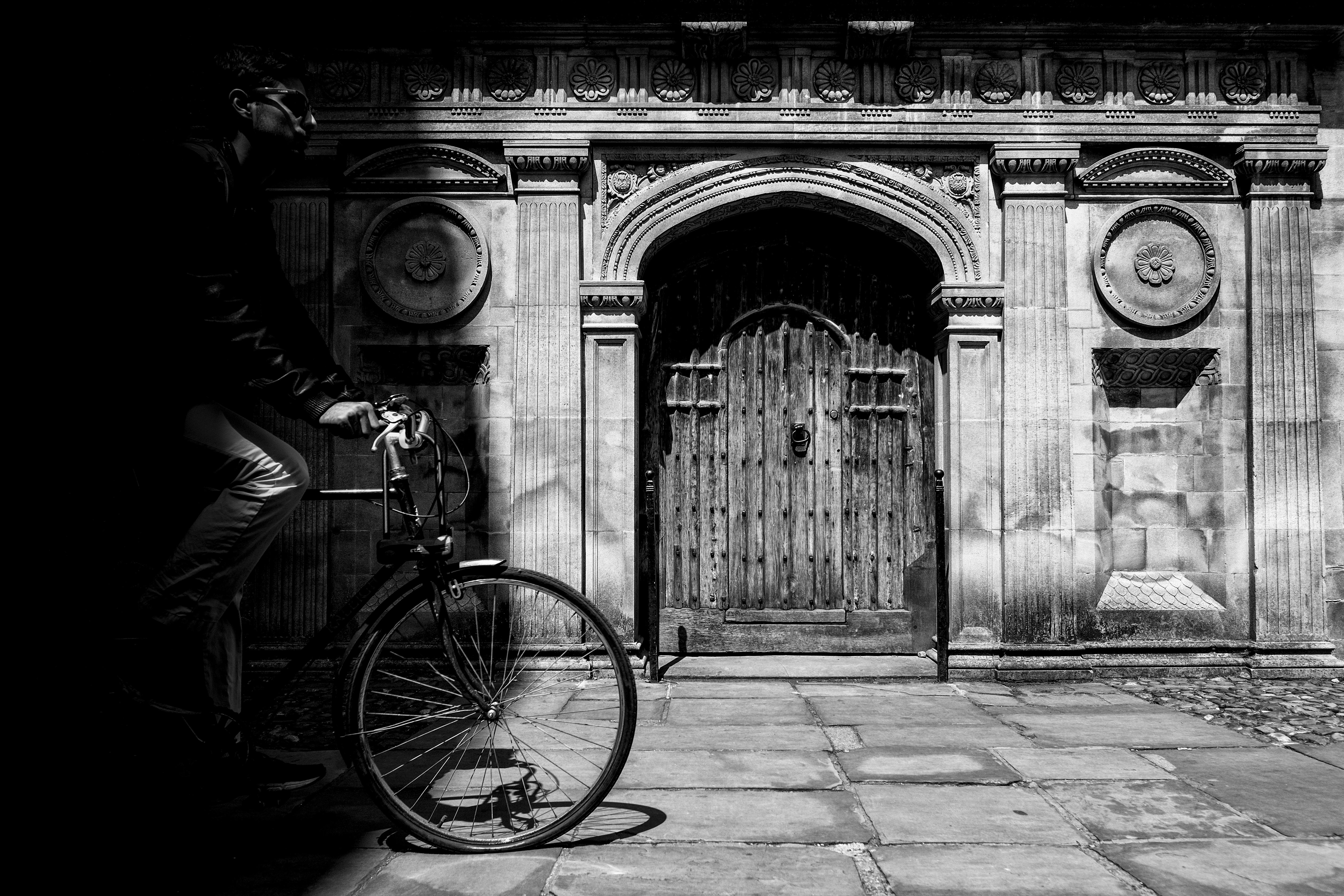
I spend most of my days teaching people how to see the streets with fresh eyes. Helping photographers to see the world around them through a lens in a more unique way. I spend my free time exploring the streets of our cities looking for a different view of the world around us and trying to find something unique or different.
Street photography is not just taking photos of people in the street. There is so much more to it than that, and the FUJIFILM X-Pro2 helps me to carry out my work in a much more unobtrusive way.
The trinity of a great street shot is Light, Composition and Moment, but add to that emotional impact and a great subject and you have a killer shot.
Creating an image without the use of Photoshop, just looking to find something different and exciting is very addictive. You don’t find it every day but when you do it’s just a magical moment you want to share.
I am constantly on the lookout for great light. We know photography is all about great light so I tend to spend my time hunting down locations with the perfect light quality and shape. Some areas and cities are laid out to allow light to hit the streets and create great shapes but some hide the light most of the day with narrow streets all facing the wrong direction.
With street photography, it’s hard to compose an image immediately but you can look for an amazing street or area with good lighting and wait for an interesting subject to come in to the frame. You should never get caught up with the look or style of a subject. It’s better to look for right light and scene and start the composition process, keeping an eye out for how people look in the light and shadows as they come in to the frame. With practice, you know what shapes and styles to look for in the subjects around you.
The decisive moment is a rare thing, but you can improve your chances by looking for the obvious. If you stand next to great light someone will walk in to it, if you stand next to a puddle someone will walk in it or jump over it. Just make sure a car does not drive through it and soak you!
A great subject, as I have said, is not always what you think. It’s all about the shape, the context and the look. After all photography is all about communication so you need to be able to find a subject that communicates to your or your viewer.
We would all love to be able to get emotional impact in to our images and this is the hardest part of all. People do not display emotion in public as much as they used to, so looking for a kiss or a smile is quite a rare thing in some cities or towns. It does not have to be a happy emotion, it could be fear, horror or fright. Anything that creates some form of emotion in the viewer. Remember, though, everyone is different so try and treat people how you would like to be treated yourselves.

I am a candid street photographer and like to shoot the scene when the subject is unaware. The rangefinder style of the X-Pro2 helps me enormously with this task. I am a right eye shooter so it’s great to be able to shoot with both eyes open. With the camera only covering a small portion of my face, it means not having my nose squashed in to the rear screen!
Quite a few people prefer the Optical Viewfinder in the X-Pro2 but I really prefer to use the Electronic Viewfinder with the histogram and the level switched on in the menu. I prefer to keep both eyes on what is going on around me and shoot from the hip most of the time. When I do use the viewfinder, I want very fast feedback of the scene. I want to know the camera is focused level and the exposure is correct. The X-Pro2 is a nice oblong shape which means that, at a glance, you can check the camera is straight without having to hold it to the eye. I do this by just looking along its edges and lining it up with straight edges on buildings. If you can’t find a straight edge turn on the electronic level and use the rear screen to level the shot.
I set the X-Pro2 up to make my life easy out on the streets and use the Auto ISO setting and, in Auto ISO 1, I set my camera to Default Sensitivity 200 max and 6400 min sensitivity. I set the Shutter Speed to 1/320 secs or above most of the year. This gives me the exposure I need for a sharp image without having to mess about with the camera all the time.
If I do need to make any changes with the exposure triangle on the outside of the camera I can just up the shutter speed using the exposure dials on the top of the camera, or close or open the aperture at will with the aperture ring around the lens (available on most XF lenses). I normally shoot between f4-f8 in the summer and f1.4-f4 in the winter in the UK.
I use single servo centre point focusing to shoot anything standing still and continues focus to shoot anything moving mostly with evaluative metering. Sometimes, in awkward light, I will switch to spot metering and just adjust with exposure compensation dial.
I shoot mainly with the wonderful set of Fujifilm F2 lenses; the XF23mmF2, XF35mmF2 and XF50mmF2 all fit nicely in a little pouch in my bag. I still love the XF90mmF2 and the XF16mmF1.4 but over the last few weeks I have just wanted to carry less in my bag.
I have shot most cities in the UK now so I know what lenses work for each city so tend to pack what I need.
I only shoot street with prime lenses and tend to go out with two camera bodies – a wide lens on one body and a telephoto lens on the other. This enables me to capture something right under my nose or on the other side of the street without having to run around like a mad thing. Once you get used to a prime you can move and shoot so much faster and capture the shot you were after, instead of wasting time trying to frame your subject by zooming.
Sometimes we see the same things repeatedly but it’s how we shoot it that makes the difference. When the everyday becomes the norm, we need to break out of the crowd and start to look at things in a different way. You can walk the same street for 10 years and the next time you turn the corner there it is a great big puddle!

Sometimes you have to wait a long time to get an image that is different and sometimes it happens 10 times in a day. I walked up and down my local railway station bridge looking at the nice yellow handrails for over 10 years before the light and subject position was good enough to lift my camera to my eye to take the shot.

Keeping your eyes open and looking all around you at all times if key. As long as your camera is set up and ready, you should be able to capture most moments.

It’s all about learning to see and taking your time; being in the right place at the right time.

There is nothing more relaxing than a day out with your camera in one of our great cities. Spending an afternoon looking for something different among the chaos, the hustle and bustle, whilst enjoying good coffee with your friends as you try to capture a different view.
More from Matt Hart
Website: http://www.matthewhartphotography.com/
Blog: https://matthewhartphotography.wordpress.com/
Facebook: https://www.facebook.com/matthewhartphotography/
Twitter: https://twitter.com/matt6t6
Instagram: https://www.instagram.com/matt6t6/
 Taking performance to new heights, the FUJIFILM X-Pro2 offers the world’s only Hybrid Multi Viewfinder and features a brand new 24MP X-Trans III sensor.
The FUJIFILM X-Pro2 boasts a Hybrid Viewfinder capable of instantly switching between optical and electronic finders, plus an updated image sensor and processor, which dramatically improve image quality. By combining these features with the ultra-high image quality of FUJINON X-Mount lenses and the color reproduction technology accumulated through more than 80 years as a photographic film manufacturer, the FUJIFILM X-Pro2 delivers the best ever results from an X-series camera.
[youtube=https://www.youtube.com/watch?v=AHFdXA4Y6lI]