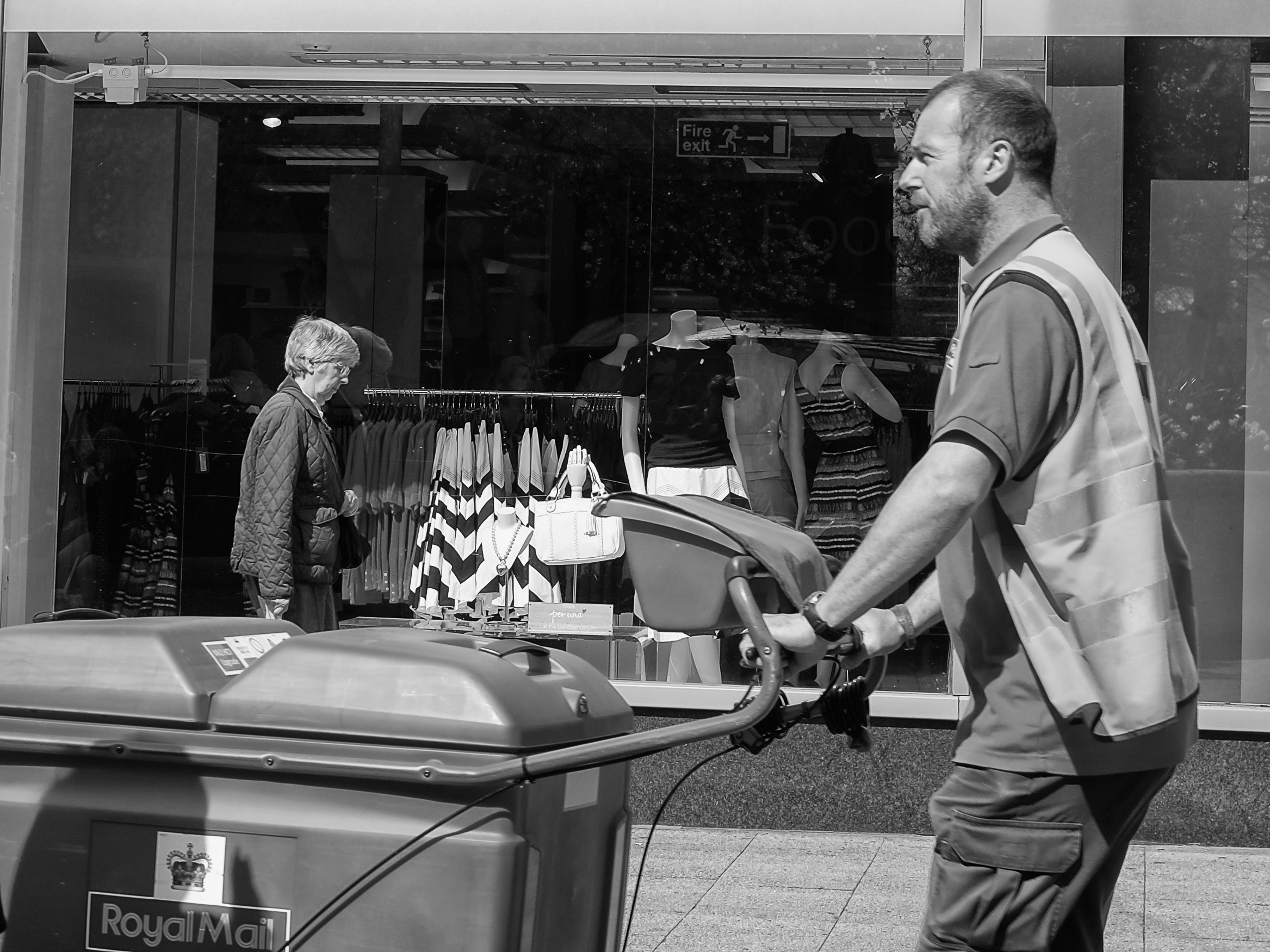
Street

The camera really does matter – Philip Ewing shares his experience with the X100s


About the author

Philip Ewing has been an enthusiastic amateur photographer since his 35mm days on the university student newspaper. Today he works as a journalist in Washington, D.C. You can find more photos at
http://metrocommutr.tumblr.com/

Photographers love to insist the camera doesn’t matter – our creative vision is what truly makes a picture, as the old bromide goes – but inside the family, we know a camera can make a huge difference.

When I decided to make a serious go at a photo project documenting my daily life on Washington, D.C.’s Metro underground system, I did not begin with a clear sense for what the images should be. Sometimes you can imagine a photo beforehand and getting it is just a matter of execution. Sometimes you sense there’s a picture out there … you almost smell it … but you don’t know exactly what it is or how to capture it. This was one of those.

madness
1/30 – f/2 – ISO1600

So starting last year, I began taking a camera with me every day on trips to work and around town. There were — and are — many more failures than successes. Plus my DSLR, along with the fast prime lenses I needed for dimly lit subterranean stations, was killing my back and shoulders. The files from my compact point-and-shoot didn’t have the detail or depth I wanted. Fortunately, there was a huge wave of anticipation about the then-new X100S, and I got on board. It has turned out to be an investment that has paid many unexpected dividends by enabling me to create pictures I didn’t know were there until the moment they presented themselves.

unamused
1/30 – f/2 – ISO1600

The unobtrusive little camera is light enough to carry all day, so you’ll actually take it with you, but it doesn’t force you to sacrifice sharp optics or a good sensor. It’s effectively silent, preserving your discretion in quiet train cars where an SLR shutter sounds like a gunshot. True, the X100S has a few quirks and faults and it isn’t the only tool I use to capture images. But the X100S is the one I carry 90 percent of the time, and it more than any other has helped translate the “sense” of a picture into an actual image.

crowded
1/30 – f/2.8 – ISO1250

As it turned out, the other keys to the Metro project were the two most basic things in photography: People and light. If any of the pictures have been successful, it has been because good light hit an interesting person at just the right time. The trick was figuring out those places and moments and just being there to try to catch them.

passenger
1/1000 – f/5.6 – ISO400

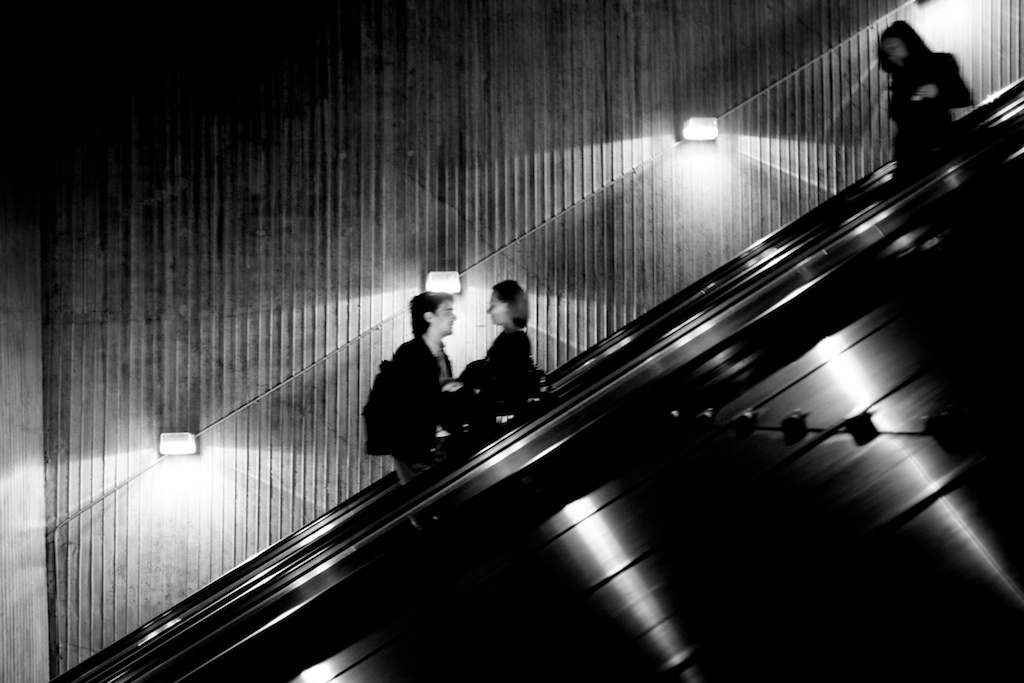
When a woman in a big woolen scarf emerged from a field of silhouettes as she stepped into a sunlit escalator — click. When a sunbeam inside a train car made a circuit over the passengers as we went around a bend, I set the camera to underexpose the scene and make a certain rider pop against the shadows. Dialing up 1/60th, f/2.8 and ISO 1250 with the Velvia film simulation mode can make the harsh-lit interior of a train car into a miniature stage for our human comedy.

escalator
1/1000 – f/4 – ISO400

There’s another aspect of using the X100S that has taken me by surprise: Its effect on others. Strangers stop you to ask about it — “It’s been years since I’ve seen somebody out using an old film camera!” they say. Once, I was photographing outside a Metro station and a D.C. police officer walked over. My heart began to race as I silently rehearsed a speech about my rights to take pictures in a public place. But there was no summons that day. “Hey,” he asked — “what kind of camera is that?”

museum
1/1000 – f5.6 – ISO400

See more of Philip’s photography here.

“To the streets!” A trip out with the X-M1 and XF27mm lens

1504372_10154010549280534_5836271885610257265_oSo here’s the question: How does the X-M1 / XF27mm combo fare for street photography?  
Before we begin our journey out on to the streets of Bedford town, like many of you out there I’m not a professional. I did not train in the art of photography, but again, like many of you, I have an absolute passion for it.

I love reading blogs on street photography and especially black and white ones. Something about it just fascinates me. Today, I really wanted to explore the X-M1 and the beautifully compact XF27mm for this very purpose. I thought with its combination of small size, high quality and tilting screen it would be a winning combo. I wasn’t wrong.

DSCF0041

Considering I love reading about street photography I rarely feel brave enough to go out and try it. Today would be different though, I had the luxury of the tilting screen to help compose my shots without drawing too much attention and it was small enough to fit in my jacket pocket when not needed. I also had the advantage that it was a beautifully sunny day creating some stunning contrast.

DSCF0034

As I wandered about looking for the perfect shot, I came across a very well presented busker playing a beautiful collection of classical pieces. I knew the shot I wanted would involve me getting up very close as I was using the 27mm lens. I simply gave him a friendly smile, nod with the camera in hand and he beckoned my forward. I shot this at f/9 as I wanted to guarantee some good focus. On reflection, I might have opened the aperture up slightly and sped the shutter up a bit to get a sharper image.

DSCF0048 (2)

After spending five or so minutes relaxing in the sun to his repertoire I moved on, in the search of the next ‘big’ scene.

One shot I love seeing is where you have one person standing looking into the distance. I’m always like “What is this man thinking about?”. I was lucky to find a few people doing exactly that.


The XF27mm lens was performing perfectly, the focus is super quick and even with some heavy crops, the physical quality of the images speak for themselves.

You might wonder what software I use to post-process my images. I do use PS and GIMP of course, but I recently discovered Google’s ‘Nik Software’. As an amateur photographer it gives great quality options for a pretty low price. I used a plugin called Silver Efex Pro to create my black and white images and pull some extra contrast and detail out of my shots. One thing to note is that it does not deal with our RAW files as far as I know. But you could shoot RAW, convert to TIF and then import for a higher file size.

As the afternoon went on I took a turn into the market stall area, it is always a pretty busy place with lots of snapping opportunities. Here are a couple from the market stalls.

DSCF0026 (2)
The Bag Maze
DSCF0027 (2)
“Anyone for a hat?”

All in all this camera combo performed perfectly, it was quiet, unnoticed (most of the time!) and gave me some excellent quality shots that I am happy to share with you all. I think that the XF27mm works great for this style of photography as it makes you get into the action and put yourself in the moment more rather than shooting from a distance. It helps you find those more intimate scenes that you might miss if you were further away. For me, I found that generally people were quite sociable and simply interested in what I was doing rather than the opposite.

I hope this inspires you to go out and have fun with some street photography yourself. Here are all the images I kept from the outing.

Written by Dale Young


X Marks the Spot: Paris, France

A classic camera in a classic location – see why the X-E1 and the French capital make the perfect combination

Al Arthur

“I love the beauty and elegance in Paris: the architecture, the open spaces and the people. But it’s the small details that I like as much as the famous monuments and chateaux.”

Alastair documents Paris with a Fujifilm X-E1, which he started using last year.

“I chose the X-E1 after hours of research into mirrorless cameras. I was using a DSLR and a bridge camera previously but I haven’t touched either since getting the Fujifilm. It’s been a pleasure to use.”

13th Arrondissement

XF18-55mm F2.8-4 R LM OIS Exposure: 1/300sec at F5.6, ISO 800
Lens: XF18-55mm F2.8-4 R LM OIS Exposure: 1/300sec at F5.6, ISO 800

This is the ground floor of a nine-storey apartment block in the 13th Arrondissement. It’s due to be demolished, but before that happens 102 street artists were given full access to do as they wished with both the interior and exterior. This was one of my first shots of the exterior of the building. I liked the combination of the three elements to the picture and the X-E1 does a great job of capturing vibrant colours. I queued for over five hours to get this shot, but it was worth it. To be surrounded by artistic creations on floors, walls and ceilings was stunning.

Métro

Lens: XF18-55mm F2.8-4 R LM OIS Exposure: 1/4sec at F8, ISO 1600

I don’t often have my camera out on the Métro as thefts are not unknown. The stations make fascinating subjects for photography though. I wanted to experiment with capturing the moving train as it pulled into the station, and I like the effect of being able to see through the train windows to the opposite platform. I can’t remember whether I intended to include the woman looking along the length of the train. I’ll claim it as good composition, but it may have been luck. The exposure is 1/4sec and it’s hand-held so I don’t know what kind of magical trickery Fujifilm have managed to incorporate into their image stabilisation. But it works!

T-Rex

Lens: XF18-55mm F2.8-4 R LM OIS Exposure: 1/1900sec at F13, ISO 200

This seven-metre, metal Tyrannosaurus Rex sculpture overlooks the Seine on the platform of the Bateaux-Mouches boating company. I’d walked past it plenty of times before but on this occasion the sky was more dramatic and the sun was offering the chance of backlighting the dinosaur. Initially I had the sculpture in silhouette but the Fujifilm RAW files give so much flexibility for changing the exposure and I prefer being able to see the amazing details in the chrome finish.

Monmartre

XF18-55mm F2.8-4 R LM OIS Exposure: 1/450sec at F4, ISO 200
Lens: XF18-55mm F2.8-4 R LM OIS Exposure: 1/450sec at F4, ISO 200

Sometimes you just notice a scene and know immediately that it will make a good image. The X-E1 is great for this as you can shoot really quickly. This is in Montmartre, and I noticed the woman taking a few photos. As well as her striking red coat, I like her stance as she leans against the wall. Hopefully my photograph makes you want to know what she’s pointing her camera at, but I’ll leave that to your imagination.

City view from Sacré-Cœur

Lens: XF18-55mm F2.8-4 R LM OIS Exposure: 1/45sec at F22, ISO 1600

I really enjoy watching other residents and visitors enjoying Paris. This is the view over the city from Sacré Cœur. I took a few shots of this couple but this is my favourite, and the only one that’s pigeon-free. I like the idea of sharing the view with them. Initially I converted it to black & white since none of the colours are particularly important to the shot. Then I tried just removing some of the colour saturation so that the colours are more subtle without being distracting, and this was the end result.

The Louvre at dusk

Lens: XF18-55mm F2.8-4 R LM OIS Exposure: 20secs at F16, ISO 200

It was a clear afternoon so I decided to head to the Louvre for dusk. With the X-E1 on a small tripod, I set the ISO to 200, switched off the stabilisation on the lens and choose the aperture. The X-E1 does a great job of exposing accurately so I’m usually happy to leave the shutter speed on automatic. All my photos are shot in RAW (although the X-E1 JPEGs are also excellent), with conversion and post-processing in Lightroom 5. My processing is usually minimal; this shot was cropped slightly to better fill the frame, with some minor exposure adjustments and a light vignette applied.

See more of Alastair’s work HERE

X-T1 – Shoot anywhere – The DIY store with Dale

Not sure what to shoot? Neither was I yesterday, so I took to the ‘streets’ of Bedford with an X-T1 and a XF56mm lens. 

I decided my aim was to try and get some ‘shoot from the hip’ style shots. A little blend of people and interesting objects with a snap of the shutter, so where better to start than a DIY store?

We set off on our ‘adventure’ just as the rain started to fall, this was perfect for a little weather testing. I caught these images of a gentleman leaving the DIY store preparing for his departure into the ‘monsoon’. I tried to keep the shutter fast to capture his movements, on reflection I might have stopped the aperture down a touch to get a little more in focus.

X-T1 - XF56mm lens 1/800 - f/2 - ISO200
X-T1 – XF56mm lens – 1/800 – f/2 – ISO200
X-T1 - XF56mm lens 1/600 - f/2 - ISO200
X-T1 – XF56mm lens – 1/600 – f/2 – ISO200

Once inside, I was instantly drawn to the lighting department, after all, photography is all about light and so where better place to start. The XF56mm lens really gave me that perfect focal length to get in close enough to capture the mood of the lights and keep out the exterior of the store itself. I also really wanted to try out the bokeh of this cracking lens, so I shot the second one at F/1.2.

X-T1 - XF56mm lens 1/420 - f/2 - ISO200
X-T1 – XF56mm lens – 1/420 – f/2 – ISO200
X-T1 - XF56mm lens 1/800 - f/1.2 - ISO200
X-T1 – XF56mm lens – 1/800 – f/1.2 – ISO200

After we left the lighting department we had a good wander around as Marc actually needed something from the store after all! I managed to grab a few shots as we went and found the autofocus to be working very well shooting from the hip. I didn’t quite get the compositions I wanted shooting this way but, it was nothing a little cropping couldn’t solve.

X-T1 - XF56mm lens 1/100 - f/2 - ISO400
X-T1 – XF56mm lens – 1/100 – f/2 – ISO400
X-T1 - XF56mm lens 1/100 - f/2 - ISO320
X-T1 – XF56mm lens – 1/100 – f/2 – ISO320

I love looking about, trying to ‘see’ a potential photograph from an otherwise bland object, and being in a DIY store there were certainly lots of random bits and pieces to shoot. I’ve found that the XF56mm lens is a superb focal length in general but also for these close up ‘artistic angular’ shots. Here is an example of a BBQ I saw while we were there. It was the way the light fell around the chrome effect metal that drew me to take the shot.

X-T1 - XF56mm lens 1/100 - f/2.8 - ISO200
X-T1 – XF56mm lens – 1/100 – f/2.8 – ISO200

After finishing our tour of the store we actually re-visited the lighting department for one last photo…

Which you can see Marc was thrilled to be part of!

X-T1 - XF56mm lens 1/100 - f/2.8 - ISO320
X-T1 – XF56mm lens – 1/100 – f/2.8 – ISO320


I personally think it is always a good idea to experiment with your camera angles, sometimes it’s all that’s needed to turn a shot from bland to grand! This doesn’t mean you have to stand on your head mind you! Just ‘play’, enjoy the fact you can shoot as many pictures as you like and simply delete the ones that were not good enough. No one ever has to know!

Here was the last shot I managed to grab whilst Marc was driving us back to the office, not perfectly in focus but I did shoot through the car window and edited out Marc’s head from the equation! I also desaturated the colour a little as I wanted to capture that dull, moody weather we were so very much enjoying.

X-T1 - XF56mm lens 1/500 - f/8 - ISO200
X-T1 – XF56mm lens
1/500 – f/8 – ISO200

All in all, I would say it was nearly a success, after all, I did take some pictures and Marc found what he was looking for in the store. I think the aspect I could’ve improved on was being more confident shooting the subjects on-the-fly from an eye level perspective, rather than shooting from the hip. You may have found yourself in the same situation if you have ever tried ‘street’ photography, certainly it is a blast though and definitely worth trying out if you haven’t already. Maybe in a future blog I’ll try again and see if I can improve on my skills, until then, happy snapping!

Written by Dale Young

Interview with Tom Lazar – Street Photographer

Photographer Tomasz Lazar finds that the Fujifilm X100S is the best choice for his brand of street photography

Tomasz Lazar is a photographer from Poland and a graduate of the West Pomeranian University of Technology. His black & white documentary images of street culture have won numerous accolades, including placing in the Sony World Photography Awards and the International Photography Awards. “I also took second place in ‘People in the News’ category of the 2012 World Press Photo contest and received Picture of the Year at BZ WBK Press Foto 2012,” he tells X Magazine.

X100S Lens: fixed 23mm Exposure: 1/15 sec  ISO: 400
X100S Lens: fixed 23mm Exposure: 1/15 sec
ISO: 400

 While Tomasz was still at university he planned a trip to Spain with his girlfriend, but didn’t own a camera. “I was given [a camera] by my parents, a Nikon D50 – and that’s how it all started,” he said. “After coming back from Spain I wanted to learn more about photography. I read books, looked at photo albums, talked to people about it – and I still remember the first photography book I bought, by Jeanloup Sieff. I really felt that photography was what I loved and what I would like to do in the future. I’ve always liked to talk to people and listen to their stories, but photography also enabled me to capture their stories.”

Street life

After a year living in Warsaw, Tomasz is now based in Szczecin, and tries to constantly be on the move. “I travel around Poland and Europe, and try to visit New York at least once a year,” he explains. As a long-time member of the un-posed photography group, which focuses on street photography, Tomasz devotes most of his time to taking pictures. To Tomasz, the street is an almost magnetic place, which he describes as being like a ‘living organism’. “Everything is constantly changing,” he says. “Street photography gives you a kind of freedom but also allows you to converse with people and observe situations.” He also points out that despite the name, you don’t have to be on a street to take street photography. “Street is a combination of factors that are relevant to each other – moments that together, give you this kind of mood.”

Whether on the street or not, Tomasz is always searching for images that, in his words, ‘enchant reality’. “The photographer Ernst Haas said of photographs, ‘the less information, the more allusion; the less prose, the more poetry’, which works to stimulate the imagination,” Tomasz explains. “This is what I’m really looking for. Some people say that I’ve got my own black & white style in photography, but I think that I can try different approaches to develop my consciousness. With my pictures I like to tell stories about places and people or try to show the mood.

Question time

Tomasz has come to the conclusion that there are two kinds of photo projects: “One kind answers questions, but the other aims to force the viewer to think, and actually asks questions. My Theatre of Life is such a project – its point is to raise questions and make the viewers consider what to do next, what impact is had on our lives by technological development and the media.” Theatre of Life is a project that Tomasz has been working on since 2008, an exploration of surrealism. “It’s an essay on my experiences and thoughts about what surrounds me,” he says. “As a result of fast-changing technological developments, many people seem to feel disconnected from the world. Some seek refuge and create alternative realities: some dress in costumes, play role-playing games or pretend to be heroes from movies or Japanese anime. We all find our ways to cope, but these ‘off’ moments are what interest me.”

Tomasz frequently works in black & white, enjoying the dark and mysterious perception that people have of monochromatic pictures. “I also like to use natural light mixed with a flashlight,” he says. “I’ve learned a lot of my black & white technique from the classical darkroom – such as how to develop and work on the images. I like to work on all the details to make the picture better. To make really good black & white, everything is important: composition, light, people’s faces – and that’s why I like monochrome images.”

Tomasz often works with the Fujifilm X100S and has high praise for the camera’s capability at delivering black & white images. But it’s not just the inner workings of the cameras that Tomasz enjoys: he loves their style and size as well. “I like the way they are built. When I’m going on assignments for The New York Times I take the X100S: it is small, but the quality of the images, even set to high ISO, is very good. That’s why I like to work with it on the streets and during my journalism work.”

Trying the X-E2

During a series of workshops run by Fujifilm Poland Tomasz was able to spend some time with the new X-E2. “Last year I was working on Beer Project, a collection of images about beer culture in Prague for Fujifilm using the X-E1, and for me it was a very good camera – but after holding the X-E2 I can tell it is even better. For me, lenses and cameras are like kitchen knives, pots and pans for cooking: different projects mean I’ll choose different cameras and lenses.”

Along with a decent camera in his pocket, Tomasz recommends any keen street photographers find themselves a good pair of walking shoes – “because sometimes you can spend more than eight hours shooting” – and also advises that in order to be as creative as possible photographers shouldn’t close their minds to other genres. “I’ve tried many types of photography – I share the view of Alec Soth from the Magnum agency that you should try everything, because you never know when you might need this kind of skill,” he says. “Besides, this opens up your mind and makes it easier to become a ‘humanist’”.

VISIT TOMASZ’S WEBSITE HERE

X Magazine Issue 3This interview was first published in issue 3 of the Fujifilm X Magazine. Click here to read it for FREE.

Jim Marks, Fujifilm X-T1 + XF56mm lens and Yokohama China town

During a recent trip to Japan, Pro Photographer Jim Marks was able to test out the new XF56mm lens on on Fujifilm X-T1. Here’s a few example shots.

All shots here are straight out of camera JPEG images that have been resized and nothing else.

1/114 sec;   f/1.2;   ISO 400
1/114 sec; f/1.2; ISO 400
1/160 sec;   f/1.2;   ISO 400
1/160 sec; f/1.2; ISO 400
1/64 sec;   f/1.2;   ISO 800
1/64 sec; f/1.2; ISO 800
1/64 sec;   f/1.2;   ISO 1250
1/64 sec; f/1.2; ISO 1250
1/160 sec;   f/1.2;   ISO 400
1/160 sec; f/1.2; ISO 400
1/200 sec;   f/1.2;   ISO 400
1/200 sec; f/1.2; ISO 400
1/200 sec;   f/1.2;   ISO 400
1/200 sec; f/1.2; ISO 400

More from Jim Marks

Website: http://marks.co.uk/
Twitter: https://twitter.com/itsjim