Fujifilm EMEA

This blog account is managed by the Corporate Communication team for Fujifilm in EMEA.

Guest post: The Beginning

By Steve Best

Who am I? Good question.

I’ll be succinct.

I’m a clown photographer.

But mainly I’m a stand-up comedian – www.stevebest.com. I have been one for many years. I have plied my trade all around the world, having toured with many a famous person.

I have also co-founded Abnormally Funny People, which is a group of gifted stand-up comedians strutting their funny stuff. All but one of them is disabled (that’s me!) I’m the ‘token’ able-bodied comedian  www.abnormallyfunnypeople.com

I also take pictures. Mainly of comedians. I have published a book with 436 pictures of comedians. One comedian on each page, with a joke of theirs, and a few weird and wonderful facts about themselves.


I’m very proud of this book. Nothing like it has been done before – www.comedysnapshot.com.

So, what now? And why is Fuji posting this blog? Let me explain a bit more…

The first book wasn’t really intentional. When I set out I took a few pictures with a camera phone just for posterity. Here’s one of Ross Noble. The fuzziness kind of suits him.

Ross Noble
Ross Noble

I had a Ricoh Caplio GX100 camera with me. It was a great little point and shoot. Of course it had its limitations. It was pretty slow to start up. And it wasn’t great in low light situations. Most of the pictures in the first book were taken with the Ricoh.

Sean Lock
Sean Lock

So, I had a collection of comedians, which every now and then I plonked up on Facebook. Make it into a book, many people said. One such person who said this was my next door neighbour (ish – 3 doors down), Javier Garcia, who is a wonderful sports photographer, and owner of www.backpageimages.com

So I did it. Just like that. Well not quite. Jeez, it was bloody hard, and rather costly.

The person who really, really, really, really helped me… really, was Drew De Soto. Drew used to be a comedian. He’s still pretty damn funny. He runs a graphic design company,www.navig8.co.uk and in fact was running it while being a comedian. We met again when I was on my quest for the answers to my questions from the comedians. I tracked Drew down. He then asked me the question,
‘Where are you going to design it?’
‘Err, on line?’ I answered back with a kind of question.
‘Come into my office,’ he said.
And the rest is history, so historians would say.

You’re still asking where does Fuji come into this.

While being taught InDesign (actually learnt about 4% of what it can do) and Photoshop (5%) and how to kern (the process of adjusting the spacing between characters in a proportional font, usually to achieve a visually pleasing result), Drew would often pop out to take a picture with, wait for it, the Fuji X100. He loved it. All apart from the slight focusing problem, rectified somewhat with new firmware, and even more rectified with the X100s, which I will one day get him. Although I hear the X100T is out…

So the book came out, and I had become hooked on taking photos. I was still gigging, still bumping into comedians that I somehow hadn’t snapped for the first book. I’ll do another book then, I thought. I wanted to up my game. Park Cameras was down the road to Drew’s offices, so most lunchtimes I’d wander in and touch and stare. Mainly Fuji. But not exclusively. In fact I looked at Ricoh too, as I was pretty familiar with their kit. I took the bull by the horns and phoned up Ricoh to see if they would give me a camera as I had used their GX100 for the first book. Unfortunately the Fuji X100s was in my head as I started talking to the PR person at Ricoh.

‘I love your cameras’ I said, and began to explain my project of the Comedy Snapshot sequel
‘It’s not something we usually do, but what camera would you be looking at?’ She asked.
‘The X100s.’
There was a small pause.
‘That’s not a Ricoh,’ she replied with a little laugh in her voice
There was another pause
‘I’ve mucked this up, haven’t I?’ I said
‘Yes, I think you have.’

I didn’t phone Fuji for fear of doing the same thing in reverse. Instead I spent two weeks of lunches in Park Cameras.

The X100s, the X-Pro1 or the X-T1?

Fuji were doing an offer for the X-Pro1 – the body and a lens, and you’d get a free lens in the post. I went for it, I got the X-Pro1 and the XF18mm F2, and true to their word a few weeks later the XF35mm 1.4 was handed to me by the postman. What a beast! The camera, not the postman…

So off I went taking pictures for the next book with my X-Pro1. And of course a few other shots for the hell of it. Here’s a few. The ‘sheer hell of it shot’ made it to the Sunday Observer.

Arthur Smith
Arthur Smith
Tina T'urner
Tina T’urner
David Baddiel
David Baddiel
The Observer
The Observer
La Voix
La Voix

The X-Pro1 is a great camera. And both lenses are superb. It’s wonderful in low light, even with smacking the ISO up high. It’s not too bulky, it’s quiet, and damn sexy looking… I updated the firmware. But for some reason I kept going back to Park Cameras to touch the other Fuji cameras. I needed another body. I wanted another body.

I looked at the X100s and the X-T1 again. I had no more money left.

I knew a comedian who knew a man at Fuji.

Johnny Murph
Johnny Murph

He showed my book to him with the tag that I was doing another, all shot on Fuji. The man at Fuji liked my first book, and loved some of my recent pictures taken on the X-Pro1. Would they be interested in loaning me the X-T1 and the 56mm 1.2 lens?

I waited a few weeks.

The man from Fuji, he say ‘YES’. The deal was done, no meet up, no handshake, no signatures, just coolness and a willingness to take a shot. This is not to say to say that Fuji are lending out cameras willy nilly. I think I was just a little lucky, the right man, the right place, the right face. Two weeks later a brand spanking new X-T1 and 56mm F1.2 lens was delivered by the same postman that had delivered the X-Pro1.

It really is an amazing camera and lens.

The next blog will be a bit more technical on how and where I take the pictures. But for now here’s some pics taken on the X-T1 with the 56mm lens.

Russ Haynes (Monkey with a Gun)

DSCF6440-2

David Berglas and Dynamo
Tom Mullica
Tom Mullica

DSCF6490-2

This blog post was taken, with permission, from Steve’s own blog that can be viewed here. You can also follow @stevebestcomic on Twitter

The man behind X-series design

As the head of design for the Fujifilm X-series we have a lot to thank Masasumi Imai for.

He’s overseen the design development of all models including the original X100, the X-E2 and, his own personal favourite, the X-T1. During the very busy photokina 2014 show we were able to grab 15 minutes with Imai-san to ask him about his inspiration, the current range and what we can hope to see in the future.

DSCF0049

On a day-to-day basis what does your job involve?
Every day I think about design. I am in charge of the exterior design team, comprising five product designers and three GUI designers.

When an X-series camera is designed, what comes first, the interior design or the exterior?
Normally, designers will start by sketching the design of a camera, but Fujifilm is completely different to other companies. All three teams will meet; the brand team, the design team and the development team and all aspects of the camera are discussed all the way through the process. All aspects of the camera complement each other.

How long before a model comes to market would you start talking about it?
That depends on the model, but typically one year. An upgrade will be quicker – from the X100 to the X100S, for example – but that’s only because a great deal of time was spent on the original concept.

Is the design of the X-series what is making it so popular?
I think so. Although I am the design manager, many people decided that we should go for this traditional design style. It has always been a team effort.

Where did your original inspiration come from?
My father had a film camera and he used to tell me not to touch it. He would say: ‘This is very important and very expensive.’ But I wanted to touch it and this helped me realise the importance of creating a camera that users wanted to pick up and use. When I discussed this with my colleagues, they confirmed similar experiences. This wasn’t purely my Japanese colleagues, but also those in the USA, the UK and many other countries. They all said the same thing. I thought this was a great reason to create a camera that evoked these feelings.

Where do you get your ideas now?
Everywhere! I love to listen to music, drive cars, drink, eat and go to the movies – all these things give me ideas that can be put into camera design.

Do you have a favourite X-series camera?
That is a difficult question, but I think I like the X-T1 Graphite Silver edition the most.

One of very few criticisms of the X-T1’s design was that the buttons on the rear quadrant were too recessed. How do you feel about those comments?
When the X-T1 was designed we were aware that, due to the small size of the camera body, it was possible to press the buttons accidentally, so we made them more convex to prevent this. This is the reason for them being more recessed into the body. We didn’t change the design on the Graphite Silver version, but we did improve the operability of the buttons, making them easier to press. We are always looking to optimise and improve our manufacturing processes in this way.

One thing that Fujifilm does very well is listen to customers. How does that process of listening and then implementing the ideas work?
We get lots of feedback from customers. We split all the opinions into different categories, such as operation, image quality and design so we can consider each set individually. It’s very important to do this as customers sometimes suggest changes that we have either dismissed or not considered. The grip we launched for the X100 series is a good example. We didn’t think it was needed, we initially felt it would make the camera too much like a digital SLR and not like a rangefinder. But many people asked for this so we went ahead and produced it.

How will X-series cameras develop in the future?
There are many possibilities. One option would be to modernise the existing camera styles, another would be to go for an even more traditional style. Internally, we are going to concentrate on our APS-C X-Trans sensor and make sure there are many lenses and accessories that complement it. There could be a full-frame model in the future, I don’t know, but we started as a film company and this means we’re used to working with different formats.
Viewfinder resolution will undoubtedly increase going forward, as well as the speed – the current scanning frame rate is 54 frames per scan, but we want it to be over 100. This will help it look even more like an optical viewfinder and, in fact, exceed it.
We do intend to keep producing models at the current rate, so there will be plenty more to come from Fujifilm – our teams are very busy!

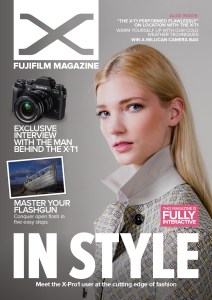
The Fujifilm X Magazine is back!

X07-COVER-UKIssue 7 of the Fujifilm X Magazine is now available to view online, or download to your mobile or tablet via the Android or Apple app.

We pass on some brilliant cold weather shooting advice, showcase the work of portrait and fashion photographer Jamie Stoker, teach you how to master open flash and give you the chance to win a Millican camera bag.

We’ve also given the XF18-135mm lens a bit of test run and let you know how we got on.


Interview – Jamie Stoker

Jamie Stoker is a rising star in the world of fashion photography. We talk to the X-Pro1 user about his approach in this ultra-competitive field.

Click here to read the full interview »

X Marks the Spot

Tom Applegate travelled through Europe earlier this year, taking a Fujifilm X-T1 to document his journey. See a selection of his shots and read how they were taken.

Click here to read the full article »

What to shoot

4_what-to-shoot_1 As temperatures cool down, photo opportunities hot up! We offer tips and advice to help you make the most of the colder conditions.

Click here to read the full article »

Exhibition

5_exhibition
Want to get great pictures? You need to take things slowly, as these shots by your fellow readers show.

Click here to read the full article »

Master the X-series


Grab your flashgun and create superb outdoor shots by using open flash – we show you how. Plus, the weather-resistant XF18-135mm lens on test.

Click here to read the full article »

Competition

Daniel the Camera Bag from Millican is up for grabs and he could be yours. Just answer a simple question to be in with a chance of having him on your shoulder!

Click here to read more »

Yellowstone’s Winter Wildlife Seven Day Photo Safari

Start the New Year a new photographer

By Simon Weir – Professional X-Photographer

If you’re like most people, much of the time you live life on autopilot. Everyday tasks, like taking a shower and driving to work are managed by long-established habits. This leaves the mind free to think but rather than exploiting this freedom the mind, left unattended, fills its day with internal chatter about what happened yesterday or last week or what you have to do after lunch or this coming weekend. Sometimes it all gets a bit too much.

Untitled-1

What is “enlightened photography”?

Photography provides an opportunity to give our minds a holiday but unless we also clear the mind of its senseless chatter, photographs only ever reflect our cluttered existence. That is why, on a Magic Is Photo Safari, we teach more than just the technical aspects of photography. We also help you to be mindful to the photo opportunities around you – to recognize each moment for what it is and connect with the land and the wildlife in a way that will not only transform your photography but possibly your everyday life as well.

Take a load off and fire your imagination

Imagine, then, that it’s February and you are deep in Yellowstone National Park. The quiet is absolute. The waist-deep snow is talcum powder-soft and the park’s ancient trees loom against the vast blue sky to create a landscape plucked straight from your wildest imagination.

The clean, crisp air, sulfur springs and pine nut-aromas unite to provide the perfect accompaniment to the natural geothermal features that are an ice age in the making. It’s an ethereal, ever shifting landscape of cryptic light and shadow that plays home to wild wolves, coyotes, bobcats, eagles, bison, foxes and elk – the perfect location to immerse yourself in nature and take a load off your mind.

top

The highlights

  • See fantastic wildlife, including top predators and snow-covered bison and elk
  • Our specialised snow coaches give us brilliant winter access to the park
  • Immerse yourself in the solitude of this incredible landscape
  • Dawn ‘til dusk photography
  • Our flexible itinerary allows us to go where the action is
  • No single supplement
  • Learn from Simon Weir’s 10-years experience as a pro’ photographer
  • Hands-on tuition as you need it and optional evening seminars
  • Special extra lectures on Infrared, night and time-lapse photography
  • £300 discount for Fuji photographers

The experience

Let’s start off by saying that everything you’ve ever heard and seen about Yellowstone in winter is true. Every step you take can quickly become the best step you’ve ever taken. And through this land of ice and magic move the animals. Like apparitions, in the semi-corporeal mists they drift through the hinterland. Yellowstone may seem at slumber but in winter it’s awake and alive with wildlife.

Our photographic days begin at around 7:00AM, when we board our specialized snow coaches for a full day in the park. Initially, the road takes us east, following the course of the Madison River. This is an excellent area for sighting trumpeter swans, bald eagles, elk and bobcat. At Madison, there is a warming hut, which provides hot drinks and snacks and a warm fire, and is a favourite mid-morning stopping place with our guests.

The Madison Valley is a prime wildlife area and we can expect to see plentiful bison, coyote, fox and maybe the rare and elusive wolf and bobcat. From Madison we can take one of two routes: north-east following the course of the Gibbon River, towards the Norris Geyser Basin, taking in the famous Gibbon Falls; or south, initially following the course of the Firehole River towards Old Faithful, Yellowstone’s most famous geyser.

Each route offers a changing landscape, interspersed with ghost-like trees and the rising steam from distant geysers, and wildlife sightings of bison and elk and more. We spend the whole day in the park, returning as the sun disappears beyond the horizon, leaving behind its fire-red glow.

At day’s end, we head back to the warmth and comfort of our cozy lodge where, like old friends around the fire, we’ll share our stories from the day’s photography and visualize the next day’s adventure. Life – and photography – really doesn’t get much better than this.

The details

A 7-day photo safari from 8th – 14th February 2015 at just £2,255 per person with £300 “Fuji” discount (normal price £2,555). Price includes airport transfers, accommodation, lunches, Park entry fees and permits, snow coach transport and all tuition. Flights to and from Bozeman International Airport are excluded.

Booking

For further information and to book on this safari, simply click here.

bottom


Film Simulation test by Dave Jackson

By Dave Jackson

My wedding workflow for the past few years whilst shooting with Nikon DSLR’s has consisted purely of shooting RAW and processing the files initially in Lightroom and with some additional tweaks in Photoshop with Nik and OnOne software plugins. The aim is to produce a set of colour and exposure corrected JPEGS for supply to our clients. Since switching to Fuji for most of our wedding work I wanted to compare the film simulations in ‘real life’ shooting situations. Just to clarify, this is not about shooting JPEG only which I know some photographers do but this is part of a bigger picture in exploring the possibilities of producing ‘in camera’ JPEGS from the RAW files for supply direct to the client with little or no external processing after the wedding.

The original RAW files were transferred back to a memory card and then processed in camera. All other settings eg colour. shadow,etc. were 0. The images are in the same order from top to bottom L-R as the film simulation selections in the camera’s menu, starting with the unprocessed RAW file then Provia, Velvia, Astia, Pro Neg Hi, Pro Neg Standard, BW, BW Yellow, BW Red, BW Green, Sepia.

Bridal portraits

bridal portraits 1
X-T1 / 18 -55 F2.8-4 F4 @ 1/250 1250 ISO +0.33 Exp comp. Auto WB

The first set of images (above) are some Bridal portraits taken in the reception room as we were rained off for outside shooting.

There was a large expanse of windows with natural, overcast daylight behind me.

Of the colour versions I don’t think it will come as any great surprise that Velvia is just a bit too saturated for this type of image and personally I find Pro Neg Standard to ‘flat’. That leaves Provia, Astia and Pro Neg Hi. Of these Astia has produced the warmest image, closely followed by Provia and then Pro Neg Hi. Astia will be my first choice for similar lighting / subject in the future.

So far as the black and white versions, my choice here for skin tone would be the Red filter but the overall contrast has reduced with Green producing the darkest lips. I think I might be wary in using the green filter as a ‘redder’ skin tone could cause the skin to darken more than I would wish.

X-T1 / 18-55 F2.8-4 F4 @ 1/150 3200 ISO +0.33 Exp comp Auto WB
X-T1 / 18-55 F2.8-4
F4 @ 1/150 3200 ISO +0.33 Exp comp Auto WB

This was at Bride’s home before the wedding (above). There was a window to camera right but it was quite dull outside and it provided very little light so we set up our Lupolux LED650 with a showercap diffuser to camera right.

Once again the winner for me is ‘Astia’, however they are all acceptable, even ‘Velvia’ hasn’t gone too far with a nice boost to the flowers. Of the black and whites, ‘Red’ has given the lightest skin tones and ‘Green’ the greatest contrast. Yes, you guessed – still a thumbs down for ‘Sepia’.

Wedding Couple

wedding couple
X-T1 / 18-55 F2.8-4 F4 @ 1/640 400 ISO Auto WB


The lighting was gorgeous here, with the sun low and diffused slightly through clouds to camera left. (Above) 

Would be quite happy to use ‘Velvia’ here. It hasn’t affected skin tones too much – and wow! – those Fuji greens! I was a bit surprised at the very little difference with the black and white filters. Understandably the ‘green’ filter has produced the lightest image with ‘red’ providing the most contrast – just. Still wouldn’t use ‘sepia’

Classic Chrome

Whilst putting this test together it became possible via an update to apply ‘Classic Chrome’ to existing X-T1 RAW files using Lightroom (5.7). Below are the 3 files with this mode.

classic chrome

For me ‘classic chrome’ is just a little on the ‘grungy’ side and I’m not quite sure yet where it might fit in with our current style of wedding shooting / editing. However, I can’t wait to use this in lots of other genres, especially ‘street’ and some ‘urban portraits’.

Conclusions

As mentioned at the beginning of the post, the aim here was to find out how usable the film simulations are straight out of camera in ‘real life’ wedding shooting. I am working on switching film simulation modes during the wedding to suit particular lighting and subject matter and then using the resultant JPEGS as part of our workflow to supply direct to our clients with no further post processing. DR settings are also going to play a big part in this, especially when shooting high contrast scenes. We will continue to shoot both RAW and fine JPEG and will of course use the RAW files as needed for post processing if the need arises.

To be honest I’m knocked out by the quality of JPEGS produced in camera, the noise reduction is also truly amazing. I would prefer a stronger filter effect with the black and whites as there isn’t a great deal of difference between them all.

For me the Sepia simulation is very limited for our particular requirements and I don’t envisage using it at all.

For full resolution image examples, please click here. 

David Jackson’s Twitter & Blog

Guest post: My Wedding Photographer Mindset. Or: How I learned to stop worrying and Love Fujifilm.

By Mick Servodio

Ok. Let me start by saying: that this is not another fanboy drooling over his Fujifilm gear. I won’t be talking Tech in this Post. I will be talking from the heart. About me, my experiences. I know you know about the cameras (those Fujifilm cameras). So, no drooling here. This is a bit more than that (and hopefully not less than that!).

Let me start by telling you who I am. I’m a bit like you. I love photography. I love the arts. I sort of fell into it. You see, I’m a cook by trade, and have had photography as a hobby. But I do now consider myself a working, semi-professional, whose main focus is wedding photography. I lived in Brisbane, Australia, where I built up my business, but now I live in Perth (for about 18 months). I’m working under the name of Velvet Photography (Check out my website)

X100S

In that short time in Perth, I have pretty much built up my business from scratch. It’s doing Ok. But luckily I know how to cook for a living while I continue to lock in those bookings (and I am).
I’ve come from Team Nikon. Starting with a d80, then a D700, and all that great glass that came with the cameras. It was my gear, and I was used to shooting with it.

So what happened?

I wanted a personal camera. Something for my own. Something that didn’t remind me of a workhorse. That’s when I found the Fujifilm X100. It was the camera that got me totally hooked. I loved everything about it. The retro Chic styling: the Hybrid viewfinder. Just everything. And once I got used to it, I even got used to its quirks. But you know, most of all, it got me loving my craft again: Photography felt passionate again to me. It was more than just work

Now I’ve read this a lot from other photographers. But why do we hear it over and over? We seem to hear this commonality because it’s a common truth for so many of us. I can say for certain that it was 110% true for me.

Initially this was just going to be a camera just for me. I needed something to be separate from the job. Something to take to all those family functions without cringing every time someone asked me to bring my camera with me.

The X100 was my loved personal camera right up until I sold it, and bought a 2nd hand X-E1. This camera made the addiction serious. When I brought it along to a wedding, I became surprised with how much it was getting used. The client ended up getting about 40% of their images with the X-E1, and the 35mm lens.

But the transition for me wasn’t as easy as I thought it would be. The real challenge was breaking away from the headspace of what it means to be a Professional Photographer, and how one should look. And in my mind, it had to be a guy with BIG cameras, and massive, long, heavy lenses. That was it. There was no other look. And all I could think for ages was what would people (that is: paying clients) think when I rocked up shoot their Lush wedding with some tiny cameras that were smaller than Uncle Bobs Gear. It was on my mind so much and often that I almost put it out of my mind. There was no way I could pull this off. How could I be taken seriously as a pro? It shouldn’t have mattered, but it did. I wanted to work through this. And this is how it did it:

X100S

I used my D700 as a security blanket of sorts. It was hung over my shoulder as I shot with the x-e1 at my next wedding. This was my way of working through this Image I was (self) programmed to project. For me, the Image of Velvet Photography (me) was everything. I had to look the part. But in the end, I worked through it. The new mindset was: “I’m making choices for both myself and my client. These cameras make me happy, and so, if I’m happy to shoot a wedding like this, then my clients will benefit”. Or something like that.

But like any addict, I wanted more. That’s when the X-T1 came in. And then that WAS it for me. This was the game changer for me, and I didn’t care about Nikon. Suddenly it was a paperweight. Suddenly I was drooling (but not like a fanboy). I was enamoured with the dials. OMG: the dials spoke to me. And suddenly I wished I had grown up shooting on Film. Because this was what it would have been like. All this control at one finger tips.

The images coming from the X-T1 were great, and best of all the response time from this camera was something that I could finally take more seriously than the previous two cameras I had owned.

There seems to be a consensus that the focusing of all the Fujifilm cameras just are not fast enough (well, this is what I keep reading on forums and blogs), but for me, and for what I’m doing, the X-T1 is fast enough for me. And this is what this line of cameras has taught me: to slow down as a photographer, and to think about everything I shoot a little more. There is no more “spray and pray” mentality here. This camera was all about increasing the percentage of keepers. And there were more keepers than ever before, even though I was shooting less than before (totals, I mean).

So what’s my new line-up now?

Well, there’s the X-T1, with the 18-55 the 35mm 1.4 (which gets a lot of use), and the 56mm 1.2 which is without a doubt the nicest lens I have even owned. I don’t have to worry about shooting wide open because I know the images will be tac sharp. TAC. SHARP.

X100S

Back by my side is the X100S with its fixed field of view (23mm). I had forgotten how much I loved shooting with this. After all, it was a little sentimental buying this camera that looked identical to the first camera that had started it all for me. And yes, I admit it, I LOVE the retro chic look of it.
At the time of writing, I’ve just ordered the 23mm Prime for my X-T1. I’ve only heard good things about it, and I can’t wait to add it to my bag.

Having this new line-up of gear means a little retraining for myself. You see, I was used to shooting with the Nikon 24-70 , and the 70-200. The longest lens in my bag now is the 56mm, but I have found this to be enough reach. It just means I have to think differently. Time to freshen up the approach to my business, and my craft as an artform.

And as far as what people think? Well, all I know is that the X100S was a great conversation starter at a couple of weddings. Stuff like: “How old is that camera?” and “Is that a leica?”

X100S

The transition wasn’t smooth sailing, but it’s been great. For me and the Photographic journey I’m on, it’s all been about getting out of a rut, getting into a new mindset, and believing in a new system. The system may not be right for everyone. Some may not even have an interest in what else is out there, but the Fujifilm range of Bodies and Lenses works for me. It really does. It’s not about Pepsi or Coke anymore, I keep saying to anyone who will listen. I needed to change the way I was working, because I’m not getting any younger, and the idea of carrying around gear that was optically on par with what I was using, not to mention lighter was more than appealing. But in reality it was a lot more than that. I needed to find that spark again. I didn’t have it (even though I was producing some very fine work with my Nikon line up). I’ve found it now, and I stand tall and proud with these cameras over my shoulders as I work. I thank Fujifilm. My back also thanks you.

Related links:

View Mick’s site here: http://www.velvetphotography.com.au
Facebook: https://www.facebook.com/perthvelvetphotography
Instagram: http://instagram.com/velvetphotography_perth
Blogger: http://velvetphotography.blogspot.com.au/

X100S

X-E1

X-E1

X-E1

X-T1

All of the images in this blog post are © Velvet Photography.