Please see our new movie ‘Fujifilm in Europe’. You use our products and technologies every day. Even without knowing it. We evolved, adapted and changed into a company employing thousands of passionate professionals. Specializing in seven distinct business domains. Enjoy watching and if you like, leave a comment!
2.3 billion people worldwide lack access to reliable electricity. In Nepal roughly 80% of the population live in rural mountainous regions that have little to no access to electricity. With the devastating earthquakes last year (April 25th and May 12th 2015) the citizens of Nepal were left with a broken country, 9,000 people killed, tens of thousands of people injured and over 2.5 million homeless.
In Nepal, rooftop solar panels are being used in households to provide power for daily electrical appliances and activities; at schools to power computers, laptops and cellphones; and at hospitals and health posts to power patient needs in the rural mountainous communities. Solar integration for agricultural purposes has recently been implemented throughout various parts of rural Nepal to aid in the irrigation and harvest of crops year round.
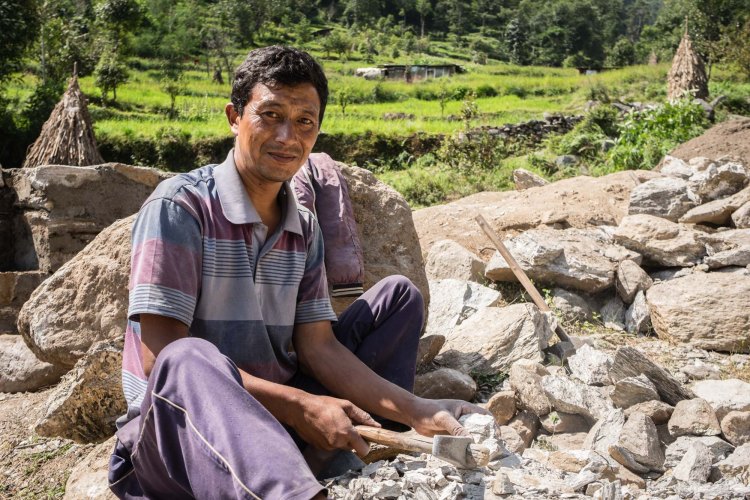
My goal with my photography is to raise awareness around humanitarian and environmental issues globally. I focus on documenting the candid and capturing moments that inspire a call-to-action. Through a partnership with Photographers Without Borders and SunFarmer, a non-profit organization focused on delivering solar power to developing countries, I returned to Nepal in October 2015 to capture the impact of solar technology and build awareness around the work of SunFarmer on local Nepali communities enduring the difficulties of life without electricity due to energy poverty.
The country continues to rebuild with the citizens of Nepal struggling to survive in the midst of the current political crisis that has left the country with a limited access to petrol, medicine, cooking gas and other essential supplies.
Sanepa Chowk, Kathmadu, Nepal.
Kupondole, Kathmandu, Nepal.
How did you get started as a photographer?
My inspiration for photography began in early childhood when I travelled with my family throughout Asia. I took my first film photography course in high school at the Hong Kong International School, while living and studying abroad in Hong Kong. But it wasn’t until years later after working in the financial services sector and living close to 10-years overseas, did I find my hand in photography. Over the years while living abroad, I’ve gained an understanding and deep appreciation and respect for diverse cultures and places.
Community member, Lakuri Danda health post, Lakuri Danda, Dolakha, Nepal.
In the pursuit of my passion, I’ve travelled extensively throughout South East Asia with my partner and with a camera always by my side ready to document my environment, culture and people that I encountered. With my photography, I seek out stories that raise awareness and address social, humanitarian, environmental and cultural issues to evoke positive change for the natural world and its inhabitants.
Charikot, Dolakha, Nepal.
How did you get involved with the SunFarmer project in Nepal?
The SunFarmer project came about through a partnership with Photographer’s Without Borders (PWB), a non-profit collective of journalists, photographers, filmmakers and passionate storytellers with a mission to inform and inspire positive change by visually communicating the ways that grassroots initiatives are addressing problems in their communities. I was assigned to document solar energy solutions for SunFarmer in Nepal.
SunFarmer is a solar engineering non-profit that installs solar energy in hospitals, health clinics, schools and agricultural sites throughout the developing world. Nearly 1.3 billion people worldwide are without access to electricity. Without electricity, a modern quality of life is impossible and the growth and prosperity of a country is severely hindered. SunFarmer has a mission to reduce this figure by providing best in class solar at an affordable rate to schools, farms and health posts. The team’s goal is to provide electricity access to seven million people by 2020. In Nepal, SunFarmer has partnerships with various stakeholders that include private organizations, NGOs, government organizations, banks, bilateral organizations, and microfinance institutions. The basic criteria when choosing to work with these organizations are like-mindedness, a vision to provide access to reliable and affordable electricity over a long period of time and access to transmission lines in areas that are difficult to reach often due to rough geographical terrain in the rural parts of the countryside.
Since SunFarmer started in Nepal in 2014, the team has successfully implemented over 100 projects in the country. The value SunFarmer works with is to provide the best in class, affordable energy solutions to their clients. Many developing countries are facing similar situations to that of Nepal with regards to energy and electricity crisis and are equally as important to focus on next. The team is still weighing out the various different countries to focus on next and has made a global announcement on their commitment to rebuilding Nepal at the Clinton Global Initiative. Their commitment will bring 1.5 MW of solar powered electricity to at least 2 countries in the next 3 years.
SOS Children’s Home, Joripati, Bhaktapur, Nepal.
How do you go about determining your focus for a project of this size?
My goal for partnering with SunFarmer was to capture the impact of solar technology as Nepal continues to rebuild after the earthquakes that hit the country earlier in the year.
Kupondole, Kathmandu, Nepal.
Rebuilding Nepal in Thamel, Kathmandu, Nepal.
Rebuilding Nepal in Thamel, Kathmandu, Nepal.
The vision I had was to share a story that chronicles the lives of the Nepalese families and local community members that we visited throughout Nepal’s countryside and to show their shared hardships, stories and experiences. Through a series of photo essays, I illustrate the struggles faced by the citizens of Nepal as the country continues to rebuild and how solar energy is changing their lives.
Dhan Kumari KC, Lakuri Danda health post volunteer, Lakuri Danda, Dolakha, Nepal.
I’ve lived in many of the world’s major cities and remote areas of Southeast Asia and it has been an invaluable experience that has become a strong influence in the way I shoot and go about determining my focus for long-term projects. Before I pick up the camera, I enjoy seeking out new places and diving into unfamiliar scenarios where I find my way by building strong relationships with the people I end up encountering.
Kathmandu Durbar Square, Kathmandu, Nepal.
Over the years, my curiosity to explore has taken me to the top of the world on a month-long expedition trek across the Everest Region, to the bottom of the Red Sea free diving in Egypt and on to studying meditation and traditional Muay Thai boxing in the mountains of northern Thailand.
My project with SunFarmer took me back to Nepal for a second time. The first time I visited was in April 2012. I landed in Kathmandu on my birthday. My partner and I stayed in Thamel where we purchased our gear and equipment for an expedition trek. It was an incredible, life changing experience. We started at the famous ‘world’s most dangerous airport’ in Lukla, acclimatized in Namche Bazaar Village, crossed the Chola Pass, summited Gokyo Ri and Island Peak and made our way to the Everest Base Camp and back to Kathmandu in one piece.
We ended up spending three months in Nepal and I had a genuine connection with the people, community and country. The Nepalese are a very special kind of people with a strong sense of dignity, compassion and unity.
What did you do to prepare yourself for the trip to Nepal?
Of critical importance to successful assignment photography is the research you do before you book that plane ticket. The more legwork and planning done upfront, the better your images will be when you land.
My first point of contact for the project was SunFarmer’s Director of Impact & Partnerships, who is based in New York. SunFarmer has operations in the US, Canada, and Nepal. Planning began with logistics and safety discussions in late February 2015. Over several months we coordinated the solar site visits at SunFarmer and with SunFarmer’s partner organizations throughout Nepal’s countryside.
Temporary health post in Lakuri Danda, Dolakha, Nepal. Dolakha district is one of the hardest hit April 25th Nepal earthquake disaster zones in Nepal.
Inside the temporary health post in Lakuri Danda, Dolakha, Nepal. Dolakha district is one of the hardest hit April 25th Nepal earthquake disaster zones in Nepal.
There are several factors to consider when working on location and in a developing country. Not surprisingly, the first avenue of information is from the Internet. I have a quick look at tourist information and government sites, travel advisory boards, official country tourism boards, news outlets for the most updated look at the country’s political standing and issues, guide books such as the Lonely Planet Guide and Rough Guides for high level country profile information, sites to see and places to stay, and travel sites like WikiTravel, VirtualTourist and Trip Advisor. It is also extremely useful to take a good look at the best time of year to head over to your destination.
Kupondole, Kathmandu, Nepal.
Collapsed health post in Lakuri Danda, Dolakha, Nepal. Dolakha district is one of the hardest hit April 25th Nepal earthquake disaster zones in Nepal.
With this information, I also prepare a concept and shot list with details on the shoot objectives, location, setting and contact list. Purchasing a local map and marking off sites and locations of importance will be extremely helpful to ensure you get all the shots you need for the project and your creative curiosity.
Rebuilding the health post in Lakuri Danda, Dolakha, Nepal. Dolakha district is one of the hardest hit April 25th Nepal earthquake disaster zones in Nepal.
What were some of the obstacles you had to overcome while planning the trip?
The biggest obstacle was looking at the best time of year to visit. In Nepal, there are two preferred times a year for travel. Peak season, particularly for trekking is from late September to early December when the air is crisp and fresh with clear skies for the best mountain views. From the end of February to mid-April, it is warm and dry; the rhododendrons are in flower and bloom. This season brings a second wave of visitors. The summer months of June to August are also the monsoon season in Nepal and not an ideal time to visit. The weather is hot and wet. It rains almost everyday with occasional thunderstorms in the evenings.
Another factor to consider is the festival season. Throughout the Nepalese annual calendar, there are several religious holidays. Dashain is a very popular festival in Nepal. It is the longest and most auspicious festival celebrated. In Nepal, it is a celebration of family. People return home from all over the world to spend time with their family and loved ones. All government offices, educational institutions and businesses remain closed during the festival period that falls in September or October and lasts for fifteen days. Making a visit during the festival season can be great for street and travel photography, but is not always the ideal time to visit while on assignment. Many of SunFarmer’s partner organizations remained closed during this time and we had to work around the festival schedule.
Chinatown Shopping Centre, Churchil Complex Sundhara, Kathmandu Nepal.
Chinatown Shopping Centre, Churchil Complex Sundhara, Kathmandu Nepal.
Travel and logistics are equally as important to work out long before the project starts. We had to secure well in advance a four-wheel drive vehicle and experienced driver to take us across Nepal’s countryside and up the mountainside to visit the agricultural solar sites and solar water pumps that lift water from the valley below to a tank above the community on a hill. Access to water from tap stands outside each house gives families back time they would otherwise use for collecting water and gives farmers water to irrigate their crops.
How are solar photovoltaic systems used and are they anymore beneficial than the more traditional energy gathering techniques such as hydro or wind for Nepal?
A solar photovoltaic system or PV system is a power system that harnesses the power of the sun which is composed of particles of energy called photons that is converted into electricity via solar panels to power electrical loads. Simply put, solar panels absorb and convert sunlight into usable electricity.
Sanepa, Kathmandu, Nepal.
SunFarmer Nepal team has noted that Nepal has around 720-740 MW of hydro power plants installed in the country and import around 200MW of electricity from India. There is a large demand of around 1300 – 1400 MW of energy for consumption. The supply and demand clearly doesn’t match and there is a large energy deficit in the country. Nepal has not been able to upscale their hydropower installations to meet its citizen’s demands because the demand for energy grows roughly 10% every year. An additional problem is that currently there is only one hydro station that has storage capacity in the country. The remaining hydro plants are run-of-river power. So during the dry season Nepal only has 25% of energy generation leaving the population with around 12-16 hours of load shedding (scheduled blackouts) during the dry months that runs for more than six months. This is why it is important to have a healthy energy mix of renewable energy sources in the country to address the energy crisis, to be independent and to be climate resilient. With the earthquake, most of the hydro stations were damaged. Nepal lost around 150MW of power due to the earthquake.
What were some of the obstacles you had to overcome while filming in remote locations?
In Nepal, 80% of the population lack access to reliable electricity and live in the rural parts of the country. Naturally, the biggest challenge we were faced with was keeping our equipment charged and ready to shoot at all times. A few of the project sites we had on the agenda required a days worth of travel and off-road driving up Nepal’s countryside.
For the project, we had arranged in advance with community directors at each of SunFarmer’s partner locations to join us for the site visits. SunFarmer provided me with a translator and solar operations engineer to interview our subjects. Once on site, I setup my equipment for a series of interviews with the local community members and a series of portraits to follow.
We shot under all environmental conditions, rain or shine, indoors and outdoors. We were blessed with good weather during the tail end of the monsoon season with sunny skies and little rainfall. It became a bit of a challenge to work with the changing sunshine. While shooting outdoors and interviewing our subjects, we had to wait several times for the clouds to pass and the sun to shine to keep a consistent exposure. For portraits, we shot mostly indoors or in a shaded area outside with a 3” Octabox providing warm light to envelop the sitter in their natural environment.
How does travel affect what you bring to shoot?
I try to be a minimalist when it comes to things to carry while traveling on assignment. When I traveled throughout Asia for over 2 years, I had with me two camera bodies (one for backup or video), a laptop for quick edits and social media updates, a cobra flash, a 3’’ octabox, tripod, light stand, transmitter/receiver, extra camera batteries, CF cards, rechargeable AA batteries and a reflector. Today, I wouldn’t go without my Fujifilm X-T1 with X Mount lenses and Voltaic Systems 17-watt solar charging kit.
Traveling has taught me to shoot creatively in difficult situations, think on my feet and problem solve various scenarios that come up. Oftentimes, you will be uncomfortable, but as long as you keep your equipment close, stay safe and keep a flexible attitude and an open mind, travel is the best kind of education that will take you to some of the most intriguing and wonderful places the world has to offer.
Rebuilding Nepal in Thamel, Kathmandu, Nepal.
Chinatown Shopping Centre, Churchil Complex Sundhara, Kathmandu Nepal.
What advice would you give to someone interested in documentary photography?
When you first arrive at your destination, begin to quickly familiarize yourself with the lay of the land. Don’t be afraid to walk around while always being cautious of your surrounds and self-aware. Look for interesting vantage points and characters, and keep in mind when the sun rises and sets to scope out areas the day before for where you will need to be during the ‘magic hour.’
Be present, shoot in the moment and become inspired by the rich, diverse cultures of the people that inhabit the world. Everyday we are faced with environmental and societal concerns that challenge us to look inward, encourage us to re-evaluate our actions towards one another and inspire us to look closely at the world we reside in. Be true to yourself and follow your curiosity and passion.
Patan Durbar Square, Patan, Nepal.
Thamel, Kathmandu, Nepal.
In Nepal, the streets are so full of life with people who are proud to share their stories and life experiences if approached. Their strength of character shines through and it was important to me to capture this in the best light possible. With every photo you take, try to find a way to create images that humanize various situations and cultures. With my photography, I hope to open avenues of understanding between people and cultures and inspire positive change out of difficult situations.
Developing countries must expand access to reliable and modern energy services if they are to reduce poverty and improve the health of their citizens. Nepal is currently facing a petrol crisis on top of their electricity crisis. As a landlocked country, Nepal depends heavily on India for the import of goods into the country. Nepal is facing a shortage in fuel stock with the continuous blockade of supply at the Indian border.
The sad reality I witnessed by working alongside SunFarmer is that the current petrol crisis is worse than the April 25th 7.8 magnitude earthquake that hit the country. Nepal received a lot of support globally with regards to earthquake relief. The earthquake has caused around USD $7 billion in damages, and it is estimated that the current cumulative loss from the blockage significantly exceeds that amount.
Kupondole, Kathmandu, Nepal.
About Kristin Lau
All images in this photo series were shot on the Fujifilm X-T1. To view more of Kristin’s images from Nepal and project “Light for Life: Solar Energy in Nepal,” visit her website: www.kristinlau.com
Kristin Lau is an award-winning Toronto-based documentary photographer from Queens, New York. She’s focused on social documentary, portraiture, and underwater and aerial subjects. Kristin seeks out stories that raise awareness about the environment to evoke positive change for the natural world and its inhabitants.
DeLorme inReach used to track and send location points for the cracked health post in Boch, Dolakha, Nepal.
Not many people realise it, but before I started travelling and shooting Motorsport, photographing pets was a major part of my business. I would shoot a lot of equine and dog portraits with the odd cat, snake or rat thrown in now and then. I still run Pawfolio, but it’s now more a project of love, or reserved for when people who know me as ‘the pet photographer’ really want me to shoot their most beloved….. not the kids, yep it’s always the dog!
I see a lot of people posting photos of their pets on instagram lately, with some pets even having their own pages. So I thought I would put a few tips together that might be fun to try out if you want to get a great shot of your own pooch…. some of the tips might even work on pictures of the kids too!
For my doggy model, I’m going to use Bria aka ‘The Beast’, my beautiful Sprocker Spaniel. These shots all involve natural light as I wanted this article to be of use to everyone. As long as you have a camera and a lens you can get stunning shots of your beast without expensive lighting.
Preparation
In my ‘Pawfolio’ bag. Don’t panic! You don’t need all of this! this is just some of the equipment I use on various shoots… If you have only one lens and a camera you’ll be fine 🙂
Camera: XPro1, XT1, XT10
Lenses: 18mm F2, 35mm F1.4, 10-24 F4, 90mm F2, 50-140mm F2.8
Lighting: Ambient/Natural Light
Extras: Dog, lead, willing assistant (wife, kid, person you met on a dog walk?), dog treats / squeaky toy / bouncy ball / whistle, silly voice, insurance (if you want to shoot other peoples dogs!), mobile phone
Top Tip! Things become massively easy in life once a dog knows how to sit, stay, and look at food!! this is where all that training pays off! You will need a few basics such as;
Sit, Paw, Down/Sleep, Stay, Come…
(We had to learn some of these commands in polish once for a clients dog we photographed.)
A food-orientated dog is perfect, if this isn’t working then it’s down to the favourite toy, bouncy ball or failing that, making stupid noises…..dogs love this! The right noise will get a dog to tilt it’s head in a way that looks cute but whilst saying ‘what are you doing, human?’
Play with your beast first;
this builds a little trust between the dog and yourself.
It’s fun for both of you,
it burns off the dog’s energy reserve
A few minutes playing around the kit isn’t a bad thing either, it lets the dog know that the camera is nothing to be worried about and not something strange and dangerous…
Around the house – Your own dog
Ideal for practice and often the easiest of images to shoot are where the dog is relaxed in their own surroundings or favourite spot. I normally wait for ‘Beast’ to find somewhere nice to settle or I encourage her to sit roughly in the right place. Quite often I’ll pap her as she drifts off to sleep. These are candid based shots but can turn into gorgeous intimate photos.
I use any of the following 18mm f2, 35mm f1.4 and the 90mm F2 mostly to achieve the shallow depth of field for this type of shot. The XF35mm f2, XF16, XF23 and XF56mm would be amazing also. Any lens at F1.2 – F2 will make a stunning image. I often use the X-Pro1 and X-T1. The OVF on the X-Pro1 can be really useful in hybrid mode during low light if the EVF wont preview the shot.
#Tip – You can put the Fuji camera to silent mode if the dog is too distracted by the shutter sound. Beast used to hear the shutter then pounce on me because she thought the sound meant that the shoot was over.
The candid shots I usually try to get for every dog shoot are:
Nose
That big snuffler is amazing. Shot at 1.2 or on a Macro it makes a stunning detailed image.
Paws
The texture of the pads or the hairy paw is beautiful. If it’s your dog, hold the paw and capture a paw & hand selfie #TooCute
Face
Poor beast with the collar of shame
“What’s going on down there?”
Like any face or portrait I shoot, I always focus on the eye closest to me. If you shoot the furthest one and the closer one is blurred, the image just looks wrong – please don’t do it!!
#Tip – Try shooting the dog from ‘a dogs view’ or from below the dog looking up. Crawling around in the dirt is just an everyday thing for me, but I think it’s really worth getting the unusual perspective. This is also now where the flip out screen is genius and the X-T1 or X-T10 becomes king.
That said, don’t rule out the standing up traditional viewpoint. Sometimes if you stand right over the dog looking down, you get that ‘puppy face’ beaming back up at you, and there is nothing cuter.
Outdoors
For outdoor shots, choose a nice spot your dog is going to love and that has some features or atmosphere about it. The beach is an awesome place for dogs, and one of our favourites, with lots of space, great light, and lots of zooming. For this a 90mm, 50-140 or the new 100-400 is ideal because the animal can move around freely but you can still fill the frame. This situation is ideal for the X-T1 or X-T10 because of their high frame rate. I would probably go for the X-T1 more to help keep the sand, salt and spray out of the camera. I would also recommend the weather resistant lenses for this type of shoot. A rogue wave splash or a shake down from the Beast can spray your gear from a surprising distance.
You won’t believe the range on this thing!
Rivers are great too, but always check the current is safe. Look for a spot on the bank with space and great moody lighting, perhaps between some trees. You should make sure your beast can get in and out easily, and I always have someone with me to throw a ball or something safe for the dog to chase, or I sometimes just sit and watch the animal play and have fun on their own.
Before river
After river
My favourite lens for outdoor dog shoots has to be the 50-140 F2.8. With good flexibility and a shallow depth of field at F2.8 there’s always gorgeous bokeh in the background. I try to keep the shutter up between 2000th and 4000th of a second to keep the motion frozen. If the light is changing or the dog is running through light and dark patches, try ‘auto ISO’.
Set the the auto ISO range function to work between ISO 200 and 6400. To control the aperture, try to stay in the range of F2.8 – F4/5.6 or if you want some amazing textural shots and there is loads of light, dial in F8 – F11. Again get low… I have the tilt screen for this, or just get in the dirt and sand and the shots will be amazing.
You could also try the 16-55 F2.8 if you want the shot to be a little more environmental, shoot wide and get more of the landscape in your photos. When you print this type of shot they look great printed large.
If you want to get really creative try ‘panning’ the dog. This is a technique we use on the track to shoot cars at the races. Select a shutter speed between 1/8th (very creative) up to 1/200th (suggest you start there and work your way down to 1/8th), and rotate your body at the hips following and tracking your dog as it runs past. You want to work your shots at slower and slower shutter speeds to create a wonderful action arty shot…
Doggy pan
More about the author
John + Beast
John Rourke has been shooting professionally for 15 years and is the owner of Adrenal Media, the Official Photography Agency for the FIA WEC (World Endurance Championship), and the ELMS (European Le Mans Series) including the world famous ‘Le Mans 24hr’. He shoots all of his professional and personal work on Fujifilm X series cameras.
FUJIFILM Europe today announces the establishment of a new facility based in its manufacturing and R&D centre in Tilburg, the Netherlands, called the Open Innovation Hub. This new European facility joins the two sister Open Innovation Hubs in Santa Clara, USA and Tokyo, Japan. The official opening ceremony will take place on March 9th. A new website provides background of Fujifilm’s open innovation culture and features a broad show case of technology ideas.
What’s not to like about macro (close up) photography? Getting closer to your subjects to see them in greater detail will always appeal, so picking up a few techniques to help you get better at shooting close ups is always worthwhile. Before we get down to the picture taking, let’s cover off the basics.
First, to get the best results you’re going to need a macro lens. That doesn’t mean a lens that has a macro setting, it means a proper macro lens. Such optics aren’t only suitable for close up work. The FUJIFILM XF60mm F2.4 Macro lens that we’re using here, for example, doubles as an excellent lens for shooting portraits, but it’s optically engineered to excel at close ups.
When it comes to macro lenses you’ll often hear the term ‘reproduction ratio’, such as 1:2 or lifesize. Put simply, this refers to the size the lens can reproduce what it’s being pointed at. A macro lens that offers a lifesize (or 1:1) ratio will reproduce the subject at the same size on the sensor as it is in real life. 1:2 means the subject will be reproduced at half lifesize, and so on. The XF60mm offers a 1:2 reproduction ratio.
Finally for now, it’s important to know that the closer you get to a subject, the smaller the area that appears in sharp focus. Given this, focusing has to be extremely precise, which is why a tripod or some other form of support is recommended.
Scenario 1: Shooting macro outdoors
With spring just around the corner, it’s obvious to brush up on your macro skills so you can shoot flowers. Indeed, for this very blog, I found a clump of snowdrops in my local park. Shooting macro images outdoors brings a number of challenges. The light levels vary which can cause exposure issues and, on the day I shot, it was windy, which causes delicate flowers like this to blow around a lot. That means you’ll need to shoot plenty of images, so make sure your battery is fully charged and you there’s plenty of room on your memory card.
I used an X-T1 for all these images as the fold out LCD is an absolute godsend. As I was working at ground level, it avoided me having to lay down on the cold ground. Instead, I popped out the LCD and rested the camera on a rolled up coat for support as my tripod didn’t go low enough.
I picked my subject carefully, finding one bloom that was isolated away from a larger group so I could focus attention on it and still get some complementary colours in the background; always check what is behind your subject before you shoot.
The first shot I took (above) was with the XF18-55mm set to 55mm and at its closest focusing distance. To be fair, this isn’t a bad result at all, but doesn’t really have a huge amount of impact as the bloom is quite small. So I reached for the macro lens and took this:
It’s a big improvement with the bloom occupying more of the frame, but the light is a little flat, so I used a small silver reflector placed under the snowdrop to push some more light in and get an even better shot:
I could have stopped there and been happy, but I also had the FUJIFILM MCEX-11 and MCEX-16 extension tubes with me, so I gave them a try. The tubes fit between the lens and body and allow you to focus even closer. Both tubes maintain all functionality between lens and camera including autofocus, but the focus can hunt a little more and as I was getting so close to the snowdrop I opted to switch to manual focus and use Focus Assist to enlarge the subject on the X-T1’s rear LCD for focusing accuracy. AF hunting isn’t the end of the world, but means you can end up with shots like this where it’s focused on the background rather than the single bloom.
I took three further sets of images, one with the 11mm, one with the 16mm and then one with the two combined, which got me closest of all. The reflector stayed in place for each image, but the sun was in and out hence the variations in light levels. Take your pick!
11mm tube
16mm tube
11mm and 16mm tubes together
Scenario 2: Focus stacking indoors
Time to warm up and head indoors to try another macro technique: focus stacking. Here, you take a range of shots with the lens focused on different parts of the subject before using Photoshop to stack them all together and get one super sharp image.
As previously mentioned, the closer you get to the subject, the smaller the zone of sharp focus so it can be difficult to get the image sharp from front to back. One solution would be to put the camera on a tripod and use a small aperture. But this could make for a long exposure, plus lenses aren’t always at their optical best at smaller apertures. It’s better to pick a central aperture – here I used F5.6 – and stack the images together.
To make this technique work, you’ll need something called a focusing rail. This attaches to your camera and allows you to make precise incremental changes by using the measure on the side of the rail. I used the 454 Micropositioning Sliding Plate by Manfrotto. I attached this to the X-Pro2 and XF60mm with MCEX-11 extension tube I was using inside, then put both on a tripod and framed up my subject – a dusty snooker scoreboard. In case you wondering why I didn’t remove the dust, this is purely to show how much detail you can get using the stacking technique.
With the XF60mm set at F5.6 and manually focused on the number 9, here’s the result I got (above). The 9 is nice and sharp, but the in focus area soon drops off on either side. Next, I didn’t touch the focus on lens and moved the focusing rail until the point nearest the camera came into focus. Noting the distance on the rail, I took a shot. I then moved the rail until the furthest point from the camera into focus and took another shot. Again, nothing on the camera was changed and I noted the distance on the rail.
The distance between the two focus points needed the rail to be moved by 4cm. So, again, by not touching any settings on the camera or lens, I moved the rail incrementally by 2mm at a time and took further shots. This gave me a total of around 20 images. Shooting over, I went to my computer and fired up Photoshop.
Nearest point
Furthest point
I opened all the files at once in Photoshop and then chose File>Scripts>Load File into Stack then on the dialogue box that opened, I chose Add Open Files and OK. With this complete, I then opened the Layers palette in the resulting image and selected all the Layers before choosing Edit>Auto-Align Layers. Once this was complete, I then selected all the Layers again and chose Edit>Auto-Blend Layers. On the resulting dialogue box, I chose Stack Images and then hit OK.
Depending on how much RAM your computer has, these processes may take a while, but once Photoshop has weaved its magic, you should find a sharp image where all the frames are stacked together. There is a possibility that your image will have some odd overlapping elements caused by the slight variance in camera angle between each frame as you move the camera along the rail. In this case, I did, but I was able to crop in slightly to removing the offending areas. If that’s not an option, you’ll need to try a different subject matter and preferably shoot on a plain background such as white or black.
If you’re happy with the result, finish by choosing Layer>Flatten Image and you’re done!
So there you have it – macro in a nutshell. One final point to bear in mind, macro photography is time-consuming to get right. Don’t expect great results straightaway, although there’s little doubt that patience will be rewarded. So when it comes to macro ideas, think big!
Exhibition: Thoresby The End Of The Mine features around 50 framed images Venue : Mansfield Museum, Leeming Street, Mansfield NG18 1NG Dates : 9th January – 27th February 2016 Open : Monday – Saturday 10am – 5pm Admission: Free




 By
By 


