So I got my hands on the new XF18-135mm lens a few weeks ago and I had planned to prepare a blog post about my thoughts and also contain some images showing off just how versatile a lens this was.
However, my colleagues in Japan politely asked me to hold it off because the sample lens I was using was a very early pre-production version and the image quality it would produce wouldn’t do justice to the full production version.
Personally, I think this was just a typically Japanese polite way of saying “don’t publish those images, they are terrible” 🙂
So instead of posting my thoughts (which I will do in time once I have a REAL lens to use) I am simply posting the thoughts of a couple of photographers who have also been using pre-production lenses, but were not politely asked to not publish any image 😉
Please bear in mind that all images on both of these 3rd party blogs were NOT shot on final versions, but I am sure you will find David, Ben and Kerry’s comments interesting:
David Cleland
When Fujifilm make announcements about new cameras or lens I always react with acute excitement. Ever since the release of the weather sealed Fujifilm X-T1 I have been longing for the release of their first weather sealed lens. When Fujifilm announced the XF 18-135mm lens with image stabilisation I couldn’t wait to have a completely weather sealed system for out in the Northern Ireland mountains.
I was lucky enough to be contacted by Fujifilm UK to use one of the prototypes of the XF18-135mm F3.5-5.6 R OIS WR lens to obtain some wildlife shots. Being a part of the Fujifilm X-Photographers is a real honour, and to be asked to try out a prototype lens is an opportunity I am extremely grateful for. Within two hours of the first email being sent I had thought up some ideas on how I could get some wildlife shots.
I am not going to write a super in-depth technical assessment of the lens – there will be many who will do that once the fully finished product is released. But, I have been using the lens on almost every shoot over the last 6 weeks or so. I’ve shot racing, polo and also some landscapes – so have given the lens a real ‘hands on’ test. And I love what I’ve seen.
It’s that time again. A new Fujifilm X Magazine issue is ready to your reading and viewing pleasure.
Interview with Eric Bouvet
This issue features an interview with the amazing award-winning reportage photographer Eric Bouvet who travels the world with his X-Pro1 and X-T1. Learn about what inspired Eric to take up photography and what pressure really feels like when he is standing in the firing line (literally) and trying to capture the events so people like you and I can see first hand what is going on across the world.
Eric Bouvet
Eric Bouvet
Eric Bouvet at the Burning Man festival
Take a walk around Yellowstone National Park
This issue’s “X Marks The Spot” features some amazing infra-red photography by Simon Weir using a modified X-E1 plus Lightroom and Silver Efex Pro.
Simon Weir
Simon Weir
Simon Weir
Be inspired
And the usual features; “What to Shoot Now” provides you with inspiration on what subjects to shoot during the summer months, “Get more from your X series” takes a look at the wireless connectivity function featured on many Fujifilm X cameras and the “Exhibition” shows a fantastic array of images, plus the sotires behind them, shot by our readers.
What to shoot now
Get more from your X series
X Magazine exhibition – Documentary
Competition time
Fujifilm X Magazine competition. Win an XF10-24mm lens!
And finally, you could win a fantastic XF10-24mm lens in our competition. For a chance to win, send us your best wide-angle image. More details in the magazine itself!
Jens Franke is a professional designer and photographer from Stuttgart. His passion for photography started during his exchange semester in Rio de Janeiro. He was so impressed about the versatility and tensions between the different population groups living together in one mega city.
To share his impressions he started a blog where he posted his personal view on the city. Back in Germany, his aroused wanderlust took him to exciting destinations in Columbia, Morocco, Europe and the US.
Capturing fleeting emotional moments of people, whether of happiness, sadness, joy, anxiety or loneliness became his goal of each journey.
Stuttgart
X-E1 with XF35mm – f/1.4, 1/125sec, ISO800
With all the possible exotic places in mind, and having grown up in the Bavarian Alps, I thought Stuttgart would be quite a boring place to live when I was here for the first months. To keep myself entertained I started to watch out for the subtle adventures of every day life. My camera got the main pretense for my everyday strolls through the little neighborhoods here. It worked out for me! I sensitised my view and step by step I got used to the rhythm of the city. Sometimes i feel like Daniel Quinn in Paul Auster’s fiction `City of Glass` when he is loosing himself in the city of NY.
X-E1 with XF35mm – f/1.4, 1/4000sec, ISO200
I really like Austers quote in this book: “In other words: It seems to me that I will always be happy in the place where I am not. Or, more bluntly: Wherever I am not is the place where I am myself. Or else, taking the bull by the horns: Anywhere out of the world.”
X-E1 with XF35mm – f/8, 1/125sec, ISO800
While I started photographing the people in the streets of Stuttgart, I got more and more interested in individual portraiture and the story behind the people. In my last Exhibition “Little Districts”, I combined street photography and portraiture to enable my visitors to see my city from both an intimate and a mysterious perspective at the same time.
X-E1 with XF35mm – f/1.4, 1/60sec, ISO400
Morocco
X-E1 with XF35mm – f/4, 1/40sec, ISO400
During the last two years I’ve traveled to Morocco four times to capture the glimpse of the Moroccan spirit close to the western Saharan border and the region around Marrakech. But a lot more I wanted to illustrate the people in their every day life – Moroccos inhabitants are the real points of interest of the country!
X-E1 with Contax C/Y Sonnar 85mm – f/2.8, 1/320sec, ISO400X-E1 with Contax C/Y Sonnar 85mm – f/2.8, 1/125sec, ISO400X-E1 with XF35mm – f/1.4, 1/1200sec, ISO400X-E1 with XF35mm – f/2.8, 1/3000sec, ISO200
Technique
Most of my current images are taken with this Lineup:
Fuji X-E1
Every Day Lens: Fujinon XF 35mm f/1.4 R
Fujinon XF 56mm F1.2 R
Fujinon XF 18mm 1:2 R
I really like the unobtrusiveness of the X System. With my blacktaped E1 I got barely noticed on the street and my whole equipment fits in a small camera bag. Since Street Photography is often a matter of performance i also like the intuitive controls and the customizable function keys. I made my X-E1 behaving like the Contax G2 which handling i loved. I set the focus via thumb and set the lightning via pressing the shutter halfway down. For a better handling i use the additional and pretty ergonomically handgrip.
I also enjoy the analog developing process and some of my other work is photographed by analogue medium and 35mm cameras.
Philip Ewing has been an enthusiastic amateur photographer since his 35mm days on the university student newspaper. Today he works as a journalist in Washington, D.C. You can find more photos at http://metrocommutr.tumblr.com/
Photographers love to insist the camera doesn’t matter – our creative vision is what truly makes a picture, as the old bromide goes – but inside the family, we know a camera can make a huge difference.
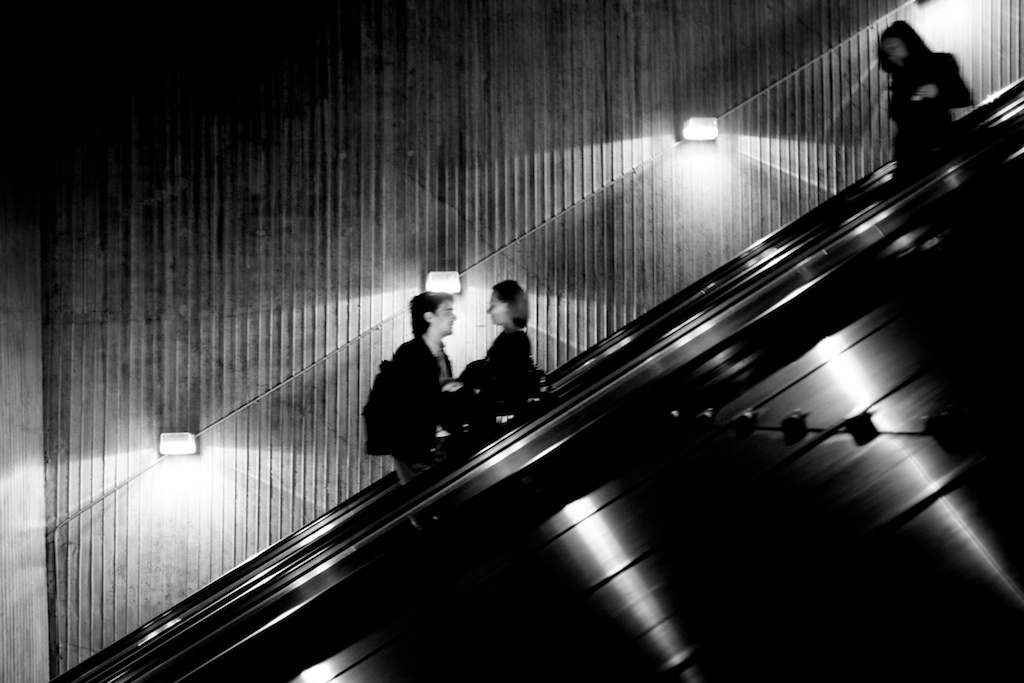
When I decided to make a serious go at a photo project documenting my daily life on Washington, D.C.’s Metro underground system, I did not begin with a clear sense for what the images should be. Sometimes you can imagine a photo beforehand and getting it is just a matter of execution. Sometimes you sense there’s a picture out there … you almost smell it … but you don’t know exactly what it is or how to capture it. This was one of those.
1/30 – f/2 – ISO1600
So starting last year, I began taking a camera with me every day on trips to work and around town. There were — and are — many more failures than successes. Plus my DSLR, along with the fast prime lenses I needed for dimly lit subterranean stations, was killing my back and shoulders. The files from my compact point-and-shoot didn’t have the detail or depth I wanted. Fortunately, there was a huge wave of anticipation about the then-new X100S, and I got on board. It has turned out to be an investment that has paid many unexpected dividends by enabling me to create pictures I didn’t know were there until the moment they presented themselves.
1/30 – f/2 – ISO1600
The unobtrusive little camera is light enough to carry all day, so you’ll actually take it with you, but it doesn’t force you to sacrifice sharp optics or a good sensor. It’s effectively silent, preserving your discretion in quiet train cars where an SLR shutter sounds like a gunshot. True, the X100S has a few quirks and faults and it isn’t the only tool I use to capture images. But the X100S is the one I carry 90 percent of the time, and it more than any other has helped translate the “sense” of a picture into an actual image.
1/30 – f/2.8 – ISO1250
As it turned out, the other keys to the Metro project were the two most basic things in photography: People and light. If any of the pictures have been successful, it has been because good light hit an interesting person at just the right time. The trick was figuring out those places and moments and just being there to try to catch them.
1/1000 – f/5.6 – ISO400
When a woman in a big woolen scarf emerged from a field of silhouettes as she stepped into a sunlit escalator — click. When a sunbeam inside a train car made a circuit over the passengers as we went around a bend, I set the camera to underexpose the scene and make a certain rider pop against the shadows. Dialing up 1/60th, f/2.8 and ISO 1250 with the Velvia film simulation mode can make the harsh-lit interior of a train car into a miniature stage for our human comedy.
1/1000 – f/4 – ISO400
There’s another aspect of using the X100S that has taken me by surprise: Its effect on others. Strangers stop you to ask about it — “It’s been years since I’ve seen somebody out using an old film camera!” they say. Once, I was photographing outside a Metro station and a D.C. police officer walked over. My heart began to race as I silently rehearsed a speech about my rights to take pictures in a public place. But there was no summons that day. “Hey,” he asked — “what kind of camera is that?”
When I first read about the forthcoming Tele-Conversion Lens for X100/X100S, being a very keen user and huge fan of the Fujifilm X100S, I was really looking forward to getting my hands on it and seeing what it can do.
I’ve used the WCL-X100 quite a bit and really love the results. Personally I can’t see any difference in the image quality and I’ve found those extra few millimetres can make all the difference when taking a few steps backwards is not an option.
Assuming the same could be said for the TCL-X100, I knew we’d have a product that will be highly regarded by the X100 community – you know who you are!
Image comparison
Here’s two comparison images of my kids. My eldest is like a statue with my “do not move your feet!” instructions. The other not taking this highly technical and scientific experiment as seriously as I’d like.
Fujifilm X100S with TCL-X100, f/11, 1/100 sec, ISO200, @33mm
Fujifilm X100S, f/11, 1/100 sec, ISO200, @23mm
The River Ouse looking rather attractive – showing some more of the edge detail.
Fujifilm X100S with TCL-X100, f/5.6, 1/140 sec, ISO200, @33mm
Fujifilm X100S, f/5.6, 1/170 sec, ISO200, @23mm
Another two showing edge detail.
Fujifilm X100S with TCL-X100, f/5.6, 1/125 sec, ISO200, @33mm
Fujifilm X100S. f/5.6, 1/140 sec, ISO200, @23mm
Bokeh effect of the TCL-X100 compared to the XF35mmF1.4
James Limpua, a Facebook user, requested a comparison between the XF35mm and the X100S with TCL-X100. So here goes. X100S + TCL-X100 (+ in-built ND filter) are on the left, X-T1 with XF35mmF1.4 are on the right. Both shot at f/2.0.
Fujifilm X-T1 with XF35mmF1.4, f/2, 1/2000 sec, ISO200, @35mm
Is digitally cropping pretty much the same as using this conversion lens?
A user has asked the question in the Comments section about whether Digital Cropping could have the same effect as using the TCL. I took a couple of example shots last night to demonstrate why the TCL is not just about bringing things closer, but actually narrowing your field of view.
Here’s two shots of my Millican bag. In both cases I lined the edge of the bag up with the 1/3rd gridlines on my camera. Obviously this means I was standing further away when I shot with the TCL.
X100S with TCL, f/2.8, 1/500sec, ISO200, 33mm
X100S without TCL, f/2.8, 1/600sec, ISO200, 23mm
As you can see, when I shot with the TCL on, the narrower field of view effectively makes the background appear much closer. One practical benefit of this is it allows you to cut out unwanted background distractions. Also, the longer focal length give a slight compression to the subject which is often more flattering. IF you notice in the samples, the bag looks slimmer in the TCL shot.
My verdict
IQ
Just like the WCL, as far as image quality is concerned, I personally can’t notice any loss of IQ when using the TCL-X100.
Autofocus
I have read people saying that the AF tends to miss more often with the TCL on but I have not experienced this. Although I’ve not used it in low light yet and I’ve only tested it on the X100S, not the X100.
Size and weight
X100S with TCL-X100
X100S with TCL-X100
My X100S is my absolute “go to” camera because it fits in my coat pocket, or in a small bag along with other things. The TCL does change that dynamic slightly, although it’s nothing I can’t overcome by storing it in my other pocket. If I’m really travelling light, unless I know I have a specific reason to have 50mm equiv, I’m probably going to leave this at home.
Overall
I think that after a fairly high investment (for a hobby) in an X100/S body, to be able to have the flexibility to change between 3 different focal length, leaf shutter, prime quality lenses (when factoring the WCL) for only a few hundred pounds extra per converter lens is a great move by Fujifilm.
You could live without it, and half the fun of the X100S is using your legs to zoom in or out and always thinking about what would fit into your 23mm (35mm FF equiv) frame, but this is certainly something that I will buy to turn my already awesome X100S into a better portrait camera.
As usual, please leave a comment below or send me a Tweet if you have any questions at all.
I may work for Fujifilm UK but I’m also a keen enthusiast photographer, and getting keener by the day. This blog is my opinion on the TCL-X100 and should not be considered the “official word of Fujifilm”.
Interview with Michelle Williams – professional photographer that recently made the switch to the world of Fujifilm X
Michelle is a professional photographer from North Wales. She has been photographing weddings, newborns and animals as her full time job on a Canon camera for the last ten years. She recently discovered the Fujifilm X series of cameras so we got in touch to ask her a bit about her rite of discovery.
So what made you decide to try a Fujifilm camera?
I’m a Canon user and have been for ten years. I never thought I would want to change to another make of camera, ever. Recently however, I’ve seen a lot of feedback online about the Fuji cameras so last week I sold some bits and bought a used X-E1 and a 35mm lens.
I wasn’t expecting much as these things are usually prone to hype. I’d tried the Olympus pen for a walk around camera and it was good but more of a fun camera than one I would seriously use. From the very first image I took with the X-E1 I was nothing short of gobsmacked. I was so excited to see what it was capable of.
How has the X-E1 changed how you shoot?
I’ve not been out of the house without it since I bought it. This weekend I had a wedding and packed my usual kit of a 5D2 and a 7D with all my lenses. I also took along the little Fuji to play with if I got a chance.
To my surprise, I shot the majority of the day with the Fuji alone! The images are brilliant straight from camera which on a wedding means saving tons of time for me so again I’m taken aback by its capabilities…especially in low light!
I truly am blown away with the colour, clarity and functionality of this camera.
Once again, thank you to you all for making photography fun and exciting for me again. Keep up the great work!


 Jens Franke