Month: September 2014

Interview with Dave Jackson – a recent convert to the Fujifilm X-T1 for professional wedding work

Dave JacksonDave started as a full time professional photographer in 1993 using a medium format Bronica. He made the switch to digital in 2005 using Fujifilm S2 and S3 cameras. From 2008 he’s been using Nikon D300’s and D700’s.

Dave and his wife Janice now specialise in weddings (40-50 per year), with a blend of classic, traditional, contemporary and reportage. They are pretty obsessed with lighting and locations. and use Graphistudio exclusively for their albums.

Recently they made the switch over to Fujifilm and offered to write about their reasons for doing so.

“My love affair with Fuji X cameras started like many professionals with the X100 which I’ve had now for a couple of years. I had yearned after an X-Pro1 for a while and took advantage of the great deal at The Photography Show in Birmingham this year which included the grip, 18mm F2, an extra battery and the chance to claim a free lens from Fuji I chose the 60mm F2.4 macro and also purchased a 35mm F1.4 shortly after.

“I really don’t know why but I didn’t take a lot of notice of the X-T1 on it’s launch but after another trade show and attending Damien Lovegrove’s Concept to Print tour I was hooked.

“I began to consider how the X-T1 could fit into our current range of Nikon D700’s and pro lenses and even on a longer term could it become our main camera(s)?

300814_XT1D_0695
XF18-55mm – ISO 640 – 1/160 – f/8

“We are a 2 shooter husband and wife team currently covering between 40 – 50 weddings per year. For some time, we have been concerned about the weight of our equipment and camera bags, today’s weddings are non-stop, very demanding assignments, often with several locations and very little time for actual shooting. I can’t begin to tell you how many camera bags / waist belt combinations we’ve tried (“oh no! Not another camera bag”, sighs Janice!) but nothing can change the actual weight of a D700 with battery grip, 2 batteries and a 70-200 F2.8!

290814_XT1D_0049
XF35mm – ISO 1250 – 1/160 – f/1.4

“I was taken aback at the weight of the X-T1 with vertical grip and 18-55. Other features that attracted me were the large dials for exposure compensation, ISO selection and shutter speeds, the tilt screen, virtually silent operation (the D700’s are noisy in a quiet church) and of course the best electronic viewfinder available so far. Fuji’s ‘roadmap’ of lens releases was also beginning to make everything look so promising.

“So I went ahead and purchased an X-T1 with 18-55 F2.8 -4. Already owning an x100 and X-Pro1 meant many of the menu settings were familiar and of course the 3 prime lenses I already owned could be put to immediate use if necessary. I already had 2 batteries but purchased another 2 as well as I knew they would be needed for the number of shots we take at an all day wedding. The camera felt so right in my hands and in no time at all I set everything up ready for wedding photography (settings shown in the image captions).

“We had a wedding just 5 days after purchasing the camera. I decided to jump straight in at the deep end and shoot as much of the wedding as possible with it.

“The X-T1 behaved impeccably! It took a while to get used to the EVF, I found a sort of 3 stage evaluation of the images whilst shooting-
1. Assess image with live view (aperture priority with exp compensation). The image can look a little contrasty with dark shadows and / or bright highlights.
2. Check the 0.5 sec preview. This looks better and less contrasty than the live view.
3. Chimp the image on the rear screen if in doubt. The image on the rear screen was confirming all was fine and I found myself ‘chimping’ less and less, knowing if the EVF preview looked ok that was enough.

300814_XT1D_0274
XF35mm – ISO 400 – 1/3000 – f/1.4

“Use of the EVF provided another advantage that I hadn’t really thought about. When ‘chimping’ with the Nikons the rear screen can be difficult to view. We often find ourselves taking a shot and turning our backs to couples to shade the screen to try and check exposures / blinks etc. The XT-1 solved this immediately with the preview in the viewfinder perfectly viewable regardless of light levels.

“A lot has been said about battery life. I added the vertical grip after the first 2 weddings and purchased another 2 spares. If a battery dies then the one in the body is immediately deployed so no chance of missing any shots and I can change the grip battery at a convenient moment. I am using 8GB Sandisk Extreme cards getting about 200 shots and the batteries are lasting for about 2 cards (400 shots).

“My next task is to sort using flash. Conditions were such that I didn’t need to use fill flash for these weddings. I used a Nikon SB22 and Nikon SB900 on Auto Aperture for a couple of in car shots and one cake cutting shot and used the D700 for first dance.
At the time of writing we have now shot 4 weddings with the XT-1 and I am completely convinced we have made the right decision.

“So, another XT-1 for Janice with 55-200 F3.5 (until the 50-140mm F2.8 arrives!) and probably an X-E2 each as well + 56mm F1.2, 10-24mm F4 lenses, – Oh dear the bank balance is going to take a hit!”

Check out more shots in the slideshow below:

To see even more of David’s work, click on the following links:
http://www.davejackson-photography.co.uk
https://www.flickr.com/photos/djp_lighterside/

Fujifilm at Photokina 2014!

Last week we were at photokina, the world’s largest imaging fair, from Tuesday 16th to Sunday 21st September. It’s been a complete blast and this post will hopefully highlight the bits you missed if you couldn’t make it to Cologne this year.

Our booth was big. It was made up with lots of different sections covering many different areas of our business, all with the same common goal – helping people with photography.

The X-Photographers Gallery

We had images from many different photographers displayed how they were always meant to be seen – printed.

Some were printed on FUJIFLEX Crystal Archive Printing Material and others on Fujicolor Crystal Archive Digital Paper but they were all amazingly good to look at. We’ve combined our X series cameras with many years’ experience of printing and finally the creativity of real users of our cameras to create a truly awe inspiring array of beautiful prints. Many visitors to the stand told us that they thought these were the best prints on display at the show.

The X-Photographers Stage

For me the stage was the real star of the show.

We had 23 photographers from all over the world talking about a wide range of subjects. Some were very inspirational, other educational, but all were very interesting. We will post another blog post shortly with more detail on each of the photographers and what their talk was like. Sign up at the top-right of the page to receive notifications when it is published.

“Touch and Try” section

On the stand we had the new X100T and X30 cameras and the new XF50-140mm F2.8  and XF56mm APD lenses available in our “Touch and Try” section for people to use. We also made sure there was something beautiful to shoot in the way of a BMW i8 and some lovely models so everyone had something to shoot.

The X100T is an evolution from the X100 and X100S with the main upgrades being a 1/32000th electronic shutter, digital rangefinder and new Classic Chrome film simulation.

Shot by Kevin Mullins at f/2 and 1/32000th in bright sunlight using Classic Chrome film simulation
Image by Kevin Mullins using the X100T at f/2 and 1/32000th using Classic Chrome film simulation

The X30 takes the popular X20 and gives it a new high-resolution Electronic Viewfinder, tilting LCD, new control ring, lots of new customisable Function buttons and the same awesome Classic Chrome Film Simulation as sported by the X100T.

Image by Alex Lambrechts using the X30 with new Classic Chrome film simulation

The XF50-140mm is our first weather resistant constant aperture lens. It boasts f/2.8 throughout its focal length range and contains a lot of amazing technology to make sure the results are comparable to prime lens quality

The XF56mm APD is a fast, sharp prime lens that contains an Apodisation filter that helps produce an even smoother bokeh affect than the standard XF56mm.

The final new product people could get their hands on was the new X-T1 Graphite Silver Edition pictured below.

The full X line-up

Additionally, behind a glass cabinet we had the entire range lined up (click the image below for a larger display)

Full X series lineup. Click to enlarge

Notable products were:

The XF16mmF1.4 has the same focus ring as the XF14 and XF23 with focus distance and depth of field guide on the barrel itself.

The XF16-55mmF2.8 appears to have OIS dropped from its name suggesting that the final lens will not have OIS, but instead aim for absolute optimal image quality. This is still to be confirmed though.

The XF90mmF2 looks like it’s going to be a big bit of glass. Similar in length to the XF56mm but a bit thicker.

Finally, previously known as the Super Tele-Photo Zoom Lens on the roadmap, a lens with no label underneath. However, it had an inscription bearing the specifications “XF 140-400mmF4-5.6 R LM OIS WR”. I’d like to point out that these are not 100% final specifications. They just needed to put something on the front of the mock-up lens to give a better idea of what the final lens would look like. Either way this gives us a guide as to what sort of spec the final lens is likely to be, and also how big it will be.

Free maintenance and camera loan service

maintenance

We offered a FREE maintenance service and a FREE camera loan service for the six days of photokina, In total we were able to service 510 cameras and loaned 433 cameras and lenses combined.

Technologies

We showcased a few of our technologies – some current and some in development

Film simulation
Fujifilm Film Simulations
Film is our heritage and therefore we spend a lot of time developing (pun not intended) our film simulation modes for our digital cameras. The latest film simulation mode we have released is Classic Chrome and it is available on the new X100T, X30 and will be made available via a firmware update for the X-T1 later this year.

Electronic rangefinder
tech-x100t-viewfinder
Here’s what the Hybrid Viewfinder in the X100T looks like. Learn more about the X100T Electronic Rangefinder here.

Lens coating demo
Nano GI comparison demoAlthough it’s pretty hard to see in this photo, here we demonstrate the lens coating on the new XF50-140. It has a special coating applied to reduce the amount of light that is reflected away.
Learn more about the technology that goes into the XF50-140mm lens, including Nano GI technology, here.

Remote “Multi-shooting” application
tech-multi-shoot Here’s a new app we’re currently working on that allows you to wirelessly control and shoot up to three cameras at one time using the same tablet computer.

Applications for this could be for recording video, creating 3D imagery or shooting event photography.

Since the launch of the X-T1 we have seen some amazingly creative uses people have found for the existing remote shooting app so we hope that this will allow people to be even more creative with their photography.


The Cologne photokina Photowalk

photowalk

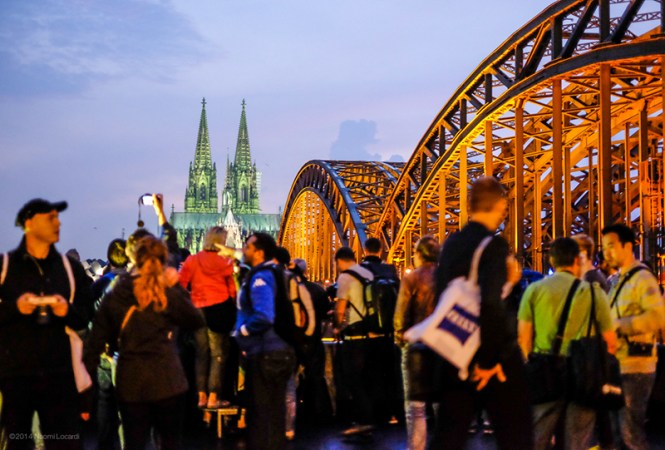
On Saturday night we held a photowalk with X-Photographers Elia Locardi and Ken Kaminesky. 213 people showed up, despite the threat for heavy rain beforehand. Most people brought their own equipment to shoot with and Fujifilm X-T1s and lenses were available for people to borrow if they wished.

We met at the Dom and then walked as a very large group around the cathedral and then across the river to watch the sunset from the East bank. It was a great event and we’re sure everyone enjoyed themselves and made a few new friends that share their love of photography.

These guys even won some prizes by having their names drawn at random:photowalk-prize-winners

FROM LEFT TO RIGHT: Fabiano Dallmeyer , Richard Powazynski, Jens Fricke, Ken Kaminesky, Carl Nasman, Patrick Mayon, Elia Locardi, Florin Lucian Patras and Michael Magner

Participants soohting the padlocks on the bridge (image by Naomi Locardi)
Participants shooting padlocks on the bridge (image by Naomi Locardi)
An after-dark image by Naomi Locardi
After-dark (image by Naomi Locardi)
Me, being mocked by Justin from Fujifilm USA... (image also by Naomi Locardi)
And finally me, being unwittingly mocked by Justin from Fujifilm USA… (image also by Naomi Locardi)

Many more photos from participants of the event have uploaded and will continue to be added to the Google Plus public event here: https://plus.google.com/events/chu5ri84smk6smt9ags8inu36l4

Fujifilm X Live

For more photos from the whole photokina event, and to keep up to date in real time with future events like this, please check out our Social Media accounts:

http://www.facebook.com/FujifilmXLive
http://twitter.com/FujifilmXLive
http://instagram.com/FujifilmXLive

Why lens choice is important?

Use of different focal lengths

This blog is going to try and cover the fundamentals of lenses, explaining when to use them and why. If you have any questions after reading this then please get in touch via:

If you haven’t already seen Dale Young’s great blog on “What focal length I should use and why?” Then check it out here.

I too took some photos at different focal lengths (see the below slideshow), between 10mm and 135mm, to emphasise how certain focal lengths are generally better than others for portraiture. This topic has brought up lots of comments and I have edited this part a number of times to try and get the best brief explanation, without going off on too big a tangent! To break it down to fundamentals, the thing that affects perspective is distance, the distance between the camera and the subject. The focal length you choose affects the framing of a subject. With the series of photos below, I tried to keep the framing the same for all the focal lengths; the thing that changed was the distance between the subject and me. At 10mm I was a mere few cm’s from the subject’s face (awkward), while at 135mm we were a few metres apart. This longest example (135mm) shows a flattening effect, where the content seems compressed. This occurs because of greater distance between the subject and myself. Making the depth of the face (e.g. from the nose to the ear) proportionally less compared to the distance between the subject and the lens… The opposite is true for the wide-angle photos. Take the 10mm example again; I am so close to the subject that the depth of the face makes up a larger distance than the distance between the lens and the nose, making the perspective exaggerated (also note how you can see the shadow behind the model with the wide-angle shots but you can’t with the telephoto portraits because of the narrower angle of view).

In full frame or 35mm film terminology, 50mm is deemed the ‘standard focal length’, as it is close to our eye’s central angle of view. This means that a 50mm lens produces a perspective very similar to what we see. Because the sensors in Fujifilm X-Series cameras are generally 1.5X smaller than full frame sensors (APS-C sensor size), this standard focal length equates to a 35mm lens, like the XF35mm F1.4 R. This is quite complicated to explain (it could be a whole other blog!)… So much so that I have spent hours editing these paragraphs, but hopefully you get the gist of how different focal lengths affect the perspective of a picture. There are some very informative comments about this topic at the bottom of this blog if you want to find out more.

Wide-angle lenses can create exaggerate perspectives which produce amusing (which is good as it’s engaging) portraits, especially with animals!


Apertures

Before we go any further, lets just check you understand the fundamentals of using apertures. If not then check out my previous blog that helps to explain how different apertures affect a picture (plus there are cute labrador puppies!).


Putting both together

35mm f1.4
35mm f1.4

Now that we understand how different focal lengths and apertures affect the look of a picture we can look at how to combine the two. First of all lets think about portraits: If you want to isolate a subject generally you are going to want to use a standard or telephoto lens with a low F-stop, such as the XF35mm F1.4 RXF56mm F1.2 R or the imminent XF50-140mm F2.8 R OIS WR. For the image to the left I wanted to try and isolate the woman from the background as it was very busy and distracting, and while it isn’t entirely clean it is made better as a result of using F1.4 for a shallow depth of field.

If you want to capture an environmental portrait generally you would use a wide-angle lens and depending on how much of the environment you want to make out in the background you’d range the F-stop between F2 and F11.

Both of the pictures above were taken with the X100s (I love using it for these kinds of photos). The left image is at F2 and while you can make out the room the clarity of it is poor. Compare that to the right image where the use of F11 results in the mountain behind the boarder being sharp.


Prime vs. Zoom

This is very much a personal preference, there is no right choice. It depends on lots of factors, from space and weight restrictions to financial limitations. Because prime lenses have a fixed focal length, they tend to be smaller, lighter and have larger minimum apertures (F1.2-2.8) compared to zoom lenses. While zoom lenses have the convenience of effectively including many different prime lenses, generally these have more restricted apertures (F2.8-5.6). For me, it depends on the situation. I prefer prime lenses because of the greater depth of field control. As well as this I believe that the fixed focal length makes you think more about your photography, particularly composition. However, the convenience of zoom lenses in situations that are changing quickly can be invaluable as you don’t have to change lenses as often to obtain a variety of photographs. When conditions are unpleasant this is vital in order to protect the sensor. A point to consider is that the XF18-135mm F3.5-5.6 R LM OIS WR plus the recently released XF50-140mm F2.8 and XF16-55mm F2.8 R WR (hopefully arriving in the first quarter of 2015) are all weather sealed making them ideal partners for the X-T1, creating a weather sealed system.

If I am working in relatively controlled conditions where it is easy for me to change lens regularly then I try to use prime lenses.

But if conditions are not suitable for continuous lens changes or a situation is quickly evolving and I need to be on my toes the zoom lenses are what I grab.

The zoom lens examples above are all wildlife examples (which are often taken in difficult conditions where a situation is quickly changing) were captured with the telephoto half of the XF18-135mm F3.5-5.6 R LM OIS WR. The reason why I chose these examples is because I wanted to show what can be done with F5.6 as the maximum aperture, showing nice bokeh in the images where I’ve tried to keep the attention on the subject. Now imagine what will be possible with the new XF50-140mm F2.8 R OIS WR! Can you tell I’m a bit excited about it…?


What lens for the occasion?

The main reason I first moved to the Fujifilm X-Series was the prioritisation of high quality lenses. With the announcement of the X-Pro1, the first lenses available were the XF18mm F2 R, XF35mm F1.4 R and XF60mm F2.4 R. These are all high quality, lightweight prime lenses that, together, offer a wide focal length range package. From there the lens road map laid out Fujifilm’s intentions to create a strong lens collection covering a wide range of uses.

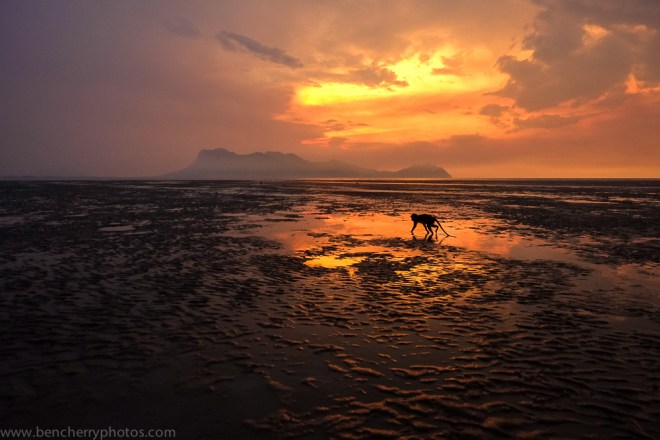
Generally lenses are associated with a particular genre of photography based on their focal length. For example wide lenses such as the XF14mm F2.8 R and XF10-24mm F4 R OIS are intended for landscapes and long lenses like the XF55-200mm F3.5-4.8 R LM OIS are for wildlife and sports. But rules are made to be broken and your lenses don’t necessarily have to be used to fit those stereotypes. The photograph below was taken with the 14mm lens, generally intended for landscape photography, however I used this lens to capture this macaque foraging for stranded marine life amidst a sunset scene.

14mm - Foraging macaque
14mm – Foraging macaque

The important thing to remember with your lens choice is to think “what do I want to convey?” On this occasion I wanted to show the scene as a whole. In the landscape shot below I focused on the distant hills over a bay with the setting sun using the 55-200mm lens, which is usually associated with wildlife and sports. This helped to emphasise the golden glow which wasn’t as prevalent with a wider-angle view.

120mm - Landscape
120mm – Landscape

Conclusion

Hopefully you now understand that lens choice can have a huge impact on your end result. If you understand the principles of focal lengths and apertures then you have a grasp on what lens to use and why. Remember that lenses are tools designed to help fuel your creativity. For me, a lens that I am very much looking forward to is the XF50-140mm F2.8 R OIS WR. This lens offers the versatility of a zoom but with a constant aperture of F2.8 it gives very good depth of field control. A lens such as this has many uses and I’m sure it is going to be a big hit with photographers from all genres.

A good exercise to try would be to force yourself to use one focal length next time you go for a walk. No matter if you’re using a prime or a zoom lens, try and restrict yourself. The purpose of this is to understand what you can capture with certain focal lengths so that in the future you will hopefully be more decisive with what focal length to use in a given situation. Remember that you can change the end picture dramatically through different apertures. Why not give it a go and then share with us the variety of photographs you managed to capture with the same focal length. Or you can change it up and use one aperture but change your focal lengths. Share your results with us and if you have any questions please get in touch via the contact details at the top.

Until next time, happy Shooting!

Ben Cherry

The X100T – from concept to product announcement in seven short months

In February 2014, during my first ever trip to Japan to attend the CP+ Show in Yokohama, I was also lucky enough to be present at one of the early planning meetings for the X100T, along with a few carefully selected professional photographers – Yukio Uchida (Japan), Bert Stephani (Belgium), Gianluca Colla (Italy) and Kevin Mullins (UK). Each one of the photographers used Fujifilm CSCs for their work, but also an X100S for personal work, and some professional work where it suited. After spending a few days talking about how our equipment affects their working lives in a positive light, they were given very specific instructions to tell us exactly what they didn’t like about them.

Less than seven months on and I’m holding in my hands a pre-production version of a camera that was based on many of the subjects discussed in this meeting.

How do you make something “more perfect” ?

There were two sides to the meeting. First up, the Japanese developers worked through a list of their ideas to understand what the photographers thought of them.

I paraphrase of course but here’s kind of how the conversation went:

Developers: Do you want a full-frame sensor?
Photographers: No because the camera would need to be bigger and that would degrade the purpose of the camera

Developers: Would you like an f/1.8 or larger aperture lens?
Photographers: As above. No because the camera would need to be bigger.

Developers: Would you like a tilting screen?
Photographers: As above again.

At this point you could see that the Japanese product developers are getting a bit nervous. How can you further evolve and develop a product if the users of the product are already perfectly happy with the existing one?

Developers: Does it need an Electronic Shutter?
Photographers: Not sure… what would be the benefits?
Developers: Shooting much faster shutter speeds, even with the aperture wide open – no need for the ND filter

OK finally we have our first TICK!

Developers: Would you like better movie functions? More frame rate options, manual exposure control?
Photographers: Yes, as long as it doesn’t have any effect on the camera’s ability to shoot stills

And another TICK. We’re really cooking now.

Developers: What about Wifi?
Photographers: Would be useful, as long as the camera doesn’t get any bigger

Developers: How would you like to be able to use manual focus while shooting OVF?
Photographers: We’re listening…

The developers pulled out a concept modified X100S with a special LCD panel installed outside the Optical Viewfinder. They went on to explain how this LCD display would actually be inside the camera and the user can switch on or off the ability to fine-tune the focus without switching from OVF.

I’ve had a go with this on the pre-production version and I can really see the value. I’m a big fan of coloured focus peaking so to be able to have it while looking through an OVF is really nice. It’s quick to toggle on or off, much faster than switching between OVF and EVF, so you can pay attention to the frame and just check the focus when you need it.

They then went through a pretty long list of changes / enhancements etc… of which a lot made it into the X100T I’ve got in my hand.

“We will consider”

In my experience, one thing that Japanese people hate to do is to outright say the word “no”. Every suggestion for a change to any of our cameras always gets one of these two responses:

  1. “We will do this” – this actually means “We have already done this”
  2. “We will consider” – And they do!

Next up in the meeting it was the photographer’s turn to suggest changes, all of which met one the answers above. Here are a few things I remember our guests asking for. This is not to say that these were not already in consideration by the development team.

  • Ability for the user to customise the Q menu – check
  • Standardise the main layout of the camera controls – time will tell on this but the X100T button layout is more like the X-T1 than the X100S, particularly on the user’s right thumb.
The rear controls of the X100T are more like an X-T1 than an X100S
  • Various different film types to be considered to be added to the list of Film Simulation modes – Classic Chrome making it into the range
  • More Function (Fn) buttons – check
  • Black version available at launch – check
  • Everything above, but retain the same size, shape and pretty much weight as the X100S and X100 – check

It’s not to say that the entire product was built from that one single meeting. Of course not. The team in Japan do an amazing job considering requests from Fujifilm staff and professional photographers all over the world. It is this constant ability to listen to feedback and then build on it that makes this an incredibly exciting and rewarding place to work.

On top of these changes, here are a few others that I’ve heard customers ask for that have made it in:

  • Allow users to select the AF area with the 4-way controller, without pressing the Fn Key.
  • AUTO ISO “profiles”
  • Ability for Exposure compensation to still work when the camera is in M mode, as long as the ISO is set to AUTO
  • Aperture ring moves in ⅓ increments.
  • Increase the grip on the manual focus ring

And finally some nice changes that made it over from the X-T1:

  • Coloured Focus Peaking
  • Remote shooting / wireless image transfer
  • Awesome updated GUI that rotates based on camera orientation
  • Interval Shooting
  • 3 stops Exposure Compensation
Here's what my X100T will look like when I get it. Much love for the WCL-X100
Here’s what my X100T will look like when I get it. Much love for the WCL-X100

Conclusion

The whole experience opened my eyes to what an amazing company it is that I work for. Staff and customers alike have a voice that is constantly helping to shape future development to produce the perfect products.

Many of these changes have been added to already-released cameras via free firmware updates. In my opinion this is a great move by Fujifilm as we are relatively new (this time round) to the professional end of the market and building trust is very important to help us gain a good reputation.

But whether we’re able to update existing models, or evolve the models with newer, improved versions, the reason it is working well is because everything is being carefully developed based on what actual users want. I’ve now seen this with my own eyes, and hold the proof in my hands.

改善 (kaizen) – Good change.

Come and see the X100T

The Fujifilm X100T will be available to get your hands on in the Touch & Try section of the Fujifilm stand at Photokina 2014 – Tuesday 16th September to Sunday 21st September at the koelnmesse Trade Fair and Exhibition Centre in Cologne, Germany.

http://fujifilm-x.com/photokina2014/en/whatson-touch-and-try.html

Oh and I’ll be there too if you fancy coming along and saying hello 🙂

Links

X100T
Learn about the new X100T camera
Read the X100T announcement

X-Photographers website’s
Kevin Mullins
Gianluca Colla
Bert Stephani
Yukio Uchida

Shoot like a pro, with a pro – win the chance to shoot a band live with one of the biggest names in live music photography

We’re offering you the opportunity to learn from and shoot with one of the UK’s best music photographers, Tony Woolliscroft, and to win a Fujifilm X-T1 and XF10-24mm.

Fujifilm and Tony have created an amazing opportunity for one lucky person. What you’ll win:

  • One-to-one mentoring from one of the biggest names in live music photography during a gig with a world famous band.
  • Learn what it’s like to be on the road with a band.
  • Learn how to shoot with the X-T1 and XF lenses and understand from Tony why he’s moved over to the Fujifilm X system, the best techniques, the optimum settings and some of Tony’s best kept secrets.
  • Meet the band, shoot the sound check and crew and understand what can be improved / worked on before the live gig.
  • Shoot the fans waiting to get into the gig.
  • Shoot the headline gig – shoot the first three songs in the photo pit with Tony.
  • After the first three songs you can enjoy the remainder of the gig.
  • Post-show feedback. After the gig, the winner will sit down with Tony and you can talk about the whole experience and a summary of what you’ve learnt.
  • On top of all this, you’ll be using your brand spanking new Fujifilm X-T1 and 10-24mm, the same kit which Tony uses.

About Tony

Tony has shot some of the biggest rock bands on the planet today – Foo Fighters, Red Hot Chilli Peppers and The 1975, with over 20 years photographic experience the winner will be in safe hands.
Click here to check out his website

The Fujifilm X-T1 and XF10-24mm

The X-T1 features evolved SLR-style handling, mechanical dials and weather-resistance, together with all the benefits of an X-Series camera, such as compact size, excellent mobility and high-speed performance. What’s more, its newly developed electronic viewfinder is almost indistinguishable from an optical viewfinder thanks to its ultra fast display speed. The XF10-24mm is ultra wide to standard focal length capabilities make it the perfect choice for shooting dynamic, high impact images with excellent detail from the foreground to the far distance.
Click here to learn more about the Fujifilm X-T1

Event details

Date of event: September 29th
Time: Mid afternoon onwards
Location: Wolverhampton Civic Hall

How to enter

Send an email to competitions@fujifilm.co.uk that contains a link to your portfolio and a short explanation as to why you want to win the prize. Tony Woolliscroft will then make his selection.

The deadline for entries is 17:00 BST on Monday 15th September 2014 and the winner will be notified by 17:00 BST on Friday 19th September 2014.

Good luck!

Terms and conditions

1. Entry is open to residents of the UK
2. The entrant must be aged 18 or over.
3. Proof of identity and age may be required.
4. Use of a false name or address will result in disqualification.
5. All entries must be made directly by the person entering the competition.
6. No responsibility can be accepted for entries lost, delayed or corrupted, or due to computer error in transit.
7. The prizes are as stated, are not transferable to another individual and no cash or other alternatives will be offered.
8. The winner is responsible for expenses and arrangements not specifically included in the prizes, including any necessary travel arrangements
9. In the event of a prize being unavailable, the promoter reserves the right to offer an alternative prize of equal or greater value.
10. The winner agrees to the use of their name, photograph and disclosure of county of residence and will co-operate with any other reasonable requests by Fujifilm UK Ltd relating to any post-winning publicity.
11. Reasonable efforts will be made to contact the winner. If the winner cannot be contacted, or are unable to comply with these terms and conditions, Fujifilm reserves the right to offer the prize to the next eligible entrant drawn at random, or in the event that the promotion is being judged Fujifilm reserves the right to offer the prize to the runner-up selected by the same judges.
12. Confirmation of the prize will also be made in writing to the winner.
13. Failure to respond and/or provide an address for delivery, or failure to meet the eligibility requirements may result in forfeiture of the prize.
14. The decision of the judge is final and no correspondence will be entered into over this decision.

All images in this post are © Tony Woolliscroft and taken on a Fujifilm X-T1

My love affair with EVFs

When I first started using the Fujifilm X-Series last summer I didn’t realise how helpful electronic viewfinders (EVFs) can be. Being able to see a live view of the exposure and then adjusting this via the exposure compensation dial means that I am more efficient. When using SLRs it is often difficult to get exposure compensation exactly right the first time around, this often means you take a photograph multiple times to get it just right. With X-Series cameras you are able to see how an exposure adjustment will effect the exposure of the image before you take the photo. This is especially helpful for fleeting moments, especially in quickly changing light.

The exposure compensation can be adjusted in post-production but I feel the live view produced by EVFs has helped me improve my photography. This makes my editing workflow shorter, which is always an advantage.

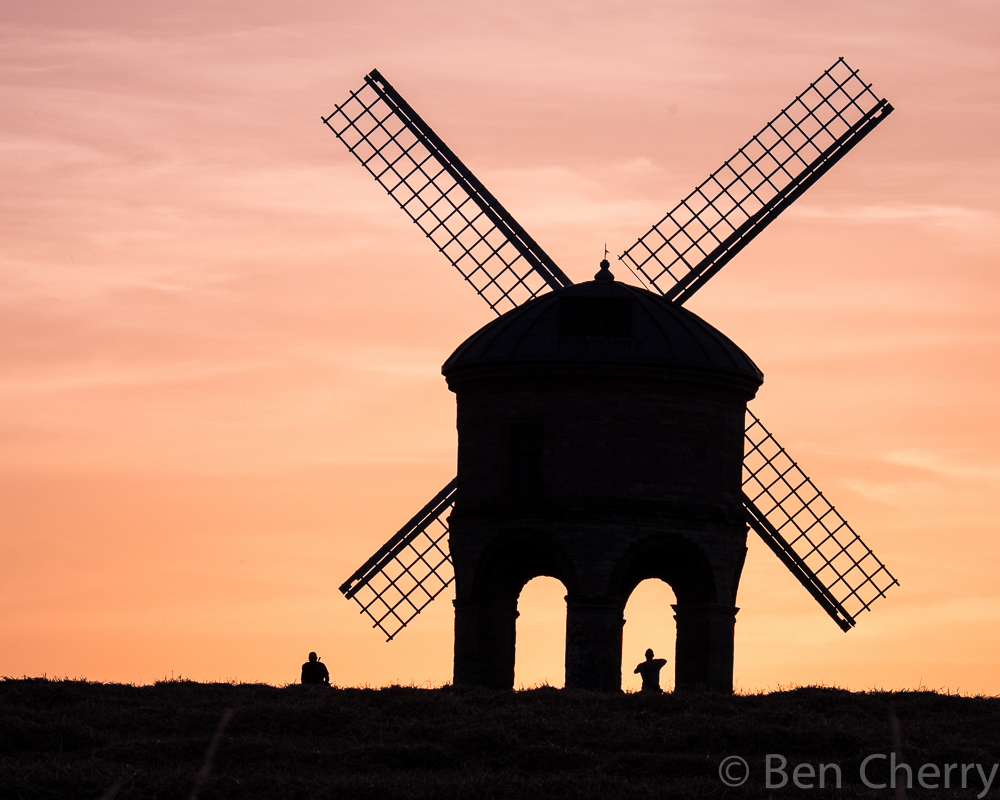
I found this feature particularly helpful when taking silhouettes, such as the images of Chesterton windmill in the gallery below.

EVFs are also very helpful with non-Fujifilm lenses or using Fujifilm lenses in manual mode as they can accurately show when the focus is correct. Even with the X100s and X-Pro1, which have hybrid viewfinders, I use them almost exclusively in EVF mode instead of OVF mode because, for me, it offers more benefits.