Through a Photographer’s Eye

Through a Photographer’s Eye: Myles Kalus

Welcome to the Third Series of Through a Photographer’s Eye. In this series, we continue to learn about Australian photographers and how they use X Series Cameras to photograph their world around them. Our eighth interview in Series Three is with photographer, Myles Kalus.

Myles, tell us a bit about yourself and how you relate to Fujifilm X Series cameras?


I originally intended to pursue an engineering career and studied mechanical engineering at university. Towards the end of my degree, I realised that engineering wasn’t really for me. By some stroke of luck, I picked up a camera in my last semester and realised that photography was what I wanted to do. I finished my degree, and immediately immersed myself into photography. I spent some time looking for the right camera to work with as I grew as a photographer, bouncing between different brands and different types of cameras.


I eventually picked up a first Fujifilm camera, the X100S, and knew from using it that what I needed for my “perfect” camera was one that had the modern advancements of digital camera technology in the shape and feel of a traditional camera. Having the aperture, and shutter speed dials right there to see just felt right to me. So, when the Fujifilm X-T1 was announced, I sold all the gear I had and made sure I was the first one in line at my local camera store to get my hands on it. I’ve exclusively used Fujifilm cameras ever since for both work and leisure.

Fujifilm X-T1 with XF23mmF1.4 R – 1/500 second – F5.6 – ISO 320


As someone who photographs a lot of portraits, do you have any recommendations for XF lenses to use? For instance, based on your experience which lens do you think is better, the XF56mmF1.2 or XF90mmF2?


It’s hard to pick between both as they have different qualities but I’d have to go with the XF56mmF1.2. While the XF90mmF2 is technically the perfect lens for portrait work, the XF56mmF1.2 allows me to get physically closer to the subject, allowing me to interact, and connect better with the person I’m photographing. It’s also a smaller lens, so it’s less intimidating for my subject.


I’ve always found the smaller more retro your gear looks; the more relaxed and natural people will be when photographing them. Alternatively, I’ve also used the XF23mmF1.4 to shoot portraits to provide a little more context to the picture and involve the environment to show where the portrait is captured. This lens has been instrumental when doing backstage work.


If you have some advice for someone starting out in photography what would it be?


Looking into gear, I would say to buy a camera that is straightforward to use. A lot of cameras these days have added functionalities that sometimes become a distraction. I’ve personally found that the fewer choices I have, the more concentrated I’ve been with learning and studying the camera and photography. If possible, I’d highly recommend a camera with an electronic viewfinder (EVF) as it allows you to immediately see how the settings affect exposure and depth-of-field. All these factors taken into consideration will speed up your learning process significantly, and improve your technical mastery within a short span.


From a photography perspective, I’ve always advised newcomers to find a few photographers of which their works you like, go through their work obsessively, learn what is it about their work that you admire, and try to replicate their work. This forces you to experiment with your camera and pushes your eye to see what and how they saw and why they photographed it.


You have worked with many international clients, do you think the Fujifilm X Series system delivers the image quality they are after and what are your thoughts on the new Fujifilm GFX 50S medium format camera for fashion photography?


Yes. I can confidently say that the Fujifilm X Series fulfills what my clients need. I’ve never heard back from a client questioning me about the quality or questioning about the gear I used. Whatever does the job as per client requirements. That’s all that matters when working with a client.


I feel the Fujifilm GFX 50S is a great addition to the Fujifilm lineup, and see it as an ideal camera for those requiring the benefits of medium format when working within fashion photography; higher resolution for detail, reduced vibration from the lack of a mirror and expanded dynamic range. It also opens the doors to medium format that would otherwise be closed to many photographers due to how expensive other medium format cameras are in general.


What is Street Style Australia and how has it helped you establish yourself?


Street Style Australia is a documentary project I started some years ago with the goal of documenting how Australians express themselves through what they wear. No one was doing it properly back then. So, I decided to take it upon myself to do it. Doing the project has opened many doors for me, regarding meeting and working with people within the industry, and allowing me to create work and fulfil a niche for an international audience. It’s also allowed me to further delve into the inner-workings of the fashion world documenting backstage and behind-the-scenes for runways, fashion events, etc.

Fujifilm X-T2 with XF56mmF1.2 R – 1/1000 second – F1.2 – ISO 640

Fujifilm X-T1 with XF56mmF1.2 R – 1/500 second – F1.4 – ISO 200


Aside from fashion, what elements of the photo do you think are important to make a portfolio-worthy fashion shot?


For me, the first step is understanding the purpose of the photo and working out how to deliver that goal through the photo. Great portfolio-worthy fashion photographs have always put feeling, mood, and story-telling before technicalities and aesthetics. An aesthetically pleasing photograph doesn’t cut it. Great fashion photographs also make the audience immediately look straight into and embrace the content within the frame as if it is a window, and see what the photographer is seeing. The presence of the photograph as an object to the viewer is invisible or non-existent.


So, giving an example from landscape photography, when I look at Ansel Adams’ photographs of Yosemite, I don’t think about how beautiful the photograph is. I think about how beautiful Yosemite is, feel how amazing it is to see the view. His photos make me feel like I’m there witnessing or at least, make me want to go there to witness Yosemite myself. I forget that the photo is a photo.


How important is it to work in a team in your field? Do you find stylists; makeup artists and models are all easy to work with? How does a general shoot form?


A good team is vital because you can’t-do everything yourself in general. How easy others are to work with is usually based on the individual and their capabilities. Most of the time, everyone’s down-to-earth and professional. Occasionally, you do get less than ideal team member, but that doesn’t often happen, thankfully.


Ideally, you’d work with those who understand what you’re trying to create in the photographs. A lot of discussion happens before shoots, to discuss how to execute the shoot, and to find the right people who can do what you need in the shoot.


Generally, a shoot forms when someone (client, creative director, stylist, or even the photographer) has an idea or a brief that they want executed. A team that they feel is right for the task is then assembled, pre-production for the shoot that involves location-scouting, pulling garments or accessories from brands/labels, identifying the right gear (camera, lighting, etc.) for the job. Then, once all the pre-production is hopefully done, then the shoot happens.


Can you share some insight into what it’s like to cover an event like Paris Fashion Week on the street? What gear would you recommend someone have to help capture stunning images?


Looking at the photos that usually come out from any fashion week, you can’t really tell but shooting street style at fashion week is quite a physically straining job; a lot of running, a lot of rushing from one venue to the other, staying outdoors regardless of how bad the weather is, barely any resting or eating from the deadlines and number of photographs you take in a day. I take about 5000 photos per day and go through them all at night to send them off to the client by morning.

Fujifilm X-T2 with XF56mmF1.2 R – 1/2000 second – F1.4 – ISO 200


This goes on for each day of fashion week. I usually only get time to have a couple of small meals and about 4 hours of sleep each day during fashion week if I’m lucky. Also, the environment you photograph in is best described as chaos; there are so many unpredictable elements to juggle with, and you have to make quick judgment with what you see in front of you.


You’re dealing with trying to find the best angle to photograph the best-looking outfit or garment after finding it among a mass of people moving in an environment that is full of distracting elements, traffic, and at times, unforgiving weather. Think too much and you might lose your only opportunity to photograph a look.


Camera body-wise, the X-T2 with the grip was perfect. I bought it before flying off to Europe, and its upgrades over the X-T1 made my life much easier while shooting. The 11 FPS and high refresh rate in the EVF provided in Boost mode, and the customisable autofocus system the X-T2 has were a joy to have while shooting in the erratic shooting environment. For lenses, I predominantly used the XF56mmF1.2. Ideally, I would have preferred using the XF90mmF2 because I prefer the look produced by the lens, is weather-sealed, and is quicker at autofocusing, but ultimately chose not to use it as forced me to step too far back from the subject to photograph them. I did use the XF23mmF1.4 when I wanted to capture more of the environment. Though, I mainly use that lens backstage due to there being limited space.


To see more of Myles photography follow Street Style Australia on Instagram or mylekalus.

Previous interviews from Series Three of Through a Photographer’s Eye:

Through a Photographer’s Eye: Johny Spencer

Through a Photographer’s Eye: Gavin Host

Through a Photographer’s Eye: Mike Bell

Through a Photographer’s Eye: Ryan Cantwell

Through a Photographer’s Eye: Sarp Soysal

Through a Photographer’s Eye: Harrison Candlin

Through a Photographer’s Eye: Geoff Marshall


Through a Photographer’s Eye: Geoff Marshall

Welcome to the Third Series of Through a Photographer’s Eye. In this series, we continue to learn about Australian photographers and how they use X Series Cameras to photograph their world around them. Our seventh interview in Series Three is with hobbyist photographer, Geoff Marshall.

Geoff, can you tell us a bit about yourself and how you got started in photography?


I am a hobbyist photographer and have been since 1979, back in the days of 35mm film and before digital. I enjoy photography very much and rather than shooting one genre I tend to shoot anything and everything. I started out with a Zenit 35mm film SLR but quickly moved onto the Olympus OM system. In 2000, I ditched all the Olympus gear to get into digital and purchased, of all things, a Sony Cybershot. I fortunately saw the error of my ways and in 2005 bought into the Nikon DSLR system. I always hankered after a smaller camera and tried out a number of compact cameras but none really did it for me. In January 2012 I purchased a Fujifilm X- E1 with the XF18-55mmF2.8-4 kit lens to see if this system was a viable option for me. I was blown away by the output of the files and that little kit lens attached to such a small body.

Fujifilm X-T1 with XF55-200mmF3.5-4.8 R LM OIS – 1/60 – F4.8 – ISO 320


On your website, you showcase a selection of images taken from a range of Fujinon lenses. What’s your favourite photo you have taken and can you tell us the story behind the image?


That’s not a fair question! With getting on for 40K images shot with the Fujifilm X Series how can one choose a favourite photo?


Fujifilm X-E1 with XF18-55mmF2.8-4 R LM OIS – 1/60 – F5 – ISO 800


I guess this image, it was taken during a trip back home to the UK. The photo has meaning for me as it was a great holiday albeit in mid-winter, and includes my youngest daughter (foreground) doing ‘touristy’ things in the big smoke of London.


What is it that you most like about Fujifilm X Series equipment?


I enjoy everything about the Fujifilm X Series equipment. It suits me very well because of its compact size and of course the file output. I have invested heavily into the X Series and my go-to combination is the X-T1 and the wonderful XF56mmF1.2, my most often used lens. Since switching to the Fujifilm X Series 4 years ago, I am primarily a prime lens shooter, my zooms seldom see the light of day but they should be shown more love for they perform very well.

Fujifilm X-T1 with XF56mmF1.2 R – 1/850 – F2.5 – ISO 400


If you have some advice for someone starting out in photography what would it be?


Learn the basics of exposure such as aperture, shutter, ISO and how to use them in combination to achieve desired outcomes. Consider your composition and just get out there and shoot. Analyse your photos, be self-critical and learn from your mistakes (we all make them) and develop a technique that you are happy with and produces results that you like. Don’t try and please everybody with your photographs, that’s an impossible task to achieve, we are all different, what one person likes the next will not.

Fujifilm X-T1 with XF90mmF2 R LM WR – 1/75 – F8 – ISO 200

Fujifilm X-Pro1 with XF35mmF1.4 R – 1/900 – F5.6 – ISO 800


You unfortunately recently experienced an issue with your Fujifilm X- T1. How did you find the repair process in Australia and do you have any thoughts on how Fujifilm can improve this process?


The fault with my X -T1 was frustrating, isn’t it always the same with any product we may purchase be it a camera or a car? The fault with the X- T1 occurred while under warranty and was dealt with promptly and professionally by Fujifilm Australia. From my initial enquiry to report the fault with the service team, to the safe return of my camera, the service was second to none. That said I hope I never need to use the service again.

Fujifilm X-T1 with XF23mmF1.4 R – 1/80 – F11 – ISO 200


Not many photographers may have used the XF60mmF2.4 with an Extension Tube to take macro photos of insects. Do you have any tips you could share that would help someone getting started with Fujifilm equipment for macro photography?


I purchased the MCEX 11 extension tube so that I could get closer to 1:1 reproduction with my macro work. Although this can be achieved, the depth of field is reduced significantly and therefore you need to be careful with your point of focus or the impact of the shot will be lost. When photographing insects (crawling or flying bugs) I don’t use a tripod as they move too quickly (apart from snails, but they aren’t insects!). However, I do use a tripod for static subjects such as fungi. The number one attribute needed for macro photography, in my opinion, is patience. You also need to learn to slow down, a bush walk that would normally take an hour to complete could easily take me 4 hours as I’m looking for the small details. Oh yeah, one last thing, be prepared to get dirty and to have passers-by look at you strangely as you crawl around on the floor to get the shot!

Fujifilm X-T1 with XF60mmF2.4 R Macro – 1/125 – F4 – ISO 200

Have you ever experience a lull in your creative passion? How did you overcome it to keep taking photos?

I think all photographers go through a creativity block from time to time. It’s a challenge to make your images different, to stand out from the plethora of other images being produced by other photographers, after all most people have a convenient camera with them at all times due to the mobile phone technology we have available to us, collectively we must be taking millions of images on a daily basis. Recently I have purchased two books for moments when I get a creativity block, both provide challenges and ideas to kick start the creativity process, ‘The Photographers Play book’ (Fulford & Halpern) and ‘Use This If You Want To Take Great Photographs, A photo journal’ (Carroll).

Fujifilm X-E1 with XF27mmF2.8 – 1/60 – F8 – ISO3200


What sort of processing workflow do your photos experience and do you prefer to shoot in RAW or Jpeg?


I shoot exclusively in RAW, legacy from DSLR days I suppose. Many users of the Fujifilm X system rave about the JPEG output and I have used JPEG + RAW settings but I always gravitate toward the RAW files. I use Adobe Lightroom CC for all my processing needs (and cataloguing) and occasionally use the NIK Silver Effex program for processing to monochrome.

Fujifilm X-T1 with XF56mmF1.2 R – 1/550 – F8 – ISO 200


To see more of Geoff’s photography visit his blog and website.

Previous interviews from Series Three of Through a Photographer’s Eye:

Through a Photographer’s Eye: Johny Spencer

Through a Photographer’s Eye: Gavin Host

Through a Photographer’s Eye: Mike Bell

Through a Photographer’s Eye: Ryan Cantwell

Through a Photographer’s Eye: Sarp Soysal

Through a Photographer’s Eye: Harrison Candlin

Through a Photographer’s Eye: Sarp Soysal

Welcome to the Third Series of Through a Photographer’s Eye. In this series, we continue to learn about Australian photographers and how they use X Series Cameras to photograph their world around them. Our fifth interview in Series Three is with Melbourne based photographer, Sarp Soysal.


Sarp, your story about how you started photographing with the X100 is quite interesting. Can you share it with us?


Ah yes, it is actually a pretty interesting story but a little tragic at the same time. I was travelling around Europe a few years ago on a personal photography project with a fair bit of gear: a Nikon body and a bunch of lenses and even speedlights. I also had a tiny little backup camera buried somewhere deep in my backpack that I never touched and had barely even used before.


One day when I was shooting in Paris, my Nikon was set up on my tripod, and for some strange reason that I still haven’t figured out, the camera fell off and shattered. As a broke backpacker, I wasn’t at all in a position to buy any new gear, so I had to reach into my bag for that tiny backup camera which was, as it turns out, a Fujifilm X100.


I didn’t have much experience with this camera, but it was all I had to finish my project. I remember sitting in my hotel room and trying to figure out how I was going to finish working with this one small point and shoot and its fixed lens. It wasn’t even a full frame camera, and this was around five years ago when full frame cameras were seen as the only professional cameras. But when I actually started walking around with the Fujifilm X100, something quite strange happened.


Through its optical viewfinder, the world looked different. It reminded me of being a teenager and using my dad’s analogue rangefinders. I didn’t have my bag of lenses for every possible shot, but through Fujifilm X100’s fixed lens, the streets started to look more romantic to me almost. I would say this was the beginning of a very important, almost spiritual, transformation for me.


In the way, I shoot, see the world and travel. While I felt pretty lost after I broke my Nikon, in the end, I managed to complete my project with some pretty special images thanks to my little Fujifilm camera. Needless to say, when I arrived back in Melbourne, I sold all of Nikon gear including that ridiculous backpack. And I have never looked back.


After moving from the Fujifilm X100 to the Fujifilm X-Pro2 what sort of advantages have you found the newer camera offers?


I think the biggest advantage of the Fujifilm X-Pro2 over X100 for me is its weather-sealed body. Already, while travelling, my X-Pro2 has withstood thunderstorms, unexpected torrential rain, bumpy bus rides, the ridiculous dust of Kathmandu and you name what else. The X-Pro2 feels tough in my hands, with its brick-like body. Secondly, obviously, the X-Pro2 is a much faster camera than the X100, which is very important for my photography style, mostly being snapshots on the street. Despite these things though, I still have my original X100 and from time to time, shoot with it, for old time’s sake. It will always have a special place in my heart.


If you could explain X Series cameras to someone who had never heard of them before what would you say?


Well, that’s quite a difficult question to answer. Let me put it this way: I wouldn’t explain X Series cameras from a technical perspective but more an emotional one. Pretty much every camera brand on the market at the moment, many of which I’ve shot with in the past, is almost like shooting with a computer rather than a camera. Most of their mechanical or software features that help sell them don’t really add much to your shooting experience and in my opinion, don’t serve a lot of purpose in the actual field.


X Series cameras, however, are so thoughtfully designed, with the photographer’s experience in mind, they feel to me like an extended eye, or like an additional organ. The dials, the viewfinder and even their compact size and grip really create a very organic shooting experience that doesn’t distract you from creating images with technical functionality or settings. So if you ask me to explain X Series cameras, I’d say they are cameras for creativity and for storytelling. They are cameras with soul.


Travelling is obviously high on your agenda, where have you been recently and can you share your favourite photo and tell us the story behind the image?


Most recently, I did a 100 days project, beginning with a road trip from Melbourne to Queensland and then three months travelling across Asia. I visited Indonesia, Malaysia, the Philippines, Vietnam and finally Nepal, where I am at the moment. I challenged myself to post a photograph everyday on Instagram that represented that day which turned out to be harder than I thought but I did it only skipping maybe 2 or 3 days. If I look back on my Instagram feed now, I’d say that my favourite image would be from day 40 of the journey, not necessarily because it is the best photograph but because of the story behind it.


I took this photograph in the south of Cebu Island (Philippines) on a modest fishing beach called Santander where all along the sand, there are tiny homes housing the families that collect seaweed and fish every morning. On one of my walks down to the beach, I found myself in the home of about 7 or 8 little hooligan kids who welcomed me with excited screams, dancing, playing and just general tomfoolery. These kids had next to nothing. Their clothes were ripped and dirty, their shoes didn’t match, and their play equipment consisted of some rope, a tree and a few planks of wood. I have honestly never seen happier, more energetic kids.


I ended up visiting these kids a few times during my stay on the island and got to know the family a little. I couldn’t stop taking their photographs because they got so adorably excited about having their picture taken and when they’d see their own faces on my LCD screen, they’d go crazy. I think I was the first person to ever take their photograph.


While portraiture isn’t my forte, I had to capture the kids’ faces which just beamed with spirit and hope. To me, this photograph is both a story and a lesson. It tells of hope and need and happiness and most importantly, of how much you actually need in order to be happy.


If you have some advice for someone starting out in photography what would it be?


I’d say the biggest piece of advice I’d like to share with young photographers is not to get trapped in the technical side of photography or with camera reviews, equipment choices and stuff.


In my opinion, the most important first step is to get to know the gear that you have, whatever it might be, and understand everything about it so you can learn how to work with it and how to make it work for you. Because at the end of the day, when someone is looking at your photographs, no one cares really about what settings you used or what camera you have. It’s about the story you tell.


As any skill or art form, it requires a lot of practice. So take your camera with you everywhere and use every outing as a learning opportunity. Devote 20 hours a week, every week to making photographs. Get yourself a good pair of walking shoes and hit the streets or parks of your town or city and just shoot. Eventually, you’ll find your voice, and then you can focus on developing your own photographic style to tell your own stories.


You said the following statement after photographing with Fujifilm equipment over the last five years:

“My style has evolved to be a kind of poetry: subtle metaphoric images that tell stories through layers and light, shadows and figures”.

Can you provide a photographic example and explain the romance behind the image based on this statement?


Like I said before, X series cameras aren’t technically distracting so when I’m shooting on the street, I’m able to enter a kind of zone in which I am completely tunnel-visioned: all I see are light and shapes. Over time my photographs have moved more and more away from obvious compositions and stories and more towards combining elements under interesting light.


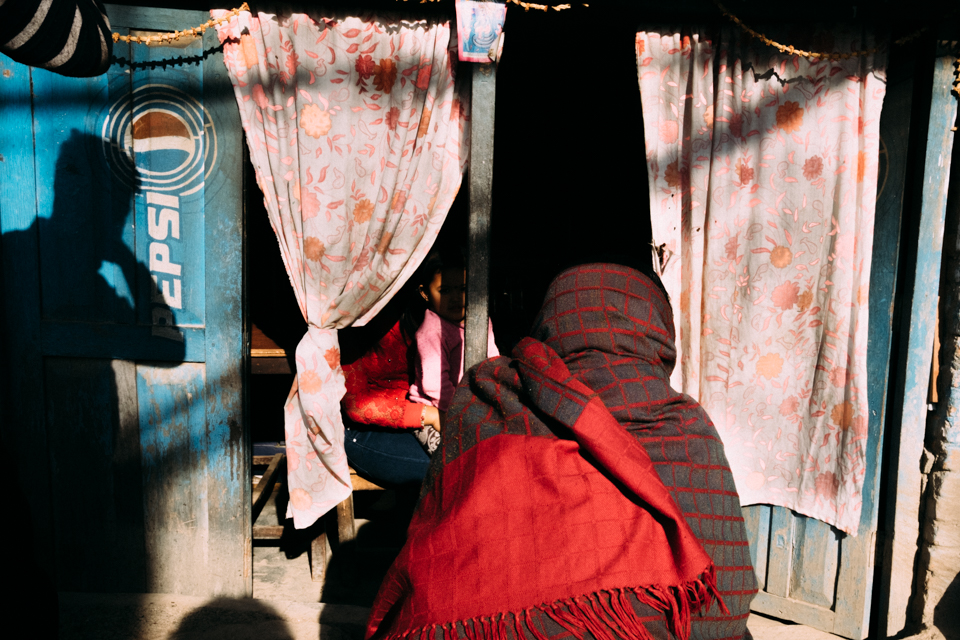
Most of the time, I take scenes that are seemingly nondescript but that through my lens I know will become something quite interesting. This image, for example, is one I took in Kathmandu, Nepal this month. While to my partner, it was nothing more than an ordinary Nepalese house front, to me, the shadows created a mysterious story: to whom does the hand belong? What is the child looking at? And why is he dressed so smartly while living in such an apparently poor house?


I like to make people wonder, and I think that my favourite kind of photographic story is not the one that I tell myself but the one that someone who looks at my photograph will imagine.


We noticed in your portfolio you have a number of portraits, can you give any tips on how to best approach people on the street to take their photo?


It’s funny that you say that because to be perfectly honest, I never feel that portraiture is my strong point. But I do like to include people and faces in my street scenes. I don’t really have any specific approach per se, but I do feel that if you’re a shy person, you will struggle as a street photographer. It is largely about engagement, with the elements around you and most importantly, the people you intend to photograph.


I suppose my photography reflects my personality in general as someone that tends to engage with strangers quite a bit, especially while travelling. To take someone’s portrait, is a kind of unspoken negotiation a lot of the time, relying on body language and your ability to read the situation. That said, a lot of the time, I usually avoid any kind of engagement before I’ve taken the shot.


My photography focuses a lot on candid, organic moments and so I like to be invisible. I even avoid eye contact because once the person is aware of the camera, the scene is shattered. Afterwards, I like to engage, chat with them or ask them questions depending on how open they are. And mostly people don’t have a problem with their photograph being taken.


The Melbourne streets are far from your travels, what do you like most about returning to the ‘Most Livable City in the world?


I love shooting on Melbourne’s streets. I guess it’s where I feel most comfortable. I have been living in St Kilda East specifically for almost seven years, and I’d say that the surrounding suburbs like Balaclava, St Kilda and Chapel Street are my usual photographic battlefields.


I know the culture and city very well, so I know how people usually react to my camera on the street which is important for the kind of work that I do. There isn’t the same chaos or exotic situations that you’ll find in Asia, but there is a very distinctive light that belongs to Melbourne that I think is almost recognisable. It helps to create its own kind of mysterious and dramatic images in an otherwise very orderly city.


To see more of Sarp’s photography follow him on Instagram.

Previous interviews from Series Three of Through a Photographer’s Eye:

Through a Photographer’s Eye: Johny Spencer

Through a Photographer’s Eye: Gavin Host

Through a Photographer’s Eye: Mike Bell

Through a Photographer’s Eye: Ryan Cantwell

Through a Photographer’s Eye: Ryan Cantwell

Welcome to the Third Series of Through a Photographer’s Eye. In this series, we continue to learn about Australian photographers and how they use X Series Cameras to photograph their world around them. Our fourth interview in Series Three is with Adelaide based photographer, Ryan Cantwell.


Ryan, what do you most enjoy about photography and how did you get started in this creative field of work?


I enjoy the practical side of photography. Being able to be in different environments, places, spaces and the travel side of it.


It all started with a video camera I bought in my early high school days to film friends skateboarding and the ruckus you get up to in between it all to make movies for fun and school projects, but that camera packed up and called it a day just over two years from getting it.


After that, I went and purchased a $150 compact digital camera from Harvey Norman, and from there I just took that little camera everywhere with me in my pocket. I didn’t have the funds to get an SLR and lenses, so holding a wide angle lens for my retired video camera at the front of the camera was my way to get fish eye photos of friends skateboarding when I needed to.


My parents at the time didn’t notice I was taking a lot of pics since I was running a compact digital camera and I also wasn’t running to them to get me a kit camera since I was happy using what I had. Outside of that the photo classes in the darkroom throughout my high school years got me into photography. It’s quite the common cliché, but I wouldn’t want it any other way. To put this answer in one word it would be – skateboarding.


You recently used the Fujifilm X-Pro2 and X-T2 to capture images around the state of South Australia. Out of the two cameras, which one did you prefer to use the most? Can you tell us why?


The X-Pro2… Hands down. Shooting range finder style cameras like the X-Pro2 is such a relief after using a digital SLR.


The X-Pro2 is an ideal travel camera (if you want to take lenses) that will hold up in quality against full frame bodies. Using a smaller retro looking camera lets you get away with a lot more than when carrying a DSLR; people tend not to notice you. It’s like a versatile pocket knife compared to a sword.


How did you find the colours produced by the X-Trans CMOS sensor appeared when compared to previous cameras you may have used in the past? Did you notice any differences?


Good as basic as that sounds the colours Fujifilm punch out are something that’s noticeable compared to other RAW files I’ve shot. There’s something in the images that make skin tones look better; even the blue channels do something that’s fun. It’s hard to explain, but it’s noticeable when you start ‘nerding’ out on the computer.


Your style of photography portrays a unique view. What are you looking for when taking a photo of a person or subject and do you prefer to shoot in a particular sort of light?


It depends on the environment the person is in. The subjects face is normally the key attraction in portrait photography, but there’s something more with the motion and shape the person you are photographing can make. It’s even better if they are wearing something that just pops in the surroundings they are in.


I feel it is a cross over between a super candid movement and an observation of shape and colour all co-existing between each other.


The preferred lighting I like to shoot in is a tricky question since various light produces different scenarios. I like harsh mid to late afternoon light. When cloud cover appears I know that it will slightly diffuse and when that happens perfect golden light results in my subjects. This light doesn’t happen often, but six out of ten times it does, Murphy’s Law says I won’t have a camera with me!


How did the XF50-140mmF2.8 perform for surf photography when coupled with the Fujifilm X-T2? Was the focal length long enough or would you recommend the XF100-400mmF4.5-5.6?


It was just long enough for the surf spots I went to. The stretch of beach I shot at has different ranges of sand height to work with but if you go to the back where the dunes roll in that lens wouldn’t have the reach you would need to do the wave(s) justice. I would prefer the XF100-400mmF4.5-5.6 as that range can give you more placement on land with out letting mother nature get close to you such as the tide getting closer when you’re too zoned in looking through the viewfinder.


If you have some advice for someone starting out in photography what would it be?


Don’t worry about the fancy technical side of the gear. Get a cheap camera and work with that. Don’t rely on editing so much. If you’re growing up in a ‘boring’ town that offers a lot of mundane surroundings and you feel like there’s nothing pretty to take photos of then you’re not paying enough attention.


You will learn to find ‘beauty’ and oddities in places rather than just visiting the regular postcard scenes and look outs. Look at art paintings and how they applied technique and composition. Paintings have been around a lot longer than the camera. Be forward with yourself and the people you approach it can be awkward, but your results will be more to the point you have in mind. Sometimes don’t take photos, so you can live in semi regret you didn’t take a photo of a wonderful thing, move on and remind yourself to be more mindful next time.


You also used the XF56mmF1.2. After taking photos using this lens, did you find there was any need to edit them on a computer and how would you rate the bokeh?


That lens is ridiculous. It’s sharp and if you’re a person that likes cranking the sharpness slider when post processing then you’re image is going to be over done. The size of its build and the results it provides indeed live up to its hype. I didn’t play with the lens too much, but the results it gave me in low light conditions were a no brainer. I would definitely want this lens in my kit.


If a photographer was visiting South Australia for the first time, can you recommend two locations to visit?


A day trip down the Fleurieu coast. From midday onwards, as the sun sets on the water the area glows in the afternoon light, and there is an array of coastal and inland textures to play with in the right light. I haven’t been there in a while but the Flinders Rangers and beyond in the winter time gives a lot of wild scenery if you want to see how barren things can get in this state.


To see more of Ryan’s photography visit his website or follow him on Instagram or Facebook.

Previous interviews from Series Three of Through a Photographer’s Eye:

Through a Photographer’s Eye: Johny Spencer

Through a Photographer’s Eye: Gavin Host

Through a Photographer’s Eye: Mike Bell


Through a Photographer’s Eye: Mike Bell

Welcome to the Third Series of Through a Photographer’s Eye. In this series, we continue to learn about Australian photographers and how they use X Series Cameras to photograph their world around them. Our third interview in Series Three is with Sydney’s North Beaches based photographer, Mike Bell.

Fujifilm X-T1 – XF16mmF1.4 R WR – 1/350 second – F2.5 – ISO 200

Fujifilm X-T1 – XF16mmF1.4 R WR – 1/80 second – F2.2 – ISO 320


Mike, commercial photography isn’t for everyone, so what made you choose the genre and how did you get started?


A couple of years ago I was made redundant. I worked for a large company doing photojournalism type photography for a magazine. Being a photographer & retoucher for so many years I wanted to continue my passion for my trade, and there wasn’t that much full-time work that incorporated this.


I decided to set up a retouching business, retouching professional wedding photographers images, but soon realised this wasn’t what I wanted. I began to notice the amount of building and construction that was going on around Sydney and decided to target this industry and started getting in touch with large companies to see if I could help out by photographing any of their completed jobs, fit outs or progress photography.


This then led me to get involved with event photography and corporate portraits etc. I had done a bit of wedding photography and wasn’t interested in getting involved in that over saturated market and thought there was a business for me in commercial work. So far I am working with a few large building and event companies, and my business is growing every day.    

Fujifilm X-T2 – XF16-55mmF2.8 R LM WR – 1/45 second – F5 – ISO 6400


You use the Fujifilm X-T2 for professional use, how do you find the image quality and do you hear any feedback from clients after they see the images you take?


Before switching to Fujifilm cameras about five years ago I was using Nikon DSLR equipment, and my previous job involved a lot of travel, it was a lot of heavy gear to lug around. I began by buying a Fujifilm X100S and was so impressed by the files I was getting I changed my whole kit to Fujifilm cameras.


I started using the Fujifilm X-T1 and then upgraded to the X-T2. I find the image quality on my X-T2 superb, in particular with the prime lenses, for the work I am doing the lenses give me amazing results. Unlike the wedding industry feedback from my clients is very thin but when I do get feedback, it is always very positive.


I am now very interested in shooting with the new medium format Fujifilm GFX 50S camera and GF lenses. I believe with this new equipment; I can take my images and business to another level. This new medium format camera is absolutely perfect for most of the work I shoot and look forward to the time I can add this camera to my line up.  

Fujifilm X-T1 – XF16-55mmF2.8 R LM WR – 1/180 second – F2.6 – ISO 200


If you have some advice for someone starting out in photography what would it be?


Photography is obviously a passion and not a job most people would choose if they were not into it, so by having that passion for what you do you are already halfway there. Create a service for clients that is reliable and ALWAYS deliver what you promise.


Taking an interest in your customer’s business, showing them you have done your research always helps. Never stop looking for new clients, self-marketing is key. Your creativity and skill will get you so far, that’s almost the easy bit, creating a customer base and the way you deal with your clients can be the difficult bit.

Fujifilm X-T2 – XF16mmF1.4 R WR – 1/160 second – F5 – ISO 200


Which was your first Fujinon lens? Can you share your favourite image taken using the lens and tell us how you captured it?


My first Fujinon lens was the XF35mmF1.4 R; I obtained the lens when I purchased my Fujifilm X-T1. This is still my favourite lens that sits on my camera most of the time. If I’m looking for a crisp shallow depth of field portrait style shot, this is my go-to lens, and the 50mm equivalent on a 35mm frame is a classic.

Fujifilm X-T1 – XF35mmF1.4 R – 1/160 second – F2.8 – ISO 1600

Ah, choosing a favourite shot with a particular lens is a difficult one. The black & white image shown above is from a recent wedding I took and one of my favourites from the shoot. The XF35mmF1.4 R just nails the beautiful natural low light that was coming through the window that afternoon. The dynamic range is great (another reason I want to upgrade to the Fujifilm GFX 50S camera)


If someone was given a brief for a commercial job, what advice can you give them based on your experience?   

Briefs can be handed to you in all sorts of shapes and sizes; I get a lot “We want to look relaxed and easy going without looking to corporate”. Sometimes clients are not sure what they want, and you have to put your creative spin on it. I would always suggest getting as much information you can with regards to what they will be using these images for, for what purpose are they trying to achieve with the shots, the more information you have, the happier the client will be with your images. Always turn up prepared, enough batteries, cards, lighting if needed, etc.


Information again is key. Find out when the client needs the images, what format they need them in, anything you can do to make the whole process easy for them will make your job easier.

Fujifilm X-T1 – XF16mmF1.4 R WR – 1/800 second – F2.5 – ISO 200


As you photograph quite a bit of architecture how do you find the distortion on the Fujinon lenses compared to any other gear you may have used previously?


One word…AMAZING, the Fujinon lenses I use have nearly zero distortion. The widest lens I use in my kit is the Fujinon XF16mmF1.4 (24mm Equiv), I find this wide enough for most of my work and find the barrel distortion almost non-existent, and what there is can be fixed in post. The Fujinon lenses I found a lot better than the Nikon wide lenses I was previously using.

Fujifilm X-T1 – XF16-55mmF2.8 R LM WR – 1/6 second – F4.5 – ISO 200

Fujifilm X-T1 – XF35mmF1.4 R – 1/55 second – F1.6 – ISO 200

Fujifilm X-T1 – XF16-55mmF2.8 R LM WR – 1/4 second – F8 – ISO 200


Can you provide some insight into your workflow process from shot to end result?


I almost always shoot RAW files on most of my jobs and apply my edit to the images in Lightroom depending what the client is after. I also shoot jpegs for a lot of my personal work as I love the in camera Fujifilm Film Simulation presets. I take all images into Lightroom for post processing and supply my client with a proof sheet to choose from and then provide high-resolution files as needed.

Fujifilm X100S – 1/1600 second – F5.6 – ISO 400


As a Sydney-sider is there anywhere in the state of New South Wales where you find yourself constantly going back to, to capture that perfect image?


As a Sydney based photographer, I travel all over Sydney, quite a bit out west as a lot of large construction is happening out there. I’ve been from Melbourne to Canberra and from Newcastle to the south coast. There is not one particular place that draws me back for any of the commercial work I am doing at the moment, but I did do a job for a magazine once in Broken Hill and would love to go back there and shoot again as the light is amazing out there.


If you would like to see more of Mikes’s photography then visit his website or follow him on Instagram or Facebook.


Previous interviews from Series Three of Through a Photographer’s Eye:

Through a Photographer’s Eye: Johny Spencer

Through a Photographer’s Eye: Gavin Host


Through a Photographer’s Eye: Gavin Host

Welcome to the Third Series of Through a Photographer’s Eye. In this series, we continue to learn about Australian photographers and how they use X Series Cameras to photograph their world around them. Our second interview in Series Three is with Western Australian photographer, Gavin Host.


Gavin, can you tell us about yourself and how you started using Fujifilm X Series cameras?


I first picked up a camera in high school and when my chosen career path as a Furniture Maker was abruptly interrupted, I turned to photography once more. I spent five years as an automotive photographer in my home state of Western Australia, but as I began to travel more, my interest turned to landscapes, portraits, architecture – anything I could find. From late 2015 I began travelling full-time, exploring Europe, Asia and recently chose Hội An, Vietnam as my base. During this time, my partner and I established a travel and photography blog and began shooting for tour companies and hotels, which has pushed me as a photographer to be constantly photographing and adapting my skills to different situations on a daily basis.


After travelling through Indonesia, Vietnam, Japan, Singapore, USA and Canada with a full frame digital SLR kit I found myself leaving lenses behind on a daily basis to save on weight, struggling with a Pelican case on flights, and generally just finding the gear too cumbersome. I decided I needed to find an alternative. In mid 2015 I attended the Camera Electronic Expo in Perth with plenty of research about the Fujifilm gear behind me, but without having picked up a camera yet. I spent a few hours talking to the Fujifilm reps and by the end of the day, I was the proud new owner of an entire Fujifilm kit, complete with an X-T1, X100T and three Fujinon XF lenses. I’ve been travelling with the kit ever since. It has certainly evolved over time and I’ve found that the transition from a full-frame digital SLR kit to the mirrorless Fujifilm gear has been liberating.

Gásadalur waterfall, Faroe Islands – Fujifilm X-Pro2 – XF10-24mmF4 R – F22 – 3 seconds – ISO 200


Why do you use the Fujifilm X-Pro2 for your travel photography? Why don’t you use a Digital SLR?


The weight and size advantage was my main motive to make the change from a digital SLR to a mirrorless kit. I’ve found my Fujifilm gear to be less intimidating for my subjects when shooting portraits, and it attracts much less attention while I’m on the road, which is definitely a concern in some of the areas I’ve travelled. I moved from the X-T1 to the X-Pro2 as soon as it was released in Scotland, where I was working at the time. My X-Pro2 is the perfect travel companion – lightweight, discreet and capable.

Santorini, Greece – Fujifilm X-Pro2 – XF10-24mmF4 R – F8 – 8 seconds – ISO 200


What’s your favourite Fujinon XF lens? Can you share your favourite photo taken with the lens and tell us the story behind the image?


The XF23mmF1.4 R, would have to be, by far, my favourite Fujinon XF lens. It’s the perfect focal length for most of what I shoot and is incredibly sharp, fast, and renders beautifully.

Mount Bromo, Indonesia – Fujifilm X-Pro2 – XF23mmF1.4 R – F8 – 1/50 second – ISO 200


My favourite shot from this lens is of Mount Bromo, an active volcano in Java, Indonesia. After a flight, bus trip, and mini van ride, we arrived late afternoon in Cemoro Lawang and spent our evening chatting to the locals to decipher where the best vantage point would be – without being surrounded by tourists, being able to enjoy the moment, and also get the shot I was envisaging. A 3:30am wake-up call after a rough night’s sleep in the worst accommodation we’ve ever stayed at, we took a bumpy and dusty jeep ride in the darkness of the night to the recommended location – lower than the standard view point where there would potentially be hundreds of travellers. It was still pitch black (and freezing!) at this stage so I started shooting photos at ISO 51200 to decipher exactly where the volcano was, before taking some astro shots of the starry night sky. As time wore on I became worried I was out of luck, it was extremely hazy and as the sun began to rise the light was looking flat and dull. And then it hit. Layers upon layers of mountains became visible through the golden light and the sun rose to hit that perfect position, right at the tip of the volcano, glowing through all the billowing smoke.


What did you most enjoy about growing up in Western Australia?


I grew up in a small, quiet town about 100 kilometres east of Perth before I left at 20 to pursue career opportunities in the city. Western Australia has a lot to offer from incredible white-sand beaches, various wine regions and stunning nationals parks, however, I’m ashamed to say I have seen very little of my home state. My partner and I were back in Australia for a few months last year and we did spend some time exploring Western Australia; down south near Albany and up the coast towards Lancelin, but we know there’s plenty more to be seen. The north of Western Australia has many areas I’m itching to photograph – Karijini National Park is my first target.

The Pinnacles, Western Australia – Fujifilm X-Pro2 – XF10-24mmF4 R – F9 – 1 second – ISO 200


If you have some advice for someone starting out in photography what would it be?


I believe learning how to work with light is the first step to understanding photography, and the only way to do this is to experiment. Learn how to shoot using manual before you begin automating anything (other than focus). It’s very important to understand the basics of ISO, aperture and shutter speed and how they impact both each other and the final photograph, before leaving it to the camera to decide anything. You’ll make mistakes and take some horrendous photographs (I cringe at some of my earlier work!) but it’s the best way to learn.


Also, find someone that is in the industry that you respect and ask them as many questions as you possibly can. I spent six months on work experience with one of Perth’s top fashion photographers and although it was in an area that I didn’t pursue, the knowledge that I gained from working alongside him on a daily basis formed the foundation for my photographic skills.


Immerse yourself in photography if that’s truly what you want to be doing. I literally never leave the house without a camera (be it film or digital).

Jatiluwih Rice Terraces, Indonesia – Fujifilm X-Pro2 – XF10-24mmF4 R – F8 – 1/250 second – ISO 200


Does travelling with a partner benefit your photography in any way?


My partner and I have extremely different styles of photography; she’s a portrait photographer that loves natural light and soft tones while I thrive off a dramatic landscape and punchy colours. Travelling with her has certainly made me appreciate the finer details as well as challenged me to develop skills as a portrait photographer and learn how to include a human element within my work – she’s adamant we need to document ourselves in our travels! Not to mention the fact that she generally sticks with the XF35mmF2 R WR so she’s got plenty of extra weight available in her carry on for my multiple lenses – now if that’s not a benefit, I don’t know what is.

Koh Rong Sanloem, Cambodia – Fujifilm X-T1 – XF23mmF1.4 R – F2 – 1/640 second – ISO 400


If you could put a new feature on a future X Series camera what would it be and why?


I picked up an old Canon EOS 3 film camera when I stumbled across a flea market in Paris and was blown away by the focus by eye control. The ability to look your subject straight in the eye, or pin point a certain building in a cityscape, makes shooting fast, accurate and personal. I haven’t heard of this being integrated into a camera since, and I believe a more refined version would be an incredible addition to a future X Series camera.

Sørvágsvatn, Faroe Islands – Fujifilm X-Pro2 – XF10-24mmF4 R – F10 – 1/3 second – ISO 100


Do you have a favourite location you have visited so far? Could you give us a glimpse into how you see that part of the world through the lens and provide some ‘local’ knowledge about the area?

Myanmar. Over the past eighteen months, we’ve travelled through over 20 countries but Myanmar was something else. It still has that feeling of being untouched, combined with beautiful locals, unusual landscapes, and incredible culture. I really felt like I connected with the country and the people, even if we often couldn’t speak the same language. The dusty atmosphere, intricate structures and golden light made for some of my favourite photos to-date.

Bagan, Myanmar – Fujifilm X-T1 – XF55-200mmF3.5-4.8 R – F4.2 – 1/640 second – ISO 200


Myanmar is somewhat of a mystery location, there are areas that are completely closed off to foreigners and unlike other destinations, the internet isn’t saturated with information about how to travel there. We found the easiest way was to book everything through local travel agents once you’re in the country, be careful where you visit but don’t be afraid to go off the beaten track. And go now, before everyone else discovers it too!

Novice Monk, Indein Village, Myanmar – Fujifilm X-T1 – XF56mmF1.2 R – F1.2 – 1/5000 – ISO 200


If you would like to see more of Gavin’s photography then visit his blog or follow him on Instagram, 500px or Facebook.


Previous interviews from Series Three of Through a Photographer’s Eye:

Through a Photographer’s Eye: Johny Spencer