blog

Neil Torr shares his thoughts on the X-A1

“Would I recommend this as a good place to start for someone ready to move on from a bridge camera? Absolutely.”

I have been fortunate enough recently to have had a Fujifilm X-A1 on review, so now I come to share my thoughts, but first of all to put this in perspective here is a bit of history about my photographic background.

Before Jan 2012 as much as I enjoyed taking photos my cameras had consisted of film compacts, simple point and shoot jobs. I had access to some digital cameras belonging to my wife after that, but again they were point and shoot compacts.

Having been to RAF Waddington International Airshow in 2011 with a compact I soon decided I wanted something that allowed me to do more with photos. As much as I fancied the idea of a DSLR I couldn’t justify the cost with so little proper experience in photography so I opted for the HS20EXR bridge camera in December 2011.

Since then I have found myself enjoying photography more and more finding my favourites subjects to be airplanes, birds (particularly birds of prey) and architecture, as well as the obvious family photos. So when I was given the chance to try the X-A1 (together with the XC16-50mmF3.5-5.6 OIS lens) I jumped at the opportunity.

X-A1 072 copy1

X-A1 Oxburgh Hall 190

As an introductory level CSC it does not have all of the high tech wizardry of some of it fellow X-series siblings, but I soon found it was a great camera and performs significantly better than the HS20. So what were the key differences between the HS20 and X-A1?

Physically it is a much smaller camera in all respects and the build quality seems much better, though the HS20 is by no means of poor build quality. One thing in particular that was quite nice was the metal tripod screw – on the HS20 it is plastic and so can be a bit of a worry for damage.

One thing that I did miss on the X-A1 was the EVF. However, on using the camera it became apparent the LCD panel was of a good quality and although there are situations I would have preferred to have the EVF it was certainly not the end of the world. Most people coming from compact cameras would not notice the EVF missing as they tend not to be on compact cameras anymore.

Using the X-A1 felt like a very natural progression from the HS20, the menu layout was very similar but with some improvements made to navigation – the Q-button was a particularly handy addition for quick changes when needed.

Having a much larger sensor the X-A1 was able to utilise a much wider range of light levels and capture far more detail. In my time with it there were a number of occasions I would have had to resort to using the flash on the HS20 but the X-A1 took the low light in its stride and simply took great pictures at higher ISO values. For once I was using auto ISO usually with an upper limit of 3200, though 6400 was also still quite acceptable, a big improvement of the 400 which is the highest I would normally use on the HS20. This was particularly noticeable in trips to Oxburgh Hall (a National Trust property) and Peterborough Cathedral. The good low light performance, allowing pictures to be taken handheld that would have needed the tripod with the HS20. This allowed a far more productive time as I was not having to set up the tripod, adjust angles, settings, fiddle with a remote release, etc, etc. It even allowed for easier capture of sunsets whilst being driven around in a car.

X-A1 080 copy1

Visiting The Raptor Foundation, a near by raptor sanctuary, I needed a lens with a larger zoom to make the most of the visit but found in action, it performed well, being able use higher ISO settings for faster shutter speeds for the in flight shots. Even with the limited zoom of the XC16-50mm lens I was still able to get some great images of the birds. Even birds I couldn’t get very close to the images were high enough quality to be able to crop in.

As a simple amateur I have never done an official wedding shoot, and yet I found myself being asked to do just that for my brother-in-law. As I had the X-A1 this became a far less nerve racking thing for me to do than might have been the case. I was however worried about battery life as I had no spare. Even in this department thought the X-A1 performed beyond my expectations. I had expected no more than the 350 shots it is rated for so I had my HS20 on stand by for emergencies. However, almost 500 shots in and the single charge was only just beginning to show signs of running out.

X-A1 wedding 090

As well as all of this, with my two children – one of whom was only 2 weeks old at the time of receiving the X-A1 – there were a number of cheeky shots made easy simply by the quick start up and focus, catching moments that might otherwise have been missed.

X-A1 004 copy1

As you may have guessed I rather liked the X-A1. As much as I love my HS20 there really is no comparison. Despite being a different breed of camera, the X-A1 is no more difficult to operate than the HS20EXR, in fact if anything there are improvements of the controls with the X-A1.

I have now returned the X-A1 to the kind people of Fuji who allowed me to review it. Even at essentially the bottom of the X-series range it is an amazing camera to work with and a great introduction to CSCs.

Do I miss it? Yes, and it’s only been a few days.

Would I recommend this as a good place to start for someone ready to move on from a bridge camera? Absolutely.


Freedom Through Photography – No. 3 Portrait of a Rock Climber

No. 3 in the Fujifilm x Millican series, following a number of award-winning X-series photographers for a day in the Lake District, England. This time, award-winning documentary photographer Derek Clark works with local rock climber, Al Wilson – capturing his experience as he boulders on the famous Bowderstone in the Borrowdale Valley.

Join the campaign and share your own #FreedomThroughPhotography, or find out more about our collaboration with Millican: http://homeofmillican.com/info/fujifilm-x

The ‘Bear’ Necessities

1504372_10154010549280534_5836271885610257265_oEver wondered how the X-E2 performs in low-light? I took a trip to a local jam night to find out. 

So, what’s with the title? Well, it is the perfect combination of wanting to carry as little as possible to not hinder my evening and the fact the pub was called The Bear.

DSCF0019
ISO 6400 – f/2 – XF35mm

My aim was simple, have a great night and take some great shots. I really wanted to push the camera and give it a good run in low-light, and inside this pub it wasn’t hard as it was noticeably dark. This allowed me two options; shoot at high ISOs or use fill-in flash. I choose to have a little combination of the two.  When I first arrived, I just took some time to take in all areas of the bar, the lighting, the people, everything and anything that might be interesting as the night went on.

DSCF0043
Can you see why it’s called ‘The Bear’? ISO4000 – f/14 – XF35mm

My brother catching me at work

After taking in the environment, I knew I needed to get a good spot for the music. The best I could muster was a front row ‘stand’ as I couldn’t find a seat at the edge of the stage area.  The lighting in the stage area was still very dimly lit on one side, but quite bright on the other. This made for some excellent contrast, which if you didn’t guess already, I love a bit of contrast in my images.

DSCF0045 DSCF0012DSCF0020


I took a break from the music and went outside with friends, aiding another perfect opportunity to catch some good candid shots. Here is a handy hint I discovered: For great candid shots without being noticed, bring a friend. You can aim the camera at them but focus beyond them to get the ‘actual’ subject you want to capture. Here is a shot that reflects this ‘technique’.

DSCF0034

As the evening went on I just kept snapping away trying to get a blend between abstract and street style. Generally I kept the aperture wide open to ensure the stunning bokeh you get from the 35mm lens, and also to keep the ISO down as much as possible.

DSCF0046

I love the simple, yet powerful message scribbled on a window pane in this shot below.

DSCF0030

After having such a great evening with the X-E2 and XF35mm combo, I thought my luck was all but spent for good photography, then, on the walk home I got just a couple more shots that I was pretty happy with. As it was getting dark and the shutter was very slow, I kept my elbows tight into my sides and always shot the image on my out-breath.

DSCF0049

I also caught some wedding dress makers working very late, maybe it was a short deadline? These are the kind of self generated questions I love when shooting street photography.

I hope you have enjoyed this little blog and it inspires you to keep your camera on you at all times. You really can push the camera and retain excellent quality images that can be enjoyed by all. Here are all the ‘keeper’ shots from the night.


“To the streets!” A trip out with the X-M1 and XF27mm lens

1504372_10154010549280534_5836271885610257265_oSo here’s the question: How does the X-M1 / XF27mm combo fare for street photography?  
Before we begin our journey out on to the streets of Bedford town, like many of you out there I’m not a professional. I did not train in the art of photography, but again, like many of you, I have an absolute passion for it.

I love reading blogs on street photography and especially black and white ones. Something about it just fascinates me. Today, I really wanted to explore the X-M1 and the beautifully compact XF27mm for this very purpose. I thought with its combination of small size, high quality and tilting screen it would be a winning combo. I wasn’t wrong.

DSCF0041

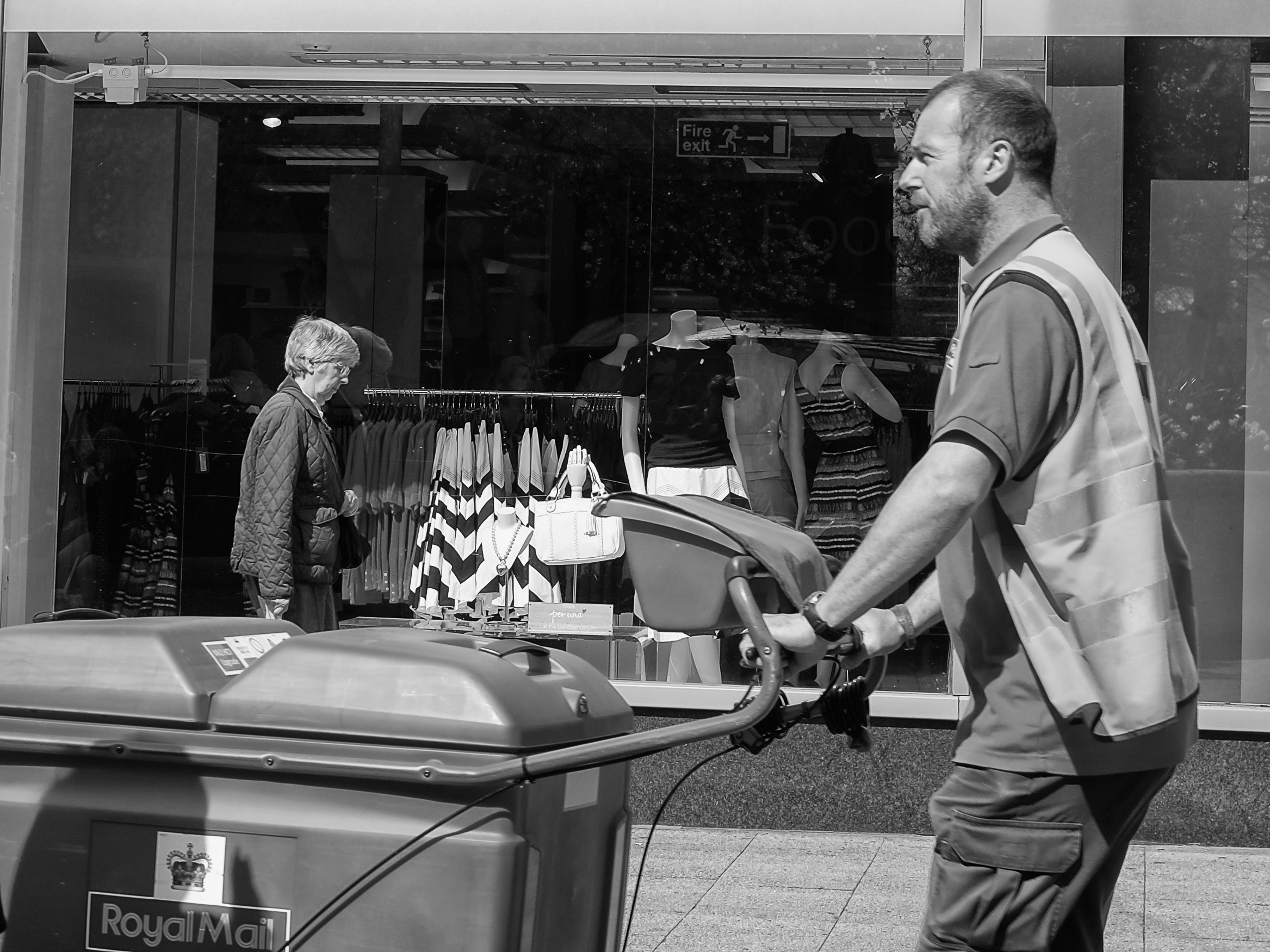
Considering I love reading about street photography I rarely feel brave enough to go out and try it. Today would be different though, I had the luxury of the tilting screen to help compose my shots without drawing too much attention and it was small enough to fit in my jacket pocket when not needed. I also had the advantage that it was a beautifully sunny day creating some stunning contrast.

DSCF0034

As I wandered about looking for the perfect shot, I came across a very well presented busker playing a beautiful collection of classical pieces. I knew the shot I wanted would involve me getting up very close as I was using the 27mm lens. I simply gave him a friendly smile, nod with the camera in hand and he beckoned my forward. I shot this at f/9 as I wanted to guarantee some good focus. On reflection, I might have opened the aperture up slightly and sped the shutter up a bit to get a sharper image.

DSCF0048 (2)

After spending five or so minutes relaxing in the sun to his repertoire I moved on, in the search of the next ‘big’ scene.

One shot I love seeing is where you have one person standing looking into the distance. I’m always like “What is this man thinking about?”. I was lucky to find a few people doing exactly that.


The XF27mm lens was performing perfectly, the focus is super quick and even with some heavy crops, the physical quality of the images speak for themselves.

You might wonder what software I use to post-process my images. I do use PS and GIMP of course, but I recently discovered Google’s ‘Nik Software’. As an amateur photographer it gives great quality options for a pretty low price. I used a plugin called Silver Efex Pro to create my black and white images and pull some extra contrast and detail out of my shots. One thing to note is that it does not deal with our RAW files as far as I know. But you could shoot RAW, convert to TIF and then import for a higher file size.

As the afternoon went on I took a turn into the market stall area, it is always a pretty busy place with lots of snapping opportunities. Here are a couple from the market stalls.

DSCF0026 (2)
The Bag Maze

DSCF0027 (2)
“Anyone for a hat?”

All in all this camera combo performed perfectly, it was quiet, unnoticed (most of the time!) and gave me some excellent quality shots that I am happy to share with you all. I think that the XF27mm works great for this style of photography as it makes you get into the action and put yourself in the moment more rather than shooting from a distance. It helps you find those more intimate scenes that you might miss if you were further away. For me, I found that generally people were quite sociable and simply interested in what I was doing rather than the opposite.

I hope this inspires you to go out and have fun with some street photography yourself. Here are all the images I kept from the outing.

Written by Dale Young


Pimping my Fuji X-Pro1 – X-Signature Skin

By Kevin Mullins

What is the X-Signature range then? Recently, I was made aware of the new “pimping” service of the X-Series of cameras that Fujifilm have launched in the UK and I believe, worldwide. The Service involves having your X-Series Camera skinned with a choice of many different options. Current options include; Racing Green, Burnt Orange, Black Lizard, Blue Lizard, Beige Lizard Emboss, Light Green Lizard, Navy Blue Crinkle, Red Lizard and Red Crinkle Emboss.

Fuji-X-Signature-4-1024x689

Now, I’m a reportage wedding photographer right? Part of my remit at a wedding is try not to stand out in the crowd and to blend in as much as possible. So, with that in mind, I decided to avoid options such as Red Lizard and Burnt Orange (though I’m sure these will be fine choices for certain people!). Instead, I went for Black Lizard. Why? Well, because it’s black….mostly.

The process has been superb. I ordered my “pimping” on Tuesday. On Wednesday morning I received a pre-paid box and padded envelope. I popped my X-Pro1 in the post on Wednesday afternoon. Less that forty eight hours later I receive a parcel from Fuji with my brand new X-Signature Skinned X-Pro1.

For what it’s worth, as you know, I’m an official X-Photographer and a working professional. My cameras do take a battering and I was really keen to see the new skins in action. I chose my X-Pro1 as it’s my oldest work horse and probably, a bit like me, needed a face lift of some kind.

Fuji-X-Signature-2-1024x689

The box arrived. All plush and very very well presented. Inside the lovely box is the X-Pro1 with its X-Signature skin.

Now, the X-Pro1 had a pretty good feel in the hand and I never had the need to “grip” it to avoid slipping in the hand and it’s important that the X-Signature Skins offer that same tactile embrace. And it does. It actually feels better in the hand, and almost gives it a “better quality” feel.

According to the Fujifilm website you can “Personalise your camera by choosing from one of the fantastic customised Signature colours and textures. Whether you already own a camera or are looking to purchase one today, simply select a style to suit your personality and we’ll get your tailor-made camera to you in a flash.”

Fuji-X-Signature-5-1024x689

And pretty much I think that sums it up. Listen, having your X-E1 in Red Lizard isn’t going to make you a better photographer. It’s probably going to make you cooler that me of course icon smile Pimping my Fuji X Pro1 ~ X Signature Skin Ultimately this is about personalisation of your camera. It had to be excellent quality and materials that are good for the rough and tumble of the average wedding photographer.

Good Value? I think so. It’s not going to be for everyone of course but if you fancy being a bit different and adding a bit of quality personalisation to your camera then go for it.

Click here to get your X-Series camera pimped with a X-Signature skin on the Fuji UK shop.


Fuji-X-Signature-7-1024x689

Fuji-X-Signature-9-1024x689

Fuji-X-Signature-3-1024x689

About Kevin

Kevin Mullins is an award winning UK Wedding Photographer specialising in the documentary style of wedding photography. To see more of his work you can follow him on Facebook or follow his blog. Kevin’s non-wedding related Fuji content is on his new Fuji specific blog over at The Owl.

Guest post: Hands on with the XF10-24mmF4 R OIS

Title image: 24.0 mm (in 35mm: 36.0 mm) 1/8 sec; f/4.5; ISO 6400

By Gianluca Colla

I generally do not like to write reviews of products without a long and intensive field test. And by long I do not mean days – I mean several months.

I also don’t like writing first impressions of a camera or lens, because in a few days, even shooting many hours, I do not have enough time to get perfectly tuned with the gear I am using. I still remain a stranger and there is still the excitement of the new toy.

It’s almost like in real life, with couples. You can (almost) never tell after a first date or two if your partner will be “the one” but after several months of dating, you get a quite good idea if your relationship will go for a long run.

That’s why, although I’ve been one of the first and privileged people in the world to get my hands on the X-T1, long before it was announced, I didn’t write anything about it yet.

This was all true until one night in Yokohama, Japan, where a group of X-Photographers are gathered to speak at CP+, I went out with some friends and colleagues, and coupled the latest X-series with the Fujinon XF10-24mm F4 R OIS.

13.8 mm   (in 35mm: 21.0 mm) 1/8 sec;   f/4.5;   ISO 6400
13.8 mm (in 35mm: 21.0 mm)
1/8 sec; f/4.5; ISO 6400

Love at first sight
I guess this is what is known as love at first sight. A perfect match. When you know there is no need to further test, or to “date” a little bit longer because you simply know it will be a long-lasting and happy relationship.

There are plenty of detailed reviews online and plenty of technical data sheet about the camera and the lens, there is no need to cover again that kind of information.

11.5 mm   (in 35mm: 17.0 mm) 1/32 sec;   f/4.0;   ISO 3200
11.5 mm (in 35mm: 17.0 mm)
1/32 sec; f/4.0; ISO 3200

All I can say is that the camera is designed to fit perfectly in the hands and to have that kind of tactile feel that only a vintage camera could offer and is designed with a lot of technology inside but with a simple usage in mind. And the lens, is just amazing: wide open is razor sharp, it has an impressive OIS that can easily hold 5 stops, all you have to do is get out and shoot. And this is what the X-T1is made for: to simply take beautiful picture, to forget about the technical race and to focus on what should be every photographer’s main concern: making stunning images.

I want to add is this:

  • 3200 or 6400 ISO
  • 1/8th and 1/4th of a second, handheld (yes, you read it correctly, handheld – God bless OIS and the small weight of the camera)
  • f4

You judge the result your self. All of the images featured here were taken on the X-T1 with a (pre-production) XF10-24mmF4 lens and are JPEGs straight out of camera. I dare you to find me another combination like this.. 😉

10.0 mm   (in 35mm: 15.0 mm) 1/4 sec;   f/4.0;   ISO 3200
10.0 mm (in 35mm: 15.0 mm)
1/4 sec; f/4.0; ISO 3200

About Gianluca

An in depth knowledge of photography has led Gianluca to travel to many diverse destinations around the world, from the Arctic Polar Circle to Africa’s deserts, from the Far East to the Amazon. Gianluca’s photographs have appeared in various publications including National Geographic Magazine, New York times, Newsweek, Los Angeles Times, CondèNaste, Bloomberg News.

His images are represented by National Geographic Creative.
His series of images from India has been projected at Musèe de Elysèee in Lausanne.

Gianluca is also a member of NAPP (National Association of Photoshop Professionals) and he has an intense lecturing and teaching activity counting various seminars and workshops: he teaches reportage at European Institute of Design of Milan, and is a Photography Expert and teacher for National Geographic Expeditions.

When not on assignment Gianluca spends his time in Switzerland and in Italy.

Click visit his website
Follow Gianluca on Twitter