Street

A journey to Marrakesh

9. DSCF5376 mercato medina - sitoby Jesper Storgaard Jensen

About me

Jesper Storgaard Jensen bwI’m Danish, born in 1964, and have been living in Rome since 1997. I have always loved writing and at a certain point, after my arrival in Rome, I started to collaborate with magazines producing travel articles. It was from this that the Danish Daily wanted to publish a travel article of mine from an Italian island. Unfortunately the PR-photos were of a too poor quality. In other words, I had to do the photos myself. This is when I purchased my first ever 5-mega-pixel camera. That was back in 2003, and since then, my interest in photography has been steadily increasing. I had been working for the Danish Embassy in Rome for ten years, but in 2009 I took the jump to become a full time freelance journalist and photographer shooting travel, culture, food & wine and interviews. Everything with my own imagery.

The journey to Marrakesh

We – a total of eight persons – were doing a 7 day on-the-road-trip round Morocco, two days of which were spent in Marrakesh. As I needed to travel light, I packed only my Fuji gear – Fuji X-E2, the 18-55mm kit lens and the 35 mm lens for portraits & food. I must say that I find this a excellent combination and the overall weight is significantly reduced compared to DSLR gear.

7. DSCF5387 medina - sito

Travelling in a country with a completely different culture to my own I wanted to play it safe. So I asked most people if I could take their photo, especially regarding portraits, which I guess is quite obvious. There were occasions where some scenes were too good to miss, and in these circumstances I fired from the hip, looking elsewhere.

6. DSCF5536 Amir Marrakech - sito

5. DSCF5591 street portrait marrakech sito

8. DSCF5345 pink all over - sito

Generally speaking, Marrakesh is a very photogenic location. There are so many varied situations, so wonderfully exotic, with such incredible faces, emotions, the colours, the textures. Everything seems to be calling you to be immortalized.

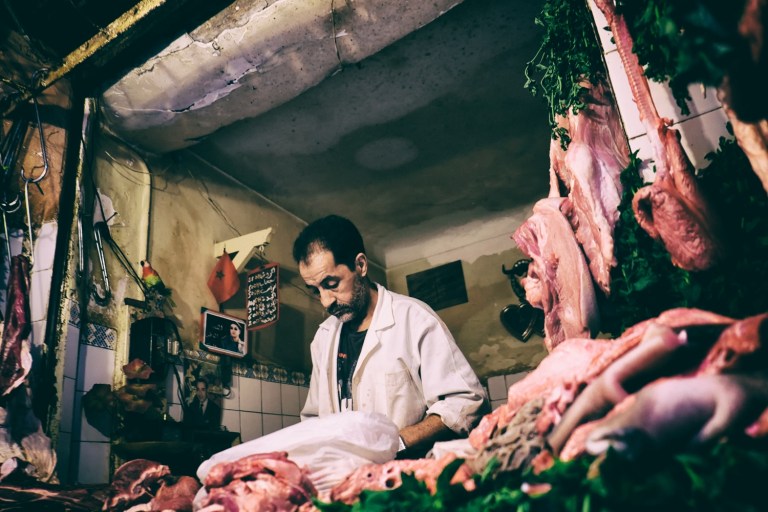
3. DSCF5470 butcher marrakech - medina

11. DSCF5408 medina nr. 2 - sito

2. DSCF5480 man with hat - sito

1. DSCF5566 medina - sito

Future projects

Aside from my daily work, I like to have detailed, lengthy photographic projects and I’ll soon be leaving Rome for my summer holidays. I’ll be driving through the south of Italy to the island of Pantelleria, south of Sicily. During that month of holiday I’m planning on doing a project called “People I met”, taking portraits of people I’d casually meet during that month. On a long term basis, I’m working on a project where I’ll be photographing different kinds of Roman artisans in their working environments. This project will be continuing into 2016.

Contact

Web
Instagram
500 px
Picfair

Cuba with X-Photographer Chris Upton

20150309_cuba_2804

by Chris Upton

Cuba, the largest island in the Caribbean is a stunning and diverse location. The noise, hustle and bustle of Havana, teeming with brightly coloured vintage American cars contrasts with the quiet verdant plantations and gorgeous beaches. The wonderful Spanish architecture is at odds with the decaying beauty of some of its poorer areas.

Cuba has had a turbulent history from Spanish colonial rule and the slave trade to Batista’s dictatorship and overthrow by Fidel Castro and it’s subsequent economic struggle. Throughout this it’s culture, music and arts have remained as colourful and vibrant as ever.

I have recently returned from a trip visiting Havana, the plantations in the west around Vinales and the towns of Cienfuegos and Trinidad on the south of the island.

What you were looking to capture?

20150316_cuba_4060

20150304_havana_0685

Cuba is simply a photographer’s paradise, there is so much to photograph. I wanted to capture the spirit of the country, it’s unique feel, from it’s people, architecture, landscape, crumbling urban beauty, to it’s political heritage and, of course, the wonderful array of vintage American cars.
From my research, the colour and the vibrant feel to the country captivated me and my goal was to reflect this in my images.

There was clearly going to be an emphasis on Street, People and Architectural photography whilst in Havana, Cienfuegos and Trinidad with more traditional landscapes when in the west of the country around Vinales.

I also wanted to capture the incidentals, the detail shots that “shout” Cuba. The American cars topped that list, but signs, revolutionary slogans, images of Che Guevara, graffiti and of course the famous Mojitos and Daiquiri’s were in my plans too!

How did you plan your adventure?

20150304_havana_0759-Edit

20150307_cuba_2145

Of critical importance to successful travel photography is the research before you go. The more planning you put in the greater the chance of capturing great images. Having the best technique is no use if you’re not in the right place at the right time or you return home and realise you have missed some great locations.

Before I discuss how I planned the trip it is important to understand the objective. You need to be so well planned that when you arrive on location you should feel like the place is familiar, as if you’ve been there before. You will then find that you are comfortable in your surroundings, already having some shots planned in your mind. You can then concentrate on shooting those and then look around for other shots, for your own personal interpretation. This approach saves you time and helps ensure that you don’t miss important shots.

Not surprisingly the first port of call when planning is the internet. Whatever did we do before?! I will look at Tourist information / Government sites, Google images, Flickr, 500px and Stock Libraries. It is important to note that this is not to simply copy pictures that have been shot by others but to give you an idea of what is possible and to help you then put your own stamp on a place.
Good guide books are also an invaluable source of information and offer plenty of hints, tips and recommendations, especially for food and hotels. Well you’ve got to be comfortable when you’re out shooting all day! They also provide you with some basic language, very important to break the ice with the locals. I prefer the Dorling Kindersley Eyewitness Guides as they have sufficient historical and background information but are also much more visual than some of the other guides.

Not only is it imperative to have a list of planned shots but you also need to have locations for sunrise and sunset. The best source for these timings is the Photographers Ephemeris, a web app which shows you not only what time the sun rises and sets for any place in the world on any particular date but also the direction of the sun. This makes it an invaluable tool in your planning armoury. I planned my pictures taken on the Malecon (seafront) by using this app.

I also looked at Travel brochures and the Travel sections in newspapers.

You will also need a good Weather forecast so that you can amend your plans to suit the conditions. If the weather is really bad spend time inside buildings or churches though don’t miss out on the opportunities that bad weather presents by shooting outside, you might be really surprised at what you achieve and it will most likely be very different from the standard shots.

From all this information I prepare a Shoot List including all the details. This is invaluable and I check it every night. I always buy a decent street map and mark the key locations to ensure that I cover all the shots when in that area.

What kit did you take?

20150306_cuba_1750-Edit-Edit

20150307_untitled_1960-Edit

One of the most common questions when I give my Travel Photography lectures is: “What kit do you take”?

So here is a list of the equipment I took:
• Fujifilm XT1 and XE1 bodies
• Fujifilm Zoom lenses XF10-24, XF18-55, XF 55-200
• Fujifilm Prime lenses XF35 f1.4 and XF56 f1.2
• Nissin i40 flash
• Lee Seven5 filters
• Cable release
• 6 spare batteries
• 80gb SD Cards in a Think Tank Pixel Pocket
• Giottos Vitruvian Carbon Fibre travel tripod with Really Right Stuff B30 ballhead
• Gorillapod
• Cleaning cloths, rocket
• Headtorch
• Think Tank Urban Disguise 50 shoulder bag

• 13” Macbook Pro and Lacie Rugged Hard Drive
• i-phone
• 4 gang adaptor.
• Twin Battery charger

Here is some background to my choices.
I always take two bodies with me, primarily for insurance in case one fails or doesn’t survive being dropped onto a marble floor as happened to me on this trip! Thankfully the XE1 and 55-200 must be made of sturdy stuff as they survived and continued to work perfectly, but it just goes to show how important this is.

My lenses needed to cover wide angle, for interiors, to long telephoto to capture detail or compress the perspective. My three zoom lenses 10-24, 18-55 and 55-200 zooms are ideal for this. On this trip I also took along the XF35 f1.4 and 56mm f1.2 primes. These are stunning lenses superb for portraits, with their wide apertures, and great when the light is low.

The Nissin i40 flash is a fairly new acquisition and complements the Fuji form factor superbly, being extremely small and light and with enough power for most tasks. I tend to use it mostly for fill in flash on portraits.

My Lee Seven5 filters include a polarizer, ND Grads and ND filters for long exposures.

Tripods usually cause much debate. There simply isn’t a perfect tripod as the conundrum of size, weight, robustness and price cannot be solved! That said I am very happy to pair my Fuji cameras with the Giottos Vitruvian tripod (a few years old and I think there is a newer version) and Really Right Stuff Ball head. This tripod packs down small, with it’s legs folding back over itself, is light and sturdy and best of all weighs little over 1kg. The RRS ball head is superbly engineered and holds the camera in position really well with no droop even with the 55-200 lens.
In certain places the tripod police are only too keen to assert their authority preventing you from using your large tripod. In these situations I have a Gorillapod which I can attach to a support, chair, barrier or even place on the floor.
I use the Arca system of quick release L brackets on both my cameras for ease and speed of use.
When the power supply is unreliable it’s vital you have sufficient battery power. Therefore I took 6 spares plus the ones in my camera. I always take a lightweight 4 gang adaptor and a twin battery charger. When you need to charge your batteries quickly, together with your phone and laptop you need the extra sockets and hotel rooms usually have a dearth of wall sockets.

All of this packs into my Think Tank Urban Disguise bag and weighs in at less that 10kg! Think Tank products are superb, so well made, extremely functional and they are like the tardis, you can just keep filling them up! On this type of trip I prefer a shoulder bag to a backpack both for security reasons and ease and speed of use.

Any general tips?

20150304_havana_1171

20150303_havana_0098

When you arrive at your destination familiarise yourself as quickly as you can, good planning will help here. Look for interesting viewpoints and check to see where the sun rises and falls. In Cuba the streets are laid out on a grid system so I found streets that ran east / west where the sun would backlight my subjects early or late in the day.

When you photograph buildings or churches always snap the sign when you finish, you won’t remember the names of the places you visited.

You will need to work quickly, the lighting is challenging, very contrasty in the middle of the day and the sun rises and sets very quickly so you don’t have too much time to get your shots. Be in place an hour before sunrise and stay at least 45 minutes after the sun has set.

It will help if you have practiced other techniques that you might find useful such as panning. You don’t want to be learning and missing great shots whilst old American cars are speeding by on the Malecon.

If you are shooting a panorama to stitch together later I always shoot a frame first and last of my hand so the pictures in between can be easily identified as a pano set.

Walk, walk and walk more. If you find an interesting background in the streets, wait a while until someone interesting walks into the frame, it will happen.

Finally, the most important tip, always carry a camera. You never know what might present itself at the most unexpected time!

How did you get those stunning portraits? Did you ask them. etc.

20150310_cuba_5049-Edit

20150309_cuba_2777

The people in Cuba were full of character and life and capturing this is a must.

There are various ways of approaching this. A street approach using wide lenses and getting amongst the action to achieve reportage type, unposed, images. Using a long lens and shooting without the subjects knowledge or getting posed shots after asking permission to take a photograph. Many photographers find walking up to total strangers and asking to take their picture very difficult. However if you can overcome this and your subject agrees, the pictures you get will be far better than any long distance grab shots. This is my preferred method with which I have found most success. Sure you will get some rejections in which case I simply smile, wish them a good day and move on. But get a willing, interesting, character and you will get some stunning shots.

My technique when I see a subject, before I approach them, is to check my camera. I will select the appropriate lens then check camera settings, battery level, memory left on the card and my flash settings if appropriate. Only when that is completed do I walk up to them keeping my camera to one side. I smile introduce myself and ask if they speak English. I try and learn these words in the native language which immediately breaks the ice and often makes them laugh! I might ask a little about them before asking to take their picture. If you are already prepared you can get to work straight away, you don’t want to be checking your screen or fiddling with your settings. Don’t just grab one shot and move on, take several, some people will move to a different area for you or pose as you request. It’s important to show them some images on the back of your camera and thank them before moving on. Children love to see their pictures and the best shots are often when you’ve just shown them so be ready!

So to the thorny subject of payment. My rule is generally not to pay money as I think it simply sets a precedent for other photographers and encourages the practice of begging. However I will sometimes take pencils, pens or soap and shampoo and sweets for children. This rewards them without actually paying them cash. If I have worked with a person for say 10 minutes or more and they have been really helpful then I may give them a small tip but usually I try not to.

I had wanted to visit Cuba for some years and often such high expectations can be cruelly dashed. However this was definitely not the case here, it is a stunning destination perfect for photographers. My recommendation is to go soon, before it changes too much.


To see more of Chris’ images from Cuba see his website www.chrisuptonphotography.com


Story behind the photo – A girl watching the world pass by

By Danny Fernandez

As dusk settled a new side of Agra began to come alive. The thick air was filled with the incessant sounds of rickshaw horns, and the buzzing of electricity from the network of power cables which decorated the streets.

The roads, which had previously been a high contrast haze of burning light had cooled, and become illuminated by florescent shop signs and orange street lamps.

It was the end of an incredible day spent exploring the Taj Mahal and Agra. I was exhausted after spending the day walking around in the sweltering heat, and had 2 hours left before catching my train back to Delhi. So I decided to do what any normal Englishman would do – stop for a cheeky beer.

I began looking for a bar, and before long walked past one with a man standing outside. The man had an incredibly friendly face, and I stopped to ask if I could take his photo. He told me that I could, on the condition that I come inside and buy something from his bar. It was a win-win situation.

The bar had a rooftop with a view of the Taj Mahal in the distant background. There were children on neighbouring rooftops fighting kites. The man and I exchanged conversation for the duration of a few beers. His benevolent disposition which initially drew me to the bar did not disappoint, as he entertained me with stories of his family and his love for India. At one point I asked him if he would like to live in another country, and he simply answered “Why?”. For him, India was the greatest place on earth.

Agra Danny Fernandez2

As the light faded from the sky, our conversation was interrupted by the sounds of blaring music. I walked over to the ledge of the rooftop and saw trucks, which had been elaborately decorated with enormous chrome horns, blasting music at a deafening level. The man told me that today was a special festival in Agra.

Agra Danny Fernandez3

I stood there watching and decided to start taking photos. The mixture of ambient light, combined with the twilight of the sky was beautiful. For my 3 month trip backpacking India, I was travelling light – my main camera being an Fuji X100s. I set it up on the wall of the rooftop on a Manfrotto Pixi mini tripod and started shooting. I wanted to capture the energy of the street so set a slow shutter speed to capture the movement. The auto white balance on the X100s worked amazingly well.

Agra Danny Fernandez1

After a few minutes a young girl appeared on a rooftop below me.

She walked to the wall of her rooftop and stood there, gently observing the life on the streets. She was unaware of my presence as a picture unfolded in my viewfinder.

There was a beautiful contrast between the peacefully still young girl and the noisy and fast life on the street that was passing beneath her. I wanted to capture the contrast, so again choose to use a shutter speed of 1/8 second to get a slight motion blur of the passers by, while freezing her in her graceful stance. I began shooting, and after a few frames she rested both of her arms on the wall at the same time two cyclists passed by. I fired and got my shot.

Agra Danny Fernandez4

About Danny

Danny Fernandez is a creative photographer living and working in Barcelona. He likes cycling, records and vegetarian food.
To see more of his work, visit Danny Fernandez’s official website here or follow him on Flickr

Punjab travelogue by Sinbad Phgura and his X100s

My name is Sinbad Phgura I am a fashion, lifestyle & travel photographer

201746_10150136198419787_2761543_oFor me photography has been a life long passion , I got my first a square 35mm box tammy camera at the age of nine and and have been shooting ever since.

I use mostly digital format cameras now, but not much has changed subject-wise, it’s people that I like to capture most, working with natural light & keeping the whole process as simple as possible. The magic for me has always been in the character study, to capture the honesty of the moment, & to connect with the soul somehow.

That’s why India is such a joy to shoot, with all of it’s humanity right there in front of you to see, smell, hear & touch! I love the light, it’s incredible how its shades, textures & changes everything it touches throughout the day.

www.sinbadphgura.com

I’ve been around the Fujifilm X system for a while now, one of my best friends Alex Lambrechts shoots with it & I know that these cameras are capable of stunning results! But I myself have so far have resisted to try one.

It’s only when you have the camera in your hand and you have to shoot with it for a period of time, adjusting your mindset from dslr to rangefinder that the magic happens.
Equipped with the Fuji X100s and a Millican camera bag I was off on my journey, Qatar Airways to Amritsar & into the heartland of the Punjab for my nephew’s wedding.

10827901_10152891223834808_5736446108255047467_o

1522796_10152891221629808_7969940031836849956_o
It was a very special time for all of our family and it was so wonderful to see the remote family farmhouse turned into a fairytale setting.
What I wanted to capture with this picture travelogue was the backdrop to the wedding, the rural way of life, the people the environment and the excitement & build up to the big day.

10818299_10152891230399808_3322046534073892201_o

The X100s is indeed a beautiful looking machine with its classic styling it’s a great to hold and a pleasure to use. The physical dials feel just right, and it’s a joy not to have to scrabble through a ton of menus. I like that the fixed lens made me think more about composition and less about focal lengths & changing lenses, just being in the moment … capturing the moment. Taking me back to real photography, back to my film days when I used to shoot film.

10830731_10152891226414808_7330207723044884526_o

1402223_10152891227224808_2683260967163836733_o

10818321_10152891226624808_6240229330175515705_o

The biggest thing I found using the X100s was that you just can blend into the environment much easier and that there is less of a barrier between you and your subjects. It really makes this the ideal street / reportage carry everyday camera, silent lightweight and stealth!

10454417_10152891229069808_8231962881706616460_o

1522900_10152891224599808_7972258162363039143_o

This wedding was such a special time for all our family! I’m so glad I got to enjoy it to the full & still get some great shots without worrying about loads of heavy camera gear!
Yes I really liked my Fuji X experience! And now with the new X100t out, I’ll definitely be coming back for more.

For images of the whole experience, please click here.

1926299_10152891228584808_5770720528644776409_o

Nice one, centurion

By Roger Payne

Is it just me, or have other people experienced a weird phenomenon when they start using Fujifilm X-series cameras? I’m not talking about aesthetics here, I’m talking more fundamental, cerebral kinda stuff.

Lately, thanks to the nice people at Fujifilm UK, I’ve been able to get my hands on some of the X-series models. I’ve tried the X100S (it’s very nice), the X-T1 (it’s very nice) and, most recently the X-E2 (it’s, erm, very nice). But when I’ve gone back and looked at some of the shots I’ve taken with this trio of models they all bear the hallmarks of me transforming into some wannabe reportage-come-street photographer. It’s really quite alarming.

To understand the full gravitas of this situation, it’s important for you to understand what sort of a photographer I was before I started using X-series cameras. The immediate word that springs to mind is ‘safe’. Technically adept, but safe. I photographed landscapes because they don’t move, buildings because they don’t talk back to you and my dog, because he’ll do pretty much anything with the promise of a treat. The idea of photographing a fellow human being filled me with fear while the very thought of photographing a fellow human being in a candid way would have me blowing into a paper bag to calm my nerves.

But Fujifilm cameras have changed all that.

I’d borrowed the X-E2 to go on a short city break to Rome. It was accompanied by an XF18-55mm and an XF10-24mm. Ordinarily on a trip of this type, I would have sought out the tourist hot-spots, documented them in my technically adept way and then gone home to bury them on an external hard drive, never to be seen again. But with the X-E2 in my hand, I became some kind of gung-ho street photographer, snapping pretty much anything that moved, and some things that didn’t. Within minutes, Rome went from a selection of photo locations carefully plotted on a tourist map to a photographer’s playground. My playground, to be precise.

The pictures I’ve brought home are unlike anything I’ve ever captured in a foreign city. They include people; people I’ve never met before, nor will I ever meet again. As you can see, they do also include a few shots where I lapsed into capturing subjects that didn’t have the ability to talk to me, but even these are a little different. They’re not hackneyed scenes photographed millions of times before by others, they’re my interpretations of the locations I visited; they communicate how I was feeling and how I viewed the area.

How was the X-E2? Well, it was excellent. Sure, it could do with an articulated rear screen, but I also enjoyed not having an optical viewfinder option to choose from; the finder in the X-T1 is fantastic, but I didn’t miss its functionality. In fact, I preferred the X-E2’s viewfinder simplicity (just don’t tell Fujifilm, OK?). The lenses were great, too – sharp, easy to use, no complaints.

So, am I alone, or have other experienced feeling of photographic invincibility with an X-series camera in their hands? Oh ok, just me then.

Couple. XF18-55mm, 1/80sec at f6/4, ISO 400.

Jens Franke combines street photography with portraiture to capture images that are both intimate and mysterious

Münzstraße März 2013Jens Franke is a professional designer and photographer from Stuttgart. His passion for photography started during his exchange semester in Rio de Janeiro. He was so impressed about the versatility and tensions between the different population groups living together in one mega city.

To share his impressions he started a blog where he posted his personal view on the city. Back in Germany, his aroused wanderlust took him to exciting destinations in Columbia, Morocco, Europe and the US.

Capturing fleeting emotional moments of people, whether of happiness, sadness, joy, anxiety or loneliness became his goal of each journey.

Stuttgart

Rotebühlplatz März 2013
X-E1 with XF35mm – f/1.4, 1/125sec, ISO800

With all the possible exotic places in mind, and having grown up in the Bavarian Alps, I thought Stuttgart would be quite a boring place to live when I was here for the first months. To keep myself entertained I started to watch out for the subtle adventures of every day life. My camera got the main pretense for my everyday strolls through the little neighborhoods here. It worked out for me! I sensitised my view and step by step I got used to the rhythm of the city. Sometimes i feel like Daniel Quinn in Paul Auster’s fiction `City of Glass` when he is loosing himself in the city of NY.

Friedrichstraße Februar 2013
X-E1 with XF35mm – f/1.4, 1/4000sec, ISO200

I really like Austers quote in this book: “In other words: It seems to me that I will always be happy in the place where I am not. Or, more bluntly: Wherever I am not is the place where I am myself. Or else, taking the bull by the horns: Anywhere out of the world.”

Herderstraße Januar 2013
X-E1 with XF35mm – f/8, 1/125sec, ISO800

While I started photographing the people in the streets of Stuttgart, I got more and more interested in individual portraiture and the story behind the people. In my last Exhibition “Little Districts”, I combined street photography and portraiture to enable my visitors to see my city from both an intimate and a mysterious perspective at the same time.

Königstraße Januar 2013
X-E1 with XF35mm – f/1.4, 1/60sec, ISO400

Morocco

Marrakech, Medina, Januar 2014
X-E1 with XF35mm – f/4, 1/40sec, ISO400

During the last two years I’ve traveled to Morocco four times to capture the glimpse of the Moroccan spirit close to the western Saharan border and the region around Marrakech. But a lot more I wanted to illustrate the people in their every day life – Moroccos inhabitants are the real points of interest of the country!

Marrakech, Januar 2014
X-E1 with Contax C/Y Sonnar 85mm – f/2.8, 1/320sec, ISO400
Marrakech, Medina, Januar 2014
X-E1 with Contax C/Y Sonnar 85mm – f/2.8, 1/125sec, ISO400
Sidi Ifni, Januar 2014
X-E1 with XF35mm – f/1.4, 1/1200sec, ISO400
Tafraoute, Januar 2014
X-E1 with XF35mm – f/2.8, 1/3000sec, ISO200

Technique

Most of my current images are taken with this Lineup:

  • Fuji X-E1
  • Every Day Lens: Fujinon XF 35mm f/1.4 R
  • Fujinon XF 56mm F1.2 R
  • Fujinon XF 18mm 1:2 R

I really like the unobtrusiveness of the X System. With my blacktaped E1 I got barely noticed on the street and my whole equipment fits in a small camera bag. Since Street Photography is often a matter of performance i also like the intuitive controls and the customizable function keys. I made my X-E1 behaving like the Contax G2 which handling i loved. I set the focus via thumb and set the lightning via pressing the shutter halfway down. For a better handling i use the additional and pretty ergonomically handgrip.

I also enjoy the analog developing process and some of my other work is photographed by analogue medium and 35mm cameras.

Links:

To see more, you can visit Jens Franke’s website here or follow him on Facebook here.