Think about it, it’s your dream job. You’re a Liverpool season ticket holder and supporter and as a professional photographer you are asked if you’re interested in photographing the portraits of a number of former and famous Liverpool FC captains for an upcoming book.
Of course I jumped at the chance!
My brief was pretty simple, make all the captains look good, but the harder part of the brief was to make all the pictures look like they had been shot in the same session at the same time ……. Of course this would mean shooting on location in ten different locations!
The first captain on our list was perhaps the hardest logistically to set up as when we arrived at Ron Yates’ home there was simply nowhere to set up my studio and Ron’s wife was not too pleased at the thought of moving everything around in her living room!
But we soon persuaded her that it was ok to shoot with a simple one-light set up and so photographed Ron on his sofa right there in the front room.
“One of the great advantages of shooting with my Fujifilm X-T1 camera system is that the camera is not overwhelming in size and this makes it easier to communicate with your client.”
Ron Yates
I was not given a lot of time to take Ron’s portrait as he sadly suffers with Alzheimer’s so I needed to work quite quickly. This meant going for my trusty XF16-55mm f2.8 lens. This lens is amazing at times like these – it’s versatile in focal length from wide angle to zoom, sharp and very fast to focus.
From here I worked quickly, taking as many different portraits as I could in as short amount of time possible.
Over the next few captains that I photographed I was given more time and space to get what I had in mind for the book.
Robbie Fowler
One location I was given was to shoot in was Jamie Redknapp’s garage at his home! It was a big space to set all my studio backdrop and lights in, plus I received refreshments from Jamie’s lovely wife Louise!
Jamie Redknapp
Also having the luxury of more time and a bigger working space is that I got to use my different Fujifilm prime lenses. And let’s not forget that with each different portrait sitting you have to come up with a variety of posed shots, I tend to shoot a full length sitting down shot, a ¾ length standing up shot and then a selection of close-up headshots. The lenses I use in my shoots are the XF16-55mm f2.8, XF23mm f1.4 and my XF56mm f1.2.
“I really love the 56mm as it’s pin sharp, fast to focus and gets a great headshot in a limited space.”
And the locations where quite varied too – from conference suites in Southampton Airport (amazing what access you can get in these places dropping Graeme Souness’ name) to removing furniture from Ronnie Whelan’s dining room so I could set my studio in there (Massive table and chairs out!).
Graeme Souness
There was also the time aspect to all this as each Captain was giving their time for free, so I was very conscious that my photoshoots didn’t drag on.
In my experience with these types of shoot I’ve come to know and trust the equipment that I use. From my portable studio set up to my Fujifilm camera and lenses, I know I’ll get great results each time.
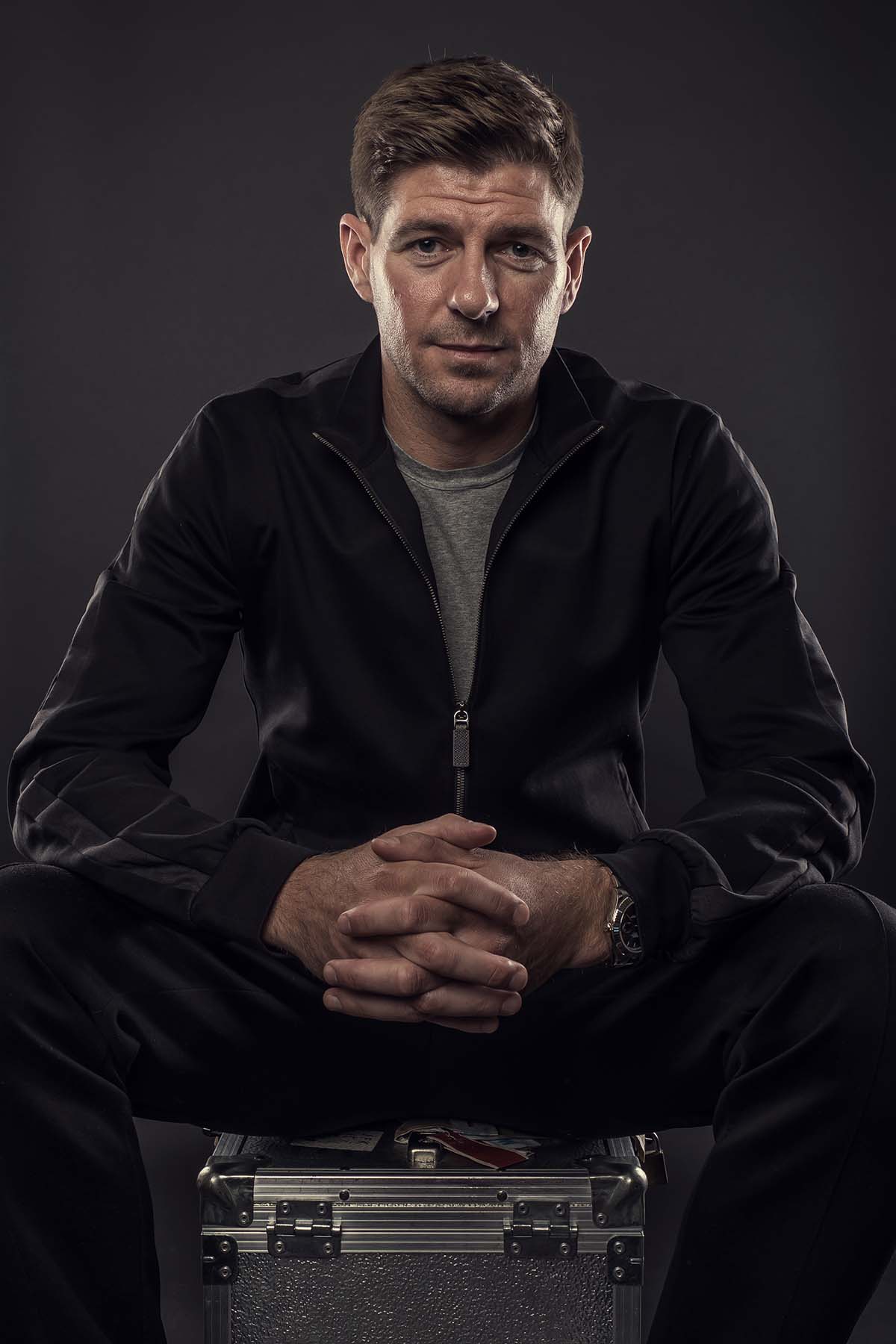
Paul Ince
One of the most common questions I get asked is which Captain was the most difficult to shoot.
It’s an easy answer really – Steven Gerrard.
On the day of the shoot Steven was very pushed for time as he had a big appointment in Milton Keynes for Adidas. To compound matters further the interview for the book ran over as well…… So in the end I was given just 60 seconds to get as many portraits out of the shoot as possible.
Lucky I had just enough time to set my studio up and was ready as he walked in. I used my Fujifilm X-T1 camera alongside my XF16-55mm lens to create the shot.
As I said before, in times like these you need equipment you can trust and that will simply get you a great result.
May this year I picked up a second-hand graphite silver edition X-T1 and wanted a good excuse to go out shooting with it.
Shooting with the XF50-140mm
So.. I arranged to meet a model I’ve known for 5 or 6 years now, Imogen Leaver who’s with Nevs Models in London. We got chatting and I mentioned a friend of mine who’s a makeup artist that had just moved to Ibiza, well she’d been on my case to fly out and shoot on the island, it was something I’d been wanting to do for a long time.
To cut a long story short, we were both fairly quiet work-wise so we looked into flights and within a few days that was it, flights were booked and we were going to fly out the following week for 3 days!
The next thing to decide was what gear to take?
You see my switch to regular use of the Fuji X System was still pretty fresh, my Canon 5D MkIII was and still is part of my kit but I’d only used it once in about 4 or 5 weeks, even in the studio I’d been reaching for the X-T1.
Honestly, I thought I might have deliberated more over what kit to take but I wanted to travel light and I already knew how much I loved Fuji in natural light from past experience so that was that – I took the X-T1, the X100T, my 35mm and 56mm.
I’d also been hearing great things about the XF50-140mm zoom, but being a prime shooter I wasn’t too sure if it would work for me, but Fujifilm kindly loaned me one for the trip so I could try it out and see what all the fuss was about, I wasn’t expecting to use it much – how wrong I was!
The Shoot
First day out we drove to a beautiful beach, Sa Caleta the sun was shining & we were ready to get going, the rocks and cliffs were a beautiful golden colour I just knew would give amazing tones and colour to Imogen’s skin.
We started with a bit of fashion on the water’s edge before heading up into the cliffs, at this point I pulled out the 50-140mm lens as I thought it would be good to stay fixed to one spot rather than moving around the rocky terrain with the camera to my eye and tripping.
Well, I really wasn’t prepared for how much I was going to fall in love with that lens, it performed like a prime, fast to focus, sharp and the Optical Image Stabilisation (OIS) was a real plus. I’ve not got the steadiest hands so when I’m out in natural light it can be so easy to miss a shot due to camera shake, but with this lens every shot was in perfect focus.
I was also surprised how balanced it felt in the hand for a large zoom, when you compare it to something tiny like the 35mm F2 you’d expect it to feel very heavy and just a bit odd on a small body, but I found it really easy to use and very comfortable.
Day one was the last time I used my primes, seriously.
The zoom did not leave my camera for the rest of the trip as after reviewing the images on my MacBook Pro every evening I noticed they appeared to have more depth to them, almost a 3D quality. Maybe it was the beautiful Ibiza light I don’t know, but there’s something I can’t quite put my finger on that’s different to the primes and whatever it is, I love it.
I really did put it to the test on this trip as well, some strong winds on the second day really showed how the OIS helps. We shot alongside those famous Ibiza sunsets where Imogen modeled swimwear out upon a jetty with the sunset behind her – I experimented quite a bit here as it’s not something you get to shoot everyday!
I’d shot sunsets in the past but throwing a model into the mix really offered up a new challenge for me, and I knew Imogen really wanted some sunset shots too… no pressure!!
I exposed for the sunset initially leaving Imogen in silhouette but then found a good middle ground exposure to be able to have enough light on her while still capturing the beauty of the sunset, the colours and reflections on the water. I also tried exposing for the model and blowing out the sunset more and I have to say they all worked out very well.
You don’t get more than maybe 20 minutes to get those shots and yet I was still spoilt for choice with the results. I knew I could push things in post but I’m a bit of a stickler for getting things as close in camera as possible & having all the dials on top of the camera really helps to make those quick adjustments.
I think the ultimate test was as we were driving away from the beach on the cliff road, Lauren, our make up artist and host pointed out to the sun just about to disappear into the water behind us, I wound down the window grabbed the XT and with my upper body hanging out of the moving car I took a shot, as you can see it came out beautifully!
I have to say that I truly missed that lens when it went back to Fuji and I think I’m very likely to get myself one in the near future. The whole trip was a great success and we’ve had great feedback from the images that were taken.
I’d like to thank Fuji for providing the lens for this trip as well as my friends Lauren Buckley make-up artist and Imogen Leaver for making the trip such a successful and memorable one.
I was assigned by ‘Sports Illustrated’ to shoot a multimedia project of The USA Olympic Team Womens 8 before they travelled to Rio where they would be in the running for another Gold medal. And having recently been greatly inspired by Google’s Excellent ‘Inside Abbey Road’ I came up with the idea of shooting a 360 project with video content within it.
There is often too much emphasis on equipment but on this occasion having exactly the right tool for the job, something small, light, with superb still image quality, 4K video capable and user friendly.
Enter the brand new Fuji X-T2, the successor to the highly popular and delightful Fuji X-T1
Small, light with 4K video capability and VERY user friendly.
There are many really good camera’s out there but in my opinion none have the special ‘instantly at home’ feel for someone coming from a DSLR as Fuji does with its ‘X’ series cameras.
I am baffled as to why Fuji is alone amongst digital camera manufacturer has managed to successfully take the ‘soul’ from a film camera and transplant it in a digital offering (incidentally this is not an opinion I have reached overnight, but a view I have held for some years now.
I’m delighted to say that Fuji have been successful in carrying on this tradition with the Fuji X-T2, combining a truly intuitive user experience with superb performance on all fronts.
24.3mp X-Trans CMOS sensor which feature which debuted on the Fuji X-Pro2 is quite a step forward over the X-T1
The X-T2 is a camera with heaps of performance and is ready to shoot when you are, you can feel from the moment you pick the camera that it has massive processing power – dubbed the X Processor Pro. Aside from the sensor this is one of the key areas I look for as it is pointless having a great sensor if the camera does not have the processing power to handle it.
A powerful processor opens the gateway to all sorts of high performance feature in a camera, such as 14 frames a second (should you need it), 325 autofocus points and 4k video at up to 30fps (more of this later)
Ok so it is incredibly responsive and easy to use but what about the image quality?
I am happy to report that the image quality in terms of resolution is handy step forward over the X-T1 delivering more detail and the dynamic range, though I have not had chance to test this back to back it seems to be better.
The X-T2 viewfinder is clearer and brighter than the X-T1 and I found it easy to manually focus.
So how did it work out?
First shot of the day was the team portrait in the lake, this was carefully worked out to coincide with Sunrise (a time so early that it is actually difficult to get yourself to believe it will ever get light)
The still shot was actually way more difficult than it might first appear as there was only a limited area of hard standing in the water after that you hit deep mud…which also smelled pretty bad.
Taylor Ballentyne who shot behind the scenes of the project was kind enough to stand in so we could establish where it would be safe to stand.
Then there was the lighting.
Let me rewind a little – I hired the Profoto B1 lights along with all other kit from one of the coolest rental houses in New York City – Scheimpflug (to quote Wikipedia it takes its name from the Scheimpflug principle which is a geometric rule that describes the orientation of the plane of focus of an optical system when the lens plane is not parallel to the image plane)
The guys at Scheimpflug were super helpful and highly professional and were more than happy to let me come along a couple of days before the shoot so I could test the gear and ensure it worked as it should (this might seem a bit extreme but this shoot was super special and I wanted to make sure I made no mistakes). These guys are highly recommended.
Why Profoto B1 lights? Well right now my opinion they are the simplest, most reliable location light out there in with not a cable in sight, this gives you unparalleled flexibility – it is a photographers license to put a light just about anywhere.
I did not use the Profoto modifiers – I instead reverted to my softbox of choice the Chimera medium softbox (with a white interior).
I have been using the soft but highly directional Chimera modifiers exclusively for 20 ish years, they give me exactly the look I want and you can do so many clever things with them – they are versatility personified.
If the team were on a limited small hard(ish) standing area where could I put the lights?
I was restricted to putting the key lights at the edge of Lake Carnegie, which as you will see from my drawing, has all sorts of creatures swimming in it.
I needed a little more power and I ‘only’ had 4 lights – which sounds like a lot but when you are shooting a large group on location and you are aiming for F11 or F8 to ensure everyone is in focus it really is not a great deal of light.
I was going to put a light in the water as a back light but as the sun was a great celestial back light it freed up one more Profoto B1 head.
To get a little more ‘oomph’ to my key light bank of lights I put two heads in one softbox by slightly unconventional means (though I believe you can get a speed ring which takes two heads for the Chimera soft box)
So it was three Profoto B1 lights off to camera left, which worked very well but I needed a little fill head on so I used my last Profoto B1 in a brolly – the lights were set.
The team entered the water and I had a very short period of time with them – think around 10 – 15 mins in the water before they went training.
Team USA Womens 8s Rowing Team
Even though time was short I mounted the Fuji X-T2 on my Gitzo tripod as if needed to undertake any extensive post production (which I didn’t) it was going to be much easier – remember the tripod is your friend…..
The second shot was the 360 stills panorama where I needed to have clickable hotspots which would link to short video interviews with the team members.
I really did not want to switch between multiple cameras so the Fuji X-T2’s enhanced video capability came into play.
Though we did not output the video in in 4K(we downsampled the footage to 720p so the final file would be less ‘heavy’) we did shoot the videos in 4K as being in the throes of another major project everything HAS to be shot in 4K it seems like ‘short change’ to shoot in 1080p but perhaps more importantly it gives me the capability to crop into the video. As we were shooting with ‘just’ one camera this could be a useful feature to have to say the very least.
While I am talking video I shot in the standard 4K setting as Fuji’s F-Log, which ensures you get the maximum from a file as you shoot in a ‘flat’ profile was not yet available when I shot the project.
Even with the standard profile available to me on the day I was very pleased with the video output
Some of the enhanced video features that were available to me on the day, the ability to monitor audio via the headphone jack and the extended recording time (30 mins of 4K) came to me courtesy of the new VG-XT2 hand grip which takes two batteries in addition to the standard camera battery.
The 360 stills shot itself was shot on the Fuji X-T2 with the excellent Zeiss Touit 12mm lens which I find to be a dream for 360 panoramas and I used the Seitz Roundshot VR drive which I have come to rely on to deliver the goods day in day out without missing a beat. Ever.
When you are using a motorised VR head – sometimes with quite big lenses and battery packs the weight does add up so I use the Gitzo GT5562LTS which is a serious pro tripod which you can fit in your carry on luggage. For the still 360(and the stills team shot in the lake) I used the Gitzo 5381SQR which is perfect for panoramas and landscapes – it is however worthy of note as this tripod does take a full on video head too – one tripod which really does do it all.
Speaking of something that does it all it seems like a good place to round up with my thoughts on the Fuji X-T2.
If you use a an X-T1 and you are expecting a camera which completely different from your current camera then think again – the X-T2 is more about evolution than revolution and it is all the better for it, with tweaks and enhancements which makes it the most complete mirrorless camera to date that Fuji has yet produced
For me this is the camera which takes the ‘X’ series into everyday pro territory for the first time. Until now, for me at least, the X cameras which I love with their charm and wonderful image quality have been been my ‘fun’ cameras and I have walked out the door to shoot the ‘big’ jobs on something else.
The mixed still/360 still and 4k video nature of this assignment was a serious challenge and one that X-T2 rose to without any fuss or drama – excelling in every area WITHOUT making my brain melt.
Whisper it. Fuji might, just might have, produced the best mirrorless camera to date one that combines charm, image quality, capability and is a joy to use.
Photography is art. Whether you’re capturing the soul of another in a portrait, or the essence of our world in a landscape image. What you capture on a sensor is reflective of how you perceive our shared environment. A camera, in other words, is akin to a painter’s brush. Perhaps this is why we place so much importance on our tools. We want to wield a brush that will help us achieve what we see in our minds. I love the analogy of a painter and a photographer especially when considering the use of Fujifilm for one of my brushes.You see, one of the reasons I bought into the Fujifilm X System was because of how I thought it’d allow me to obtain a certain aesthetic. Sure, I loved the retro look, the portability, the easy access of essential controls, the fact that it was supremely sharp; but there was more to it than these common Fuji-loves. As an artist I draw a lot of inspiration from the work of old masters. I find their aesthetic as timeless and powerful. The use of light and contrast in their paintings to be awe inspiring. I wanted to achieve with my camera and lens something close to what they were able to produce with a brush and canvas. Enter the tools I prefer to wield for a master aesthetic: the X-T1 and X-Pro2.Fujifilm’s X-Trans APS-C sensor has a few advantages in regards to capturing light. One of the largest advantages is how well it can get everything in focus when compared to one of its full-frame counterparts. A crop frame essentially increases your depth of field while you are also able to bring in more light to the sensor with an equivalent aperture and focal length. Why is this an important factor, even for portraits? Because having your scene in focus allows your viewer to get a better idea of the entire area your subject is in. A story can unfold before your viewer with better ease. Of course, you can achieve a deep depth of field with larger sensors, but you’ll lose out on light and sometimes even enter into diffraction issues depending on your scene. I’m sure some of you are wondering, “but what about the bokeh?!” Sure, bokeh can be nice for a headshot and even in environmental portraits. Bokeh offers a great way to force a viewer to look at the subject. Though, I feel as though there is a stronger element to draw attention to a subject: light. Breaking out of the bokeh-mold you’re able to expand upon your use of light. The X-Trans sensor also has an oddity about it that I have not found on a Bayer patterned sensor: it produces sharp images that have an almost a brush stroke feel to them. Some will point out that it is due to my processing an image in Lightroom and Adobe’s refusal to really figure out how to sharpen an X-Trans sensor. There could be some truth to that and from what I’ve read online, most people aren’t impressed by this interaction between camera and processor. I, however, enjoy this look and use it to my advantage. The images produced by a Fujifilm sensor seem to come together in a different manner than my images from other sensors.Since I am a large fan of natural light I really love cameras that are able to take what I throw at them in terms of needed dynamic range. With Fujifilm, I love how easily I’m able to bring down the highlights and get a nice overall exposure. This puts me shooting my exposure a little to the right more often than I’m used to, but it’s great to be able to see a clean sky in my images. There is also the DR setting which gets baked into the RAW files and even allows some more pushing of the files if need be. This is especially useful when using harsh lighting.There you have it, some of the greatest reasons of why I love my Fujifilm cameras and why they are able to capture the moments I love.
Hello friends. My name is Chris Daniels. I’m a portrait photographer based in Nashville, Tennessee. I’m here to tell you about a year-long project that I’ve recently launched and the key role that X Series cameras are playing. The project is called Project 104. Most simply explained, it is an exploration and observation of humanity through portraiture.
2 portraits per week
52 weeks
The same 3 questions asked to each participant
The project is one of honesty. It asks people to reach within themselves and give something real back to the world. If you asked me to sum up in a word what Fujifilm cameras are to me I would say
“Honest”. From the moment I put my hands on one, and especially once I started to really test the X-Pro2, I knew that it was something extremely special. As an artist, I can’t 100% agree with the phrase, you’re only as good as your equipment. It is up to us as creative people to use our means to the best of our ability. What I will say is that when I have the X-Pro2 in my hands, it becomes much more than equipment. It becomes an extension of myself and my mind.The cameras made by Fujifilm are incredibly intuitive. I’m never fumbling around trying to get the settings just right or searching through menus with no seeming end looking for the perfect whatevers and whatnots. Adjusting to light and situation is all at my fingertips and I feel as though I could do it blind.
When I’m sitting face to face with a person, camera in my hand, and they allow me a tiny glimpse into their world I can’t think about my camera in that moment. It’s usually such a fleeting moment and I need to be able to trust that I can capture it. The X-Pro2 allows me that ability. The camera itself is beautiful and inviting, which goes to far greater lengths than just aesthetics alone. It puts the subject on the other side of the lens at ease. The system is small. Quiet and not at all intrusive. For those reasons I am able to capture naturally. My intention is to always focus on the art first. That is what Project 104 is about. Having a system that I can trust is such a key part of the success of the project. In the last few months of getting to know Fujifilm I have been nothing short of impressed. They seem to not only understand the needs of a photographer but they also listen to the photographer as well. I, for one, can say that I am a proud X Series user, and I can’t wait to see what they have up their sleeve in the future.Project 104. Though it is still very young, it has already proved itself true and invaluable. The three questions that I ask are simple, but somewhat intense. I ask them just prior to taking the person’s portrait and let the mood and emotion created by them answering somewhat dictate the mood and feel of the image.
I hope that you’ll follow me along as I journey through this year of portraits, X-Pro2 in hand. It’s been fantastic. I have met and had beautiful conversations with some amazing people already and I’m excited to see who chance sends my way soon.
Check out the project and see everyone’s answers so far here.
Same 16mp sensor, same auto focus, and roughly the same weight and size… So what is different between the X-E2s and the X-T10?
Well as it turns out quite a lot! In this video blog we’ll take a look at the key differences between these two cameras and determine which is better for certain styles and situations.
Both cameras are available in silver or black variants and the retro, functional designs are indicative of the Fujifilm X-Series, but there are clear differences between them. The X-T10 is an SLR-style deign with the viewfinder in the centre of the camera, while the X-E2s has a rangefinder-style design with the viewfinder on the far left of the camera. This doesn’t sound like too big of a deal, but this difference is the main reason why I use these two very capable cameras for different situations.
X-E2S
X-T10
Which eye to use
That sounds like a bizarre subtitle, maybe Ben has had a long night…? No this is actually a really important thing to consider. I am left-eye dominant, so when using the SLR variant my face is mostly obscured by the camera, but this would pretty much be the same if I used my right eye. But with the rangefinder-style cameras (X-E2S) I deliberately use my right eye (yes it was a bit weird at first but I quickly got used to it). The reason for this is if you use your left eye with one of these camera then the camera sits completely across your face, whereas with your right eye, the camera is off to your right, leaving your face mostly unobscured. This can be a really big factor if you are going to be photographing people regularly as it makes it so much easier to interact with your subject. Particularly if you don’t know each other or have limited common language to otherwise engage, simply being able to smile while taking a photo makes all the difference.
X-E2S – Rangefinder-style images
Kota Kinabalu docks 2013.
X-T10 – SLR-style images
The little brother of the X-T1 and X-T2, this dynamic camera is great for those looking to cover a wide variety of photographic genres, whether that is through travelling or simply experimentation. Combining this compact but powerful camera with the likes of the XF18-55mm F2.8-4 OIS and the XF55-200mm F3.5-4.8 OIS makes for a brilliant, lightweight travel set up. Maybe add a low-light prime in there like the XF35mm F1.4 or F2 and then you have most bases covered in a very compact system. I was fortunate enough to be a part of the launch of this camera while working in Borneo. Here are a selection of images from that trip with the X-T10. As well as that, here is a link to my brief review of the camera – http://www.bencherryphotos.com/Blog/OMG-is-that-the-XT10
A female orangutan searches for food amongst the rainforest canopy.
Benefits of each camera
X-T10
8 frames per second
Articulating LCD screen
SLR-style design
Great general travel option
X-E2S
Discreet, slim design
Rangefinder-style design
Slows you down
Best for people interaction
Fantastic with XF prime lenses
Different to most other cameras on the market
X-E2S
X-T10
Which would I choose?
Both are superb cameras with clear benefits over each other. Choosing between them very much depends on where you want your photography to develop. For me, I would opt for the X-E2s with a handful of lightweight prime lenses like the XF18mm F2, XF35mm F2 and maybe the XF56mm F1.2. This creativity inspiring set up would encourage me to think more about my photography, slow me down and encourage better interaction between me and my subjects (with beautiful results wide open using the prime lenses). What set up would you choose and why? Let us know in the comments below.
Ben is an environmental photojournalist, zoologist and Fujifilm X-Photographer. His passion is showing the beauty and fragility of the natural world. Find more of his work at:

 Think about it, it’s your dream job. You’re a Liverpool season ticket holder and supporter and as a professional photographer you are asked if you’re interested in photographing the portraits of a number of former and famous Liverpool FC captains for an upcoming book.


 Photography is art. Whether you’re capturing the soul of another in a portrait, or the essence of our world in a landscape image. What you capture on a sensor is reflective of how you perceive our shared environment. A camera, in other words, is akin to a painter’s brush. Perhaps this is why we place so much importance on our tools. We want to wield a brush that will help us achieve what we see in our minds. I love the analogy of a painter and a photographer especially when considering the use of Fujifilm for one of my brushes.
 You see, one of the reasons I bought into the Fujifilm X System was because of how I thought it’d allow me to obtain a certain aesthetic. Sure, I loved the retro look, the portability, the easy access of essential controls, the fact that it was supremely sharp; but there was more to it than these common Fuji-loves. As an artist I draw a lot of inspiration from the work of old masters. I find their aesthetic as timeless and powerful. The use of light and contrast in their paintings to be awe inspiring. I wanted to achieve with my camera and lens something close to what they were able to produce with a brush and canvas. Enter the tools I prefer to wield for a master aesthetic: the X-T1 and X-Pro2.
 Fujifilm’s X-Trans APS-C sensor has a few advantages in regards to capturing light. One of the largest advantages is how well it can get everything in focus when compared to one of its full-frame counterparts. A crop frame essentially increases your depth of field while you are also able to bring in more light to the sensor with an equivalent aperture and focal length. Why is this an important factor, even for portraits? Because having your scene in focus allows your viewer to get a better idea of the entire area your subject is in. A story can unfold before your viewer with better ease. Of course, you can achieve a deep depth of field with larger sensors, but you’ll lose out on light and sometimes even enter into diffraction issues depending on your scene. I’m sure some of you are wondering, “but what about the bokeh?!” Sure, bokeh can be nice for a headshot and even in environmental portraits. Bokeh offers a great way to force a viewer to look at the subject. Though, I feel as though there is a stronger element to draw attention to a subject: light. Breaking out of the bokeh-mold you’re able to expand upon your use of light.
  The X-Trans sensor also has an oddity about it that I have not found on a Bayer patterned sensor: it produces sharp images that have an almost a brush stroke feel to them. Some will point out that it is due to my processing an image in Lightroom and Adobe’s refusal to really figure out how to sharpen an X-Trans sensor. There could be some truth to that and from what I’ve read online, most people aren’t impressed by this interaction between camera and processor. I, however, enjoy this look and use it to my advantage. The images produced by a Fujifilm sensor seem to come together in a different manner than my images from other sensors.
 Since I am a large fan of natural light I really love cameras that are able to take what I throw at them in terms of needed dynamic range. With Fujifilm, I love how easily I’m able to bring down the highlights and get a nice overall exposure. This puts me shooting my exposure a little to the right more often than I’m used to, but it’s great to be able to see a clean sky in my images. There is also the DR setting which gets baked into the RAW files and even allows some more pushing of the files if need be. This is especially useful when using harsh lighting.
 There you have it, some of the greatest reasons of why I love my Fujifilm cameras and why they are able to capture the moments I love.
 By
By  If you asked me to sum up in a word what Fujifilm cameras are to me I would say
 The cameras made by Fujifilm are incredibly intuitive. I’m never fumbling around trying to get the settings just right or searching through menus with no seeming end looking for the perfect whatevers and whatnots. Adjusting to light and situation is all at my fingertips and I feel as though I could do it blind.
 The camera itself is beautiful and inviting, which goes to far greater lengths than just aesthetics alone. It puts the subject on the other side of the lens at ease. The system is small. Quiet and not at all intrusive. For those reasons I am able to capture naturally. My intention is to always focus on the art first. That is what Project 104 is about. Having a system that I can trust is such a key part of the success of the project. In the last few months of getting to know Fujifilm I have been nothing short of impressed. They seem to not only understand the needs of a photographer but they also listen to the photographer as well. I, for one, can say that I am a proud X Series user, and I can’t wait to see what they have up their sleeve in the future.
 Project 104. Though it is still very young, it has already proved itself true and invaluable. The three questions that I ask are simple, but somewhat intense. I ask them just prior to taking the person’s portrait and let the mood and emotion created by them answering somewhat dictate the mood and feel of the image.


 A little about Ben