When I first started using the Fujifilm X-Series last summer I didn’t realise how helpful electronic viewfinders (EVFs) can be. Being able to see a live view of the exposure and then adjusting this via the exposure compensation dial means that I am more efficient. When using SLRs it is often difficult to get exposure compensation exactly right the first time around, this often means you take a photograph multiple times to get it just right. With X-Series cameras you are able to see how an exposure adjustment will effect the exposure of the image before you take the photo. This is especially helpful for fleeting moments, especially in quickly changing light.
The exposure compensation can be adjusted in post-production but I feel the live view produced by EVFs has helped me improve my photography. This makes my editing workflow shorter, which is always an advantage.
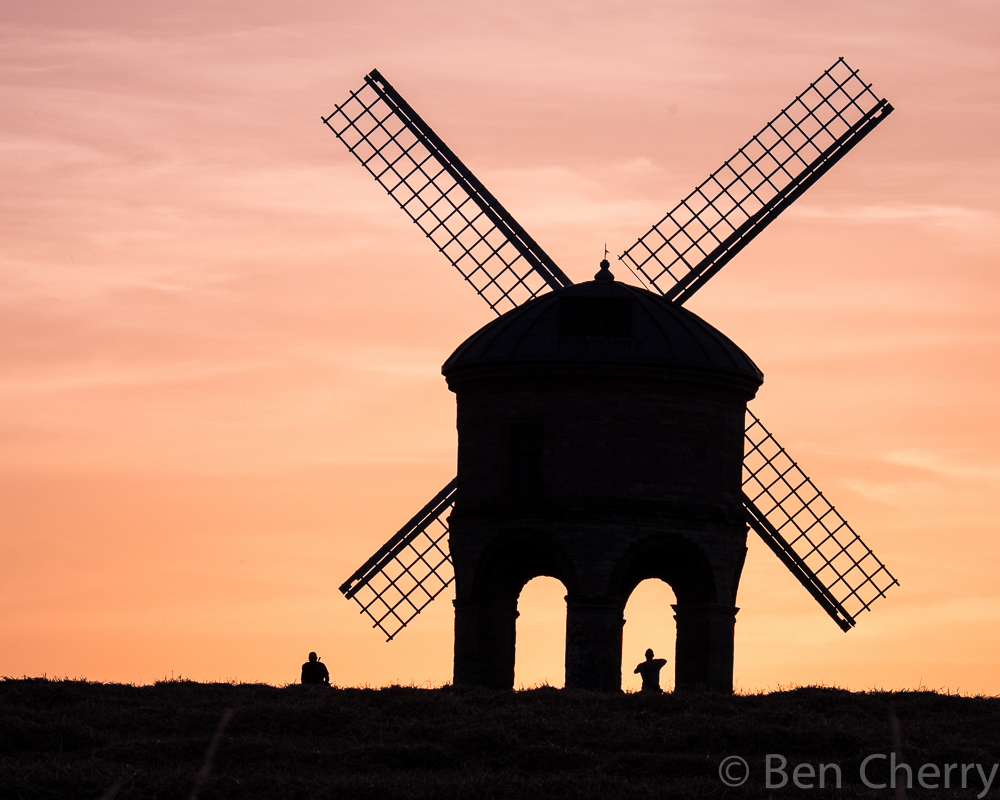
I found this feature particularly helpful when taking silhouettes, such as the images of Chesterton windmill in the gallery below.
EVFs are also very helpful with non-Fujifilm lenses or using Fujifilm lenses in manual mode as they can accurately show when the focus is correct. Even with the X100s and X-Pro1, which have hybrid viewfinders, I use them almost exclusively in EVF mode instead of OVF mode because, for me, it offers more benefits.
I start to get nervous about two weeks before I shoot a wedding. It’s around this time that I start taking an unhealthy interest in the weather forecast, start worrying about whether I’m going to get enough time to shoot everything and start limiting the use of my camera because I’ve convinced myself it only has a few more shots left in it before the shutter combusts. This all happens because I don’t shoot weddings very often, I’m what fellow photographers would call a ‘Weekend Warrior’ and what pros lovingly refer to as ‘a pain in the arse’. I shoot weddings for friends and acquaintances and don’t charge much; I see it more as part job, part wedding present. You may be the same.
18-55mm @55mm, 1/60sec at f/4, ISO 800
My most recent part job/part wedding present represented two firsts for me. It was the first same-sex marriage I’d photographed (congratulations Gemma and Fiona!) and it was also the first time I’d added an X-E2 to my camera line-up. I’ll be honest from the outset and admit that the X-E2 wasn’t my primary shooter. Although I’m well versed in its capabilities, having previously blogged about using the same camera on a trip to Rome, I still don’t feel I know it well enough to use it as Camera 1. Instead, I’d earmarked it – along with the 18-55mm, 60mm and 55-200mm XF lenses – for specific tasks throughout the day, plus it would also double as a more than capable backup option should Camera 1, as prophesied, burst into flames during the nuptials.
Of all the things to have sleepless nights about before a wedding, camera gear shouldn’t be one of them. My search continues for methods of controlling the weather and bending time, but I prepared the night before safe in the knowledge that my camera gear was ready; firmwares updated, batteries charged, lenses polished, straps attached.
60mm, 1/60sec at f/4, ISO 400
55-200mm @90mm, 1/2400sec at f/3.9, ISO 200
55-200mm @64mm, 1/680sec at f/3.6, ISO 200
The X-E2 was the first camera out of the bag the following morning when I arrived early at the reception venue to shoot details on the tables. It quickly established itself to be a reliable focuser and exposer, while the image previews looked sharp and full of colour. As planned, it then came out on a number of other occasions throughout the day. Its near-silent operation and more discreet appearance enabled me to wander around and capture a whole host of shots that, had I attempted to shoot with Camera 1, would inevitably have resulted in wedding guests standing bolt upright while affecting cheesy grins. Not so the X-E2 which, with the 55-200mm attached, is the perfect combination for candids.
Its hushed credentials also proved their worth during the speeches at the reception. After selecting the Silent mode I was able to capture a wide variety of images, without causing the assembled guests to turn around every time I pressed the shutter. In short, the X-E2 and I got on famously during the day, even though it did show a larger than expected appetite for battery power.
18-55mm @55mm, 1/60sec at f/3.5, ISO 250
The bigger news was to come in post-production. I’d shot nearly 1500 images, so editing in Lightroom was a lengthy affair, especially when you consider everything was captured in Raw. But while general tidying up of images is to be expected, I found myself spending far less time on the X-E2’s files. They were supremely sharp straight out of camera, wonderfully vibrant and showed impressive quality at high ISOs. The speeches, for example, were shots at ISO 3200 and 6400 because of the low light levels at the reception, yet noise was well under control – far better, in fact, than Camera 1.
55-200mm @156mm, 1/90sec at f/4.5, ISO 3200
So what did I learn? Well, I’d certainly pack the X-E2 if I was shooting a wedding again – it’s agile, easy to use and cuts down post-production time, all of which are huge positives. Its retro charms didn’t go unnoticed by guests at the wedding, either. As I mingled at the reception, a DSLR-toting attendee came over and asked about the X-E2. ‘Is it a Leica?,’ he asked. I explained what it was, showed him some shots I’d taken and invited him to have a try. He took a couple of shots and handed it back, gave it the one over and said, quite simply: ‘Lovely’.
We recently held a small internal training course for the Fujifilm UK team and we asked professional photographer Paul Sanders to join us and help teach us more about landscape photography. After spending some time with Paul and listening to him talking about his work and his thought process in regards to photography, it became apparent that Paul had a very interesting story that I’d love to share.
Below is Paul’s story from being a trainee photographer in 1991, up to his current passion, hobby and luckily for him, profession – Fine Art Landscape Photography. If you have any thoughts or questions for Paul, please feel free to leave a comment at the bottom of this blog.
Fine Art Landscape Photographer Paul Sanders
“I’ve been involved in news photography since 1991 when I started as a trainee photographer at The Daventry Express in Northamptonshire. I’m incredibly driven and knew straightaway that I wouldn’t settle for life on a weekly newspaper, I wanted the big time, the only place I could see myself working was for a national newspaper and one in particular; The Times. I think essentially it was because The Times is in my opinion the best newspaper in the world for it’s reporting and accuracy. I got my head down, worked hard sacrificed everything, relationships, family, friends and social life all in the single minded pursuit of my dream job.
X-T1 with XF10-24 @10 – F8 – 120 Seconds – ISO200
“By 1998 I was working for the international wire agency Reuters in London and in 2002 I got the call from The Times to join their team. When The Times changed from broadsheet to the more modern compact format I was given the job of revitalising the way pictures were used in the new format. Finally on 1 April 2004 I was made Picture Editor, I had total responsibility of the entire visual content and a team of the finest researchers and photographers working with me. To say I was in my element was an understatement. However success at that level comes with a high price. Daily I would view between 17 and 20 thousand images, direct photographers, manage budgets, layout pages and train young hopefuls. By 2010 I had reached breaking point, I suffered with chronic insomnia and depression, my marriage started to break down and the wheels came off my train. I hid this all from the world until December 2011 when I announced that I was leaving the job I had pursued for years.
“When you have a breakdown your body and mind are telling you to change a few things, I needed to slow down, take stock and recover. My recovery began with shooting large format landscapes. I’d wander the country 5×4 camera and tripod over my shoulder trying to be Ansel Adams or Joe Cornish and failing miserably. The process of shooting film again slowed me down, enabling me to organise my mind a little and start to get in touch with the joy of photography. In many respects my early foray into landscape work was such a failure because I wasn’t being true to myself – I wasn’t connecting with my subject at all.
X-Pro1 with XF14mm – F16 – 140 Seconds – ISO200
“During 2013 I had an epiphany in seeing, I realised that actually it was ok to shoot the images I wanted, not the classic views, but using my emotional and spiritual connections with the landscape to create images that resonated with my soul. I had switched from 5×4 to DSLR during 2012, to save weight and money. Still I was finding it hard to work, I would always think can I be bothered, many times I would lug my equipment to a location and not bother getting it out of the bag; it was too much hassle. I wasn’t enjoying my work at all.
“However what I had realised was that to truly see what I wanted, the sitting, watching and listening had really opened my eyes and my heart to the images I wanted to create. What I needed was a camera that didn’t get in that way of my connection or creativity.
X-Pro1 with XF14mm – F22 – 1/2 sec – ISO 200
“In early 2014 I handled the Fuji X-T1 for the first time and instantly fell in love, I actually had goose bumps on my skin, such was my connection with this camera. It was a bit like the moment Harry Potter picked up his wand for the first time!
“As soon as they came to market I bought two, a variety of lenses, and swapped out much of my DSLR equipment totally committed to these tiny miracle workers.
XT-1 with XF55-200 @ 100mm – F4.5 – 1 second – ISO320
“My energy and creativity were revitalised, the camera wasn’t in the way, it was literally a plug in to my imagination allowing me to record what I wanted in the way I wanted without the weight or cumbersome nature of my previous equipment. I pushed myself out of my comfort zone and shot the images I had been feeling. I stopped trying to be accepted by the majority and concentrated on being true to myself. If no one likes my work really it doesn’t matter to me at all. If people do and I sell a few pictures then that’s a bonus.
“I still sit for hours watching and feeling the landscape in front of me, but now I feel that I am truly connected with my work through the little Fuji. The X-T1 isn’t a barrier like my Canon, it’s a conduit. They are virtually invisible to me, instinctively my hands fall in all the right places, there’s a wonderful simplicity to them which helps me as I’m quite simple in many ways too. The less complex the process of making pictures the less I have to be concerned with. I have no desire to pixel peep or get bogged down in the technical arguments about shadow detail or sharpness, I just want to create images that please me.
X-T1 with XF55-200 – F16 – 180 Seconds – ISO200
“The work I shoot now totally reflects how I feel about the world and myself, I can pour my soul into those little black bodies and know that they are keeping it safe for me.”
Just to make it clear, I am not an underwater photographer. I have dabbled in it from time to time in locations of incredible marine life, such as snorkelling around coral reefs. The North Sea has a high abundance of marine life and the coast of Penzance is one of two places that you can consistently see blue sharks (the other is Cape Town). So when Danny Copeland, a fellow University of Sheffield Zoology graduate, spoke about his plan to go and see them with Charles Hood, a local charter skipper (http://charleshood.com), I jumped at the chance to join him.
Previously I have used DSLRs for underwater photography in a Ewa-Marine underwater housing. This time though I wanted to continue to push the X-T1 in difficult conditions so I put it in the same housing with the 10-24mm. Despite being dwarfed by the bag, the set up worked really well.
Thanks to Danny Copeland for this photo of me and the camera. Follow Danny on twitter to get the latest on underwater photography and marine conservation.
Once we reached 10 miles out to sea we started chumming using mackerel heads (yum) to attract the sharks. Once they were in the area the four of us that went on the trip were able to slip into the water. Once I had checked the housing was sealed I swam around to find some subjects and came across this large jellyfish surrounded by lots of little fish. This example highlights the benefit of using a zoom lens underwater as I was able to get two very different perspectives using different focal lengths.
24mm
10mm
Conditions were generally slightly overcast which actually meant there was a lovely soft light, which helped control the highlights that would have been a problem if it was a clear, sunny day. However this did mean that it was slightly dark in the water, even at the surface, so I shot at ISO 1600 to start and pushed this as the sediment levels rose throughout the day. Other settings I made sure I had set up on the boat were: continuous focus with focus priority, continuous high speed shooting (8fps), matrix metering and LCD only display. Generally I was using aperture f5.6 to strike a balance between a fast shutter speed and a good depth of field.
Because I was wearing a mask and the camera was in a housing I couldn’t utilise the wonderful EVF but instead found the LCD screen to be a great alternative. It allowed me to have a clear view of the shark(s) by not having my face to the camera and provided easy viewing of composition through the back of the camera. The advantage of the X-T1 is that I have not noticed any difference in focusing speeds between the EVF and LCD, which isn’t always the case. All of these factors meant that I could really take in this remarkable experience as one shark in particular became more and more inquisitive…
Rising out of the depth
Coming in for a closer look
Closer…
Moments before bumping the lens!
The camera only helped to make the experience more memorable, with the shark showing interest in it. With an animal like this it was so interesting to witness its intelligence and curiosity, the term ‘spaniels of the sea’ I feel is very apt. At one stage the shark photo-bombed a picture of Danny!
Shark photo-bomb
Despite coming very close, it whole situation was very calm and meant that the interaction was an absolute joy. The shark even seemed to show a happy expression.
Playful shark
Overall, the X-T1 and 10-24mm set up exceeded my expectations. I knew it would follow subjects well but I thought that shooting through water would probably lower the hit rate. However, the only factor that affected this was human error. With a specifically designed underwater housing, this camera and lens set up would be a brilliant choice for any underwater photographer, with its small size, clear controls and superb image quality.
Good day everyone, I will have to call this a mini-blog as normally I ramble on for ages and bombard you with images – who knows, maybe I still will 😉
As you may or may not know I’m an amateur photographer who loves to try out new types of photography – I’m sure this is not to different from many of you out there. When I first started out with photography I was educated that the more zoom you had the better. So when I was given the X100 for the first time I was quite baffled as to how to work a fixed prime lens. I felt restricted and puzzled as to why I would want one. Of course once I looked at the pictures from it, I was sold and this opened my eyes to the real aspects of what makes a great camera. The images were crisp, clear and full of vibrant colour, all I had to get used to was zooming without a telephoto lens – AKA the Hokey Cokey. Once I got this down though, there was no stopping me, I was out with my original X-E1 and 35mm prime lens and I loved every minute of it!
This leads me to the XF18-135mm. This time I had the promise of excellent image quality but with that lovely versatility of a zoom lens. When I first clicked it into position on the camera body and fired up the camera I was taken back by just how much I could see or not see depending on the focal length. It was something that took me back to the olde days of me using a camera, I was VERY excited to get out and use this new kit.
I decided upon a location in the local area that always seems to make a good picture, this being the Stevington Windmill. I looked at when the sun was going to set and got there about 50 minutes earlier to allow time for running across fields, fumbling with tripods and such like. Once I got a good position near to the windmill I shot this image.
Focal Length: 49mm – f/5.6 – ISO200
I shot this image at the slightly wider-side of the lens to open up the landscape a bit – this to me gives a very peaceful feel to the shot. Compositionally (is that really a word?) I have dedicated two thirds of the frame to the sky as it is a sunset after all, and I think this really helps the landscape silhouette ‘POP-OUT’ from the skyline.
This next shot I really wanted to focus on the windmill and give a more intense feel. To do this I have used the lens at a longer focal length as this has a very clever effect on the composition. The more you zoom towards a subject, the more the background and foreground are compressed together. So this in turn pulls the Sun closer to the windmill and vice-versa. Not only that, but it also reduces the angle of view – cutting out all the peripheral stuff we perhaps don’t want in our shot.
As a side note – To get the composition I wanted using more zoom, I did have to move further back to accommodate the extra focal length. Basically this means I had to run like crazy across a field and keep checking to see if the composition was right as every moment I wasted meant the sun was getting lower and would soon disappear behind the hillside.
Focal Length: 98.6mm – f/7.1 – ISO200
These next two shots show this compression effect quite well I feel. It really brings the background closer to the foreground making for a more intense composition that would not have been possible with my 35mm prime lens.
And in case you were wondering, this is my better-half with her camera at her side relaxing whilst I’m running about like a madman saying things like “That’s great, just don’t move. Pretend I’m not here..” which was all great fun. Photography should be fun and if you can get your friends and family involved, so much the better.
Here’s a playful shot of some hot air balloons in the distance. I framed it up so that they sat on the furthest third of the frame to sweep your eyes across the beauty of the landscape. Because of the compression effect (pulling the background and foreground together) I could give the hot air balloons a bit more presence in the shot, especially when you consider the real distance between the main tree and the hot air balloons.
I really hope this inspires you to go out and have a play with your camera, shoot a sunset, bring a friend, mix up your compositions and most of all have fun. When you do all that great pictures will naturally follow.
P.S: Seems I managed to get a good ramble and bombardment of images in after all 😉
Follow Dale as he takes a journey round Devon’s beautiful Croyde Bay & Lundy Island.
As you may or may not know the XF35mm is my ‘everyday’ lens but when it comes to landscape photography the XF10-24mm is my next ‘must-have’ lens. I used to use the XF14mm lens – which by the way is superb, but I’ve realised that I just cannot get enough of that ultra-wide 10mm setting.
I have only been delving into the landscape photography world of late and am still very much finding my feet. When looking back through my landscapes I have noticed that I clearly love the slightly stranger viewpoints, mainly from a wide-angle, ground-up perspective. It may be that the world is just more interesting down there!?
I like trying to ‘add a little epic’ to my landscapes. The way I have found myself doing this is to locate a small object, whether it be a footprint, a rock etc and get it right up close to the lens. This distorts its perspective and makes it a real important part to the composition. It’s very easy to miss the small details in a beautiful view, so doing this can really shake-up the images and give a new feel to your photography.
We’ve always been told practice makes perfect right? Well, I don’t know if it makes ‘perfect’ but it certainly helps with repetition. I find that the more I shoot, the more I know how a shot is going to turn out before I’ve even turned the camera on. It can give great insight as to whether I should get set up for a shot or move on to a new area / viewpoint.
XF35mm – ISO200 – f/4 – 1/2900 – Lundy Island – Had to sneak my XF35mm lens into this blog somewhere! 😉
In an effort to create better landscape images I have been using the Rule of Thirds more and more consciously. Across the board this has rewarded me with more “That’s a keeper!” shots.
In addition to this, I’ve been thinking more carefully about where to ‘put’ the horizon line. I usually just ponder which is more interesting – the sky or the foreground? If the sky is more interesting it takes up two thirds of the image and vice versa. I thought the scene below had a more interesting foreground to shoot, so the foreground takes prominence.
On the opposite side of things, I found this sky (below) to be more dramatic and I loved how the church had an on-the-edge-of-the-world feel to it. So, I gave the sky two thirds of the frame and the church the lesser attention to increase this on-the-edge-of-the-world theme. I post-processed this one to give it a more matte-like / painted finish.
XF35mm – ISO200 – f/11 – 1/420 – Lundy Island
The XF10-24mm isn’t just for landscape either, it worked perfectly inside the Lundy Island lighthouse to capture the whole winding staircase – which on a different note, was very steep!
The next few images are some of the best I could get while shooting in the ‘golden hour‘. It’s not an area I have had great amounts of experience with, but, I wanted to share a few tips that could save you some stress as I found out the hard way.
Firstly, give yourself lots of time to get to the location you are going to shoot. Set up and relax way before the sun has started setting. Otherwise, you may find yourself fumbling with ND grad filters and tripods like I was.
I always thought a sunset was a peaceful, enjoyable thing, but when you are trying to shoot it the sun seems to set faster than you can say Usain Bolt!
The second piece of advice is to know where the sun is going to set. One night I literally found myself running across a beach. I had the camera attached to a tripod while dangerously navigating slippery rocks pools and small sand holes that the kids had dug during the day! I must say though it was some of the most exciting photography I have done in a long time.
On the bright side, the running down the beach to capture the sunset actually made a picture in itself. Again, emphasising the foreground subject by getting on my hands and knees to put the lens right up close.
I hope you have enjoyed taking my very short tour of some truly photogenic places. Here are some other shots I captured from the trip away that you may like. Any questions, feel free to leave a comment below.


 “I’ve been involved in news photography since 1991 when I started as a trainee photographer at The Daventry Express in Northamptonshire. I’m incredibly driven and knew straightaway that I wouldn’t settle for life on a weekly newspaper, I wanted the big time, the only place I could see myself working was for a national newspaper and one in particular; The Times. I think essentially it was because The Times is in my opinion the best newspaper in the world for it’s reporting and accuracy. I got my head down, worked hard sacrificed everything, relationships, family, friends and social life all in the single minded pursuit of my dream job.


 As you may or may not know I’m an amateur photographer who loves to try out new types of photography – I’m sure this is not to different from many of you out there. When I first started out with photography I was educated that the more zoom you had the better. So when I was given the X100 for the first time I was quite baffled as to how to work a fixed prime lens. I felt restricted and puzzled as to why I would want one. Of course once I looked at the pictures from it, I was sold and this opened my eyes to the real aspects of what makes a great camera. The images were crisp, clear and full of vibrant colour, all I had to get used to was zooming without a telephoto lens – AKA the Hokey Cokey. Once I got this down though, there was no stopping me, I was out with my original X-E1 and 35mm prime lens and I loved every minute of it!


