Be Inspired

A collection of inspirational blog posts that will give you some great new ideas and cause you to pick up your camera and go out shooting

Adventures in Nepal and the Unintentional Beginning of a Long-Term Project

Guest blogger

By U.S. Photographer Rebecca Gaal

Day 1: Hey! You remember as a child when your parents explicitly told you not to pet stray dogs? All the CDC warning about rabies? If your first reaction after breaking these basic rules is to sacrifice your trigger finger over your X-T1… there might be a greater issue then the inability to follow directions. The X-T1 was my camera of choice because I needed something as reliable as Imodium, yet flexible enough to condone creativity – all while still resembling the look of film. I mean, come on! When you’re worried about the possibilities of your body failing, health, or basic safety, you don’t have time to second-guess about gear.DSCF9419I’ll spare you the details about the sobering reality of needing to trade my personal snacks for battery space. If you’ve ever encountered the luggage scale of doom in an airport, then you understand the seriousness of airline weight restrictions. Now, imagine restrictions for a 4 or 6 seater plane and the tired muscles of the sweet mules that will inevitably carry the still-too-heavy load.IMG_0245Let me back up a second. Journaling is my way of processing overwhelming amounts of information. Figuring out what works and what does not work, and why. Last September I was lucky enough to join an incredible group of individuals from around the globe to set off on a month-long expedition in the lesser-known mountains of Dolpo, Nepal. The group, called the Nomads Clinic, was created by Joan Halifax and serves some of heartiest, most salt-of-the-earth humans who live in some of the most remote places in the world and are in need of medical aid. There was no set storyline or plan for photographs except to document the journey. It can be challenging to narrow down your focus when everything and everyone is interesting. It’s also tricky to think at high altitude (10-18,000ft) so doing a solid amount of planning and research ahead of time is an integral part of my process. There is a lot to be said about visiting a place and meeting the people before deciding what your story is truly about.

Just as an illustrator uses multiple pens or a chef has his favorite knives, cameras bodies and lenses are no different. Prior to this endeavor I made a list of criteria my gear must meet in order to have the best chance of success. The gear would need to be: lightweight, quiet, have a high ISO range, be durable and weather resistant, have external controls easy to change and most importantly all of these functions needed to come in something small and compact. The camera is a tool, a tool to think with, understand with, initiate conversation with, but it works against you if it’s intimidating or hinders maneuverability. The rotating LCD was also pivotal. Really. Just as the ability to shoot from the hip without it looking like your hip took the shot- fantastic! The X-T1 not only met my basic criteria, but also went beyond and far exceeded expectations.

Gear List

  • 2 Fujifilm X-T1 Mirrorless Bodies
  • 1 Fujifilm XF10-24mmF4 R OIS WR Lens
  • 1 Fujifilm XF18-55mmF2.8-4 R LM OIS Lens
  • 1 Fujifilm XF50-140mmF2.8 R LM OIS WR Lens
  • 12x Extra Batteries for X-T1
  • 1 X-T1 Vertical Battery Grip
  • 1 GoPro4, 8 batteries for GoPro
  • Started with 10, 34GB SD cards and bought more out of anxiety at every airport
  • Gorilla pod
  • iPhone6
  • Lens Cleaners
  • Two battery chargers with extra cords for both Fujifilm and GoPro.
  • Goal Zero Sherpa 100 solar charger w AC converter
  • Circular Polarizers and UV haze filters
  • Peak design backpack clip
  • LowPro pouches
  • 1 XS pelican case

Things Left at Hotel

  • 2 G tech portable HD’s
  • Card reader
  • MacBook pro

DSCF5942Day 17: The clinic is roaring! Mothers carrying infants and men of all ages waiting to be treated. Waiting to be seen. Be heard. Their bodies aged by years of physical labor, scorched, wind-whipped faces with lines as sharp and jagged as the mountains they live in. A baby calf is wailing for it’s mother, the air is starting to smell like rain and dark clouds make the dust start to churn. I tell you this to paint a picture, one that requires all of your senses and mental faculties to pay attention to the life, the art that is happening before your eyes and not a giant pelican case full of electronics.

Day 18: Dolpo, like many other places people explore with cameras is a microcosm of issues and stories waiting to be told. There’s not only climate change but people change. Change in cultural practices, identity, wants and needs. Not everyone believes in climate change and that’s okay; maybe the climate isn’t changing, maybe it’s purely evolving as it has been shifting and morphing for centuries, since the beginning of time. This land is akin to the first camera and now I’m standing in a home with no electricity, no running water or toilet but the father of the dwelling has a smartphone and the children a TV to watch. What allows technology to grow here but not food?Nomads Clinic Dolpo Nepal 2015Day 19: Development is moving faster then the land can handle. There is no fossil fuel, no waste disposal methods; the first signs of growth came in the form of a handful of motorbikes, cup o noodles, soft drinks, beer and a various assortment of cell phones. There are a few crude health clinics, rarely staffed and stocked with outdated medications. Migration is increasing and thus the population is growing. Traditional annual migrations are being challenged due to severe weather and lack of food. No food for humans, no food for animals. Animals cannot transport goods and become ill. People lose money. People live in close proximity with animals and animals eat trash left by humans. Humans eat the animals. Imported and exported goods are slowed or stopped. Imported foods are primarily packaged increasing waste. New illnesses like typhoid and chicken pox are being introduced because of changes in the climate and migration, which has increased: AIDS, Hepatitis and STD rates. Increased births demand more food and water then the land can yield. Water is not sanitary because that is where waste is thrown and animals bath.  Children suffer from blistering lesions caused by lack of hygiene and the spreading of endemic skin diseases. Water scarcity, deforestation, below average snowfall, rainfall, drought, and bad soil, the burning of dried dung, smoke inhalation. A strong alcohol is made locally from barley. Everyone drinks. Muscular skeletal pain is common from hard labor started at a young age and injury, alcohol decreases their pain. Women drink during birth to ease the pain. Women drink during pregnancy causing birth defects. Diets are high in oils and spices and rock salt from Tibet. Stomach issues are common and everyone is dehydrated or has gastritis, hypertension and goiters. They seldom care about their health until it hinders their ability to perform daily functions. Or if they care, is there anything that they can do about it? Anyone to help them? All of these thoughts dance in my head as I try to sleep. 5 am comes all too quickly though and I’m soon reminded of the immense beauty here. The moment you realize you’re finally hydrated can actually have unexpected photographic advantages.Nomads Clinic Dolpo Nepal 2015Day 20: After a number of intense yak run-ins, I was ready for a little down time. I felt the need to make sure I’d backed up all of my images. Just in case. My incredibly patient and understanding tent mate made the remark that at dusk when batteries are charging and cards are downloading our tent resembled that of a rocket launching station. The launch pad was rarely needed however. Not dust, nor rain, freezing temperatures or scalding heat could interfere with the life of my batteries. They traveled between thick socks, down jacket pockets and sleeping bags. Just as I need my morning coffee to wake up, they would occasionally need a few minutes as well. Then we were off!DSCF8011Day 21: There are people on your right and people on your left, donkeys behind and cliffs in front, you can’t move yet everyone is standing in place photographing, you get this funny sensation… is everyone shooting the same thing? Or, is my gear properly attached? Did I drop something into the dusty abyss? A Peak Design backpack clip was the perfect solution. The X-T1 with my heaviest lens was light enough to attach to my backpack strap without hindering my questionable balancing abilities. In a pinch it could hang from my neck, be carried by hand or clipped to my hip without the feeling of being instantly obese on those skinny cliffs.Nomads Clinic Dolpo Nepal 2015Before I knew it: I was on a flight back home furiously downloading cards on my computer, backing them up and backing them up a second time, praying they were all there, feeling for my rescue recovery disk in my backpack just in case. Feeling the swelling in my knee caps and how difficult to impossible it would be to ‘re-shoot’ anything and how the moments never exactly happen the same way twice anyway. Dreaming about how the life of my cards would have been so much better if I only had a second card slot. And BOOM, the X-Pro 2 specs! DSCF8666Back at home: When a project starts to take on a life of it’s own… You’re driving to the market, driving to yoga, driving to work, sitting at the doctor’s office, sitting in bed, laying down in savashsna, and you can’t stop thinking about the place, the people, the culture, their needs, their dreams, and you’re mentally exploring various angles that would have better served your subject visually, how to show others everything you felt, everything you heard, how to more eloquently express the issues, tell the stories of the humans behind the faces, the smells of spices cooking. If I did this again would I change my gear setup? Telephoto? Prime? Zoom? One of each? Two of each? Same body? Different bodies? You get where I’m going with this. A project has begun. During the first two weeks I shot 2576 photos. I figure if I edit 5 or so a day you could potentially view them on my website in 2030. Right. Thank you Fujifilm for allowing this journey to begin.Nomads Clinic Dolpo Nepal 2015P.S. High performance mode makes a wonderful difference. Turn it on.
 

Help! I don’t know whether to buy and X100T or an X70.

By Kevin Mullins

KevinMullins-Headshot-200x200When I first received the Fujifilm X70 I looked at it and thought…….hmmmm.  Then I scratched my head and glanced sideways at my X100T which was looking back at me with suspicion and concern.

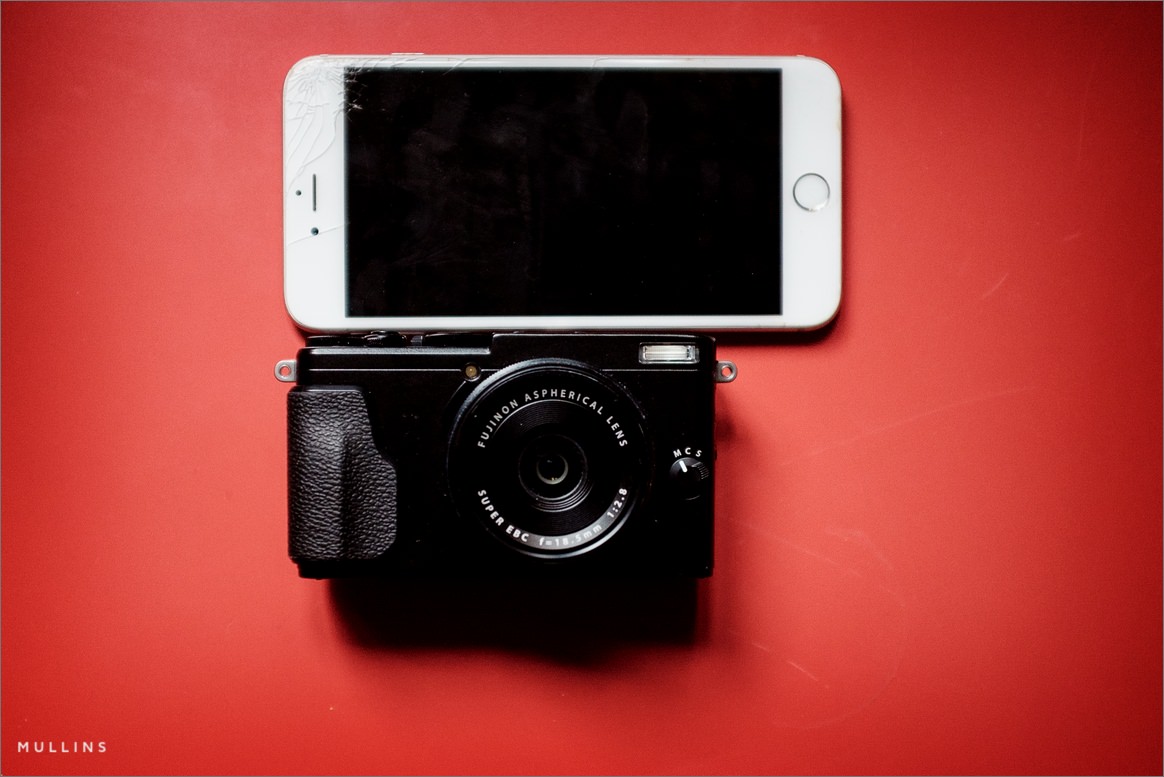
I have to admit that I also had suspicion and concern when I first picked up the X70.  It’s teeny.  In terms of length and width it’s almost a third smaller than my mobile phone.

My X100T, on the other hand, is larger.

So I challenged myself to see if size really does matter and, more importantly, does the X70 live up to its big brother X100T when it comes down to image making.

fuji-x70-review-1-2

Brief Differences and Similarities between the X70 and X100T

This isn’t a review of either camera but it makes sense for me to point out the fundamental differences, and similarities between the two cameras.

Both cameras share the same 16-megapixel APS-C X-Trans II sensor but that, possibly, is where the similarities end.

We already know about the size difference, but really the biggest differences are the interface to shooting and the lens and so I will concentrate on these during this post.


“Beat the fear of Street photography by allowing people to come to you, instead of you to them.
Then just… Click.
No pressure.


The Lenses

The X100T has an excellent 23mm F2.0 lens.  Way back when I was shooting DSLR, my preferred focal length was 35mm (full frame equivalent), and actually it still is.

I LOVE the lens on the X100T and this is one of the critical changes because if you also LOVE the lens on the X100T, you need to know that the lens on the X70 is different.

The lens on the X70 is a slower F2.8 but wider 18.5 mm focal length or 28mm (35mm equivalent).

So straight away, we can see that the X100T is going to be better at low light shooting, albeit marginally.

However, the size and weight of the X70 means we can shoot at slower shutter speeds to mitigate this to a certain extent (depending on the subject matter of course).

For me, I love that 35mm FF focal length and I’m getting used to the slightly wider view from the X70.

cheltenham-festival-2016-7

Taking Pictures

I instinctively lifted the X70 to my eye when I first got it out of the box.  Big mistake as there is no viewfinder in the camera (you can purchase an external viewfinder attachment that slots into the hotshoe).

For me, the reason I never really gelled with the Fujifilm X-M1 was because of the lack of viewfinder.  But then the X-M1 was bigger…..and didn’t have the X-Trans II Sensor.

I’ll give it a try I thought.

And you know what, I have learnt to really like the LCD shooting experience of the X70.  I’m not a hundred percent convinced I wouldn’t prefer a viewfinder as at least an option, but obviously one of the reasons this camera is so small is because of the removal of the viewfinder.

Instead of the traditional way of shooting, in the X70, you have a remarkably versatile tilting screen, which even tilts vertically above the camera to allow you to take “selfies”.

When shooting with the X100T I have to use the viewfinder, or shoot from the hip using a zone focus technique.

I can still use zone focusing with the X70 of course, but the benefit of the flip down screen is plain to see.  Additionally, the X70 implements some neat touch screen features where you can use your finger to very quickly touch, focus & shoot.

That’s a great advantage when out on the street shooting.


“I adore elderly people holding hands and I strive to look for pictures like that.
Pretty much, I just want to be like that with my wife when I’m elderly too.”


Which camera would I use?

This is the question I’ve been asking myself a lot.  When would I use one over the other?  And I actually sat down and came up with a list of scenarios where I would use either the X100T or the X70.

In really low light I’m going to need the X100T.  I don’t use flash, and I find that I use the Optical Viewfinder on the X100T a lot when shooting in low light.

For that reason, and also because of the build and form factor, the X100T will remain one of my primary cameras as a wedding photographer.

However, the X70 really comes into its own when I pick up a camera to go and shoot street photography.

In fact, for me, its superseded all other cameras in the range when it comes to shooting on the street.

I like to get in close and I like to observe and prepare to shoot.  Unless I need to use different lenses (for example, I may use a MF lens on the X-Pro2 or X-T10 for rapid zone focusing and shooting), the X70 is an ideal camera for shooting on the street.

The fact that you don’t even have to press the shutter button is a marvellous thing in itself and lends the camera perfectly to candid street shooting.

The X70 isn’t going to replace my X100T, but at the same time, my X100T will be a lot less active for my personal and street photography work.


“These images below were shot using Auto Focus, at F2.8 without the flip screen down.
Simply pointing and shooting from the hip.
One handed (as the other was occupied with Guinness at the time).”


To see more of Kevin’s inspirational images, click here.


Motorsport Photographer Jeff Carter has his say about the NEW X-T2

jeff carterAbout Jeff Carter

Jeff Carter founded MacLean Photographic after leaving the Royal Air Force in 1996.  The company name is from Jeff Carter’s full name – Jeffrey Stuart MacLean Carter.

With over 20 years’ experience in several fields, including sport, landscape, wildlife and travel, Jeff is based in Dunbar, near Edinburgh in Scotland. However he travels the world with his work in the motorsport and automotive industry and is constantly on the lookout for that next great image to capture.

As well as providing photographic services to editorial and commercial clients, MacLean Photographic runs a number of Photographic Workshops and Tours for individual or small groups of photographers of all abilities in and around the South East of Scotland.

Landscape photography with the X-T2 in East Lothian

Belhaven Bay in East Lothian

Why did you choose Fujifilm?

A camera is the tool of my trade and the best tool is one that becomes an extension of my creativity, something that I can use without thinking about how to capture an image. I have used all different types of cameras over the last 20+ years but, for me, the three X Series cameras I use are like an extension of my eye and brain.

The first X Series camera I bought was an X100 black limited edition for a business trip to Shanghai. The X100 was like a mini version of the Fujifilm GA645 medium format camera that I had used in the early 1990s and the fixed focal length camera put a spark back into my photography, it was a joy to use. The ability to travel light and still get ‘the shot’ really opened up my mind to the possibilities of the compact system camera. This led to an X-Pro1 a year later, then the X-T1, an X-Pro2 in 2016 and now the X-T2, with a good selection of XF lenses to match.

The X-T2, X-Pro2, X-T1 and X100 I currently use, along with the range of quality XF lenses, are tools that allow me the freedom to be creative but they have also put the joy back into the image making process.


How have you found the new Fujifilm X-T2 camera?

This is the camera I have been waiting for ever since I moved from Nikon to Fujifilm in 2014.  Each step that Fujifilm has made in the past four years have culminated into this camera.  It is like an extension of my arm and eye when working trackside or in the pitlane.  The X-Pro2 is a great camera and pointed the way to the next step. And the X-T2 doesn’t disappoint.

On track battles during the TCR International Series at Spa-Francorchamps

I can follow focus a car moving at 200mph and I can follow focus a bird in flight.  I can also switch focus from one subject to another quickly and seamlessly.  The Electronic View Finder is beautiful, a joy to use, and doesn’t black out when shooting long bursts.  The 11 frames per seconds on boost mode adds to the flexibility of the camera, as does the ability to shoot 4K video.

The 24MP sensor produces the same stunning image quality as the X-Pro2 and 6000 x 4000 pixel images gives greater flexibility to crop the image in post production.  The film simulations are to the same high standard as always with Fujifilm and gives me the option to take the images straight off the camera if speed is of the essence, which in sports photography is usually the case.

The quality of the images when shooting at high ISO settings is really outstanding and I have no hesitation in pushing the dial to 6400 or even 12800 when needed.

The ergonomics of the X-T2 have taken the best that the X-T1 had to offer and improved the overall operation of the camera.  The new dials and locking mechanism are really good to use and the joystick on the back of the camera also speeds up the operation in the field.  Finally the new tilting screen which means I can shoot in a landscape or portrait format from down low or above my head is a big plus point and something I was using all of the time at the 24 Hours of Le Mans.

The weather proofing got a thorough test at Le Mans too as it rained for most of the week leading up to the race and the X-T2 never missed a beat, which is more than I can say for the photographer!

For me this is the ultimate X Series camera!

Heavy Rain during qualifying for the 24 Hours of Le Mans caused the session to be stopped fo r20 minutes due to deep water on the circuit

What’s your most loved image taken on the X-T2 so far and can you tell us little bit about it?

Capturing the moment at a top international sporting event like the 24 Hours of Le Mans is hugely important for any photographer working in editorial photography, especially sport.  The new X-T2 allows me to react to a situation quickly and this was essential in capturing my favourite image so far.

The image is of the podium celebrations following the 24 Hours of Le Mans.  Porsche had a dramatic win in the final five minutes of the 24 hour race when the leading Toyota stopped on the final lap, allowing the Porsche to take the chequered flag.  The emotions on the podium were there for all to see.

The winning Porsche drivers Marc Lieb, Neel Jani and Romain Dumas were celebrating in true motorsport style and afterwards Romain Dumas was speaking to the circuit commentator on the podium after his second overall win at Le Mans.  While he was speaking he was ambushed by four of the other drivers and they tipped champagne all over his head.

I was able to react quickly and capture a whole sequence of images with the X-T2 and the XF50-140mm f2.8 + 2x converter.  This image sums up the relief and elation of winning the most famous motorsport event in the world and this is why this is my favourite image from my time with the X-T2 – so far!

Romain Dumas (FRA) celebrates winning the 2016 24 Hours of Le Mans for Porsche.

What lens do you think best pairs up with this camera for your shooting style?

For sport most people would probably think I would say the XF100-400mm f4.5/5.6 but for me, the best all round lens is the XF50-140mm f2.8.  This lens gives me the greatest flexibility and produces images that can match anything produced on the XF56mm f1.2 or XF90mm f2 (which I own and use as well).

Photographing the Gannets of Bass Rock in flight. A good test of the AF capabilities of the X-T2 and 50-140mm lens

The XF50-140mm f2.8 coupled to the X-T2 is a powerful combination, especially with the improvements made to the continuous Auto Focus function on the new camera.  The ability to follow focus a fast moving subject, such as a race car, or a randomly moving subject such as a Gannet diving into the sea for fish, is a huge plus point for my work.

Another advantage of the XF50-140mm is the ability to fit the 1.4x and 2x converters, meaning I have a focal range of 50mm to 280mm available to me in a relatively small package.


To see more of Jeff’s work please visit his website and social sites:

Website:             www.macleanphotographic.co.uk

Twitter:               @macleancomms

Facebook:          www.facebook.com/macleanphotographic

Flickr:                 www.flickr.com/macleancomms/

Instagram:         www.instagram.com/maclean_photo/

How a frying pan can help with your picture taking

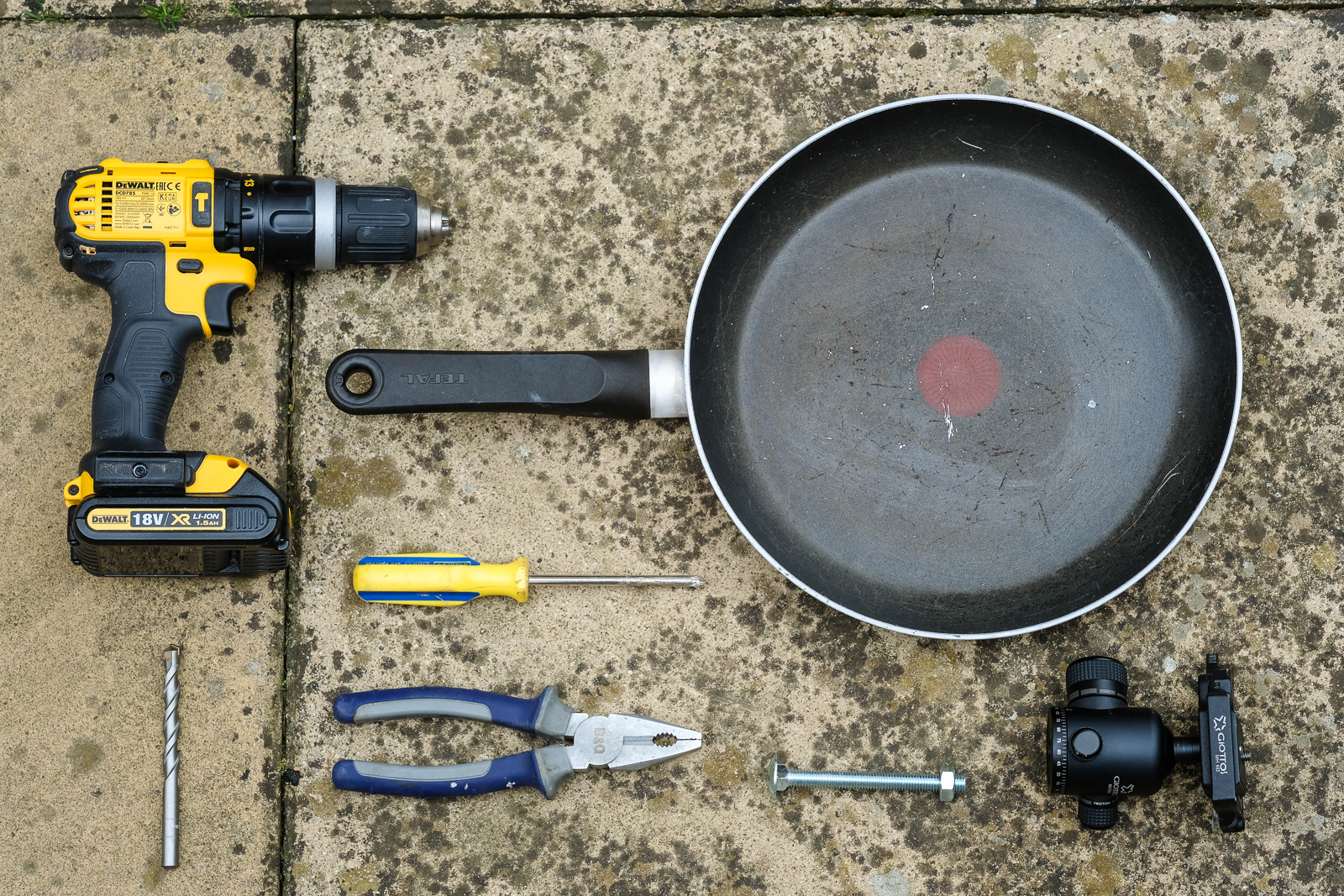
After my last blog encouraged you to make a tripod using a piece of string, I’m going to go a little more surreal this time by explaining how an old frying pan can be used to get dramatic low angle images. The standard route to getting a low viewpoint is either to lie on the floor, use a camera with a tilting screen or mount the camera on a tripod that can be dropped to ground level. The first two options can involve you getting wet and don’t work if you want to use a longer exposure as you’re hand-holding. The latter can be a real fiddle. My frying pan groundpod, however, overcomes all of those issues.


So here’s what you need. An old frying pan, a tripod ball & socket head, a nut & bolt and tools including a drill with a 10mm bit that is suitable for going through metal.

DSCF0004

First up, you need to check what size screw thread the ball & socket head has. The standard size is ⅜” but you can also get little inserts – as I have here – that converts the thread to a ¼”. In either case, these imperial sizes are not readily available in DIY stores as the world has gone metric, but they can be found online. You’ll need both nut and bolt.

DSCF0006

Raise the frying pan off the ground and drill a hole in the centre. It doesn’t have to be absolutely central. Take care if you’re drilling through a Teflon-coated non-stick frying pan like me and, as you’ll discover, this can take some time as frying pans are pretty tough. Once you’re through, tap any sharp edges of metal down with a hammer.

DSCF0014

Now take your tripod head, pass the bolt through the hole and screw it into the base of the head. If you have a long bolt like me, cut the excess length off with a hacksaw and then secure it all with the bolt. Your frying pan pod is now ready for action. Obviously, with a bolt in the base, this can’t be used on a solid surface, but it’s perfect for grass, soil, pebbles, mud and sand. I headed to the beach to try mine out.

DSCF0021

With an X-T10 attached to the tripod head and its LCD screen flipped out it was easy to frame up my shots exactly as I wanted them at the water’s edge. The sides of the frying pan kept both sand and sea away from the camera so I was able to try a variety of images.

DSCF0044

Here’s one of my favourites, I think the sail on the horizon makes it.

DSCF2677

Finally, just a couple of notes. While the groundpod can help you get some great low angle images, I can’t be held responsible for any funny looks you might get while using it – it does look as though you’re frying your camera! Also, if you are taking pictures at the sea be aware that cameras and saltwater are uneasy bedfellows.


img_main01


For more information on the Fujifilm X-T10 click here.


India – The Good, The Great and The Downright Scary – Part 2

This is a two part blog into the adventures of Tom Corban and his trip through North & Northwest India, if you missed the original post you can view it here. 


As the trip went on and the temperature increased, I appreciated not having a rucksack covering my back. I began to realise that I was missing something. It was really brought home to me when we went north into the Himalayas to do some mountain biking. We were cycling downhill on a narrow bumpy mud track with a steep cliff face going up on one side and a sheer drop of over 1 kilometre on the other and I realised that there is only so much weight you want bouncing around on you, irrespective of how you are carrying it. I started fantasizing about my X-E2 with its kit lens, but more about that later.

Spiti Valley, Himachal Pradesh, India. Jo finishing a 26 km cycle ride which started at 3940 m, descended to 3413 m, then climbed back to 3627 m. Quite an achievement at that altitude.

One of the nice things about this trip was that it was a holiday. There was no pressure and no deadline for any images. This gave me the chance to experiment with the Fuji kit without worrying about making any errors. It may sound unprofessional to some people but I have been so impressed by the Fuji Jpegs that I now rarely shoot RAW files. I had not really explored the various film settings and tended to use the Standard and Velvia settings almost exclusively. Having now experimented with the film settings, I am developing a soft spot for the Black and white with a yellow (or in some instances red) filter and I have found that in the right setting the Chrome can be stunning. I had an almost childish delight in finding out what the camera could do.

A man sits on blue steps outside his house in Jodhpur Old City, Rajasthan, India. Jodhpur is also known as the blue city because of the large number of houses and walls painted blue which, according to the locals, repels termites which are a problem in the area.

We had decided to limit our travel to the north and north west of the country, travelling by train, bus and in the more remote areas, camel and 4 wheel drive. I was interested to see how the Fuji kit stood up to the rigour of travel and how it performed in some challenging environments. I was aware that my photography had already changed as a result of using Fuji cameras but it became much more noticeable on this trip. I made fewer images and I have become, on the whole, slower.  This is not a bad thing as I find that I am getting the results I want with the Jpegs straight out of the camera.

Delhi, India. India Gate at sunset, The 42 m high archway stands in the center of New Delhi and commemorates the 70,000 Indian soldiers who lost their lives fighting for the British Army during World War 1. It also bears the names of British and Indian soldiers killed in the Afghan war of 1919. The structure sits in a large expanse of green lawns which are popular for picnics and cricket on summer evenings.

Slower behind the camera and then less time in front of the computer suits me well. I have also found that I have fewer “technical” rejects. I find that the focusing on the X-T1 is not as fast as the Canon 5D mk 3 so in some circumstances I have more out of focus shots than I would expect. However, for me this is more than made up for by the fact that I have far fewer unsharp photographs caused by camera shake in low light settings because of the wider aperture of the Fuji lenses, the lack of a mirror and the vibration it causes and the ease of holding the camera steady.

Phul Mahal (The Palace of Flowers) in the Mehrangarh Fort,Jodhpur, India. Built in the mid 18th centuryit was probably used as a private audience hall. A stunning room but with with very little light showing what the X-T1 can do in difficult lighting conditions.

Perhaps if I were doing a lot of fast action work I would be more tempted to use the full frame camera but as things stand the Fuji suits me fine.

In low light settings such as religious services in Varanasi, the Fuji kit showed its strengths. Wonderfully sharp lenses and a camera that I could hold in my hands at slow shutter speeds.

Sunrise on the Ganges at Varanasi, Uttar Pradesh, India. Garlands of flowers and candles given as offerings float on the river as the sun rises.

The weather sealing stood up well in some difficult situations with temperatures of over 50 C in the desert and below freezing in the Himalayas, as well as rain, sand and huge amounts of fine powder dye during the Holi celebrations in Jaipur. There was a little wear on the camera body and the rubber cover that protects the HDMI, remote release and USB sockets has become a little misshapen with the heat but it’s a solid body built to last.

A man bathes in the river Ganges at Varanasi, Uttar Pradesh, India. Hindu's consider the Ganges to be the most sacred river in India and thousands visit the Holy city of Varanasi to cleans their sins in the spiritually purifying water. Environmentalists are concerned about the high levels of pollution in the river caused by the increase in population and the resultant increase in pollutants discharged into the river.
A man bathes in the river Ganges at Varanasi, Uttar Pradesh, India. Hindu’s consider the Ganges to be the most sacred river in India and thousands visit the Holy city of Varanasi to cleans their sins in the spiritually purifying water. Environmentalists are concerned about the high levels of pollution in the river caused by the increase in population and the resultant increase in pollutants discharged into the river.

Did I make the right decision to take the Fuji Kit with me on this trip?

Absolutely. It’s a joy to use. The full kit fitted into a small waist bag with the lens hoods still on the lenses, I had no difficulty keeping the sensor clean, the Jpegs were wonderful straight out of the camera and the film simulations are good (I mean really good). I can also hold it in my hands at low shutter speeds, the lenses are sharp and I had no trouble with chromatic aberrations.

With a kit that performed like that, what more could I possibly want?

Well my X-E2 with its kit lens really.

I said earlier that we had been lucky on this trip. Whilst that’s true, we did have some difficult times. We had a bag with my Fuji X-E2 and Jo’s phone in it stolen on a sleeper train from Varanasi to Agra. I had taken my X-E2 on a various trips around Europe during the past couple of years and was really fond of it. It was the sort of camera and lens combination that you could carry unobtrusively and I loved wandering around new cities with it. Heat, rain, fog – just tuck it under your jacket. As our India trip went on, I found myself wanting it as a second camera.  I know that this sounds a bit excessive but the option of occasionally leaving the full kit in the hotel and just spending some time wandering around with a smaller, lighter camera and the kit lens was very appealing and certainly would have been useful when we were cycling.

It had never been an option before as there was never anywhere secure that was large enough to lock up my full frame camera and lenses and, as a result, I would carry everything with me all the time. You do get used to it but it’s an ongoing nuisance and wonderfully liberating when you get home and don’t have to carry a heavy bag everywhere. To my delight, I found that the small safes that hotels all over the world use was large enough to fit all my Fuji kit in and still leave room for a backup hard drive and a few other odds and ends.

It’s a real game changer as it gives me the option of going out with the full kit or just the X-E2. Well it would give me that option if someone had not stolen the X-E2!  I will clearly have to replace it. Mind you I have not seen the X Pro2 yet but it certainly looks good on paper and the reviews are encouraging. Now, back in England, I find myself wondering if the X Pro2 will be the camera that finally makes me sell my Canon kit and move to Fuji completely.

Shimla, Himachal Pradesh, India. Young women in traditional dress during Himachal Day. Himachal Day celebrates the creation of the State of Himachal Pradesh after independence in 1948. Hima means snow in Sanskrit and Himachal literally means "The land of snow"
Shimla, Himachal Pradesh, India. Young women in traditional dress during Himachal Day. Himachal Day celebrates the creation of the State of Himachal Pradesh after independence in 1948. Hima means snow in Sanskrit and Himachal literally means “The land of snow”

And if you’d like to read more from Tom check out:  To Glastonbury and beyond featured here at fujifilm-blog.com.

See more of Tom’s work at http://www.tomcorban.co.uk/

Let me tell you a ‘Toy’ Story

X-Photographer strip BLACK

chrisupton-168pxBy Chris Upton

I think it’s fair to say that we are all guilty of not using all of the features on our cameras. We prefer to stick to what we know or what we think we need. One of those features that I had dismissed as a bit gimmicky was the Advanced Filters. Sure I had looked at them and fired off a few shots but they weren’t for me, I preferred to produce my creative images in Lightroom or Photoshop.

However that was all to change on my recent trip to Lisbon.

Now I wouldn’t quite describe Lisbon as beautiful, it’s certainly not a Venice, Paris or Prague. But it is definitely characterful. Very hilly, lots of little streets and alleyways, buildings that have seen better days contrasting with some stunning architecture, oh and of course there are the trams. These trams have been part of Lisbon’s travel network for almost 150 years and are one of the city’s major tourist attractions.

As a travel photographer there are always the iconic images that are on my shoot list but I also try to look a little further to see how I can put my own interpretation into a place. On this trip the light was pretty harsh and the sky plain blue and so my attention turned to wandering the streets early in the morning looking for some detail shots, little cameos that communicated a feel about the place. When I’m in this creative mode I often shoot square. It’s a format that I love and one that lends itself really well to the more creative approach.

So having switched my camera to shoot RAW & JPEG and selected the 1:1 format, which helps me compose in camera, I took a few images. I was fairly pleased with the results and I knew how I might develop them in post processing but then it occurred to me that I might try the Advanced Filters just to see the effect.

Now if you’re not too familiar these modes are presets which automatically apply a certain feel to the image and include Miniature, Pop Colour, High Key, Low key, Dynamic Tone, Soft Focus and a series of Partial colour filters.

However the first in the menu is Toy Camera and switching to this I took a few shots, looked at the screen and smiled. The combination of the scene in front of me and the effect of the filter, slight underexposure, a warm tone and dark vignette together with the square format just seemed to work perfectly together.

Well that was it, I tried a few more, and loving the effect I shot many more images this way. I also tried some of the other filters and quite liked those too but my preference was for the Toy effect and I came back with enough images to create a little Blurb book. A perfect outcome and something a little different to what I had originally envisaged from the trip.

So I would urge you to open your mind to the creative opportunities that our Fujifilm cameras offer us, you might just be pleasantly surprised.

Toy Camera mode – “loving the effect I shot many more images this way”