Fujifilm Australia

This blog account is managed by the Digital Camera team for Fujifilm in Australia. To learn more about us and to get in contact, visit our About page here: https://fujifilm-blog.com/about/

9 Ways to Gain Better Rainy Day Photos

That torrential downpour you see out the window some days could signal the end of your next big shoot — or it could indicate a new, albeit slushier, opportunity. Rain brings new possibilities for portrait, landscape and other genres of photos.


Take up some savvy ways to set up these rain shots so you and your subjects minimize time spent in puddles as you get the perfect pic.


Fear not — it’s just water.

If you want the best rain photography, you have to be willing to get wet. Dress for the weather, whenever possible, and embrace a bit of discomfort for the sake of perfecting your craft.

Photo by Nick Edmunson


Use microfiber cloths to keep your gear dry.

Just as you should dress for the weather, so too should your equipment. Even weather resistant gear is better off not getting drenched, and you are going to want your lens dry for most shots.


Create contrast by shooting in low light.

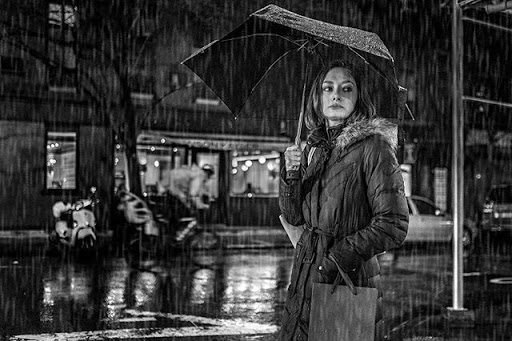
Raindrops are most apparent in twilight and nighttime shots, especially if the picture is eventually published in black and white. Viewers’ eyes are called to textures and patterns, like rippling puddles or splashing raindrops, with less light — and thus less colour.

Photo by Bob Cooley


Backlight your raindrops for visibility.

While low light calls attention to patterns, backlight makes subjects in its path more visible. Try shooting toward – though not directly into – a light source to see the raindrops against its luminosity. Streetlights are great for this approach.


Establish complementary light with your flash.

Yet another way to illuminate raindrops is to use your flash. It does not have to be your primary light source. Instead, it can be lowered by a few stops to supply complementary light that lets the precipitation glisten.


Research in advance for portraiture scenes.

Rain can be an interruption to portraiture sessions, but maybe your clients embrace its melancholy vibe. Survey your area for potential compositions where your subject could pose at length without getting soaked.

Photo by Jason Vinson


Place your subject beneath an awning or overhang.

Keep your subject dry for a portrait session by setting the shot beneath a covering on the street. This provides shelter, and the composition has a natural feel, seeing as people often wait out storms beneath these coverings.


Move out of the shower and behind the wheel.

Like awnings and overhangs, cars serve as adequate shelter and realistic scenes. Vehicles are good for more than composition, though. If the rain is too much for you and your equipment, and if you don’t have a sufficient umbrella, shoot from your car.


Capture the humanity in rainy day reactions.

It is difficult to be unaffected by rain. Reactions range from puddle dances to dread-faced power walks. Street photography on rainy days can highlight characteristics of joy, resilience and vulnerability in fresh ways.

Photo by Erwin T Lim


Rain does not have to be end of your shoot. It can be the beginning, so long as your eyes stay open to creative opportunities. To learn more about the cameras you could be using for your rain photography sessions, check out our eBook, Which X Series Should I Buy?


X-Thusiast Featured Photographer – Stephen Vincent-Grace

We caught up with photographer Stephen Vincent-Grace this month to learn more about how to capture the beauty of the world, and find out what inspires him to continue to pursue photography as a hobby.

Can you tell us a bit about yourself and where you are from?


My name is Stephen Vincent-Grace, although everyone knows me as SVG. I am originally from Adelaide but have lived in Italy, England and the U.S.A. and have now settled in Melbourne, where I am product manager for a creative online marketplace. Besides photography, I am a crazy soccer fan and love to travel with 37 countries ticked off my bucket list.


How did you develop an interest in photography using Fujifilm equipment?


My interest in Fujifilm developed when I was on a trip to New York a few years back. I had my DSLR gear and over a three-week period took it out twice due to the pain of carrying it around everywhere. Subsequently after that trip I didn’t take a photo for over a year. I knew then it was time to sell the DSLR and look for something else. The X-Pro2 had just come out and I needed a camera. I instantly fell in love with the rangefinder look and manual dials of the brand. I read reviews and I was sold on Fujifilm and have been in love with it ever since.

Fujifilm X-Pro2 with XF16mmF1.4 R WR – 1.3 seconds – F5 – ISO 200


How would you describe your photography style and strategy?


Interesting question. I would say my style is still evolving; at the moment it’s about big iconic landscapes and cityscapes with lots of colours but I am also exploring something different from this. I am working on something surrounding the ACROS film simulation with not a landscape in sight. In regards to my strategy, so far it is to research places that inspire me and then plan to see them and share my take on them.


What inspires your photography?


I get inspired by the the Fujifilm X community, from official X photographers such as Elia Locardi and Jonas Rask (who are my idols) to fellow Fujifilm X enthusiasts. I see what they can create and it inspires me to know that we are all using the same tools and that I can hopefully create beautiful photos like everyone else. It’s nice to know there is a community out there that is passionate and positive.

Fujifilm X-Pro2 with XF10-24mmF4 R OIS – 20 seconds – F10 – ISO 100


Where are your favourite places to take photos and do you prefer a certain type of light for photography?


I just love diverse and beautiful landscapes, so it has to be Iceland and New Zealand. They are a photographer’s paradise and they are small enough you can see so many different sites in a short period of time. If I am not wanting a landscape, then for the amazing skyline or cool street photos, it has to be New York City. For me, when it comes to light, it’s the tried-and-tested formula of sunrise and sunset. Sunrise is amazing as it’s hard to do, as you have to get up so early but that is why it is so rewarding because you get lovely, soft light and there are usually not many people around. I think the blue hour is magical too, especially at sunset.

Fujifilm X-Pro2 with XF10-24mmF4 R OIS – 1 second – F11 – ISO 100


What is your favourite memory from a photography session?


My favourite memory is going to Aldeyjarfoss, Iceland. I went to Iceland for five days and hired a tiny campervan and tried to get a few shots in a small amount of time. The magic of Aldeyjarfoss was that I had to drive to a spot in the middle of nowhere, sleep the night at the bottom of a path that could only be accessed via four-wheel drive or on foot. The next morning I got up at 4am, walked 45 minutes with no maps, hoping I was going the right way. When I got there, it was so magical that I got emotional because of how beautiful it was and the adventure of getting there.


Can you tell us what’s your favourite Fujifilm camera and why?


My favourite camera is the one I own, the Fujifilm X-Pro2. I just love the look and feel of the camera. It can be used as a general purpose camera for travel and landscape or it can be the iconic rangefinder street camera. I probably shouldn’t admit this but it sits on my desk at home and sometimes I just look at it and admire the aesthetic of the camera or just pick it up for no reason.


Which Fujinon lens or lenses do you prefer to use with your Fujifilm X-Pro2 and why?


My current lens lineup starts with the XF35mmF2, which I use for general walk-around, weddings for friends and family and sometimes for landscapes if my XF10-24mmF4 is too wide. The next is the XF10-24mmF4, which I purely use for landscapes and cityscapes. I absolutely love this lens, although it would be even more amazing if it had weather sealing. The last lens I own is XF56mmF1.2, which I use for portraits and weddings for friends. I intend on getting the XF55-200mm as I need a telephoto for that extra reach on some of my travel adventures. I have also just seen the newly announced XF8-16mmF2.8 WR; if it lives up to expectations and isn’t crazy big then I might have to add that, too!

Fujifilm X-Pro2 with XF10-24mmF4 R OIS – 25 seconds – F9 – ISO 100


What sort of workflow do you use in your photography? Do you shoot in RAW or JPEG?


I shoot mostly RAW, I import the photos, just copying them over to my computer then use Photo Mechanic for the cull process. I then use Adobe LR and Nik Collection and a touch of Photoshop for sharpening and corrections if needed. I have just become a Capture One Beta tester, so I want to teach myself how to use this software as I have heard it handles the X-Trans raws a lot better than Adobe. I do use JPEG when I shoot in ACROS as I have read the JPEGs are tied so closely to the processor that there is a slight difference when coming straight out of camera.

Do you have any technical tips you’d like to share? Perhaps suggestions on the best lighting, shutter speed, white balance, aperture, ISO, etc.? Other preferences?


I don’t think I have specific tips as I feel settings really depend on the lighting conditions you are in or what style of photography you are doing. However, my general tips would be first and foremost read the manual of your camera inside out. I actually bought a tip book for the Fujifilm X-Pro2, which explained in detail some of the functions that helped me get the most of my camera and understand some of the settings and how to best set them. I also follow so many blogs and photography Twitter feeds and always find something new I didn’t know. Finally, just keep practicing and use the camera as much as you can.

Fujifilm X-Pro2 with XF10-24mmF4 R OIS – 9 seconds – F10 – ISO 250


Do you have advice for new photographers or the next potential X-Thusiast?


Enjoy your Fuji camera, go out and shoot and love the photography journey you are on. It’s a journey that never has to end and can go anywhere you want to take it.


To see more of Stephen’s photography follow him on Instagram, PhotoDune or visit his website.


Are you interested in becoming our next featured X-Thusiast photographer? Check out our full X-Thusiast Gallery and submission details.


7 Ways to Maximise Your Landscape Photography

The natural world provides photographers with some of their most stunning subjects, from mountains and canyons to rolling hills and fields of flowers. Landscape photography is rewarding, but that does not mean the style is easy. You may think that, because the subjects are immobile, the composition is effortless. But this genre requires plenty of premeditation and attention to detail.


Bring mindfulness to your landscape photography by practising a few clever tips.


Go small with aperture.

You may find the occasional landscape shot that, because of textures in the near distance, warrants narrow depth of field. But most landscape photography works best with a small aperture setting and a large depth of field. Because a small aperture number brings less light into your camera, you may need to boost your ISO setting slightly to adequately balance the shot.


Get back to basics with the rule of thirds.

As you stare out at the landscape and wonder where to start with framing your shot, remember a basic principle of photography. The rule of thirds calls for you to imagine the frame as nine smaller squares, or vertical and horizontal thirds. Place your subject at an intersection of these envisioned lines. Be careful to make each of the nine squares contribute purpose to the artistry of your shot.

Image by Christopher Kirby – Captured using the X100


Find a focal point.

Most photos are best served by a specific and easily identifiable subject in the frame. Landscape shots are no exception to that rule. Even if you are photographing something grandiose, like a mountain or glacier, select a specific point of focus. Use light and shadows as your guide for picking a particular place.


Look for people, or their footprint, in the environment.

One way a landscape photo communicates a story is depicting people and their interaction with the natural world. Look for the roadway that weaves through the hillside. Include the section of the forest where trees were chopped for logging. Find the hiker climbing in the distance. Human influence is one of many facets you can use to communicate through landscape photography.


Frame your shot with a foreground object.

Your attention may be on subjects in the distance, but do not let that limit your creativity for framing. Nearby branches, bridges and foliage can fill your frame and distinguish your shot from many others.

Image by Greg Virgona – Captured using the X100


Schedule your shot for lively light.

All photography is the art of capturing light, so with landscape shots, like any others, the quality and quantity of light will separate tremendous photos from the mediocre. Golden hour is an ideal time for most landscape shots, as the warm hue creates both contrast and depth against your subject.


Invest time and patience in challenging pics.

Because we want to think of landscape photography as easy, you might feel dejected if a full day of shooting does not lead to the perfect shot. The natural world can be a fickle source of light, so remain patient. Invest hours, if not days, in capturing subjects in their optimal light.

Image by Clèment Breuille – Captured using the Fujifilm GFX 50S


With your settings, composition and outlook at their best, you maximise your potential to take landscape shots that tell stories and stand out among the masses.


Fujifilm offers a wide range of cameras to help you achieve the perfect landscape photo. Our eBook, Which X Series Should I Buy?, can help you learn more about the X Series and determine which one will help you with your landscape shots.

TAPE: Series 3 – 10 Photographers Share Their Advice

Over the last ten weeks you would have seen ten interviews forming series three of Through a Photographer’s Eye (TAPE). In each interview, we heard from a handful of Australian photographers and how they use Fujifilm X Series cameras to photograph the world around them.

Before series four of Through a Photographer’s Eye begins next month, let us take a look back at what advice was shared when each photographer was asked the question:


If you have some advice for someone starting out in photography what would it be?


Johny Spencer

Shoot what you love and love what you shoot. When you’re obsessed with the thing you like, in my case photography, it will keep you shooting even when you get stuck on the technical stuff.

Your passion for the subject will push your creativity and help you overcome any challenge you face in your photography journey. – Read the full interview here.

Fujifilm X-Pro2 – XF10-24mmF4 R OIS – 10mm – 1/60 second – F8 – ISO 200


Gavin Host

I believe learning how to work with light is the first step to understanding photography, and the only way to do this is to experiment. Learn how to shoot using manual before you begin automating anything (other than focus). It’s very important to understand the basics of ISO, aperture and shutter speed and how they impact both each other and the final photograph, before leaving it to the camera to decide anything. You’ll make mistakes and take some horrendous photographs (I cringe at some of my earlier work!) but it’s the best way to learn.

Also, find someone that is in the industry that you respect and ask them as many questions as you possibly can. I spent six months on work experience with one of Perth’s top fashion photographers and although it was in an area that I didn’t pursue, the knowledge that I gained from working alongside him on a daily basis formed the foundation for my photographic skills.

Immerse yourself in photography if that’s truly what you want to be doing. I literally never leave the house without a camera (be it film or digital). – Read the full interview here.

Koh Rong Sanloem, Cambodia – Fujifilm X-T1 – XF23mmF1.4 R – F2 – 1/640 second – ISO 400


Mike Bell

Photography is obviously a passion and not a job most people would choose if they were not into it, so by having that passion for what you do you are already halfway there. Create a service for clients that is reliable and ALWAYS deliver what you promise.

Taking an interest in your customer’s business, showing them you have done your research always helps. Never stop looking for new clients, self-marketing is key. Your creativity and skill will get you so far, that’s almost the easy bit, creating a customer base and the way you deal with your clients can be the difficult bit. – Read the full interview here.

Fujifilm X-T1 – XF16mmF1.4 R WR – 1/80 second – F2.2 – ISO 320


Ryan Cantwell

Don’t worry about the fancy technical side of the gear. Get a cheap camera and work with that. Don’t rely on editing so much. If you’re growing up in a ‘boring’ town that offers a lot of mundane surroundings and you feel like there’s nothing pretty to take photos of then you’re not paying enough attention.

You will learn to find ‘beauty’ and oddities in places rather than just visiting the regular postcard scenes and look outs. Look at art paintings and how they applied technique and composition. Paintings have been around a lot longer than the camera. Be forward with yourself and the people you approach it can be awkward, but your results will be more to the point you have in mind. Sometimes don’t take photos, so you can live in semi regret you didn’t take a photo of a wonderful thing, move on and remind yourself to be more mindful next time. – Read the full interview here.


Sarp Soysal

I’d say the biggest piece of advice I’d like to share with young photographers is not to get trapped in the technical side of photography or with camera reviews, equipment choices and stuff.

In my opinion, the most important first step is to get to know the gear that you have, whatever it might be, and understand everything about it so you can learn how to work with it and how to make it work for you. Because at the end of the day, when someone is looking at your photographs, no one cares really about what settings you used or what camera you have. It’s about the story you tell.

As any skill or art form, it requires a lot of practice. So take your camera with you everywhere and use every outing as a learning opportunity. Devote 20 hours a week, every week to making photographs. Get yourself a good pair of walking shoes and hit the streets or parks of your town or city and just shoot. Eventually, you’ll find your voice, and then you can focus on developing your own photographic style to tell your own stories. – Read the full interview here.


Harrison Candlin

Just pick up a camera and have a go. A lot of learning comes from mistakes I have realised. Dedication is something you will need to develop over time. It’s a fundamental key in developing your style, your photography quality and most importantly, being there to capture it. I have driven numerous six-hour drives to the same places just to get the shot I want, only to find out I couldn’t get it. However, if you’re dedicated enough, you’ll always want to go back and pursue it. The beauty of photography though is you might not always get your intended shot, but something else will always pop up. To be honest, most of my work has happened this way. Capture it, work the scene, change your angles, get down low or up high and fire away. Improvise and be spontaneous. – Read the full interview here.


Geoff Marshall

Learn the basics of exposure such as aperture, shutter, ISO and how to use them in combination to achieve desired outcomes. Consider your composition and just get out there and shoot. Analyse your photos, be self-critical and learn from your mistakes (we all make them) and develop a technique that you are happy with and produces results that you like. Don’t try and please everybody with your photographs, that’s an impossible task to achieve, we are all different, what one person likes the next will not. – Read the full interview here.

Fujifilm X-E1 with XF18-55mmF2.8-4 R LM OIS – 1/60 – F5 – ISO 800


Myles Kalus

Looking into gear, I would say to buy a camera that is straightforward to use. A lot of cameras these days have added functionalities that sometimes become a distraction. I’ve personally found that the fewer choices I have, the more concentrated I’ve been with learning and studying the camera and photography. If possible, I’d highly recommend a camera with an electronic viewfinder (EVF) as it allows you to immediately see how the settings affect exposure and depth-of-field. All these factors taken into consideration will speed up your learning process significantly, and improve your technical mastery within a short span.

From a photography perspective, I’ve always advised newcomers to find a few photographers of which their works you like, go through their work obsessively, learn what is it about their work that you admire, and try to replicate their work. This forces you to experiment with your camera and pushes your eye to see what and how they saw and why they photographed it. – Read the full interview here.

Fujifilm X-T2 with XF56mmF1.2 R – 1/1000 second – F1.2 – ISO 640


Matt Murray

Learn as much as you can about your camera: read the manual, watch YouTube videos, go to photography meets, ask lots of questions. Although many photographers – including myself – always want the latest and greatest camera gear, some of my favourite photos were taken with my least expensive Fujifilm kit: an X-T10 and either the XF18-55mmF2.8-4 R LM OIS or the XF35mmF1.4 R lenses (approximately $1200 worth of gear).

Learn as much as you can about photography. There are so many good free websites and resources out there these days. Follow photographers on Instagram and study their photos. Join photography related Facebook groups – I’m a member of about a dozen. Post your work in there and ask for constructive criticism. One excellent group I recommend is Fuji X Australia where a dedicated group of admins encourage and support Australian and New Zealand Fujifilm photographers. – Read the full interview here.

Fujifilm X-T1 with XF18-55mmF2.8-4 R LM OIS


Marc Busoli

Shoot as much and as often as you can. Do workshops and join photo walks, there are plenty of free options around the place, I think that’s a great path to education around photography. Be open to other styles and ideas. Take feedback well from people whose photography you admire, but always remember that you should only ever shoot to make yourself happy, that is what matters. – Read the full interview here.

Fujifilm X-T1 with XF35mmF1.4 R – 1/140 second – F3.2 – ISO 400
The Advantage of Mirrorless

Since mirrorless digital cameras entered the photography scene in the late 2000s, the question has been whether they could be a better option than DSLRs (Digital Single Lens Reflex). Since that time, the mirrorless system has grown in popularity, so it is clear photographers are increasingly making it their preference.


What’s a DSLR?

DSLR cameras (or digital single-lens reflex) use the design of old-school 35mm bodies, with light taking a path from the lens to the prism and then to the viewfinder, where you can see the preview of your image. As you hit the shutter button, the mirror flips up, a shutter opens and light reaches the image sensor, which retains the picture.


What’s a mirrorless camera?

The big difference with the mirrorless camera is that it has no mirror that flips when you open the shutter. Instead, light moves directly from the lens to the image sensor and the shot displays on your screen.


Which style is lighter?

Because mirrorless cameras do not need to store a mirror and a prism, they do not need to be as heavy or as large. If you like to travel with your camera or just enjoy a lightweight rig, then you may prefer the mirrorless system.


Which body has better focus?

Many years ago, DSLRs had the reputation of being the better – or at least faster – model for autofocus shooting. This is because DSLRs used phase detection, a quicker method that relies more on the camera’s electronic sensor, rather than contrast detection, the slower but more accurate system utilised in most mirrorless bodies. However, mirrorless cameras have since improved in this area. Now, many mirrorless bodies, including Fujifilm’s newer models, employ a contrast-phase hybrid autofocus system.


Which style is suited for continuous shooting?

If you want to capture fast-moving action, you may want a camera with the capacity for continuous shooting. Mirrorless cameras, with their simplified path for obtaining images, excel here. For instance, the Fujifilm X-T2, when photographing from its continuous shooting boost mode, shoots about 11 frames per second, well ahead of most other cameras on the market.

FUJIFILM X-T2


Which one shows an accurate shot in its viewfinder?

Mirrorless cameras also have viewfinders that display truer to what your photograph will become. Their electronic viewfinders allow you to see, in real time, adjustments to aperture and ISO, whereas the optical viewfinder found in DSLRs displays those changes only after you shoot the image. The mirrorless style has a big advantage here, as it saves you time from going back and forth between shooting and adjusting.


As with many debates over photography equipment, the choice comes down to your personal preference. If you find a camera that you handle comfortably and shoot naturally, then proudly make it yours and enjoy creating great shots with it!


For more Fujifilm camera options, download our 2017 Buying Guide.

Through a Photographer’s Eye: Marc Busoli

Welcome to the Third Series of Through a Photographer’s Eye. In this series, we continue to learn about Australian photographers and how they use X Series Cameras to photograph their world around them. Our tenth interview in Series Three is with Queensland based photographer, Marc Busoli.

Marc, can you tell us about yourself and why you enjoy photographing people on the street?


I started photography in 1992 when I obtained a camera from my sister. I did a three-year diploma in photography five years after that and since then have shot images for commercial use, weddings, portraits and several blogs. I moved to my Fujifilm system after years of shooting with a full frame camera when I bought the original X100 and was blown away by the image quality and design of the camera. I loved it. I enjoy street style photography as it gives me an opportunity to observe and record the interaction of society in a shared space. I particularly like the idea of solitude in a crowded environment, people being on their own when surrounded by a crowd. I try to hide the faces of the people I photograph to accentuate the feeling of solitude and aloneness in a crowded city. I also enjoy the simplicity of simple designs in architecture, so I publish a few photos on my Instagram to mix it up a bit!

Fujifilm X-T1 with XF35mmF1.4 R – 1/500 second – F9 – ISO 400


You mentioned you use the Fujifilm X-T1 with two primary lenses. What made you choose this camera over other mirrorless bodies and how do you find Fujinon optics for general everyday shooting?


I love the design of this camera, I’ve used a ton of cameras after working at Digital Camera Warehouse for seven years, and I can say that this is by far the best camera I’ve used. It just disappears when I’m using it, that’s really important to me as I don’t want the camera slowing me down due to bad design and the Fujifilm just is so natural to use for me.


The lenses themselves are just so sharp and not too big to be in the way when the camera is swinging around. The results are very sharp with a lovely bokeh. The two I use are the XF14mmF2.8 and the XF35mmF1.4. The XF35mmF1.4 just lives on the body, and I must admit I hardly ever pull the wide one out. The 35mm perfectly suits my eye and the results are faultless for my style.

Fujifilm X-T1 with XF35mmF1.4 – 1/18 second – F1.4 – ISO 800


Why do you shoot mainly in black and white? Do you use a Fujifilm Film Simulation to recreate a particular look or do you edit your RAW files in post-processing?


I love black and white. I started a hashtag #52weeksofblackandwhite to challenge myself to shoot an entire year of just black and white. That was over two years ago, and I haven’t stopped! I shoot in RAW before converting the photo using the Fujifilm Monochrome+R film simulation in camera. I send it to my iPad and do final edits in Snapseed and/or Lightroom mobile. Then it goes to social media. For more control, I import the RAW straight to my MacBook Pro and edit with Lightroom/Photoshop.

Fujifilm X-T1 with XF35mmF1.4 – 1/420 second – F1.4 – ISO 1250

Fujifilm X-T1 with XF35mmF1.4 R – 1/55 second – F1.4 – ISO 1250


When using the Fujifilm X-T1 do you ever use the flip out LCD screen for street shooting or do you prefer to use the large electronic viewfinder? Can you explain why you shoot like this?


I use either the viewfinder (which is great, beautiful and big) or shoot from the hip without looking at the viewfinder or the LCD. Kind of Lomo style, it can produce some interesting shots, but it is very hit and miss, as you can imagine. Most times it’s using the viewfinder though, less distracting although you need to keep your non-shooting eye open, so you don’t miss any opportunities, this can be hard at the beginning.

Fujifilm X-T1 with XF35mmF1.4 R – 1/60 second – F1.4 – ISO 800


If you have some advice for someone starting out in photography what would it be?


Shoot as much and as often as you can. Do workshops and join photo walks, there are plenty of free options around the place, I think that’s a great path to education around photography. Be open to other styles and ideas. Take feedback well from people whose photography you admire, but always remember that you should only ever shoot to make yourself happy, that is what matters.

Fujifilm X-T1 with XF35mmF1.4 R – 1/140 second – F3.2 – ISO 400


Do you have a favourite photo you have recently captured using the Fujifilm X-T1? Can you tell us the story about how you shot the photo and why you chose to compose the shot like you did?


This picture of a massive cloud formation off the Queensland coast is one of my favourite images. I used the XF14mmF2.8 to get as much in the frame as I could at the time. It was just massive in reality and when I cropped the image I pretty much just removed the top and bottom, but the width stayed the same. I tried to compose the shot to get a sense of the scale of the formation, and I really like how it turned out. I even managed to capture a little cloud-to-cloud lightning!

Fujifilm X-T1 with XF14mmF2.8 R – 2.5 seconds – F5.6 – ISO 200


In your opinion, what’s the best time of day to photography on the street and can you recommend any camera settings for someone who might wish to shoot similar photos?


Shooting street is such a reflection of the society that you’re recording that the ‘best’ time to shoot is any time that there are people around! I do prefer the drama of a late afternoon with some direct sunlight streaming in at a shallow angle. People in Melbourne CBD will know what I mean! I love to shoot directly into the light in those situations as I think it adds a sense of the dramatic to the scene, long shadows, silhouettes, bursts of light. It does tend to expose any limitations of your glass, but I’ve found the Fujifilm glass handles harsh direct light superbly.

Fujifilm X-T1 with XF14mmF2.8 R – 1/60 second – F22 – ISO 320


What methods do you use when trying to photograph people on the street? For example is there a best way to approach people if you see someone interesting or are there any ‘don’t do this’ for street photographers?


One of my favourite techniques is finding a spot with some awesome lighting, like under a street light at night or a late sunset, and staking the place out waiting for the perfect person to come onto my ‘stage.’ You need to be aware and ready to fire as soon as an opportunity presents itself, I’ve missed a few great shots when I was starting out simply by not recognising an upcoming opportunity. People are more open to being approached these days I think, mainly due to the ubiquitous of images and social media, I think they like the idea of potentially going a bit viral!

Fujifilm X-T1 with XF14mmF2.8 R – 1/340 second – F5.6 – ISO 320


To see more of Marc’s photography visit him on Instagram – @themadbusdi.

Previous interviews from Series Three of Through a Photographer’s Eye:

Through a Photographer’s Eye: Johny Spencer

Through a Photographer’s Eye: Gavin Host

Through a Photographer’s Eye: Mike Bell

Through a Photographer’s Eye: Ryan Cantwell

Through a Photographer’s Eye: Sarp Soysal

Through a Photographer’s Eye: Harrison Candlin

Through a Photographer’s Eye: Geoff Marshall

Through a Photographer’s Eye: Myles Kalus

Through a Photographer’s Eye: Matt Murray