Ben is an environmental photojournalist, zoologist and Fujifilm X-Photographer. His passion is showing the beauty and fragility of the natural world. Find more of his work at www.bencherryphotos.com
Recap – My name is Ben Cherry, I’m a Fujifilm X-Photographer focusing on environmental photojournalism. Currently I am part of the WWT Flight of the Swans conservation project, where Sacha Dench is flying from Arctic Russia back to the UK; following the declining Bewick’s swan as they migrate to overwinter in warmer climates.
Well we eventually got out of Russia, after a 19 hour border crossing. Estonia was instantly different. It had a significantly different feel to it, from seemingly greener, richer forest to just a different culture. It was all quite refreshing!
I broke off from the core team to focus on finding Read More
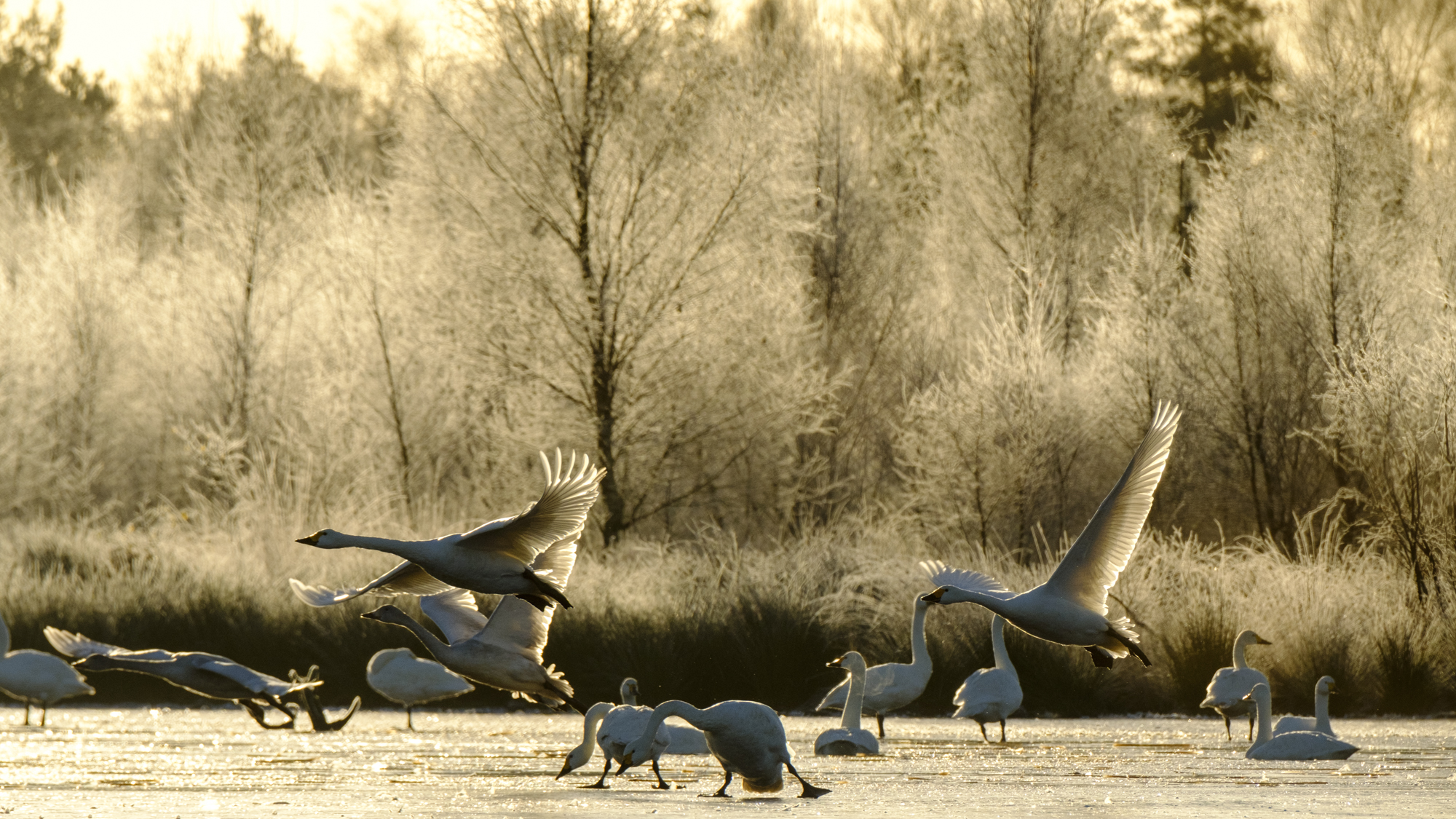
Flight of the Swans has finally left Russia, only ten days behind schedule… Ten extra days I am very happy to have spent in this dramatic country. Enormous in every sense of the word, we barely scratched the surface, but what we did see left a lasting impression. From incredible generosity to gorgeous autumnal scenes, this rugged place has wilderness to truly get lost in.
X-Pro2 and XF10-24mm F4 ISO6400 30 Seconds
Hazard lights cast against the roadside trees as the convoy headed to Kimzha. We were very much alone on this dirt road and the stars were simply spectacular!
The 19th September greeted us with a 32 hour stay at the Estonian – Russian Border, an experience that I’ve recently had a case of deja vu with as we returned from the other direction on the 19th October for a 18+ hour stay to return to the EU. In-between that time we have raced up to Kimzha, Arkhangelsk region, 1800+KM away within five days, via roads where for periods our trailer towing vehicle had to crawl at 6kph. It was a mental run, marred by a diesel spill in the trailer at 2am and paramotor pilots arriving at the collection point ahead of schedule, resulting in some all-nighters.
X-T2 XF10-24mm (24mm) F8 ISO 400 1/20
X-T2 XF100-400mm (330mm) F16 ISO 1600 30 seconds.
Once we linked up with the pilots who had just crossed the tundra section, things were marginally less hectic, marginally.
X-T2 XF100-400mm (100mm) F8 ISO 200 1/125
X-T2 XF100-400mm (370mm) F5.6 ISO 1000 1/680
X-T2 XF100-400mm (360mm) F5.6 ISO 1000 1/900
X-Pro2 XF16-55mm (55mm) F10 ISO 800 1/550
X-T2 XF100-400mm (226mm) F11 ISO 800 1/550
X-Pro2 XF16-55mm (16mm) F6.4 ISO 800 1/1900
Sacha has done an amazing personal journey so far, she even dislocated her knee! But still going via a trike to take stress off her legs. The Flight of the swan’s team have been featured on news channels all around the world and the ground team are doing their best to engage local communities, particularly through school programs. All to raise awareness of the Bewick swan and other migrating wildfowl. The aim is to improve international awareness and cooperation, to find out more and to sign the WWT’s petition to help their conservation, which can be found here.
Personal highlights included witnessing the northern lights and catching a glimpse of a wolf as it slinked off into the darkness of a moonlit woodland road. But the biggest surprise has the be the incredible generosity that our team witnessed in Russia, I haven’t experienced anything like it before, where families would happily take in 8-12 people, feed us, give us a place to stay and even offer us a banya (Russian bath)! We were welcomed with open arms. Meeting conservationists, or simply random families along our journey, all seemed to have a deep connection for nature and the importance for managing it suitably, including the declining Bewick’s swan. We would be let into the lives of these people and get to know them, usually over a skinful of vodka.
One too many..
Time-lapse taken with X-Pro2 and XF16mm F1.4 using the in-camera intervalometer.
X-T2 XF10-24mm (10mm) F4 ISO 200 960 seconds.
Frame from the time-lapse. X-Pro2 XF16mm F1.4 2 seconds ISO 1600
Cine Fujinon Lens
As well as using my personal X-Series kit on this project we are very proud to be sponsored by Fujifilm with a Fujinon ZK3.5×85 (85-300mm). Our media team are documenting the project in as wide a means as possible, from virtual reality experiences to documenting the project with various filming equipment, to hopefully continuing to share this project to a wider audience and help communicate the importance of Bewick’s swans conservation.
Here is one of our cameramen, Ben Sadd in the Gulf of Finland, Russia searching for swans.
Because so much of this trip is about communicating with as many people as possible, I have been using my instax SP-1 printer a lot to leave little mementos. It always gets a fantastic reaction, the business card sized prints are perfect for travelling with. Giving a physical print has such a positive effect on an experience compared to simply tagging someone in a digital photograph. instax has for a long time been one of the first things in my bag whenever I travel, this feeling has been encouraged further. The benefit-to-cost ratio isn’t even worth talking about as the effect it has on a situation is huge, it sounds cheesy but seeing the smiles appear as the photo develops on the instax is worth it.
I’ve found that it develops a situation from a set of friendly acquaintances to the start of friendships, leaving both the recipient and photographer with lasting, fond memories.
Some of our media team were taken in by a Russian family and joined them for a big meal. instax proved to be really popular and it was a pleasure to leave them with a dozen little prints.
Leaving a physical memory from one of our school visits.
It even proved popular with our team medic for her birthday!
Connectivity
As well as directly sending images to my SP-1 printer, the ability to send lightly edited files (via the in-camera RAW converter) to my phone and then share on the Flight of the Swans social media channels has helped to massively streamline my image sharing process. You can follow these channels here:
The team are now in Estonia. Russia was an amazing experience but the project is still very much on the move. There is a major set of wetlands in Estonia which we want to visit and hopefully witness more migrating Bewicks. You can stay up to date via our live map, with trackers on birds, vehicles and of course Sacha! Click here.
Summary
Flight of the Swans is a fascinating project, where WWT has taken a big leap into the unknown to try and reach a new level of engagement to help improve conservation of wildfowl. If you’re interested in travel, extreme sports or wildlife then hopefully this project will be of interest. If so, then please help us by signing our petition here. Until my final instalment in a month’s time, here are a few more photos from our Russian experience. In the next blog I will update you on the project as well as talking about the 4K capabilities of the X-T2 and how it has been incredibly helpful to film the swans.
X-Pro2 XF16-55mm (35mm) F2.8 ISO 400 1/750
X-Pro2 XF56mm F1.2 ISO 400 1/2700
X-T2 XF100-400mm (190mm) F5.6 ISO 1600 1/120
X-T2 XF100-400mm (150mm) F11 ISO 200 1/200
X-T2 XF100-400mm (150mm) ISO 200 1/200
X-Pro2 XF16-55mm (37mm) F2.8 ISO 1600 1/60
X-Pro2 XF16mm F1.4 ISO 1600 10 seconds
Steve Flanagan being won over by the X-Series. X-Pro2 XF16mm F2 ISO 200 1/250
By Ben Cherry – Environmental photojournalist & Fujifilm X-Photographer.
I’ve been fortunate enough to be a part of the volunteer media team covering a project called Flight of the Swans. This is an ambitious conservation expedition, where Sacha Dench will paramotor from Arctic Russia back to the UK over 10 weeks following the flyway of Bewick’s swans.
This charismatic species was what encouraged Sir Peter Scott to set up Slimbridge and eventually the Wildfowl Wetlands Trust (WWT). Now though, the species is under threat having gone through a dramatic decline over the past twenty years. Between 1995 – 2010 the Europe population fell from 29,000 to just 18,000. The purpose of this expedition is to raise awareness of their plight, to confirm the key reasons for it, and hopefully create solutions.
This is the first of three blogs covering the project. Here we will focus on the lead up to the take off and the ground team reuniting with Sacha. Then there will be a blog during the expedition and one just as we all return to the UK.
Sacha preparing her paramotor. X-Pro2 and XF56mm F1.2
Sacha and Alexander flying over Dartmoor during a practise exercise. X-T2 and XF100-400mm
Full Moon evening flight. X-T2 and Xf100-400mm
How I got involved
Ambitious and ‘out there’ projects like this don’t come around very often so when I saw the advertisement online I jumped at the chance to get involved. I was lucky enough to be shortlisted alongside an amazing group of people and the next step was a selection weekend in Wales, where we were put through a series of exercises to see how well we can adapt and collaborate. This was a fantastic weekend, supervised by seasoned explorers and everyone came together, despite the competition and lack of sleep!
Image courtesy of WWT/Jessica Mitchell
Once I was informed that WWT would like me to be a part of the media team, I became as available as possible to help where I could, leading up to the off. We have been put through a series of training exercises from remote first aid, to satellite phone tutorials, as well as covering some of Sacha’s specialist training, like having to jump into a simulation pool at RNLI College, Poole to see how well her flotation devices for the paramotor work! It does help that she used to be a professional free diver…
Long road ahead! Autumn is about a month ahead of the UK in Russia, which is why the Bewick’s have started migrating. X100T
What kit I’m taking
I have two bag set ups for two different purposes:
Shoulder bag/go bag
This is basically the first thing I grab when we arrive at a general location. It contains an X100T, X-Pro2, XF16mm F1.4, XF35mm F1.4, 56mm F1.2 and an SP-1 printer. The set up encourages me to be creative as well as being small and not intimidating when first encountering a new community.
Backpack – Wildlife/assignment bag
When I know we are going out to find the swans or capture other aspects of nature, then this is the bag I grab. Inside is an X-T2, X-T1, XF10-24mm F4, XF16-55mm F2.8, XF50-140mm F2.8, XF100-400mm F4.5-5.6. As well as miscellaneous items like filters, cleaning kit and a flash set up.
Having the two distinct bags means that I can keep my kit focused for particular types of photography, as well as not constantly overloading myself with gear. This particular project has so many interesting factors, from tracking the swans which are very timid in Russia and much of Europe, to engaging local schools, conservation and hunting groups. My kit has to be able to maximise each and every opportunity.
The rangefinder cameras are brilliant as they are particularly inconspicuous. I keep them together as I use my right eye with the rangefinder cameras, while I use my left eye with the SLR style cameras. The X-T range cameras are generally more flexible, particularly the X-T2. So from my perspective it makes sense to keep the most versatile lenses (zooms) and cameras together. Generally the X-T2 has the XF100-400mm attached inside the bag so it is ready in case we come across any wildlife suddenly or Sacha has to take off/land quickly. The advanced autofocus and 4K footage makes the X-T2 ideal for this kind of project.
How has it gone so far?
At the time of writing this (23rd September, now I will hopefully be running around the amazing tundra!) we the ground team have just arrived in Arkhangelsk, Russia. Referencing the map below, that is where the blue line from the UK has stopped, as well as the green line coming down from the tundra, that is Daisy Clarke, one of our satellite tagged Bewick’s! Sacha is the highest, turquoise line. To get the latest on our location be sure to regularly check our live satellite map – https://www.flightoftheswans.org/live-map/
Sacha has made amazing progress so the ground team have had to work double time to make sure we join up and keep on schedule. We left on the 14th September, and have managed to cover over 2,500 miles during that time, along with a 32 hour stay at the Russian border.. We will hopefully reunite with Sacha tomorrow!
Part of the ground team moving north in Russia
From there we will then steadily start heading back to the UK all together. Along the way we will be conducting lots of press, conservation and community events. Please be sure to follow our social media channels as we will be trying to make our presence known along route and could be passing nearby! I am in charge of the social media channels from the field team, so I will be sharing images straight to my phone via the FUJIFILM Camera Remote app and sharing them across our social media channels (see below).
Once we are back in the UK we will be visiting some of the fantastic WWT nature reserves as well as holding other exciting UK events. We will be running various live broadcasts too so be sure to stay up to date! You can find all the latest information via our social media channels:
Next month I’ll be giving an update on the project, as well as offering a photo travel guide for the locations we have passed through. Our focus so far has been making as much time as possible, once we are all on the return leg then our media team can really get to work so I promise there will be plenty of photos to share in the next instalment.
Be sure to stay up to date! From Russia with love. 🙂
Same 16mp sensor, same auto focus, and roughly the same weight and size… So what is different between the X-E2s and the X-T10?
Well as it turns out quite a lot! In this video blog we’ll take a look at the key differences between these two cameras and determine which is better for certain styles and situations.
Both cameras are available in silver or black variants and the retro, functional designs are indicative of the Fujifilm X-Series, but there are clear differences between them. The X-T10 is an SLR-style deign with the viewfinder in the centre of the camera, while the X-E2s has a rangefinder-style design with the viewfinder on the far left of the camera. This doesn’t sound like too big of a deal, but this difference is the main reason why I use these two very capable cameras for different situations.
X-E2S
X-T10
Which eye to use
That sounds like a bizarre subtitle, maybe Ben has had a long night…? No this is actually a really important thing to consider. I am left-eye dominant, so when using the SLR variant my face is mostly obscured by the camera, but this would pretty much be the same if I used my right eye. But with the rangefinder-style cameras (X-E2S) I deliberately use my right eye (yes it was a bit weird at first but I quickly got used to it). The reason for this is if you use your left eye with one of these camera then the camera sits completely across your face, whereas with your right eye, the camera is off to your right, leaving your face mostly unobscured. This can be a really big factor if you are going to be photographing people regularly as it makes it so much easier to interact with your subject. Particularly if you don’t know each other or have limited common language to otherwise engage, simply being able to smile while taking a photo makes all the difference.
X-E2S – Rangefinder-style images
Kota Kinabalu docks 2013.
X-T10 – SLR-style images
The little brother of the X-T1 and X-T2, this dynamic camera is great for those looking to cover a wide variety of photographic genres, whether that is through travelling or simply experimentation. Combining this compact but powerful camera with the likes of the XF18-55mm F2.8-4 OIS and the XF55-200mm F3.5-4.8 OIS makes for a brilliant, lightweight travel set up. Maybe add a low-light prime in there like the XF35mm F1.4 or F2 and then you have most bases covered in a very compact system. I was fortunate enough to be a part of the launch of this camera while working in Borneo. Here are a selection of images from that trip with the X-T10. As well as that, here is a link to my brief review of the camera – http://www.bencherryphotos.com/Blog/OMG-is-that-the-XT10
A female orangutan searches for food amongst the rainforest canopy.
Benefits of each camera
X-T10
8 frames per second
Articulating LCD screen
SLR-style design
Great general travel option
X-E2S
Discreet, slim design
Rangefinder-style design
Slows you down
Best for people interaction
Fantastic with XF prime lenses
Different to most other cameras on the market
X-E2S
X-T10
Which would I choose?
Both are superb cameras with clear benefits over each other. Choosing between them very much depends on where you want your photography to develop. For me, I would opt for the X-E2s with a handful of lightweight prime lenses like the XF18mm F2, XF35mm F2 and maybe the XF56mm F1.2. This creativity inspiring set up would encourage me to think more about my photography, slow me down and encourage better interaction between me and my subjects (with beautiful results wide open using the prime lenses). What set up would you choose and why? Let us know in the comments below.
Ben is an environmental photojournalist, zoologist and Fujifilm X-Photographer. His passion is showing the beauty and fragility of the natural world. Find more of his work at:
There are many photographs which are taken in ‘the moment’ where something happens and if you know your camera well enough you’ll be able to quickly respond and get the shot. However, sometimes you have an image or story in you head that you simply can’t move past.
In this new series we are going to look at some examples, where photographers have to dig deep, problem solve and follow their vision. Hopefully lifting the veil on the phrase “Wow you were so lucky to be there just at the right moment, all of those factors came together”. What I’ve come to realise over the past few years is that if you look at the great photographers of our time, many have one thing loosely in common – time. Time to hone an idea, experiment with a subject, to get under the skin of a location, ultimately to fulfil an idea.
This is Laurel, who was one of my star birds when it came to this project. Notice the mark on the left side of his face, that was one of his unique markings.
I spent the second half of last year working as a scarlet macaw researcher (I’m also a zoologist by training) studying a reintroduced population in a rural part of South-Western Costa Rica. What this gave me, more than any other opportunity so far was that same key factor – time. Quite quickly into the placement I became fascinated with these gorgeous birds, it’s pretty easy to see why.
Away from their clear beauty, I wanted to show these impressive birds flying through the rainforest, how their vivid colours stand out so bright against the green dominated background. But there was one key issue – light. Rainforests are notoriously difficult to photograph any form of action in because they are so dark. The canopy above absorbs the vast majority of the harsh tropical sunlight, leaving it surprisingly gloomy in the undergrowth. Combine that with the humidity that leaves everything with a thin layer of moisture on it (had to put my clothes to rest at the end of the placement, they had gone above and beyond the call of duty!) and you’ve got yourself a hostile environment for camera kit.
A common way to move around this is to use a slow shutter speed (generally your only option) and pan with your subject to capture that sense of movement. This works up to a point but I wanted to freeze the detail so I tried to implement a simple on-camera-flash approach… Again it was progress but not what I wanted to finish with.
Panning only
Flash on camera approach
NOTE – I was cautious with the birds in regards to using flash (as you should always be with wildlife), these were wild birds, but because of my research position I was in relatively close proximity to them. They were not disturbed by the flash while in flight, however I was aware that I needed to keep the number of flashes down as much as possible per encounter.
Here is a video that we produced midway through our placement. Showing the initial results and set up as well as some of the problems.
As the X-Series continues to develop, so does its autofocus capabilities. I’ve recently played with the X-Pro2 and wow, it is a definite improvement over the X-T1, which in itself is so impressive considering where the camera started and where it is now thanks to firmware updates. However, even the best cameras in the world would have really struggled with what I was attempting. Tracking a flying macaw under the rainforest canopy, flying at serious speed from tree to tree! This unfortunately meant that focus tracking was out of the window. But as time went on, I began to understand the routes the birds would fly, this allowed me to prefocus and develop my photo idea further.
Problem 2. Light source
With refocusing there still needs to be a degree of flexibility to keep the subject sharp. After all this is a wild animal and it isn’t on a scalextric track from tree to tree, they would often deviate by metres. To minimise these missed opportunities, I needed to use a relatively high F-Stop (F8-11) to allow me a good percentage of sharp images. However, high apertures need lots of light and to make it even harder I needed to use my flash(es) at 1/8 power output or faster. The reason for this is the relative time the flash fires for between full power aka 1/1 and quarter power (1/4), those flash duration are long enough for there to still be some motion blur as the birds are moving so quickly. 1/8 power freezes the birds in flight ensuring sharp details can be seen. HOWEVER, that is all well and good but when using F8/11, 1/8 flash power output and while trying to just about overpower ambient light, you need more than one regular flashgun to make this happen!
This was a key part of the project, it was initially all about finding a balance between the ambient light and the flash so I could still capture some of the surroundings, making it less of a studio shoot. To make this a reality I just dropped the shutter speed from the max sync speed of 1/180 to between 1/60-1/30. The flash would fire and freeze the details of the macaw but the slower shutter speed would create some motion blur and allow enough light from the background to reach the sensor to register the lush green environment.
Problem 3. Focal Length
I really like using a wider focal length with the macaws, however as the previous image illuminates, it often includes part of the canopy in frame. Light which penetrates the canopy shines down creating these blown out highlight trails. Sometimes these work quite nicely, but often they are difficult to make work, especially if the birds fly in front of a canopy gap, then you get these weird looking highlights cutting through the flapping wings!
Problem 4. Single Shot Flash
Fujifilm launched the update for the X-T1, allowing flashes to be fired in continuous shooting mode the week I left Costa Rica! Unfortunate for me, but it made for an interesting process, certainly a character building one. With ALL the other factors that had to be dealt with, I also only had one chance to take a shot per flyby! As you can imagine this got pretty darn infuriating at times. There were many times where I clicked at the wrong time and missed part of a wing, or got the wings up when I wanted them down etc.
The wings are usually the problem, but the long tail feathers can cause problems too! It is about finding the balance between the subject being too small in the frame and being able to fit it all in!
Steadily making progress…
Quite a strong light on the face that cast a shadow on the wing.
A softer light but less detail in the wings.
Better detail but just snagged the wing!
Then I raised the shutter speed to try and freeze the bird against a darker background. The reason why it is darker is because little of the flash light is aimed at the background (as multiple flashes were involved, all pointing toward the bird from different directions) and the shutter speed was now was 1/180 (max flash sync for X-T1) so it was 3/4 times faster than previous images.
Focusing on freezing the macaw.
Quite a striking, but studio like result.
I like the balance of blur and sharpness in this one.
Zoomed in to get more of an impact image.
All in all this process went on for three/four months. It was a very interesting exercise, and laying the photos out like this you can see how the project steadily developed. Often with projects like this it is all about problem solving, from fixing kit in the middle of nowhere to getting around problems out of your control, such as the flash-camera interaction. Though incredibly frustrating at times, it was a brilliant experience and yielded some good results by the end.
Final image
You may not agree but I like the balance in this image. the bird is clear and crisp while the background is still distinguishable.
Here is a 2 minute something video visually summarising my project and its issues.
Hopefully what you will take from this is that if you have an idea, don’t give up at the first hurdle, break it down bit by bit and steadily you can make progress.
What projects are you working on with your X-Series? Why not let Fujifilm UK know, the community is teeming with talent, ideas and people willing to lend a hand – lets bounce ideas off each other.
A little about Ben
Ben is an environmental photojournalist, zoologist and Fujifilm X-Photographer. His passion is showing the beauty and fragility of the natural world. Find more of his work at:
When I’m heading out for a long day(s) in the outdoors this is the kind of equipment I usually take with me. Now it may be more than you would ever need, but for those looking to get into landscape or wildlife photography, particularly those about to head out on safari – this blog is for you.
A bag for your gear
Camera gear ready for Costa Rica!
There are too many camera bags in the world, meaning that the choice available is verging on ridiculous! If there is one item that ignites G.A.S (gear acquisition syndrome) over anything else it is probably camera bags. I’m currently using a Pelican 1510 hard case with a Thinktank Ultralight (discontinued) that fits inside the case. This basically acts like a backup backpack as it isn’t the comfiest bag for long treks, so it generally acts as a safe and secure place to store gear. I took this set up to Costa Rica because I’m based there for such a long time so the pain of travelling with such a heavy pack was negated by the benefits it offers me over the six months away, namely water-tight, lockable security.
All fits in my Millican Dave
For when I’m out and about I have two non-camera bags to choose from: Millican Dave, a great hiking bag that when combined with a cheap padded insert becomes a very good camera bag. Or a dry bag backpack which I often use on light treks where the conditions are looking a little ominous. This isn’t to say that Dave isn’t up to the challenge (he’s pretty good at being water repellent and has rain cover), but out here in the rainforest, when it rains, it pours! And having a bag that can in fact be submerged helps to ease the mind. The advantage of both of these bags is that they are easy to stuff lots of items into. One of the issues I usually have with camera bags is that once all of it is padded, it has lost of significant percentage of space for misc items. Misc items are usually seen as add ons with certain bag companies, leaving little room for other helpful items, so hiking bags can be really helpful non-camera gear.
Gear for Ice Hotel CommissionKit in action, covering ice church!
What photography equipment do I take?
Cameras:
2 x X-T1 (fantastic all-round cameras, definitely brought the X-Series to a wider audience, and very much looking forward to trying out the new X-Pro2!)
X100s (Out of all the Fujifilm cameras I’m lucky enough to have this is the one I’d probably sell last! Does everything very well, wonderful lens/camera, makes you think much more about your photography. Above all else, it is small enough to carry around everywhere. So some of my most treasured photos are taken with this because otherwise it would have been left to my phone. Combined with the wide angle and telephoto adapters, makes for a brilliant little system. I haven’t had the chance to work with the T yet.)
Lenses:
XF10-24mm (Almost perfect – fantastic lens, hoping for a WR version in the near future.)
XF16mm (Generates so much creativity, from the extremely close focusing to the fantastic depth of field control, 24mm equiv. is quickly becoming my favourite focal length.)
XF16-55mm (Fantastic workhorse of a lens, built to last and equipped with image quality to make any prime-lover happy.)
Soon to be – XF35mm F2 (when I get back to the UK this is high up on my list – 50mm equiv. lens, small, fast and discrete WITH WR!)
XF50-140mm (My most used lens – can’t really say a bad word about it, produces the goods every time, simply fantastic!)
Nikon 300mm F2.8 ED Manual focus (The elephant in the room, because my current role is focusing on birds, I needed something longer than 200mm equiv. As the much anticipated:
XF100-400mm Isn’t quite out yet I opted for a quirky alternative… Yes it is heavy, yes it is manual focus, but thankfully peaking assist and a sturdy tripod help to make this a viable option. Nevertheless, my back is looking forward to Fujifilm’s new super telephoto zoom!)
Fujifilm extension tubes and Nikon 2x teleconverter (yep, that gives me a 900mm equiv. lens… Absolutely bonkers!!)
Frankenstein X-T1 filming sloths
Misc:
Filter system (Depends on what you prefer to photograph but I highly recommend a neutral density graduated filter set up and a circular polariser.)
Flash system (Lots of options out there, depends what you can afford/prioritise – space or power output.)
Things to always keep in your bag
Get some silica packs and store some in your backpack, these can be the difference in saving your precious lenses. Many believe that fungus is an issue reserved for older lenses, unfortunately this isn’t the case, and in particular non-weather resistant lenses are vulnerable so please look after your expensive investments! Bearing that mind, always have some lens cleaner and lens cloths in your bag. You never know when a speck of mud or raindrop will ‘attack’ your lens. Though easy to deal with they can easily ruin a photo, so best to deal with any artefacts asap.
Other items I have in my bag:
Duck tape (If you use lights in particular duck tape can be invaluable to secure lights in obscure locations to light your photos or simply to repair your watertight gear)
Pen knife (Always ends up being useful for different things but of course be mindful of this when travelling internationally.)
Table top tripod (Lets face it, tripods are always annoying to carry around and generally always scream PHOTOGRAPHER, but they are invaluable for certain situations. Nevertheless on some occasions you might not be carrying around a full size tripod so as a small, light back up is generally a good idea, so have a little tripod in the bag.)
Remote trigger (I have a variety from wired to wireless, all with their own pros and cons)
Rain cover (Generally not for me as in the tropics it is nice to get rained on! But I have a cover for my camera if I’m still shooting in moist conditions.)
Rogue Flashbender (A relatively inexpensive flash accessory, easy to pack and very effective, especially when used off-camera to help quickly improve a portrait.)
Food and water (Especially if you are trekking, these are the most important items to have on you!)
Insect repellent (Insects love me so I usually carry some form of bug spray, DEET is the best but pretty grim stuff to cover yourself with so I have a natural remedy that I prefer. Also a form Vitamin B is meant to be good for repelling mosquitoes so if you know you’re off to a problem region then start some Vitamin B pills or alternatively marmite.)
Hat and layers (Yes suncream helps to fight off sunburn but a hat can make all the difference when you are out all day. Depending on where you are, the weather conditions can change quickly so it is important to have spare clothes if it is likely to get cold.)
Rehydration sachets + general medication (You can never fully guarantee what is going to happen when you go out and about so it is best to carry some simple things with you to negate any ‘niggles’ that could hamper your day.)
Communication (Generally a normal mobile phone to contact anyone if necessary. Not for selfie usage!)
Scarf/shall (This might sound strange, being described as a ‘must have’ item, but they have a wide range of uses, from portable shade, towel, dust remover, etc.)
Thick straps, and a comfy all-round design. Makes long days so much more enjoyable!
Other items to pack in the hold:
Sensor cleaning kit (I’ve made the mistake far too many times of not bringing this with me and regretting it pretty quickly. The X-Series is very good for countering this problem, especially considering how often I change lens, but it’s best to pack safe.)
Spare chargers/cables (This may well be over the top for certain trips but if you are going into very remote regions the last thing you want is to not be able to charge your batteries or download your photos.)
Kit care in the tropics
Taking a look at the gear I have brought with me to Costa Rica. From camera gear to items keeping the cameras working, I hope this will give you a good visual representation of what to take on your next adventure!
If visiting the tropics or areas where conditions can often be very humid then it is important to figure out a way of keeping your kit dry, generally wiping away any moisture and having some silica gels in your bag should be fine but for my current placement I created a form of ‘dry space’, an area which I draped a tarpaulin in front of and had a light bulb at the top, this is generally left on whenever it is raining and works as a dry location to keep kit dry, anything slightly damp is kept as close as possible to the light bulb to dry it out and to hopefully kill off any fungus.
My camera bag system is constantly evolving but hopefully this will help some of you looking to take your camera into the great outdoors. First and foremost, remember to enjoy yourself, that is the priority. Cameras are wonderful tools for enjoyment and capturing moments, but don’t let the very item you use to capture moments get in the way of them. If you have any suggestions or ideas for other things to take with you in the great outdoors then comment below.
Until next time, happy shooting!
Ben
A little about Ben
Ben is an environmental photojournalist, zoologist and Fujifilm X-Photographer. His passion is showing the beauty and fragility of the natural world. Find more of his work at:


 A little about Ben


