I first became interested in the XF100-400mmF4.5-5.6 lens when I had an idea for a specific photo series which came to mind as I was travelling around my home city: Manchester. There’s a lot of history here but there’s also been a great deal of new architecture built in the last 10 or 15 years. For a few months, I imagined a series of images where I could get closer to the architecture that was catching my eye everyday around the city. I wanted to explore the relationships between the old and the new, whilst examining the styles and materials of the recent developments more closely and the XF100-400mm was the definitely the lens to do this. Not only was I interested to see how a lens typically used for sports and wildlife photography could work in a city; but I was excited about the new perspective it could gave me on buildings that I pass on a daily basis.Read More
In a series of articles X Photographer Jeff Carter will be shooting at sports events in the UK and showing how to capture great images with the Fujifilm X Series without the need for a media pass. In this blog Jeff gives you all his top tips for photographing football matches.
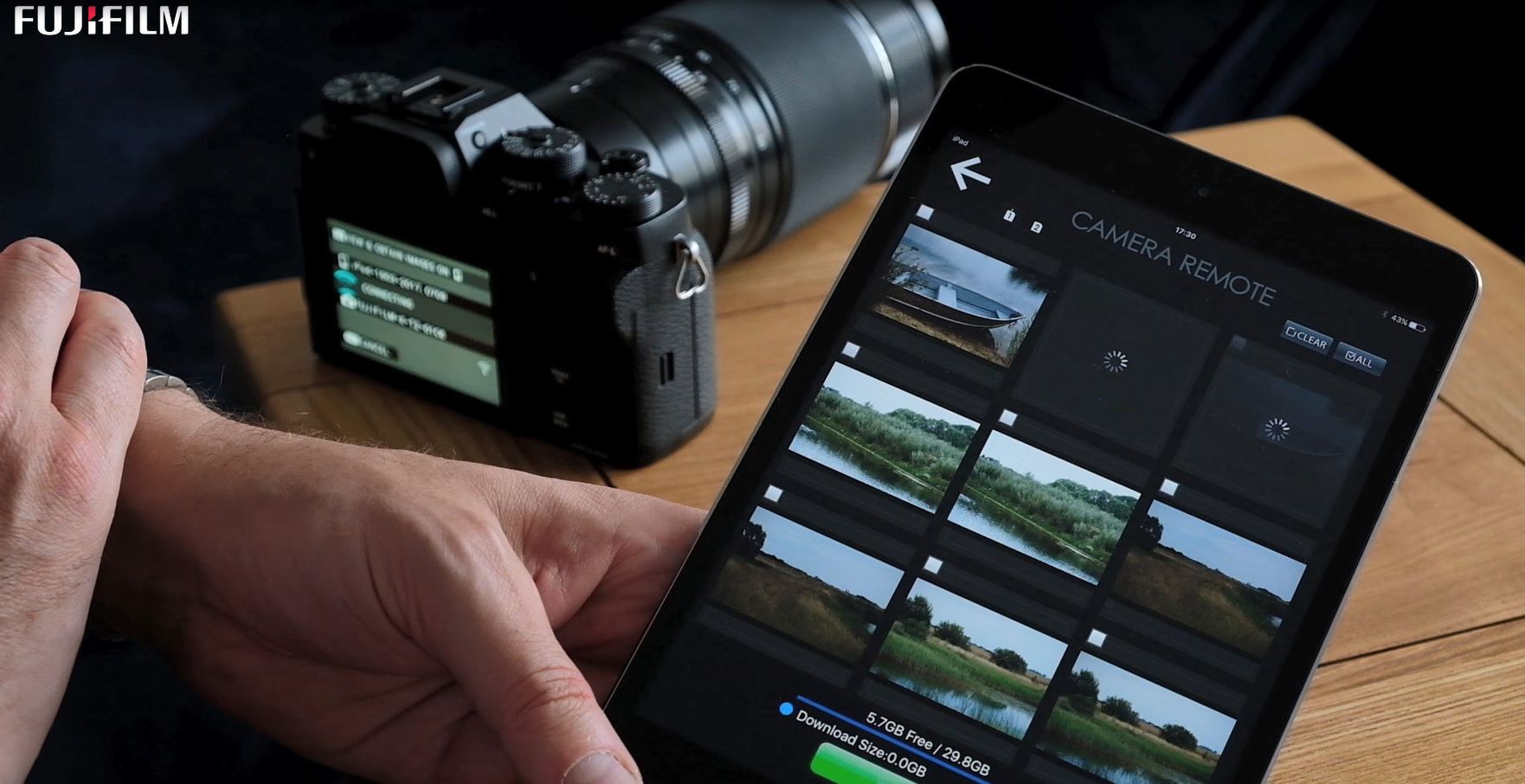
Want to get the most out of your Fujifilm X Series cameras? Our Quick Techniques will provide you with lots of handy hints and tips to help you understand the features our range offers. In the last article in this series, we look at the WiFi functionality of X Series. Read More
Our first X-Thusiast of 2018 evokes passion and inspiration with his colourful landscape photography. Learn how Singapore native David Tan uses his Fujifilm X-T1 to capture tranquil waters and sprawling outdoor scenes.
Kirkjufell – Fujifilm X-T1 with XF10-24mmF4 R OIS – 58 sec – F8 – ISO 200
Can you tell us a bit about yourself and where are you from?
Hey everyone! My name is David, and I was born and raised in Singapore. I’ve been living on the Gold Coast for the past year and am in the midst of completing my Bachelor of Pharmacology. My photography focus started around weddings and portraiture but has moved purely to travel and landscapes in recent years. I have been in love with the Fujifilm collection for the past three years and am absolutely honoured to be featured by Fujifilm Australia.
How did you develop an interest in photography using Fujifilm equipment?
While hiking up a mountain in Norway with my DSLR and heavy photography gear, I realised I wanted something a lot more compact and light that had the image quality I was looking for. A friend introduced me to the X-T1 and after a bit of research, I made the jump to Fujifilm and have never looked back. The X-T1 produces amazing colours, is intuitive to use and is easy to bring along on my travels, which is important to me.
Vestrahorn – Fujifilm X-T1 with XF10-24mmF4 R OIS – 30 sec – F16 – ISO 200
How would you describe your photography style and strategy?
Tough question! I think my style is pensive, quiet and to an extent, almost melancholic. I commonly incorporate water movement as it really adds to the depth of the photo. That combined with beautiful geographic formations is what really does it for me. Funny enough, I don’t like having people in my landscapes, though I’m quite a people person. I may possibly explore that in the future.
As for strategy, it is quite straightforward. Find awesome locations, wait till sunset then photograph it!
What inspires your photography?
Nature. Every time I see a mountain, waterfall or lake, I immediately want to photograph it. They seem so peaceful and I could sit there the whole day looking at it. At sunrise and sunset, it’s pure magic.
Where are your favourite places to take photos and do you prefer a certain type of light to photograph in?
Iceland is the definite winner, it has amazing landscapes which change so dramatically within such a short distance and looks almost out of this world. Australia and New Zealand also have really beautiful landscapes and are much closer for me to travel to.
I absolutely love shooting at sunrise and sunset; the light is golden and the sky gets some crazy colours. It’s the best when the light hits from the side and you get such a good depth.
Stokksnes – Fujifilm X-T1 with XF10-24mmF4 R OIS – 125 sec – F16 – ISO 200
What is your favourite memory from a photography session?
My favourite memory would be photographing Vestrahorn, Iceland. Driving around Iceland for eight days, eating hot dogs and sleeping in the car was an absolute experience. I didn’t know about Vestrahorn but when I drove past, the mountains against the black sand and ocean, I knew I had go back. I remember trying out a technique to stretch the mountains in-camera and was so excited to process the photo when I got back. It ended up being my favourite photo of the trip!
Can you tell us what your favourite Fujifilm camera to use is and why?
I’ve only ever owned and used the Fujifilm X-T1 Silver Graphite. It’s an amazing camera, aesthetically pleasing, shoots great photos and does everything I need it to do. The X-T2 would be an awesome upgrade and maybe the X100F might slip in there too!
Nugget Point – Fujifilm X-T1 with XF10-24mmF4 R OIS – 30 sec – F11 – ISO 200
Which Fujinon lens or lenses do you prefer to use with your Fujifilm camera and why?
For my landscape work, I exclusively use the XF 10-24mm F4. It’s got the focal range I need and has amazing image quality, much love for this lens. The XF 56mm F1.2 and XF 35mm F1.4 are also amazing lenses that I have used. Very sharp lenses, great colour and flare.
What sort of workflow do you use in your photography? Do you shoot in RAW or JPEG?
I’m a very straightforward workflow kind of guy. 30s shutter speed, ISO 200, f16, manual focus, 10-stop ND filter and tripod. This sets me up for the majority of my shots and really helps to keep me focused with composition rather than worrying about all the settings. I shoot JPEG + RAW which allows me to process multiple exposures of my photos in camera, which I then bring into Photoshop. Simple luminance masking brings back any details lost in shadows, luminance toning, colour toning, selective sharpening and a slight vignette to finish it all off!
Do you have any technical tips you’d like to share? Perhaps suggestions on the best lighting, shutter speed, white balance, aperture, ISO, etc? Other preferences?
Get comfortable with the technical side of it and know which parameters you need to achieve the look you’re going for, everything else is just compensation. A great way to start is aperture or shutter speed control. Once that’s down, your mind is free to explore the creative side of things without having to worry about the technical.
Again, I am a huge advocate of shooting during sunset, the light is golden, colours are vibrant and everything just looks beautiful. I’m also a lot more awake at sunset compared to sunrise. Knowing the location and how you plan on photographing it is also important for landscapes as it will determine if sunrise or sunset will work better for the photo.
Do you have advice for new photographers or the next potential X-Thusiast?
Make memories, not just photos. Too many times have I just gone out just to photograph an amazing location to come back home realising I didn’t soak it all in. Enjoy the view, sit on it and then, take the photo.
Arnarstapi – Fujifilm X-T1 with XF10-24mmF4 R OIS – 30 sec – F16 – ISO 200
Want to get the most out of your Fujifilm X Series cameras? Our Quick Techniques will provide you with lots of handy hints and tips to help you understand the features our range offers. This week we look at exposure compensation. Read More
Whilst out and about on your travels, I am sure you have come across a view that demands your attention and you instantly reach for the camera. “Wow, we were on this ridge and the view? Well you should have seen it. I tried to photograph it but it didn’t come out right. Why could I not do it justice? It just didn’t look the same as I saw it.”
I hear this all too often. Now I have to say here that there isn’t a generic answer, as every location, the available light etc. is different at that time but we can put a process into place that will ensure we do capture it well. A phrase I use regularly is, “a beautiful view doesn’t necessarily make a beautiful photograph”.
The great man Ansel Adams said, “We don’t take a photograph. We make it.” He is absolutely right.
So what does that mean? Putting it simply, it doesn’t just happen. We have to work at it and create the best from what we have in front of us. To explain, I often refer this to the analogy of baking a cake. Stick with me please! If we give six people the ingredients for a fruitcake they will blend them differently. They will present us with a fruitcake and whilst some will taste similarly they will all come out different. Subsequently, if you ask six people to take a photograph of the same view… you can see where this is going.
So, I liken the natural features we see in the landscape as ‘the ingredients’ and how we blend them and present will decide upon the way the photograph looks. Told you we would get there….
We know it as composition.
Understanding how your camera works will always help rather than just putting it on auto and hoping for the best. They are good but they all need controlling by us. No matter how technically competent you are with a camera, your photographs will lose impact if they are compositionally poor. The two factors go hand in hand.
We will assume then that you do have the technical under control. I find that the majority of people who come on my workshops have a basic knowledge of the dials and menus but struggle with composition. I have to say that that is not uncommon with those who are proficient too. A good image will ‘pull you into it’ and make you want to keep looking at it. The beauty of photography is that it is subjective. You only have to look across social media to see a plethora of genres being put out there for us to view. Interest is the key, inviting the viewer to become immersed in the photograph. Once lead into it, their eyes then dance around the frame.
We all have our own perspective on what we see but there are some rules or guides that you can use to enhance your photography. Of course ‘rules can be broken’ and occasionally something that goes against convention can still work. The most common guide that we read about is ‘the rule of thirds’.
Most camera menus now carry the simple grid that you can ‘impose’ in the viewfinder thus helping you ‘balance’ the image by placing interest in all three sections.
Mark Gilligan, Snowdonia – FUJIFILM X-Pro1, f5.6, 1/400th sec, ISO 200, Lee 0.6 soft Grad
This image of a waterfall with the magnificent Tryfan providing the backdrop is a good example of an unbalanced image. Whilst it is a nice memory shot for the photographer, it visually jars with you. Too much sky has made the photograph top heavy.
By changing position, introducing more interest into the frame (those ingredients again) and showing us how the falls integrate with the landscape, creates a much more pleasing photograph.
Mark Gilligan, Snowdonia – FUJIFILM X-Pro1, f13, 1/60th sec, ISO 200, Lee 0.6 soft Grad
Earlier this year I was invited by Granada TV to take Kerry Gosney, one of their weather presenters out for a full day’s workshop. It was to be filmed and inserted into the local news programme, recorded in the Longdendale Valley in Derbyshire. I was delighted to be asked and having produced and directed many programmes over the years, it would be a change for me to be on the other side of the lens!
When we met, Kerry readily admitted that she had no idea about taking ‘real photographs,’ but wanted to be able to. She had a basic understanding of how the camera worked and I talked about ‘the fruitcake’. That’s the analogy not me…
After introducing her to the FUJIFILM X-Pro1, we put on our wellies and stood in a delightful river called Middle Black Clough. The director shouted “Action!” and Kerry said, “So tell me Mark, why here? It is beautiful, such a lovely spot; the trees, the river, its waterfall and lots of rocks but why here?”
I asked her what else she could see. She shook her head. Why did she think I had picked this particular spot when there were a lot of options to explore? She reiterated the features of the scene again and whilst I agreed, I then pointed to the grooves that had been etched into the fault plane right under our noses. They lead the eye to the waterfall she was admiring. You will often hear people quoting leading lines and these were classic. Of course I mentioned the ‘fruitcake’ again and how we now had all the ingredients for a nice photo.
After getting the settings, we then set up the tripod and I showed her how it all looked in camera. Kerry was literally taken aback. “Wow I would never have seen that. Amazing!” I had added more depth to the image, allowing the foreground to dominate and by using a wide XF10-24mmF4 lens that exacerbated the lines, drawing you into the picture. “So, you are telling us that we should open our eyes more?”
I couldn’t have put it any better.
Kerry Gosney, Longdendale Valley – FUJIFILM X-Pro1, XF10-24mm, f13, 6.5 sec, ISO 200
The culmination of the shoot was to be an image that she managed to visualise and capture. As the producer said “We need a show stopper Mark, something that presents the development in a day.” No pressure then…
It was good to see Kerry being more deliberate about her choices and spotting things she felt were ‘good ingredients’ for a picture. After settling on a place by the river with a nice array of natural features, we set up and I liked what she had come up with.
Kerry Gosney, Longdendale Valley – FUJIFILM X-Pro1, f14, 125.0sec, ISO 200, LEE Big Stopper
This shot is thought out with the foreground rocks leading you to the little waterfall. You are taken into the image and then your eyes look around it. To give the photograph a little bit more appeal, I suggested adding a big stopper to create the swirls in the stream.
These are just a couple of examples of ways in which you can tighten up and present your photographs. Whilst you will initially be presented with a view that you come across, looking with your own eyes, it is good to approach the same vista by then looking through a lens. After all, that’s how the finished image will look. That’s the view you will present to people.
Never be afraid to experiment and you will find that different lenses will create different perspectives. Be choosy and only press the shutter when you are happy that you have the best of the scene captured. Just as importantly, enjoy what you do. It’s a great way of presenting the world the way that you see it to other people.


 By Felix Mooneeram
 Read More