Month: September 2017

11 Ways to Shoot Stunning Astrophotography

If you want a new challenge in your photography, take shots that are out of this world. Astrophotography, the art of recording objects beyond Earth, seems much like other time-lapse photography styles, but its dark skies and distant, moving lights present unique challenges to push you creatively.

Take stunning astrophotography shots by getting your physical setup and camera settings right for this genre.


Before you shoot, know your stars.


Study what you are capturing. By learning about star constellations, you can decide which stars you want to include and where in your composition you want them displayed.

Stake your spot to study the sky.


Determine where you want to shoot your astrophotography images. Get away from big cities and their light pollution. Go toward less-settled regions and their visible skies.

Photo by Bryan Minear


Fine-tune your whitest whites.


Astrophotography relies on stars’ luminosity, so make sure their whiteness is stark. Adjust your white balance, either through one of your camera’s preset or by manual alteration.


Increase your ISO.


Your camera’s ISO setting determines the light sensitivity of your camera’s image sensor, and astrophotography requires high sensitivity. Expect to shoot at ISO 400 or more.

Rely on manual settings.


Your camera’s autofocus mode is unlikely to stay locked onto a moving star. Use manual focus and if your camera enables focus peaking ensure it is turned on.

Photo by Photo Rangers

Stay steady for an unwavering shot.


Everything you know about camera sturdiness applies to astrophotography. Set up your most trusted tripod and, if you have one, use your remote shutter release. If you don’t have a remote turn on your camera’s self timer for two or ten seconds.


Place your focus on a single star.


With your manual settings, select a star or moon to test and improve your focus. For larger stars or the moon, locate their very edge and make sure it is optimally clear.


Embrace star trails.


As you shoot from the rotating Earth, your long-exposure photos show the path of stars in the sky. To highlight star trails, choose a wide-angle lens, which keeps a broader range of the paths in your focal region.


Or, alternately, eliminate star trails.


If you want to focus on the sky’s stillness, you can reduce star trails, though you may want to stash a calculator in your camera bag. Astro photographers follow the Rule of 600, or the Rule of 500, depending on whom you ask, to determine their maximum exposure before star trail becomes visible. Divide the rule’s number by the focal length of your lens. If you have a 28mm lens, divide 500 by 28 to get 17.85. This means you can shoot at an exposure of 17 or 18 seconds before star trail appears.


Do not forsake the foreground.


Astrophotography shots can still have earthly elements. Frame your shots with trees or hilltops to give your composition added dimension.


Utilise editing software for finishing touches.


Astrophotography benefits greatly from post-production edits. Alter your contrast, exposure and white balance until the sky tells the story you want.


Consider yourself an astrophotography expert, or at least more than a novice. Minding these principles of camera settings and general composition, you are ready to stun with your space shots.

Photo by Josselin Cornou


Want to purchase a Fujifilm camera, but not sure which one is right for you? Our Buying Guide can help you narrow down the list to find the best camera for your photography style.


Through a Photographer’s Eye: Harrison Candlin

Welcome to the Third Series of Through a Photographer’s Eye. In this series, we continue to learn about Australian photographers and how they use X Series Cameras to photograph their world around them. Our sixth interview in Series Three is with Brisbane based photographer, Harrison Candlin.

Harrison, your travel, adventure and landscape photography is spectacular. Why do you think you were drawn to photography and how will it impact your future career?


I think the reason I became so fond of photography is because of my father. I would like to say I followed in his footsteps. As a retired professional landscape and wildlife photographer, he always inspired me by his landscape imagery and how a person could capture and convey a scene with a camera. The ability to document the world around us; specifically, the natural world, opened my eyes to the possibilities of photography and how it could lead me to places and see things a bit differently to everyone else. As a travel, adventure and landscape photographer, I attempt to capture the true surroundings and emotional feelings of a scene. To me, that’s something that cannot be replaced, and this is how my style has evolved. Travelling around Australia and Europe has broadened my horizons immensely. Only four years ago I hadn’t travelled anywhere. I think the more of the world I get to see, the more landscape I can walk, and the more culture I experience, the deeper my perspective of the world will become. I’ll be a graduate Industrial Designer in a month, so having knowledge of the world is fundamental for design.


You mentioned on social media you used the Fujifilm X-E2S and Fujifilm X-Pro1. Can you provide some insight into why you choose a rangefinder over a Digital SLR?


They are both excellent cameras that have performed exceptionally well. Having previously owned DSLR’s, I never felt overly comfortable with using them and just never felt at home. The Fujifilm system is incredibly discreet and compact, and the light weight factor was a major selling point. The unique conservative design was different to the regular camera shape, and that caught my attention dramatically. Back in 2013 when I saw Fujifilm release the interchangeable lens system of the X-Pro1, I was captivated by its size, retro style, and image quality. Since then, Fujifilm and mirrorless cameras in general, have taken a huge leap forward in competition with DSLR’s. I think the major reason for wanting to own a rangefinder is its direct correlation to its old film predecessors. It makes me feel connected to photography, not just part of it.


Based on your experience, how would you describe Fujifilm’s quality when talking about image quality and the design of X Series cameras?


The image quality is superb. The colour rendition is phenomenal, and editing capability in the RAW files is outstanding for an APS-C sensor. Regarding design, Fujifilm to me has led the way in beautiful classic, refined cameras. The materials are solid, well-constructed and I feel the sense of true craftsmanship and dedication when using them.


Do you have a favourite location to photograph? How did you stumble upon it?


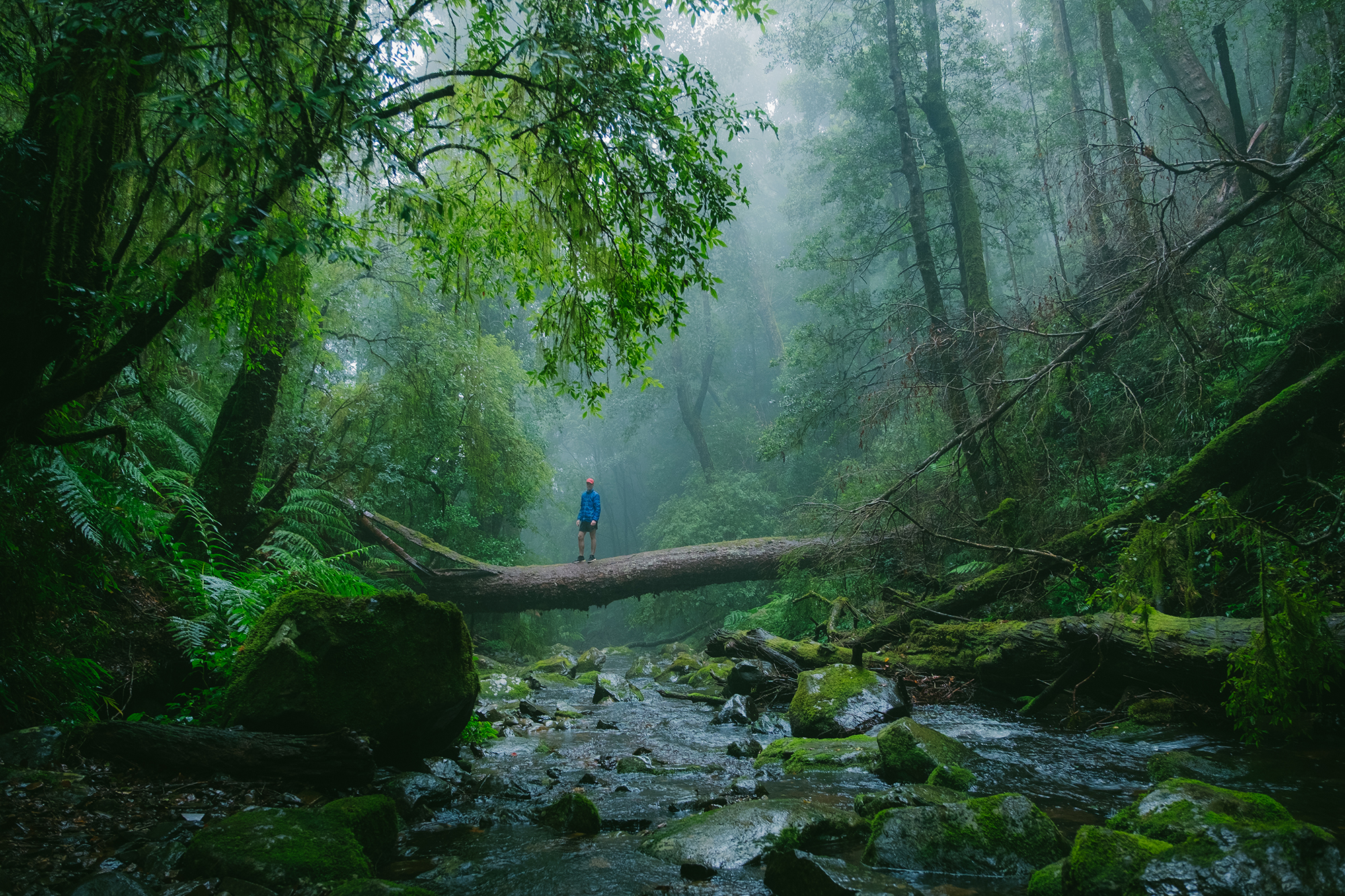
For me when I photograph in nature, I pursue the feeling of reflection and the escape that comes with it. The disconnect from the modern world when entering the natural, untampered world is a feeling I will always chase. Mount Barney National Park in the Gold Coast area and lately the New England National Park in the Northern NSW Tablelands has become a favourite place of mine. These places are relatively close to home and leave me with a greater sense of appreciation every time I go. I’m drawn to wild places where I can enjoy the surreal feeling of standing high on a mountain overlooking valleys, gorges, and lush rainforest. I’m very lucky to have such raw beauty and rugged mountains so close to home. I find most of my locations from word of mouth, books or Instagram.


How do you find the natural environment impacts your photography?


I’m lured by light and moved by the characteristic of the changing landscape. I feel a sense of security and embeddedness in the natural environment while I’m hiking and climbing, alone or with friends. It brings me to life. I feel freedom in the wild and can truly slowdown from the fast paced world. This is the basis for my photography. Enjoying the moment and slowing down, capturing what I can and leaving with a sense of accomplishment whether or not I took a great shot.


If you have some advice for someone starting out in photography, what would it be?


Just pick up a camera and have a go. A lot of learning comes from mistakes I have realised. Dedication is something you will need to develop over time. It’s a fundamental key in developing your style, your photography quality and most importantly, being there to capture it. I have driven numerous six-hour drives to the same places just to get the shot I want, only to find out I couldn’t get it. However, if you’re dedicated enough, you’ll always want to go back and pursue it. The beauty of photography though is you might not always get your intended shot, but something else will always pop up. To be honest, most of my work has happened this way. Capture it, work the scene, change your angles, get down low or up high and fire away. Improvise and be spontaneous.


Lenses obviously play an important part of overall quality, so with this in mind what lenses do you prefer to use and why?


In my field, the classic 24-70mm range out performs any other lens in versatility, and with that in mind, I use the Fujinon XF16-55mm (equivalent in 35mm). This lens is fantastic; weather sealed, durable, and exceptionally fast and well performing. In the travel, adventure, and landscape field, I always have a need to go wide and to go tight depending on the scene and landscape. Therefore, this lens covers the focal lengths I use most often while keeping a constant F2.8 aperture which is imperative for low light and shallow depth of field. Before I bought my Fujinon XF16-55mm, the majority of my landscape shots were shot on the Fujinon XC50-230mm. This lens is versatile because of its mid-telephoto to long telephoto length. It’s a great, light weight and cost effective lens that has served me for three years now, allowing me to take some of my best work in over five countries.


An expensive and fast lens doesn’t always make your photos any better. For city traveling purposes, I tend to use my Fujinon XF18mm, because of its small form factor, great width, and fast aperture. These are my go to lenses that cover nearly all of my photography and give the versatility to work scenes and make something brilliant. I have recently bought the Fujinon XF55-200mm.


What does traveling to new places mean to you and do you partake in any location research before you go?


I research a lot before I go anywhere, more so the access, facilities, and tracks instead of the photos. I like to be open minded when visiting new places so my images don’t sub consciously conform around other photographer’s work that I’ve seen.


To see more of Harrison’s photography visit his website or follow him on Instagram.

Previous interviews from Series Three of Through a Photographer’s Eye:

Through a Photographer’s Eye: Johny Spencer

Through a Photographer’s Eye: Gavin Host

Through a Photographer’s Eye: Mike Bell

Through a Photographer’s Eye: Ryan Cantwell

Through a Photographer’s Eye: Sarp Soysal


Sports Photography as a Spectator – Mountain Bike Racing

By Jeff Carter

In a series of articles X Photographer Jeff Carter will be shooting at sports events in the UK and showing how to capture great images with the Fujifilm X Series without the need for a media pass.


Sports Photography as a Spectator – Mountain Bike Racing

So far in this series I have attended seven sports events which I have shot at some point in my 25 year career as a sports photographer but for part 8 of the ‘Sports Photography as a Spectator’ features I attended the Scottish X Country (SXC) Mountain Bike Racing Series event at Dalbeattie, a sport that is a first for me.

INTRODUCING THE SCOTTISH X COUNTRY MOUNTAIN BIKE SERIES

The Scottish Cross Country (SXC) Mountain Bike Series offers everything from Taster events for novice mountain bikers to full on Elite racing, and everything in between. The series of six events across Scotland on some of the most challenging mountain bike courses in the UK.

The event I attended in Dalbeattie in Dumfries and Galloway took part on the forest trails just south of the town. The SXC event attracted a large entry of riders of all ages from under 12s to veterans, with the top riders in the Elite category also taking part to build up their points for the national titles.

Races are run over a predetermined number of laps depending on the class. The Under 12’s race took place on a shorter course over two laps, while the Elite riders did five laps over the full course.

[youtube=https://www.youtube.com/watch?v=zH0zutLxKgE]


BE PREPARED – What to Take

This is Mountain Bike Racing and takes place on forest trails that can offer some rough terrain, so dress accordingly. Also check the weather forecast before traveling and take wet weather gear for yourself and your photo gear if necessary.

As you are out in the forest take food and water as it can be a long day. While there is catering in the start finish area, it can be a long walk back if you are out on the far point of the course.

This is the first event in this series of features where I didn’t need the XF100-400mm f4.5/5.6 zoom as I was able to stand right next to the course. The long focal length was not required for the most part and under the trees the light was quite low so the f5.6 maximum aperture on the long lens would’ve forced me to raise the ISO to the top end of the range on the FUJIFILM X-T2.

For Mountain Bike Racing the XF50-140mm f2.8 is the best choice as you can fill the frame with the long end of the zoom while keeping the ISO lower in the challenging light conditions thanks to the f2.8 maximum aperture. I also had the 1.4x converter in my bag which I did use on a couple of occasions to give the lens a bit more pulling power. However, on the whole, I just needed the standard zoom range on the lens.

I also used the XF16-55mm f2.8 and XF10-24mm f4 zooms to capture the action around the course.


GET IN POSITION

You can stand right next to the course and there are no barriers apart from around the start/finish area. Remember mountain bikes are fairly quiet, so if you are walking on the course make sure you keep an eye and ear open for oncoming competitors.

As this was a sport I had never shot before, I arrived early and walked the course, noting down where the best positions were for shooting. Look for water splashes and jumps, which will make your images more interesting.

Also don’t just shoot from eye level, get down low or up high if possible to vary the angle. Another good position is to go off the course and shoot through the trees. A long exposure of a rider with the trunks or branches of the trees can produce a different composition.


SHOOTING THE ACTION

Mountain Bike Racing is not as fast as motorised sport but the riders can move quickly. It is good to inject a sense of speed into some of your images by dropping the shutter speed down to 1/60s or lower using the panning technique.

A fast shutter speed of between 1/250 and 1/1000s is necessary to freeze the action, especially for jumps and water splashes.

The X-T2’s AF system has no problem in tracking the competitors easily but with trees and other obstacles on the course the autofocus can get confused and lose the lock. I always set both of my X-T2s to ‘boost’ to improve the reaction time and the AF-C custom setting is set to Ignore Obstacles (set 2).

For this event I used single point AF and focused on the riders face or upperbody.

Be careful when shooting riders under the trees with a bright background. The final image could be under exposured because of the backlighting confusing the metering if you use matrix or centre weighted. If you are using programme, aperture or shutter priority modes I recommend using spot metering and dialing in the necessary exposure compensation to get the right exposure for the competitor.

For metering I used the centre weighted setting most of the time to see the exposure in the viewfinder. I shoot in manual exposure mode, with the shutter speed dial set to T and the rear command dial used to adjust the shutter speed. I also set the ISO dial to ‘A’ and use the front command dial to select the required ISO.

With the aperture ring adjusted by my left hand, I can adjust all three elements to get the correct exposure without taking my eye from the viewfinder.


FLASH GUNS

There were no restrictions on the use of flash at the SXC event but I chose not to use my EF-X500 flashgun just in case it distracted any of the competitors. If you want to use flash at a mountain bike race I recommend you check with the event organisers beforehand.


CHOOSING AN EVENT

There are six events in the SXC Mountain Bike Racing series and there are other series all around the UK. For more information on the Scottish series visit the SXC website and for the national scene visit the British Cycling website for more information on mountain bike racing and other forms of two wheel sport.


CAMERA AND LENSES

• Fujifilm X-T2 with battery grip
• Telephoto Zoom – XF 50-140mm f2.8 + 1.4x converter when needed. A good alternative lens in the 55-200mm f3.5/4.8 or the XF100-400mm.
• Standard zoom (16-55mm f2.8 or 18-55mm / 18-135mm) for wide action shots and portrait images.
• 10-24mm f4 wide angle zoom lens can also be useful a different perspective of the action.

Find out more about the X Series cameras and Fujinon Lenses.


CAMERA SETTINGS

• Shutter dial set to ’T’ (and locked). Shutter speed selected on rear command dial
• Optical Image Stabilisation (OIS) on.
• Metering set to Center Weighted, with Spot selected when the lighting conditions proved to be challenging under the trees.
• Autofocus – AF-C with camera set to ‘boost’ to improve reaction time.
• AF custom setting on Set 2 (Ignore Obstacles)
• AF Mode – Single Point
• Drive set to CH (8 or 11 fps)
• Action freezing images – 1/250s to 1/1000s with aperture wide open. Adjust ISO accordingly.
• Panning images – 1/125s to 1/30s will inject lots of movement in the image. Choose a suitable aperture and drop the ISO down to 100/200.
• People shots – Autofocus to AF-S and use wide aperture to isolate the subject from the background when using telephoto lenses.


PREPARING FOR MOUNTAIN BIKE RACING

• Check the weather forecast and dress accordingly.
• Take covers for your cameras. The X-T2 / X-Pro2 / X-T1 and the majority of Fujinon lenses might be weather resistant but I always cover the equipment when not in use. It is not just water, Mountain Bike Racing courses can be very muddy.
• Food and drink. There are usually facilities at an event but the courses are big and are in some rough terrain, so a snack and a bottle of water is recommended.


SAFETY FIRST

• You are standing right next to the course so keep your eyes and ears open at all times.
• Stay behind the marked areas in the start/finish area.
• Obey the instructions of the officials.


MORE INFORMATION

Scottish X Country Mountain Bike Racing: www.sxc.org.uk
British Cycling: www.britishcycling.org.uk


JEFF CARTER

X-Photographer: fujifilm-x.com/photographers/jeff-carter/
Website: www.macleanphotographic.co.uk
Blog: www.fujifilmXadventure.com
Instagram: www.instagram.com/maclean_photo/
Facebook: www.facebook.com/macleanphotographic
Flickr: www.flickr.com/photos/macleancomms/
Vimeo: www.vimeo.com/fujixadventure

X-Thusiast Featured Photographer Stephen Hobbs

This month’s photographer is Stephen Hobbs, who hails from England. He brings a unique perspective to photography with a natural approach. He enjoys working with manual cameras, so check out our interview with him to learn how he is developing his photography style.


Can you tell us a bit about yourself and where you are from?

My name is Stephen Hobbs, originally from a small town in England on the South Coast called Lee-on-the-Solent. I migrated to Australia 14 years ago, living initially on the northern beaches of Sydney but now on a vineyard in the Hunter Valley. I have several hobbies, which include sailing, motorbike riding, touring and, of course, photography.

Fujifilm X-T2 with XF10-24mmF4 – 1/60 second – F4 – ISO 6400


How did you develop an interest in photography using Fujifilm equipment?


My interest in photography developed while at college. I had a spare college unit and photography fit in the time I had. I was very lucky in having access to a darkroom and some very basic equipment. We used Zenit-Es — about as manual as you can get! Even had to manually stop down the aperture after focusing before taking an image. It’s maybe this history I have with a fully manual camera that first attracted me to the Fujifilm X Series range. I love the fact that I have access to these manual controls through dials rather than hunting through menu structures. It brings back memories of feeling in control of the image-making process rather than being reliant on auto this and auto that.


How would you describe your photography style and strategy?


It just keeps developing! I started off only printing black and white in a darkroom so I tend to be pulled back in that direction. I also love the SOOC (Straight Out Of Camera) jpegs using the Fujifilm simulations. ACROS is just amazing! I have recently been drawn to a more documentary style; I’m uncomfortable with getting people to pose, so I prefer a more natural approach to shooting images of people. I would love to try to convey emotion rather than just imagery, and it is an aspect I try to focus on more as my photography style develops. Over the years, I have been more a point-and-shoot person; it’s only been in the last few years that I’ve tried to focus on the emotion. Sometimes I feel like it’s only me who can see the emotion in a photograph, which is fine. Photography can be quite a selfish medium with most people taking photographs that only have meaning for the photographer.


What inspires your photography?

People doing everyday things. I love to try to capture people interacting with each other or their surroundings.

Fujifilm X-T2 with XF55-200mmF3.5-4.8 – 1/18 second – F5 – ISO 6400


Where are your favourite places to take photos and do you prefer a certain type of light to photograph in?


I generally prefer early mornings to any other time of day, empty streets, great tonal variations that don’t mess with dynamic range too much. My aim is to try to capture what I’m feeling when walking through empty streets. Whether that be local or while away on vacation. I also like to combine my love of motorcycle touring and photography. This is where the small-form factor of the Fujifilm system is a real bonus. That combined with having access to all the major controls externally.

What is your favourite memory from a photography session?


This is pretty easy, if you can count a two-week motorcycling tour in America as a single session. The landscapes through the mountains and deserts of the Western Seaboard of America are just amazing. The early morning light, while riding into Monument Valley is just perfect. Spine-tingling moments just made for the adventurous photographer.


Can you tell us what’s your favourite Fujifilm camera and why?


This would have to be the last one. I have owned the Fujifilm X-E1, X-E2, X-T1 and now the X-T2. The X-T2 is just amazing, the new simulations with the new sensor just delivers. Each camera has improved over the last while still keeping true to the heritage of maintaining and improving image quality. As a bonus, the usability of each camera has improved over the years, too.


Which Fujinon lens or lenses do you prefer to use with your Fujifilm camera and why?


I thought I would do the geeky thing and check which lens is used by looking up the metadata on the lenses used in Lightroom. I was surprised to find it was XF18-135mmF3.5-5.6, however, when I did the same after filtering on the rating it turns out that I consistently rate the XF10-24mmF4 based images highest of all. I’m not too surprised, as I just love this lens.


Fujifilm X-E2 with XF10-24mmF4 – 1/400 second – F7.1 – ISO 200. Converted in to Black and White in Silver Efex Pro.


What sort of workflow do you use in your photography? Do you shoot in RAW or JPEG?

I always shoot both RAW and JPEG, however I only used the RAW file when there is a really good JPEG image that I want to spend more time on. The vast majority of the time the SOOC JPEGS are perfect for my needs. All post processing is done in Lightroom, with ample use of the Silver Efex Pro plug-in when needed.


Do you have any technical tips you’d like to share? Perhaps suggestions on the best lighting, shutter speed, white balance, aperture, ISO, etc.? Other preferences?


I really am an amateur so don’t necessarily feel qualified to provide technical tips on how best to set up the camera. The only advice I would give would be to try to carry the camera with you as much as possible. You can’t capture that one in a million shot if the camera is in a bag at home.

Fujifilm X-T1 with XF10-24mmF4 – 1/420 second – F10 – ISO 400


Do you have advice for new photographers or the next potential X-Thusiast?


Don’t be afraid to take the shot and remember that another person’s criticism is just their opinion. Remember, someone paid a lot of money for a pile of bricks at the Tate Modern and we are still talking about it today, maybe that was the artist’s aim? If that was the artist’s goal then surely it succeeded beyond the artist’s wildest dreams.


Are you interested in becoming our next featured X-Thusiast photographer? Check out our full X-Thusiast Gallery and submission details.


Through a Photographer’s Eye: Sarp Soysal

Welcome to the Third Series of Through a Photographer’s Eye. In this series, we continue to learn about Australian photographers and how they use X Series Cameras to photograph their world around them. Our fifth interview in Series Three is with Melbourne based photographer, Sarp Soysal.


Sarp, your story about how you started photographing with the X100 is quite interesting. Can you share it with us?


Ah yes, it is actually a pretty interesting story but a little tragic at the same time. I was travelling around Europe a few years ago on a personal photography project with a fair bit of gear: a Nikon body and a bunch of lenses and even speedlights. I also had a tiny little backup camera buried somewhere deep in my backpack that I never touched and had barely even used before.


One day when I was shooting in Paris, my Nikon was set up on my tripod, and for some strange reason that I still haven’t figured out, the camera fell off and shattered. As a broke backpacker, I wasn’t at all in a position to buy any new gear, so I had to reach into my bag for that tiny backup camera which was, as it turns out, a Fujifilm X100.


I didn’t have much experience with this camera, but it was all I had to finish my project. I remember sitting in my hotel room and trying to figure out how I was going to finish working with this one small point and shoot and its fixed lens. It wasn’t even a full frame camera, and this was around five years ago when full frame cameras were seen as the only professional cameras. But when I actually started walking around with the Fujifilm X100, something quite strange happened.


Through its optical viewfinder, the world looked different. It reminded me of being a teenager and using my dad’s analogue rangefinders. I didn’t have my bag of lenses for every possible shot, but through Fujifilm X100’s fixed lens, the streets started to look more romantic to me almost. I would say this was the beginning of a very important, almost spiritual, transformation for me.


In the way, I shoot, see the world and travel. While I felt pretty lost after I broke my Nikon, in the end, I managed to complete my project with some pretty special images thanks to my little Fujifilm camera. Needless to say, when I arrived back in Melbourne, I sold all of Nikon gear including that ridiculous backpack. And I have never looked back.


After moving from the Fujifilm X100 to the Fujifilm X-Pro2 what sort of advantages have you found the newer camera offers?


I think the biggest advantage of the Fujifilm X-Pro2 over X100 for me is its weather-sealed body. Already, while travelling, my X-Pro2 has withstood thunderstorms, unexpected torrential rain, bumpy bus rides, the ridiculous dust of Kathmandu and you name what else. The X-Pro2 feels tough in my hands, with its brick-like body. Secondly, obviously, the X-Pro2 is a much faster camera than the X100, which is very important for my photography style, mostly being snapshots on the street. Despite these things though, I still have my original X100 and from time to time, shoot with it, for old time’s sake. It will always have a special place in my heart.


If you could explain X Series cameras to someone who had never heard of them before what would you say?


Well, that’s quite a difficult question to answer. Let me put it this way: I wouldn’t explain X Series cameras from a technical perspective but more an emotional one. Pretty much every camera brand on the market at the moment, many of which I’ve shot with in the past, is almost like shooting with a computer rather than a camera. Most of their mechanical or software features that help sell them don’t really add much to your shooting experience and in my opinion, don’t serve a lot of purpose in the actual field.


X Series cameras, however, are so thoughtfully designed, with the photographer’s experience in mind, they feel to me like an extended eye, or like an additional organ. The dials, the viewfinder and even their compact size and grip really create a very organic shooting experience that doesn’t distract you from creating images with technical functionality or settings. So if you ask me to explain X Series cameras, I’d say they are cameras for creativity and for storytelling. They are cameras with soul.


Travelling is obviously high on your agenda, where have you been recently and can you share your favourite photo and tell us the story behind the image?


Most recently, I did a 100 days project, beginning with a road trip from Melbourne to Queensland and then three months travelling across Asia. I visited Indonesia, Malaysia, the Philippines, Vietnam and finally Nepal, where I am at the moment. I challenged myself to post a photograph everyday on Instagram that represented that day which turned out to be harder than I thought but I did it only skipping maybe 2 or 3 days. If I look back on my Instagram feed now, I’d say that my favourite image would be from day 40 of the journey, not necessarily because it is the best photograph but because of the story behind it.


I took this photograph in the south of Cebu Island (Philippines) on a modest fishing beach called Santander where all along the sand, there are tiny homes housing the families that collect seaweed and fish every morning. On one of my walks down to the beach, I found myself in the home of about 7 or 8 little hooligan kids who welcomed me with excited screams, dancing, playing and just general tomfoolery. These kids had next to nothing. Their clothes were ripped and dirty, their shoes didn’t match, and their play equipment consisted of some rope, a tree and a few planks of wood. I have honestly never seen happier, more energetic kids.


I ended up visiting these kids a few times during my stay on the island and got to know the family a little. I couldn’t stop taking their photographs because they got so adorably excited about having their picture taken and when they’d see their own faces on my LCD screen, they’d go crazy. I think I was the first person to ever take their photograph.


While portraiture isn’t my forte, I had to capture the kids’ faces which just beamed with spirit and hope. To me, this photograph is both a story and a lesson. It tells of hope and need and happiness and most importantly, of how much you actually need in order to be happy.


If you have some advice for someone starting out in photography what would it be?


I’d say the biggest piece of advice I’d like to share with young photographers is not to get trapped in the technical side of photography or with camera reviews, equipment choices and stuff.


In my opinion, the most important first step is to get to know the gear that you have, whatever it might be, and understand everything about it so you can learn how to work with it and how to make it work for you. Because at the end of the day, when someone is looking at your photographs, no one cares really about what settings you used or what camera you have. It’s about the story you tell.


As any skill or art form, it requires a lot of practice. So take your camera with you everywhere and use every outing as a learning opportunity. Devote 20 hours a week, every week to making photographs. Get yourself a good pair of walking shoes and hit the streets or parks of your town or city and just shoot. Eventually, you’ll find your voice, and then you can focus on developing your own photographic style to tell your own stories.


You said the following statement after photographing with Fujifilm equipment over the last five years:

“My style has evolved to be a kind of poetry: subtle metaphoric images that tell stories through layers and light, shadows and figures”.

Can you provide a photographic example and explain the romance behind the image based on this statement?


Like I said before, X series cameras aren’t technically distracting so when I’m shooting on the street, I’m able to enter a kind of zone in which I am completely tunnel-visioned: all I see are light and shapes. Over time my photographs have moved more and more away from obvious compositions and stories and more towards combining elements under interesting light.


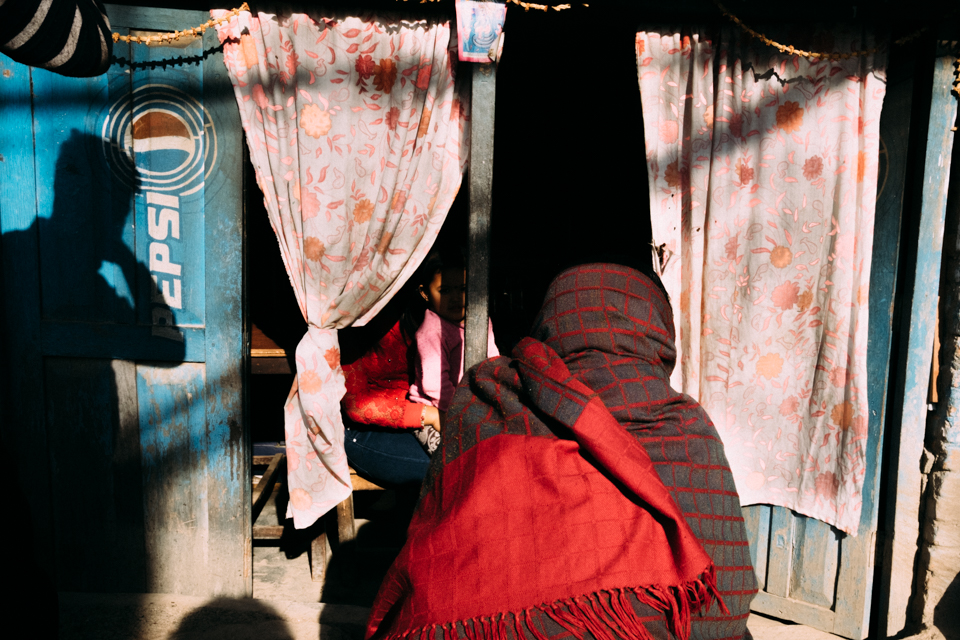
Most of the time, I take scenes that are seemingly nondescript but that through my lens I know will become something quite interesting. This image, for example, is one I took in Kathmandu, Nepal this month. While to my partner, it was nothing more than an ordinary Nepalese house front, to me, the shadows created a mysterious story: to whom does the hand belong? What is the child looking at? And why is he dressed so smartly while living in such an apparently poor house?


I like to make people wonder, and I think that my favourite kind of photographic story is not the one that I tell myself but the one that someone who looks at my photograph will imagine.


We noticed in your portfolio you have a number of portraits, can you give any tips on how to best approach people on the street to take their photo?


It’s funny that you say that because to be perfectly honest, I never feel that portraiture is my strong point. But I do like to include people and faces in my street scenes. I don’t really have any specific approach per se, but I do feel that if you’re a shy person, you will struggle as a street photographer. It is largely about engagement, with the elements around you and most importantly, the people you intend to photograph.


I suppose my photography reflects my personality in general as someone that tends to engage with strangers quite a bit, especially while travelling. To take someone’s portrait, is a kind of unspoken negotiation a lot of the time, relying on body language and your ability to read the situation. That said, a lot of the time, I usually avoid any kind of engagement before I’ve taken the shot.


My photography focuses a lot on candid, organic moments and so I like to be invisible. I even avoid eye contact because once the person is aware of the camera, the scene is shattered. Afterwards, I like to engage, chat with them or ask them questions depending on how open they are. And mostly people don’t have a problem with their photograph being taken.


The Melbourne streets are far from your travels, what do you like most about returning to the ‘Most Livable City in the world?


I love shooting on Melbourne’s streets. I guess it’s where I feel most comfortable. I have been living in St Kilda East specifically for almost seven years, and I’d say that the surrounding suburbs like Balaclava, St Kilda and Chapel Street are my usual photographic battlefields.


I know the culture and city very well, so I know how people usually react to my camera on the street which is important for the kind of work that I do. There isn’t the same chaos or exotic situations that you’ll find in Asia, but there is a very distinctive light that belongs to Melbourne that I think is almost recognisable. It helps to create its own kind of mysterious and dramatic images in an otherwise very orderly city.


To see more of Sarp’s photography follow him on Instagram.

Previous interviews from Series Three of Through a Photographer’s Eye:

Through a Photographer’s Eye: Johny Spencer

Through a Photographer’s Eye: Gavin Host

Through a Photographer’s Eye: Mike Bell

Through a Photographer’s Eye: Ryan Cantwell