Month: November 2016

Leave Nothing To Chance

X-Photographer strip BLACK

By Omar Z Robles

A good friend once told me that success often comes when two things take place: chance and readiness. I am a firm believer that it takes more of the latter than anything else. Chance…well, that could be a matter of perception. Too many people believe that situations must be just right in order to be successful, only to end up disappointed and frustrated.

Let’s rethink that approach. Replace chance with persistence, and see how that goes. Don’t worry; this is not solely a self-help post…photography, coming right up.dscf1650On my recent trip to Mexico, there was a multitude of moments where things were not how I planned – or, where circumstances changed unexpectedly. When you are traveling into new territories, you are most likely going to run into these types of scenarios. What’s important is how you handle them. I’d like to share just a two examples with you and how persistence and readiness help me pull through.dscf3393A few local people had told me that I should consider shooting in Xochimilco due to the colorful “trajineras”. Trajineras are boats colorfully adorned which take groups of people along the canals. I did a little research and thought it was a great idea. I consulted it with one of the dancers and she was thrilled with the concept. The excitement grew alongside my expectations. In order to make it there, we had to travel nearly an hour outside of the city. Upon arrival, my heard sank. I soon realized that shooting at this location was going to be more than challenging. The place was PACKED with people and to make matters worse, light was fading fast.dscf2061My initial idea was to photograph the dancer on a floating boat with other boats on the background. It was going to look AWESOME, or at least it did in my head. Unfortunately, the canal was overcrowded and we would be unable to execute the initial plan. Light was still fading and we were too far away from the city to turn back and find a different location. I would have to make due.dscf1324The important thing is that I had already been rolling with the punches. Since I arrived on location, despite the location being less than ideal, I was constantly shooting. I wasn’t waiting for the perfect setting; I was ready to make the setting work for me. We continued scouting a few locations around the area and shooting simultaneously. At the end of the day, I was really satisfied with the images we achieved.dscf2022The next example had even higher expectations. It was the Day of the Dead. The plan was to visit two cemeteries with two dancers and use with the festivities happening as part of the backdrop for the images. Again, it all looked incredible in my head. This time we had to travel even farther away, about 2 hours, to Cuernavaca.dscf3419When we arrived to the first cemetery, I quickly knew the day would be not as I had imagined. Did I quickly pack up and leave? No, I told the dancers to get ready and we shot a few frames. After some time, I decided to move to the next location. As we were approaching the next cemetery, we diverted into an interesting alleyway. We shot some frames and as we headed back, I stopped to shoot once or twice along the way.  I saw the sunset starting to break and made the decision to keep shooting on that street. After a few minutes passed, an adjacent street caught my eye …so we kept shooting.dscf3873I felt a few drops of rain as the sunset came into full effect. I changed my lens to XF90mmF2 R WR just in case, even though I didn’t see many clouds. What happened next none of us was expecting: a heavy storm broke and the day transformed into night almost immediately. Thanks to the X-T2 and XF90mm’s solid weather sealing, we were able to push on and continue shooting.dscf4100In both of these examples, the reality of each situation was nowhere near my expectation. Yet in both cases, I was able to capture some beautiful images beyond my imagination. We weren’t quite able to shoot at the locations we had set out to shoot. That didn’t stop me. I was persistent and kept shooting, making the circumstances work for me and not the other way around. I took control of my “fate” and didn’t allow the obstacles set the tone or disappoint me.dscf4065Shooting with the X Series system also contributes greatly in these moments. Being able to see an exact preview of how my images are going to look like on the EVF and rear screen helps me visualize what is going on and make sound decisions towards my goal. The weather sealing and excellent high ISO performance also keep me confident in all sorts of tricky moments. In those moments, I know I’m capable of capturing the perfect shot, but it’s up to me to persist.

(Soft)box of tricks

How a cardboard box can be turned into a useful light modifier for the grand sum of 60p

I was in my garage the other day and realised something; it’s full of empty cardboard boxes. It’s a shocking confession I know, but what with eBay and other things you just never know when you might need a box, right? The 53 I counted, however, maybe considered a little excessive. I started to think whether I could trim the numbers down a little and my mind drifted to the fact that I’d been taking some flash images a couple of weeks earlier where I’d been a little disappointed by the harshness of the direct flash light. Within moments, a plan was hatched.

ks2_5730

After a root around in the section of the garage not populated with cardboard, plus the kitchen drawers, I ended up with this selection of goodies with which I decided to make a softbox:

  • 1x small cardboard box
  • 1x roll of kitchen foil
  • 1x roll of electrician’s tape
  • 1x pair of scissors
  • 1x flashgun (I’m using an EF-42)
  • 3x sheets of tracing paper at 20p a sheet
  • 1x bottle of glue (optional)

ks2_5732

I started by placing the flashgun in a central position on the box and drawing around it to give me an approximate shape of the flash head.

ks2_5733

Grabbing the scissors, I cut the shape out, going slightly inside the lines I’d drawn to make sure that the head fitted through snugly. 

ks2_5735

Confident my cutting skills had progressed from primary school, I taped the sides of the box down. They could have been cut off, of course, but I preferred to tape them down to create slightly more robust sides to the box.

ks2_5737

I used a couple of lengths of foil to coat the inside of the box. This could be glued down if you wish, but the nature of foil meant that it moulded to the shape nicely and stayed put. There’s no need to smooth it down, just as long as the light can happily reflect around, you’re fine.

ks2_5739

Having covered up the hole in the box, I then cut a second hold through the foil and pushed the flash head back through.

ks2_5740

Putting the box to one side, I took a sheet of the tracing paper and folded it in half to provide the diffusing panel for the front of my softbox. As it transpired, I only needed the one sheet, but you could use more if you wanted an even softer result.

ks2_5741

The tracing paper was then taped on all four sides of the box leaving it ready for action.

Now, it’s pretty evident that my box had a flaw in that it covered up the AF illuminator. As I was only working in dim light, this wasn’t an issue, but if you want to shoot in pitch black you’re going to struggle. There are no worries about metering, though, the X-T2 I was shooting with has TTL metering so I could be sure of accurate exposures.

So, just how good was my softbox? I’d say the results speak for themselves:

dscf2076

This first image was taken without the softbox attached. As I was close to the subject with the EF-42 flash mounted on the camera’s hot-shoe, there’s an issue with coverage. The flash hasn’t illuminated the bottom part of the frame very well, plus the shadows behind the soft toy are very harsh. All in all, not the best.

dscf2073

With my softbox in place, however, there’s a real improvement. The coverage is much more even and the shadows are far less harsh.

dscf2074

But this shot is arguably even better, created by pointing the flashgun, with softbox attached, straight to the ceiling. It’s created a lovely even top light to the toy, which looks more like studio lighting than a flashgun with a cardboard box stuck on it.

Not bad for 60p and 30 minutes of my time, is it?

Perfecting Food Photography with FUJINON Lenses

guest-blogger-strip-black

By Nicole S. Young

One of the most common questions I receive from new photographers is which lens to use when photographing food. When choosing gear there is never a correct choice; it all boils down to the type and size of the food, your workspace and setup, the style you hope to achieve, along with how you want your final image will look. Each lens will have advantages, and even disadvantages, depending on your setup. Here is a list of a variety of lenses, along with why you might choose each type of lens for food photography.

Macro

nicolesy-food-1
FUJIFILM X-T2 with XF60mmF2.4 R MACRO Lens at 1/7 sec at F4, ISO 200

A macro lens is an obvious choice for photographing food. You can get really close to the food to highlight certain elements, and also easily photograph and fill the frame with small items, like berries or tiny bites of food. Depending on the camera you use, macro lenses come in different ranges of focal lengths.

Keep in mind that a macro lens is not always necessary to photograph food. With full-frame cameras it is sometimes necessary to use a macro-capable lens in order to get close enough and fill the frame. And, in some cases, getting too close to your dish may not be the best way to photograph it. With crop-frame cameras, such as with the FUJIFILM X-T2 used for this photo, a macro lens is not always a requirement. Because of the crop factor there is the perception that the camera is closer to the subject, and so a macro lens is only a real necessity when you want to get really close and fill the frame with small items.

Wide-Angle (12–24mm)

nicolesy-food-2
FUJIFILM X-T2 with XF18-55mmF2.8-4 R LM OIS Lens at 1/4 sec at F6.4, ISO 200

In most cases a wide lens will be best for overhead setups. The space I use to photograph food in my home is too small for a wide-angle lens to be used without including other elements, such as the window or reflectors. Instead I reserve the wider focal lengths for overhead shots.

Mid-Range (35–75mm)

nicolesy-food-3
FUJIFILM X-T2 with XF35mmF1.4 R Lens at 1/20 sec at F2.8, ISO 200

A mid-range lens, especially one that has a close focusing distance, can be a good option for food in any environment. I like to use this type of lens when I know I will want to photograph my dinner while traveling (for example). It is long enough to compress and blur the background, but narrow enough to not include too wide of an angle of view. I can also still sit quite close to the food; with a longer lens I need to move back a few feet, which can be difficult when sitting at a dinner table.

Medium Telephoto (90–120mm)

nicolesy-food-4
FUJIFILM X-T2 with XF90mmF2 R LM WR Lens at 1/9 sec at F4, ISO 200

The medium telephoto lens, also known as a good range for portraits, is also a great focal length range for food photographs. One of my favorites is the FUJINON XF90mmF2 R LM WR; I can get in close to the subject, and also compress and blur the background quite well.

Telephoto (140mm+)

nicolesy-food-5
FUJIFILM X-T2 with XF50-140mmF2.8 R LM OIS WR Lens at 1/10 sec at F4, ISO 200

When you have a lot of space to work in and really want to compress and blur your background, then a telephoto lens might be a good option for you.  This type of lens will typically work well with crop-frame cameras, which is great news for Fujifilm users! On full-frame cameras, however, you may find that the focal length will not allow you to get close enough to the subject to get it in focus. However even with this setup (a small item of food) I was unable to get a tight shot of the bruschetta with my FUJIFILM X-T2 because of the limited focusing distance, but with a larger dish this lens might work well.

Shooting live events with Fujifilm X Series cameras

_dsf0134-edit

By Matt Hart

Shooting live music events is one of the trickiest disciplines in photography. Subjects move a lot, often lighting changes constantly and in general it can be a lot of hard work. With that said, live music events have passion by the bucket load and if you can capture that in a single frame it makes for some exceptional images. It could be a front man working the crowd, the guitarist tearing up a solo or people attending having the time of their lives, whatever it is, the subject matter can never be accused of being dull.

In this blog, I’m going to get a bit technical running you through the kit I use to shoot events and the reasons behind it. Also, we’ll cover what to look for when photographing live music. Enjoy!

matt0083-edit


The kit

Right, let’s jump straight into it by running you through my usual kit for shooting live music and festivals.

Camera:

I usually take two camera bodies with me. The reason I do this is so I can use two different lenses and change quickly between them. My preference is the Fujifilm X-Pro2 and the Fujifilm X-T2 with the battery grip. Overall, the cameras are similar in terms of feature set but the build and handling of each make them serve a different purpose. The battery-gripped X-T2 has several advantages – Firstly, it allows me to shoot all day without needing to change batteries over. Secondly, I can switch to portrait and landscape orientation easily and lastly, the joystick for positioning the AF point is incredibly useful for accurate and quick focusing on specific subjects.

While the X-Pro2 is more than capable of shooting a live music event or festival, I like to keep the X-Pro2 free to shoot images of interesting people. These days I shoot with the X-Pro2 almost exclusively for my street photography, so bringing it to a festival makes a lot of sense for me. I’m taking my ever-faithful street photography setup and just applying it to a slightly different environment. For me, the main benefit is the rangefinder style. Unlike the X-T2, the viewfinder is off-centre and when you point it towards a subject, it doesn’t look like you’re aiming directly at them. This means people are far less likely to close up and act differently. Pointing a huge camera directly at a person usually means they’ll pose for their picture, but my aim is to capture the more candid, natural moments instead.

_dsf0150-edit


Lenses:

With a lot of events, you will be firmly planted in what is lovingly referred to as ‘the pit’. This is the area at the front of the stage where you can see the performers and have the opportunity to take shots of them. For this, I will opt for the XF50-140mm lens. Its focal length suits subjects that are quite far away and it also allows me to zoom in enough to get a tight shot should I want to capture that. It’s also very useful for capturing people in the crowd on each others shoulder too.

_mkh3857-edit

With the exception of the Fujinon 50-140mm XF lens, I mostly shoot with prime lenses. My kit bag usually comprises of the Fujinon 16mm f/1.4, Fujinon 23mm f/2 and sometimes the Fujinon 90mm f/2 lens too. I like to have the have fast, wide prime lenses, especially in low-light situations. I will alternate between the 16mm and the 23mm often and occasionally draw upon the 90mm when I want to capture close-up portraiture or to shoot a subject I want to isolate from the background.

_mkh5233-edit


Alternatives

In general, I use primes as I just love all the characteristics they give. However, there are a couple of zoom lenses which are incredibly sharp and suit shooting events perfectly. Firstly, the Fujinon 10-24mm f/4 is a fantastic lens. It’s wide enough for big stage shots, capturing crowds and potential to get very creative too. Another great lens is the XF16-55mm f/2.8 this serves the purpose of all of the primes and it’s a bit more convenient not having to switch out lenses.

matt0163-edit


What shots to look for

Many moons ago I shot club nights and festivals week-in week-out but these days I’m not shooting for a promoter or club, instead I’m shooting for myself. My brief is set by myself so I’m trying to look images that excite me. It’s all about capturing the mood and telling a story of the event.

Here are a few of the key shots to look for when shooting an event.

1. Performer shots

Capturing musicians in action is quite tricky. If they’re moving fast in low-light in can be incredibly difficult. The important thing to remember though is what the viewer is going to want to see – that’s the musician and possibly some environmental context if it adds to the composition. If the subject is the main focus I prefer to shoot wide open and isolate the subject. If there’s something interesting like a DJ with their decks or a rack of guitars I might stop down the aperture or shoot the scene with a wide angle lens to give a sense of the environment.

_dsf0170-edit

matt0010


2. Crowd shots

If you’re shooting from the stage or in the pit, it’s always worth spinning around and checking out what the crowd are doing. A well timed pyrotechnic or a person on another person’s shoulder makes for an amazing picture. Sometimes I walk along the front row and pick out a group of interesting people.

_dsf0113-edit

_mkh5315-edit


3. People shots

Interesting people and music events go hand in hand. The crowd shots are always good, but I love to get into the crowd and capture the people having fun. Essentially, I take a street photography approach to this. I want people to be relaxed and natural around me, so before I start taking any pictures I walk around in the crowd, blending in and just enjoy myself. Once you’re in there amongst everyone you can begin to capture what you see in front of you which will be a unique perspective.

matt0235-edit

_mkh3291-edit

_mkh6021-edit


4. Capturing the atmosphere

You simply can’t stage atmosphere – It’s either there or it’s not. The shots that I find myself looking at time and time again are the ones that tell the story of what the festival was like. It’s all about capturing the moment and the soul of the event. Now, there’s no hard and fast way to capture this kind of scene but if it sounds good, the crowd are noisy or the hairs are standing up on your arms, shoot what makes you smile!

_mkh5601-edit


Portrait Photography – Take Your Photography to the Next Level

Australia strip BLACK

Taking portraits?
Need some advice?

portrait-photography-006


One of the reasons why people choose to buy a camera is for portraiture, or more specifically, so one can take photos of friends and family. This may be the reason why you purchased an X Series camera or even why you might be considering one.

Let’s assume you have an X Series camera in your hand for the first time and wanted to capture a portrait. Looking down at the dials on top of the camera may leave you feeling quite lost about the settings you should use to capture the perfect portrait. It is a common ‘freak out’ moment among many first time users, so don’t worry.

In this article we will explain how to capture a portrait if you are just starting out using automatic mode and if you wish to grow in your photography level 2 explains a more professional approach to portraiture using aperture priority.

Level 1 – Beginner: Automatic Mode

Fujifilm X Series cameras are built from the ground up to enable anyone to capture a perfect photo no matter what their experience. The balance of intelligent design, research and development combined with incredible image quality boasts itself in all modes of the camera, including the automatic mode.

Sometimes just picking up a camera and turning it on to capture the moment is all you need to do. It can be a great starting place to invigorate your creative spark and really get you into photography.

To start operating your X Series in Automatic mode change the following settings pictured below to the red ‘A’.

portrait-photography-004

portrait-photography-005

Depending on the Fujinon lens, you may also find the ‘A’ setting on the aperture ring.

portrait-photography-008

The settings we will explore in this article (and pictured above) include shutter speed, aperture and ISO. These three corner store settings will form the base of your photography skill over the years and understanding them will take time so don’t worry if it doesn’t all sink in to begin with.

Basically, by setting the camera to auto you tell it to automatically calculate how much light should be let into the camera, how much of the subject should be in focus and how light sensitive you want the camera to be. These three settings are shutter speed, aperture and ISO respectively.

The second step when photographing in automatic mode is to ensure you select automatic focus or ‘S’ on your camera. Selecting this mode will ensure whenever you half-press the shutter button to take a photo of a stationary object (in this case a person) the camera will autofocus on the subject automatically.

portrait-photography-002

Tip: If you are photographing children, turning the focus mode to ‘C’ for Continuous as this is the best option for moving subjects.

portrait-photography-007

So you see, this mode isn’t all that hard to use. You will be surprised what success you can generate when photographing in automatic mode.

Tip: Did you know the Fujifilm X-T10 has an automatic switch that overrides all of the cameras settings? This feature makes the Fujifilm X-T10 a perfect choice for entry level photographers.

portrait-photography-001

If you want to take your photography to the next level it’s important to learn a few things about aperture priority and F-stops.

Level 2 – Professional: Changing your aperture (F-stop)

Changing the what?

F-stop is a term that refers to the amount or value of light coming in through the lens and it’s commonly referred to as aperture, something we briefly talked about when describing automatic mode.

Aperture, put simply is an adjustable sized hole in the lens you can change. The aperture is measured by numbers (F-stop), and selecting one of these numbers will determine how much of the subject is in focus. We will explain the numbers that appear on the lenses further through images for a clearer comparison, but first, do you remember when we talked about the corner stone settings that will form a basis of your photography?

portrait-photography-003

Aperture is one of those corner stone settings, so this means whenever you manually choose a priority setting, like shutter speed; aperture; or ISO, the camera will automatically take care of the remaining two modes. In this case, we would be changing the aperture by manually selecting the F-stop found on the lens, the shutter speed and ISO would then be set to automatic ‘A’. The jargon for this would be to say we are shooting in ‘Aperture Priority mode’.

Many portrait photographers photograph in Aperture Priority to ensure they utilise the best depth of field their lens can offer. The resulting picture is a subject in focus separated from the background by blur. If you are to take one thing away from this article, remember the following as it will make a huge difference to your portrait photography:


To obtain a shallow depth of field change the aperture to the smallest number (ie F2.8)
Think small F-stop = small amount in focus
Image result: The person will be in focus and the background will be very blurred.


To obtain a large depth of field change the aperture to the largest number (ie F22)
Think large F-stop = lots in focus.
Image result: The person will be in focus and the background will also be in focus.


Another important thing to keep in mind when manually photographing in Aperture Priority is to ensure you have a knowledge of the numbers on the front of your lens. Let’s use the popular kit lens, the Fujinon XF18-55mmF2.8-4 lens as an example.

portrait-photography-010

Breaking down the numbers the 18-55mm describes the focal length of the lens. 18mm describes the widest angle of the lens, whereas if you were to zoom in the maximum focal length it would be 55mm. This makes sense when written, but what about the accompanying numbers, the F-stop values?

portrait-photography-011

The listed F-stops of F2.8-4 describes the limits of the aperture (remember that hole in the lens). It is also true to say that the F-stop values on the front of the lens correspond to the focal length of the lens.

portrait-photography-012

For instance, if you zoom out to the widest point of the lens you will be able to select F2.8 as the maximum aperture ensuring you get the maximum depth of field the lens can offer.

However, if you zoom in to 55mm (to get closer) the maximum aperture decreases to F4, or in real world terms the hole in the lens gets smaller, therefore letting in less light.

Understanding these numbers will provide a greater insight into lens pricing and the amount of depth of field the lens offers. The easiest way to remember this is if the lens has a fixed aperture, for example the XF50-140mmF2.8 then no matter if you zoom in or out the size of the aperture is the same value – F2.8. In other words there will be no light loss. Whereas in our example of the XF18-55mmF2.8-4 there will be some light loss at the longer focal length.

So what does this mean? Can you still take great portraits at a focal length of 55mm at F4 using the standard kit lens found on most X Series cameras?

Yes, of course, you can! The only difference is the amount of subject matter that will be out of focus when compared to a photograph at F2.8. Remember when we said, “To obtain a shallow depth of field change the aperture to the smallest number (ie F2.8)”.

grace-089

Tip: To take the best photo using the XF18-55mm at 55mm we would encourage you to increase your distance away from your subject and zoom in while photographing in aperture priority at F4.

The other alternative, if depth of field is important to you, is to consider a specific portrait lens that has a small aperture. This may help explain why there are so many lenses available for X Series cameras. For instance, did you know there is an excellent portrait lens available in the form of the XF56mmF1.2 lens?

Can you guess what the photo will look like if you were to photograph in aperture priority at F1.2? We leave you to answer that in the comments below…

Hopefully, by reading this article and coming back to every now and again, these explanations may help you in the future. Remember, it’s not important to remember everything noted here when you start out, that’s not the point, rather what we want you to learn is just one thing at a time.

Learn ‘that’ one thing so it becomes second nature, and over time you can increase your learning. Other ways you can learn photography may include joining a photography club, attending a photography meetup, workshop or photowalk and lastly, when it comes time to purchasing a lens, we encourage you to visit an expert at a retail store – their knowledge on specific lenses could save you all the Googling!

Capturing Captains with the Fujifilm X-T1

X-Photographer strip BLACK

tony-woolliscroft-jul-2014Think about it, it’s your dream job. You’re a Liverpool season ticket holder and supporter and as a professional photographer you are asked if you’re interested in photographing the portraits of a number of former and famous Liverpool FC captains for an upcoming book.

Of course I jumped at the chance!

My brief was pretty simple, make all the captains look good, but the harder part of the brief was to make all the pictures look like they had been shot in the same session at the same time ……. Of course this would mean shooting on location in ten different locations!


The first captain on our list was perhaps the hardest logistically to set up as when we arrived at Ron Yates’ home there was simply nowhere to set up my studio and Ron’s wife was not too pleased at the thought of moving everything around in her living room!

But we soon persuaded her that it was ok to shoot with a simple one-light set up and so photographed Ron on his sofa right there in the front room.

“One of the great advantages of shooting with my Fujifilm X-T1 camera system is that the camera is not overwhelming in size and this makes it easier to communicate with your client.”

Ron Yates
Ron Yates

I was not given a lot of time to take Ron’s portrait as he sadly suffers with Alzheimer’s so I needed to work quite quickly. This meant going for my trusty XF16-55mm f2.8 lens. This lens is amazing at times like these – it’s versatile in focal length from wide angle to zoom, sharp and very fast to focus.

From here I worked quickly, taking as many different portraits as I could in as short amount of time possible.


Over the next few captains that I photographed I was given more time and space to get what I had in mind for the book.

Robbie Fowler
Robbie Fowler

One location I was given was to shoot in was Jamie Redknapp’s garage at his home! It was a big space to set all my studio backdrop and lights in, plus I received refreshments from Jamie’s lovely wife Louise!

Jamie Redknapp
Jamie Redknapp

Also having the luxury of more time and a bigger working space is that I got to use my different Fujifilm prime lenses. And let’s not forget that with each different portrait sitting you have to come up with a variety of posed shots, I tend to shoot a full length sitting down shot, a ¾ length standing up shot and then a selection of close-up headshots. The lenses I use in my shoots are the XF16-55mm f2.8, XF23mm f1.4 and my XF56mm f1.2.

“I really love the 56mm as it’s pin sharp, fast to focus and gets a great headshot in a limited space.”


And the locations where quite varied too – from conference suites in Southampton Airport (amazing what access you can get in these places dropping Graeme Souness’ name) to removing furniture from Ronnie Whelan’s dining room so I could set my studio in there (Massive table and chairs out!).

Graeme Souness

There was also the time aspect to all this as each Captain was giving their time for free, so I was very conscious that my photoshoots didn’t drag on.


In my experience with these types of shoot I’ve come to know and trust the equipment that I use. From my portable studio set up to my Fujifilm camera and lenses, I know I’ll get great results each time.

Paul Ince
Paul Ince

One of the most common questions I get asked is which Captain was the most difficult to shoot.

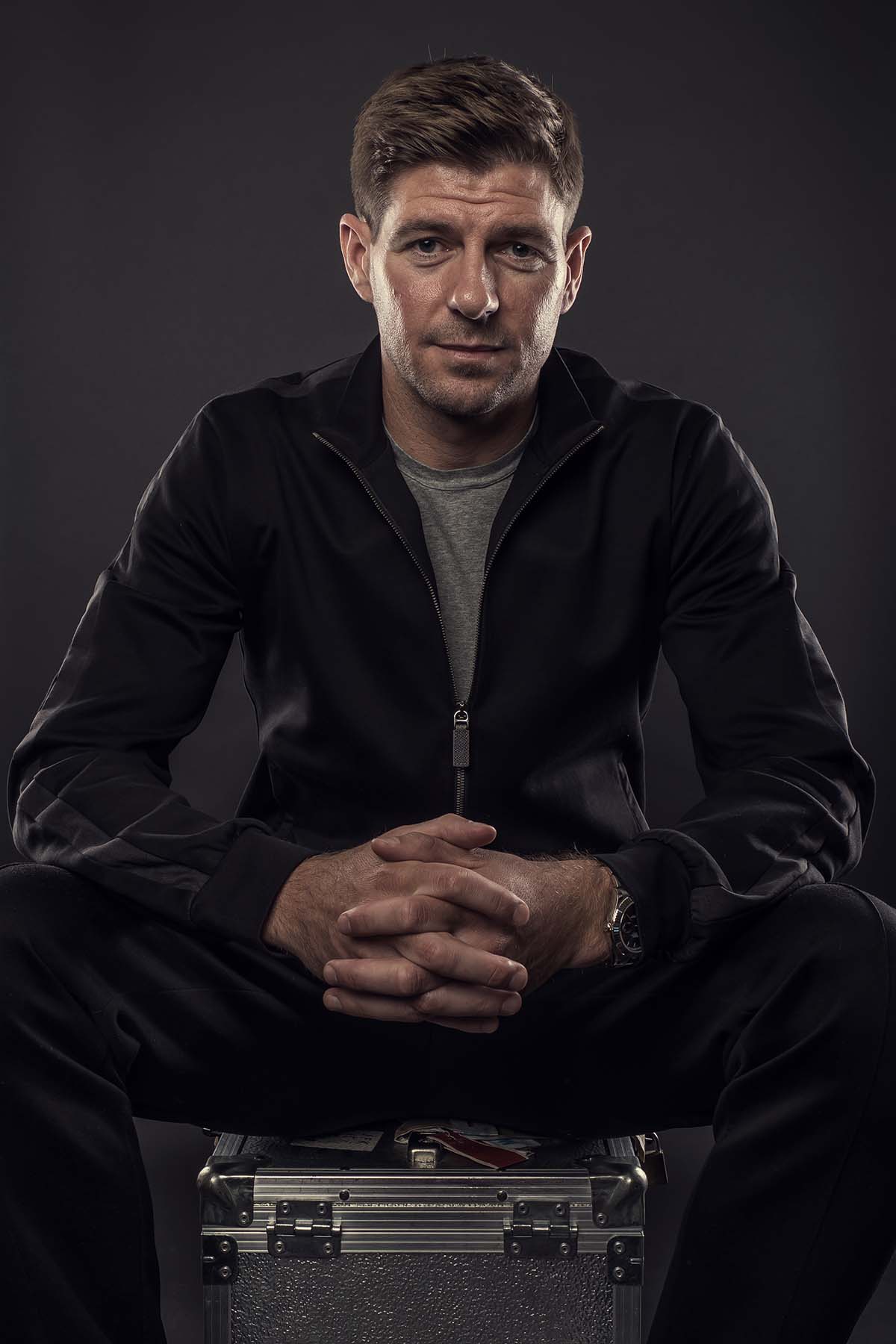
It’s an easy answer really – Steven Gerrard.

On the day of the shoot Steven was very pushed for time as he had a big appointment in Milton Keynes for Adidas. To compound matters further the interview for the book ran over as well…… So in the end I was given just 60 seconds to get as many portraits out of the shoot as possible.

Lucky I had just enough time to set my studio up and was ready as he walked in. I used my Fujifilm X-T1 camera alongside my XF16-55mm lens to create the shot.

As I said before, in times like these you need equipment you can trust and that will simply get you a great result.

That’s why I shoot Fuji!

Steven Gerrard
Steven Gerrard