Month: April 2014

XQ1 – A camera you just can’t leave at home

Test by Roger Payne

As a Fujifilm X-series fan you’ll already know that good things come in small packages, but the XQ1 takes that concept at least a couple of steps further. Significantly smaller and lighter than the X20, the XQ1 puts top quality picture taking in the palm of your hand. Quite literally.

Available in black and silver finishes, it’s one of those cameras that you simply can’t justify leaving at home. It’s been a constant companion for the last three weeks I’ve had it to review, largely by virtue of the fact that regardless of where I’ve been going it’s been small and light enough to come along too. Out walking the dog? Easy, it fits in a coat pocket. In town for a night out? No problem, it fits in my wife’s handbag. It even found its way into a tiny backpack when I was out mountain biking last weekend. Despite its proportions and weight, it gives the feeling of reassuring solidity with a build quality that can take the knocks. Kid gloves not required.

Taken on XQ1
Taken on XQ1

In line with the X-series brand, the XQ1 mixes timeless styling with the latest technology, plus throws in a few neat design touches for good measure. The most obvious of these is the Control Wheel that sits around the 4x zoom lens. Pressing the E-Fn button on the back of the camera allows you to assign a function to the Control Wheel for fast access while shooting. I chose to use it for quick ISO sensitivity changes, but users can also change other functions including exposure compensation, white-balance and zoom control.

Taken on XQ1
Taken on XQ1

Once you’ve taken images, they can instantly be shared to a smartphone or tablet thanks to the XQ1’s built-in Wi-Fi functionality. All that’s required from the receiving device is the free Fujifilm Camera App. An additional Wi-Fi offering comes in the shape of PC AutoSave, which uses a Wi-Fi network to automatically connect camera to PC for wireless image back up.

Alongside the technological and design touches, the XQ1 is a powerhouse when it comes to image capture. It boasts a ⅔-inch 12-megapixel sensor that uses X-Trans technology to deliver impressively sharp results. The zoom lens (which offers a 25-100mm equivalent range) also has a maximum aperture setting of F1.8 at the wide- angle setting to offer added versatility in low-light conditions and helps create attractive out of focus effects.

Taken on XQ1
Taken on XQ1

If you’re capturing still images, I’d urge you to try out the many built-in filter effects, 360° Motion Panorama mode, Film Simulation modes and the extremely handy Pro Low Light, Multiple Exposure and Pro Focus functions. If video is more your thing, the XQ1 offers Full HD video capture as well as a frame rate of 150 frames-per-second for slow motion effects. The latter is both great fun and seriously addictive!


In use, the XQ1 delivers a very accomplished performance. Picture quality is impressive, autofocus fast, metering assured and battery life surprisingly long. I’ll be sorry to see the camera go back to Fujifilm, it has quickly become a close companion wherever I go.

Here are some sample images taken at varying ISO values. Click on them to see them larger

The ‘Bear’ Necessities

1504372_10154010549280534_5836271885610257265_oEver wondered how the X-E2 performs in low-light? I took a trip to a local jam night to find out. 

So, what’s with the title? Well, it is the perfect combination of wanting to carry as little as possible to not hinder my evening and the fact the pub was called The Bear.

DSCF0019
ISO 6400 – f/2 – XF35mm

My aim was simple, have a great night and take some great shots. I really wanted to push the camera and give it a good run in low-light, and inside this pub it wasn’t hard as it was noticeably dark. This allowed me two options; shoot at high ISOs or use fill-in flash. I choose to have a little combination of the two.  When I first arrived, I just took some time to take in all areas of the bar, the lighting, the people, everything and anything that might be interesting as the night went on.

DSCF0043
Can you see why it’s called ‘The Bear’? ISO4000 – f/14 – XF35mm
My brother catching me at work

After taking in the environment, I knew I needed to get a good spot for the music. The best I could muster was a front row ‘stand’ as I couldn’t find a seat at the edge of the stage area.  The lighting in the stage area was still very dimly lit on one side, but quite bright on the other. This made for some excellent contrast, which if you didn’t guess already, I love a bit of contrast in my images.

DSCF0045 DSCF0012DSCF0020


I took a break from the music and went outside with friends, aiding another perfect opportunity to catch some good candid shots. Here is a handy hint I discovered: For great candid shots without being noticed, bring a friend. You can aim the camera at them but focus beyond them to get the ‘actual’ subject you want to capture. Here is a shot that reflects this ‘technique’.

DSCF0034

As the evening went on I just kept snapping away trying to get a blend between abstract and street style. Generally I kept the aperture wide open to ensure the stunning bokeh you get from the 35mm lens, and also to keep the ISO down as much as possible.

DSCF0046

I love the simple, yet powerful message scribbled on a window pane in this shot below.

DSCF0030

After having such a great evening with the X-E2 and XF35mm combo, I thought my luck was all but spent for good photography, then, on the walk home I got just a couple more shots that I was pretty happy with. As it was getting dark and the shutter was very slow, I kept my elbows tight into my sides and always shot the image on my out-breath.

DSCF0049

I also caught some wedding dress makers working very late, maybe it was a short deadline? These are the kind of self generated questions I love when shooting street photography.

I hope you have enjoyed this little blog and it inspires you to keep your camera on you at all times. You really can push the camera and retain excellent quality images that can be enjoyed by all. Here are all the ‘keeper’ shots from the night.


“To the streets!” A trip out with the X-M1 and XF27mm lens

1504372_10154010549280534_5836271885610257265_oSo here’s the question: How does the X-M1 / XF27mm combo fare for street photography?  
Before we begin our journey out on to the streets of Bedford town, like many of you out there I’m not a professional. I did not train in the art of photography, but again, like many of you, I have an absolute passion for it.

I love reading blogs on street photography and especially black and white ones. Something about it just fascinates me. Today, I really wanted to explore the X-M1 and the beautifully compact XF27mm for this very purpose. I thought with its combination of small size, high quality and tilting screen it would be a winning combo. I wasn’t wrong.

DSCF0041

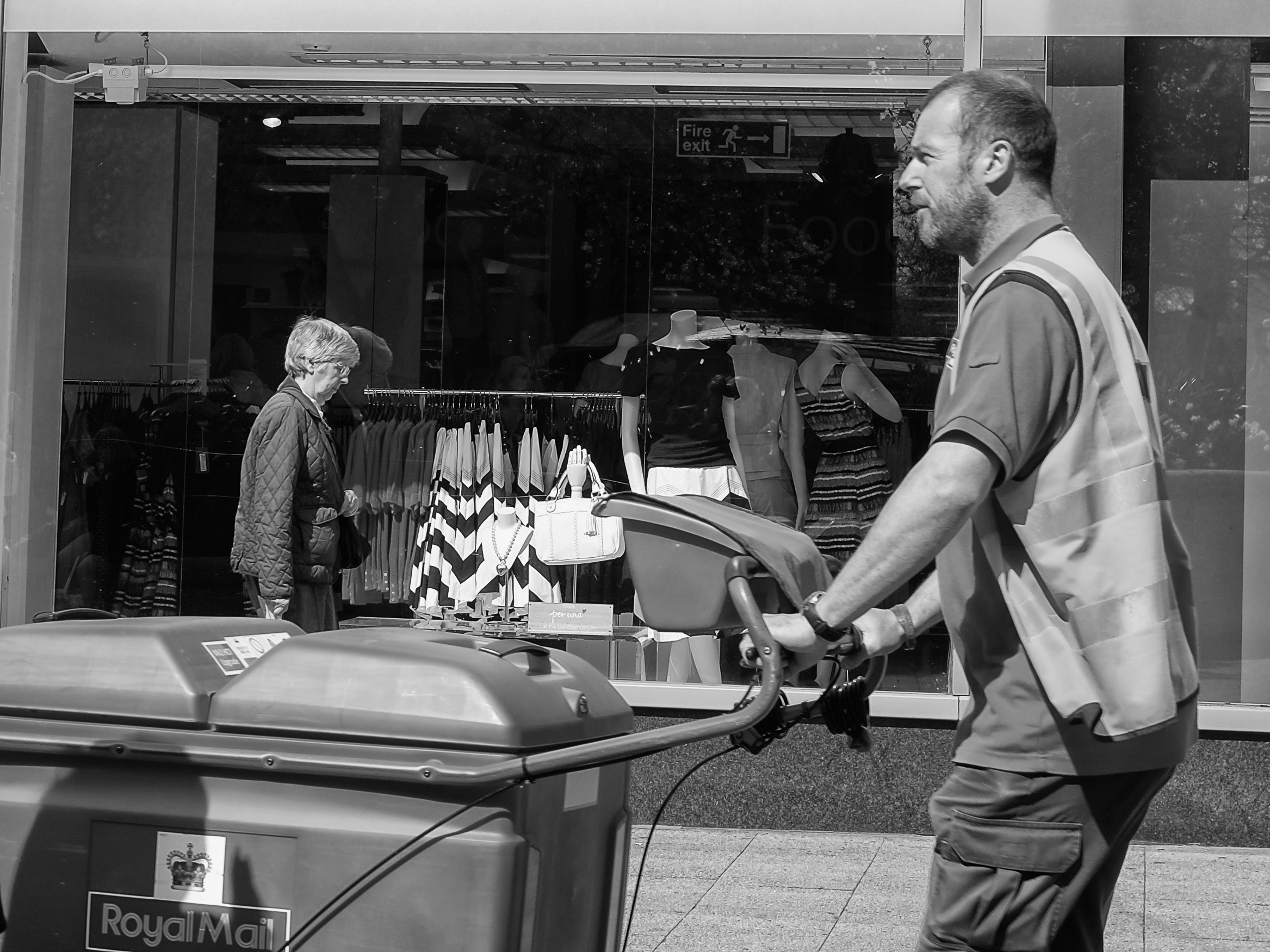
Considering I love reading about street photography I rarely feel brave enough to go out and try it. Today would be different though, I had the luxury of the tilting screen to help compose my shots without drawing too much attention and it was small enough to fit in my jacket pocket when not needed. I also had the advantage that it was a beautifully sunny day creating some stunning contrast.

DSCF0034

As I wandered about looking for the perfect shot, I came across a very well presented busker playing a beautiful collection of classical pieces. I knew the shot I wanted would involve me getting up very close as I was using the 27mm lens. I simply gave him a friendly smile, nod with the camera in hand and he beckoned my forward. I shot this at f/9 as I wanted to guarantee some good focus. On reflection, I might have opened the aperture up slightly and sped the shutter up a bit to get a sharper image.

DSCF0048 (2)

After spending five or so minutes relaxing in the sun to his repertoire I moved on, in the search of the next ‘big’ scene.

One shot I love seeing is where you have one person standing looking into the distance. I’m always like “What is this man thinking about?”. I was lucky to find a few people doing exactly that.


The XF27mm lens was performing perfectly, the focus is super quick and even with some heavy crops, the physical quality of the images speak for themselves.

You might wonder what software I use to post-process my images. I do use PS and GIMP of course, but I recently discovered Google’s ‘Nik Software’. As an amateur photographer it gives great quality options for a pretty low price. I used a plugin called Silver Efex Pro to create my black and white images and pull some extra contrast and detail out of my shots. One thing to note is that it does not deal with our RAW files as far as I know. But you could shoot RAW, convert to TIF and then import for a higher file size.

As the afternoon went on I took a turn into the market stall area, it is always a pretty busy place with lots of snapping opportunities. Here are a couple from the market stalls.

DSCF0026 (2)
The Bag Maze
DSCF0027 (2)
“Anyone for a hat?”

All in all this camera combo performed perfectly, it was quiet, unnoticed (most of the time!) and gave me some excellent quality shots that I am happy to share with you all. I think that the XF27mm works great for this style of photography as it makes you get into the action and put yourself in the moment more rather than shooting from a distance. It helps you find those more intimate scenes that you might miss if you were further away. For me, I found that generally people were quite sociable and simply interested in what I was doing rather than the opposite.

I hope this inspires you to go out and have fun with some street photography yourself. Here are all the images I kept from the outing.

Written by Dale Young


X Marks the Spot: Paris, France

A classic camera in a classic location – see why the X-E1 and the French capital make the perfect combination

Al Arthur

“I love the beauty and elegance in Paris: the architecture, the open spaces and the people. But it’s the small details that I like as much as the famous monuments and chateaux.”

Alastair documents Paris with a Fujifilm X-E1, which he started using last year.

“I chose the X-E1 after hours of research into mirrorless cameras. I was using a DSLR and a bridge camera previously but I haven’t touched either since getting the Fujifilm. It’s been a pleasure to use.”

13th Arrondissement

XF18-55mm F2.8-4 R LM OIS Exposure: 1/300sec at F5.6, ISO 800
Lens: XF18-55mm F2.8-4 R LM OIS Exposure: 1/300sec at F5.6, ISO 800

This is the ground floor of a nine-storey apartment block in the 13th Arrondissement. It’s due to be demolished, but before that happens 102 street artists were given full access to do as they wished with both the interior and exterior. This was one of my first shots of the exterior of the building. I liked the combination of the three elements to the picture and the X-E1 does a great job of capturing vibrant colours. I queued for over five hours to get this shot, but it was worth it. To be surrounded by artistic creations on floors, walls and ceilings was stunning.

Métro

Lens: XF18-55mm F2.8-4 R LM OIS Exposure: 1/4sec at F8, ISO 1600

I don’t often have my camera out on the Métro as thefts are not unknown. The stations make fascinating subjects for photography though. I wanted to experiment with capturing the moving train as it pulled into the station, and I like the effect of being able to see through the train windows to the opposite platform. I can’t remember whether I intended to include the woman looking along the length of the train. I’ll claim it as good composition, but it may have been luck. The exposure is 1/4sec and it’s hand-held so I don’t know what kind of magical trickery Fujifilm have managed to incorporate into their image stabilisation. But it works!

T-Rex

Lens: XF18-55mm F2.8-4 R LM OIS Exposure: 1/1900sec at F13, ISO 200

This seven-metre, metal Tyrannosaurus Rex sculpture overlooks the Seine on the platform of the Bateaux-Mouches boating company. I’d walked past it plenty of times before but on this occasion the sky was more dramatic and the sun was offering the chance of backlighting the dinosaur. Initially I had the sculpture in silhouette but the Fujifilm RAW files give so much flexibility for changing the exposure and I prefer being able to see the amazing details in the chrome finish.

Monmartre

XF18-55mm F2.8-4 R LM OIS Exposure: 1/450sec at F4, ISO 200
Lens: XF18-55mm F2.8-4 R LM OIS Exposure: 1/450sec at F4, ISO 200

Sometimes you just notice a scene and know immediately that it will make a good image. The X-E1 is great for this as you can shoot really quickly. This is in Montmartre, and I noticed the woman taking a few photos. As well as her striking red coat, I like her stance as she leans against the wall. Hopefully my photograph makes you want to know what she’s pointing her camera at, but I’ll leave that to your imagination.

City view from Sacré-Cœur

Lens: XF18-55mm F2.8-4 R LM OIS Exposure: 1/45sec at F22, ISO 1600

I really enjoy watching other residents and visitors enjoying Paris. This is the view over the city from Sacré Cœur. I took a few shots of this couple but this is my favourite, and the only one that’s pigeon-free. I like the idea of sharing the view with them. Initially I converted it to black & white since none of the colours are particularly important to the shot. Then I tried just removing some of the colour saturation so that the colours are more subtle without being distracting, and this was the end result.

The Louvre at dusk

Lens: XF18-55mm F2.8-4 R LM OIS Exposure: 20secs at F16, ISO 200

It was a clear afternoon so I decided to head to the Louvre for dusk. With the X-E1 on a small tripod, I set the ISO to 200, switched off the stabilisation on the lens and choose the aperture. The X-E1 does a great job of exposing accurately so I’m usually happy to leave the shutter speed on automatic. All my photos are shot in RAW (although the X-E1 JPEGs are also excellent), with conversion and post-processing in Lightroom 5. My processing is usually minimal; this shot was cropped slightly to better fill the frame, with some minor exposure adjustments and a light vignette applied.

See more of Alastair’s work HERE

Testing the FUJIFILM XF23mmF1.4 lens

By Matty Graham

Fujifilm’s XF23mm has been hugely anticipated by X-series users, and after testing the optic, it’s easy to see why. With an effective focal length of 35mm, this is a ‘go anywhere, do anything’ lens. Suitable for street photography, landscapes and even portraits.

X-Pro1 - XF23mm - ISO 1600 F/2.5 - 1/640
X-Pro1 – XF23mm – ISO 1600 F/2.5 – 1/640

What most users will do when they unbox the lens, is flick the aperture ring straight to F1.4. I can’t blame them, the larger F-number gives beautiful bokeh, and amazing images, as well as the confidence to work in low light, without the worry of camera shake and blurry images. With most lenses that sport a fast aperture of F1.4 it feels like you’re attaching a dumb-bell to your camera. However, the XF23mm only weighs 300g, making it more than manageable on the X-Pro1 that I used here.

X-Pro1 - XF23mm - ISO 400 F/1.4 - 1/850
X-Pro1 – XF23mm – ISO 400 F/1.4 – 1/850

The aperture ring takes you through from F1.4 to the minimum aperture of F16. Instead of the typical AF/MF switch, the XF23mm features a push/pull ring that switches between manual and autofocus. There are also distance and depth-of-field scales on the barrel.

When using wider optics like this, there are usually two main areas of concern – barrel distortion and vignetting. However, the XF23mm aces both categories with virtually no distortion and vignetting is handled extremely well – even at F1.4.

X-Pro1 - XF23mm - ISO 800 F/1.4 - 1/2400
X-Pro1 – XF23mm – ISO 800 F/1.4 – 1/2400

The quick, sharp focusing that this lens offers is down to the internal focusing (IF) technology, which delivers speedy and discreet autofocus – let’s face it, you don’t want the lens to be buzzing away as you try to find focus during a candid street photography situation. Because of this internal focusing, the front of the lens doesn’t rotate. This benefits landscape photographers who use graduated filters.

X-Pro1 - XF23mm - ISO 500 F/8 - 1/60
X-Pro1 – XF23mm – ISO 500 F/8 – 1/60

When it comes to results, the XF23mm really delivers. The lens is sharpest at F8 and when I say sharp, I mean razor sharp – professional photographers looking to invest in a lens of this type will not be let down by the results.

Excellent build-quality, simple ease-of-use and results to die for; what more could you ask for?

Enjoy the bokeh…

X-Pro1 - XF23mm - ISO 800 F/1.4 - 1/2000
X-Pro1 – XF23mm – ISO 800 F/1.4 – 1/2000

Pimping my Fuji X-Pro1 – X-Signature Skin

By Kevin Mullins

What is the X-Signature range then? Recently, I was made aware of the new “pimping” service of the X-Series of cameras that Fujifilm have launched in the UK and I believe, worldwide. The Service involves having your X-Series Camera skinned with a choice of many different options. Current options include; Racing Green, Burnt Orange, Black Lizard, Blue Lizard, Beige Lizard Emboss, Light Green Lizard, Navy Blue Crinkle, Red Lizard and Red Crinkle Emboss.

Fuji-X-Signature-4-1024x689

Now, I’m a reportage wedding photographer right? Part of my remit at a wedding is try not to stand out in the crowd and to blend in as much as possible. So, with that in mind, I decided to avoid options such as Red Lizard and Burnt Orange (though I’m sure these will be fine choices for certain people!). Instead, I went for Black Lizard. Why? Well, because it’s black….mostly.

The process has been superb. I ordered my “pimping” on Tuesday. On Wednesday morning I received a pre-paid box and padded envelope. I popped my X-Pro1 in the post on Wednesday afternoon. Less that forty eight hours later I receive a parcel from Fuji with my brand new X-Signature Skinned X-Pro1.

For what it’s worth, as you know, I’m an official X-Photographer and a working professional. My cameras do take a battering and I was really keen to see the new skins in action. I chose my X-Pro1 as it’s my oldest work horse and probably, a bit like me, needed a face lift of some kind.

Fuji-X-Signature-2-1024x689

The box arrived. All plush and very very well presented. Inside the lovely box is the X-Pro1 with its X-Signature skin.

Now, the X-Pro1 had a pretty good feel in the hand and I never had the need to “grip” it to avoid slipping in the hand and it’s important that the X-Signature Skins offer that same tactile embrace. And it does. It actually feels better in the hand, and almost gives it a “better quality” feel.

According to the Fujifilm website you can “Personalise your camera by choosing from one of the fantastic customised Signature colours and textures. Whether you already own a camera or are looking to purchase one today, simply select a style to suit your personality and we’ll get your tailor-made camera to you in a flash.”

Fuji-X-Signature-5-1024x689

And pretty much I think that sums it up. Listen, having your X-E1 in Red Lizard isn’t going to make you a better photographer. It’s probably going to make you cooler that me of course icon smile Pimping my Fuji X Pro1 ~ X Signature Skin Ultimately this is about personalisation of your camera. It had to be excellent quality and materials that are good for the rough and tumble of the average wedding photographer.

Good Value? I think so. It’s not going to be for everyone of course but if you fancy being a bit different and adding a bit of quality personalisation to your camera then go for it.

Click here to get your X-Series camera pimped with a X-Signature skin on the Fuji UK shop.


Fuji-X-Signature-7-1024x689

Fuji-X-Signature-9-1024x689

Fuji-X-Signature-3-1024x689

About Kevin

Kevin Mullins is an award winning UK Wedding Photographer specialising in the documentary style of wedding photography. To see more of his work you can follow him on Facebook or follow his blog. Kevin’s non-wedding related Fuji content is on his new Fuji specific blog over at The Owl.